
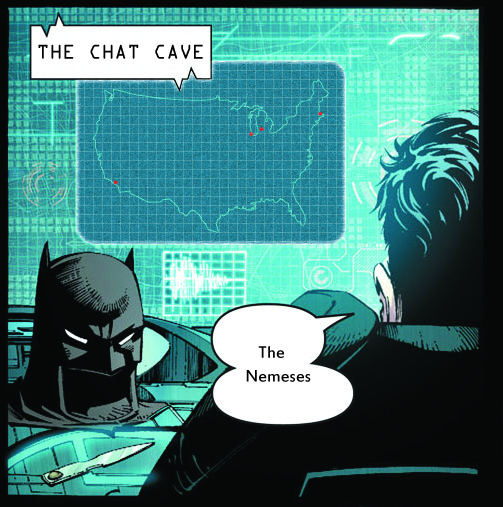
In October, Scott Snyder and Greg Capullo’s Batman series will be reintroducing the Joker to the New 52 continuity, reigniting one of the greatest rivalries in comics history. But what does it mean for a hero to have a nemesis? Are nemeses important to the identity of a superhero? Who are the best nemeses? Welcome to the Chat Cave.
Shelby: A nemesis is an important character in a comic book. It’s an opportunity for stories to explore the dark side of our heroes. Very often, the nemesis represents the “flip side of the coin” of the hero; they are what the hero would be without the sense of morality and justice. The nemesis tests the hero to find his limits, and tries to push the hero past them. Also, the nemesis is an easy trick to pull out of the bag when you’re stuck for a plot.
The Joker and Batman is probably the most well-known nemesis/hero relationship in the DC universe, and possibly in the Marvel universe as well. I think a more interesting relationship is that of Sinestro and Hal Jordan. The Joker doesn’t change; he’s batshit crazy, with zero morals and a love of the hyper-violent. That makes him a great villain, and scary as hell, but Sinestro is different. He’s complicated, which makes his and Hal’s relationship as nemesis and hero so interesting. He started out as Hal’s mentor and teacher before he turned on the Corps and formed what would become one of their fiercest enemies. The nemesis is interesting because you can see the similarities between him and the hero. Well, in this case, the nemesis and the hero were on the same side! They fought the same cause!
And on top of that, Sinestro and Hal are now, once again, fighting side by side. Sort of. It’s complicated. Really, Hal Jordan has probably had the most confusing history with nemeses, at least in recent years. Remember when he was inhabited by Parallax (we refer to that as “Halallax”) and became his own nemesis, virtually destroying the entire Green Lantern Corps? Then he came back from the dead to fight his former mentor and now nemesis, before teaming UP with said nemesis to save every universe from complete destruction. I don’t know what’s more confusing, that whole story-line or the fact that we love it oh so very much.

Drew: To me, the value of a nemesis is that they can act as a lens for viewing the hero. The way the hero deals with generic street thugs or kittens stuck in trees can reveal a bit about who they are and how they operate, but greater challenges are necessary to explore their psyches any more in-depth. As Shelby pointed out, Sinestro is a great example of the polar-opposite villain — his nuanced understanding of fear is an elegant counterpoint to Hal’s wielding will like a blunt object — but that’s not the only type of nemesis. In fact, while those types of conflicts can distill a hero down to their essence, it often means glossing over the details that make them interesting characters.
To examine the entirety of a hero’s psyche — with a more versatile lens — I prefer the rogues gallery to an individual nemesis, and of course, there is no greater rogues gallery than Batman’s. Yes, the Joker would be his biggest, most notable baddie, but the modern interpretation of their conflict — order vs. chaos — reduces Batman to the abstract idea of “order,” which makes him almost interchangeable with any other superhero. He’s also a master detective, a martial arts expert, a brilliant tactician, and an emotionally scarred individual, and while a Joker story can utilize all of those assets, they are more effectively explored when he’s battling someone whose nature requires them specifically. He deals with Two-Face differently than Talia, and Bane differently than the Riddler.
I suppose, then, that I agree that nemeses are important in defining their heroes, particularly in distilling them down to a single essence. However, because I prefer my heroes to have multiple essences, I prefer them to have multiple nemeses.
Peter: I agree with both Shelby and Drew, but probably more with Drew. I do like my heroes to have a whole rogues gallery. Comics would get boring pretty quick if Batman just fought the Joker over and over again. I feel like all the jokes would get old quick. Two of my favorite Hero/Nemesis match ups focus on different things than just psyches and opposing ideas.
First, The Flash. The Flash is not really known for having one major nemesis (okay, maybe you could count Thawne). When I think of the Flash, I think of the Rogues. Under their slightly campy exterior, they are very different from your average supervillains. Despite their need to do evil, they have a strict moral code – and even membership rules. While they are individuals, they often work together – that’s pretty cool. Also, their code — which can be summed up as ‘no women, no kids’ — is admirable (even more heroes). I would bet that, deep down, the Flash, on some level, has a respect for The Rogues, even though, you know, they’re criminals.
Next up, Captain Marvel (or Shazam or whatever they are calling him now). His greatest foe is sometimes one of his greatest allies: Black Adam. Both of their powers are derived from the Wizard Shazam, and both have a strong connection to gods. I love that they have some of the same principles: Billy and Teth want to protect their people, and those they love. Black Adam just sees his power more as an invitation to do whatever he wants, and thus, puts himself ahead of others.
A nemesis is key to a hero, I will not deny that. However, some of the best nemeses are neither the polar opposites nor even mega-crazies, but those who the hero can almost identify with. If the hero can see something good in his/her enemies, their will always be hope for them. Why do you think Abin Sur made the Indigo Tribe in the first place? Hmm?
Patrick: Man, maybe there were really two questions buried in here: one about rogues galleries and one about nemeses. Superman’s got many formidable opponents, all of whom threaten his livelihood in different ways, but his nemesis is unmistakably Lex Luthor. Other villains might be tougher (Doomsday), smarter (Brainiac) or supernaturalier (Mr. Mxyzptlk), but it’s the Supes-Luthor dynamic that actually captures readers’ imaginations. And that’s because their rivalry is based in emotion rather than convenient mirror-imagery. Luthor believed his intelligence and impeccable work ethic qualified him to be the savior of mankind, and then in swoops Superman, able to outclass him without breaking a sweat. It’s not jealousy – the character’s entire sense of value hinges on the misery he can inflict of Superman (the same can be said of the Joker and Batman).
So, in a way, the hero makes the nemesis more interesting, and not the other way around. We’ve picked out some really interesting characters here, but they’d all be pretty dull in a world without the good-guy-counter-parts – most of them wouldn’t even exist. Their very presence in a story signifies that this is one of the Real Stories where stakes are high and the outcome matters profoundly to both sides. Which is where I see the real value in a good nemesis. Shit gets real – plain and simple.
And I will also undermine my own point by saying that I’d a big dumb sucker for simple iconography. Reverse Flash/Professor Zoom wears Flash’s costume, but in an inverted color palette? Cool. Black Adam looks like Shazam, but the colors are different? Cool. Hal and Sinestro. Batman and Joker. Cool-cool. Hey, it’s shallow, but sometimes the fight’s just gotta look good.
 Retcon Punch
cool. cool. coolcoolcool
If I have a chance to imitate Abed, I’m going to take it.
Peter, how dare you steal the comment I was going to make!
Ultimately, it’s about balance. While a nemesis-only title would ultimately get boring, I imagine a rogues gallery-only title would be the popcorn flick of the DC universe: lots of fun battles, but no real substance. I don’t know, are there any major hero franchises without a nemesis? Wonder Woman, I suppose…
Well, historically, Cheetah is Wonder Woman’s most common nemesis. Also, Circe is up there. Once Cheetah is reintroduced into the New 52 in the next JL arc, she may make her way into the Wonder Woman monthly.
I don’t know about that, man. Wonder Woman is still pretty firmly entrenched in a gods-only conflict. It makes her story feel almost completely disconnected from the rest of the DC Universe, but it is fucking awesome. It would feel like such a creative curveball to start throwing other superheroes and villains into that story right now.
I also think think this is a good opportunity to invent a nemesis for Diana – one that probably shares some of her Zeusian DNA – and really develop an interesting psychology that can resonate when these characters do finally start interacting with the rest of the DC Universe.
Wonder Woman is an interesting example because she doesn’t really have a rogue’s gallery OR a nemesis right now. Circe would be a good villain to introduce that would fit in with WW’s current, mythological adventuring.
Actually, I guess Nemesis is the Greek goddess of retributive justice, so that would probably be the best way to go.
I’d fucking love that. Cut right to the chase – make her nemesis Nemesis. (STARS!)
I don’t know, I think each rogue can be given the lead for a little while. Take Nolan’s Dark Knight films, for example. The double feature of Scarecrow/Ra’s al Ghul managed to examine Batman’s morality, as well as his use of theatrics and fear in a way that served as a great introduction to the character.
The Joker definitely took a bigger bite out of The Dark Knight, but what his existence revealed about Batman was a natural progression from Batman Begins. Because we already understood how Batman operates, we could understand how those things could be undermined or outdone by a criminal equally willing to change the rules. That may be something Ra’s could have been used for, but Joker is a better choice.
Even then, though, the Joker was treated more as a force of nature than a human being with understandable motivations. He’s great at forcing Batman to his moral limits, but he almost doesn’t fit with morality. For that, you need someone more human, which is why placing Two-Face at the center of their battle was such a brilliant idea. Rather than being abstractly evil, Harvey was a good man pushed to his breaking point. We can sympathize with him even after he goes off the deep end.
I hesitate to guess how Bane will be used in The Dark Knight Rises, but my impression is that we’re headed back towards the abstract mythology of Batman, rather than his specific motives and motivations. I could be totally wrong about that, but I only have 36 hours, 45 minutes left to wait to find out.
batmanbatmanbatmanbatmanbatmanbatmanbatmanbatmanbatmanbatmanbatmanbatmanbatmanbatmanbatmanbatmanbatmanbatmanbatmanbatmanbatmanbatmanbatmanbatmanbatmanbatmanbatmanbatmanbatmanbatmanbatmanbatmanbatmanbatmanbatmanbatmanbatmanbatmanbatmanbatmanbatmanbatmanbatmanbatmanbatmanbatmanbatmanbatmanbatmanbatmanbatmanbatmanbatmanbatmanbatmanbatmanbatmanbatmanbatmanbatmanbatmanbatmanbatmanbatmanbatmanbatmanbatmanbatmanbatmanbatmanbatmanbatmanbatmanbatmanbatmanbatmanbatmanbatmanbatmanbatmanbatmanbatmanbatmanbatmanbatmanbatmanbatmanbatmanbatmanbatmanbatmanbatmanbatmanbatmanbatmanbatmanbatmanbatmanbatmanbatmanbatmanbatmanbatmanbatmanbatmanbatmanbatmanbatmanbatmanbatmanbatmanbatmanbatmanbatmanbatmanbatmanbatmanbatmanbatmanbatmanbatmanbatmanbatmanbatman
Also, I totally agree with the point you make about DK’s Joker becoming too much of a abstraction to build an effective personal rivalry between Batman and Joker. But Batman himself is also overly abstracted – explicitly, on screen, by like every fucking character in the movie. So the inclusion of everyone’s favorite DA-turned-Two-Face is the most effective way to humanize that abstract conflict.
I’m hoping DKR focus more on Batman’s humanity and less on his power as a symbol.
Patrick is right about there being two questions, but only because Peter and I kind of chose to answer a different question entirely. Our answers essentially amount to “yes, but…” which basically gives us the freedom to talk about tangentially related topics. We all agree that nemeses are important to defining a hero, I just like the many facets that can be defined by multiple nemeses.