
 Today, Spencer and Greg are discussing Astro City 5, originally released October 9th, 2013.

Spencer: Astro City contains a world of superheroes, supervillains, and their exploits that, if properly explored, could probably fill a line of books as large as DC or Marvel’s. Instead, though, it mainly uses that world as a backdrop to explore the little people, the ordinary citizens whose lives are affected and changed by the actions of Astro City’s super-powered residents. It’s a fascinating and often heartwarming approach that doesn’t really need any justification, but in Issue 5, writer Kurt Busiek provides one anyway through the actions of The Broken Man and his silent war against the Oubor. Turns out the most important character in the world of Astro City may just be the reader—you, me, and everyone else who bought this book.
The Broken Man—an indeterminably powerful creature somehow contained within the mind of a mental patient—has broken the fourth wall to address us, the reader, personally. Turns out our reading of previous issues has brought his attention to those issues’ protagonists, useful individuals who are low-profile enough to fly right beneath the radar of the Oubor, some sort of omniscient villain who is already paying too much attention to the heroes of Astro City for them to ever fight back against him. Our attention, however, drifts to some of the Broken Man’s many artifacts, and we’re drawn into the stories they hold—one a tale of 1930’s era agents possessed by a mysterious force, and one of a man masquerading as a god. In both situations the Broken Man interrupts us mid-story to warn us that the knowledge we’re taking in could attract Oubor’s attention and ruin everything. He feeds us the story of Dame Progress to appease us over before kicking us out of his world—possibly for good.
The three stories take up the bulk of the issue, but if I breezed over them a bit, it’s only because the Broken Man’s interaction with the audience—with us—is easily the most fascinating part of the issue. Early on he mentions the protagonists of the previous issue and thanks us for drawing his attention to them—as if our reading of that issue wasn’t just reading words put down by a writer, but a deliberate action meant to help the Broken Man find the people he’s searching for.

I don’t know about you guys, but I found this development to be really exciting. It’s rare to find this level of interactivity in any form of media outside Choose Your Own Adventure Books, Universal Studios Theme Park rides, or Dora the Explorer; and while it probably goes without saying, this book is of a higher quality than all three of those put together. I especially like this concept because it lumps us in with the other characters this series has been exploring since its relaunch. In issue 1 we met (and “helped” to recruit) a man who will become our race’s ambassador; In issues 2-3 we met a call-line worker who helped save the day because of her selfless attempts to fix a mistake; In issue 4 we met a woman who didn’t want to be a day-to-day superhero, but still has what it takes to come out on top when she has to. I found all these stories to be particularly touching, so getting to be a part of the force that assembles them—and getting a chance to help combat the Oubor myself, thereby putting myself in the same league as these previous protagonists—is a clever way to further invest my—and I’m assuming other readers’—emotions in the story at hand.
Of course, the risk of writing in second person is that the writer could easily lose their audience with even the smallest of mistakes. In second person, the author is basically writing “our” actions for us, and that can always be risky, because there’s any number of decisions our character could make that we personally wouldn’t, and that risks taking us out of the story. For me, that moment came when “my” prying nearly led the Broken Man to, well, break down.
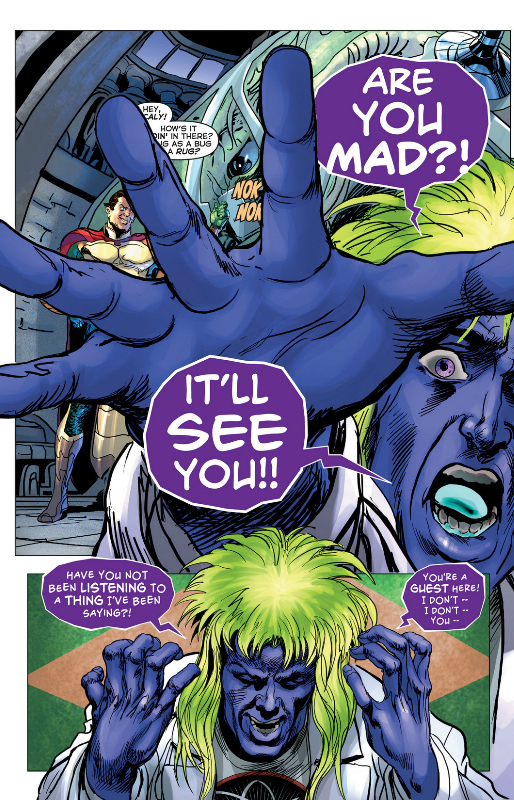
To be fair, I’m notoriously oversensitive, but it still upset me a little to have transgressed like this and hurt the Broken Man. Now I know that my reading of the issue can do just as much harm as good, and while intellectually I know that I’m not actually doing anything, it does make me much more nervous to see the rest of “my” exploits. Admittedly, this is my problem, but any decision like this might have a similar effect on another reader. I think Busiek has handled his fourth wall-breaking quite well, but it’s always a risk with this type of storytelling.
As much as I enjoyed the more “meta” aspects of this issue, though, it didn’t really draw me in the way previous issues have. The Broken Man’s story is complicated and far from complete, and even in the letters page Busiek seems to feel the need to reassure us all that answers are coming.
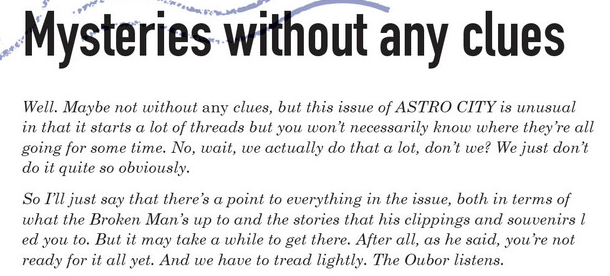
There’s certainly no problem with mysteries and setting up plot threads to explore in the future, but I kind of feel like that’s all this issue was. Two of its short tales are frustratingly incomplete, and the third has some sort of significance we aren’t privy to yet; it’s a little exasperating. There’s probably some fun to be had trying to figure out what connects these stories together, but it’s like Busiek says: We have a “Mystery without any clues.” I feel overwhelmed even trying to figure out what’s going on, and that’s a big weakness for this issue. I think Astro City is usually a great series, and everything in this issue will probably be important later on, but for the moment, the story doesn’t feel strong enough to support the mysteries presented.
Greg, welcome aboard! What do you think of Astro City and “your” contributions to the series? What do you make of Broken Man’s accusation that the reader only wants a story, not to help? And do you have any specific thoughts about the three tales he presents us with? I was woefully negligent of them.

Greg: Thanks Spencer! I’ve always felt ambivalent towards stories that purposefully point out that they’re “stories,” as they often lead to pseudo-intellectual muckraking for the sake of muckraking; an author doing stuff just because he can. Therefore, your question of whether a reader should just “get” a story or has to “contribute” something is normally one that would turn me off from the story in general (“I ain’t here for a philosophy lesson!” I would shout, my piece of hay jutting out of my mouth). In this case I’m more willing to see where Busiek is going, because although the issue can feel disjointed and random, there do seem to be some connections between the pulpier stories-within-stories and the actions of the Broken Man. They just happen to, like his red yarn map seems to have, take a while to resonate.
You spoke briefly on feeling overwhelmed by the intrigue of the Broken Man’s meta shenanigans, so much so that you neglected the actual stories, yet I had a dissimilar reaction. I was so overwhelmed by how fun the stories presented were, that I began to reject the Broken Man’s interjections. Just when the story of Lord Sampha was really going somewhere, the Broken Man would interrupt and tell me “I” was wrong. It’s things like this that make me resentful of an author, probably unfairly so. Is the point of this issue Busiek showing us he can flex his muscles in any entertaining genre he chooses, then cruelly pulling back the rug to begin pontificating on the nature of being a “guest” to a story? To further the mystery with no clues? To make me get my angry piece of hay?
Furthermore, there are some uncomfortable racial politics to unpack, that grow harder and harder to ignore as the story continues. Seeing Lord Sampha, a self-described “Polski Wille boy from Chicago” rule over your stereotypical images of Indian savagery (going so far as to call them “psychotic, drugged-out killers”), is perhaps forgivable in the context of being a subjective point of view. In other words, even though the Broken Man is our supposedly omniscient tour guide, these stories are narrated and presented by one person; in this case, it happens to be a cruel and callous imperialist. Is this a satirical rendering of pulp tropes taken to their extreme? Are the Broken Man (and by extension Brusiek) telling the readers “You want fun, pulpy stories? Well guess what, you get all the gross weird race stuff that goes along with it!”

Even though I may take issue with this critique (see, piece of hay), I hope that there’s something like that going on underneath the text, because otherwise the rendering of Mister Cakewalk is, frankly, hard to get behind. While his skills and technique are undeniably and fluidly badass, his matter of minstrel-show speak (complete with embarrassing dialect choices like “yo’,” “lawzy,” and “doin’ jes’ fine”) is ugly and distracting.
Moving beyond this potential blemish and back to the mechanics of the narrative (or lack thereof), some clues and connections in the Dame Progress story allowed me to start seeing some method to the madness. There’s a motif of self-interruption, of the Broken Man cutting both the story and himself off just when it seems like a moment of discovery is about to be made. It’s curious to see Dame Progress engage in a similar tic. Her narration, a technique which a reader often views as being ironclad or reliable, goes through the same types of hard stops, of realizing things just as the reader is. To see these two seemingly unrelated characters perform related behaviors is interesting, indeed.

There could also be some commentary ascertained via Dame Progress’ attitude towards Mister Cakewalk. “His leap isn’t random,” she explains, “it’s as elegantly, carefully planned as the rest of his actions.” Busiek may be sneakily promising us, too, that while the Broken Man seems quite broken indeed, it’s actually all puzzle pieces to one satisfying whole.
For a complete list of what we’re reading, head on over to our Pull List page. Whenever possible, buy your comics from your local mom and pop comic bookstore. If you want to rock digital copies, head on over to Comixology and download issues there. There’s no need to pirate, right?
 Retcon Punch