
 Today, (guest writer) Suzanne and Spencer are discussing Ms. Marvel 2, originally released March 19th, 2014.
“If everyone were cast in the same mold, there would be no such thing as beauty.”
Charles Darwin

Suzanne: For all of the rhetoric about body image and positivity, it’s easy to forget how confusing and filled with insecurity the teenage years can be. I can remember those years of acne breakouts, bad haircuts and trying to fit in with the “cool kids” at school. Being a teenager is hard enough when you look, talk and dress exactly like everyone else. Did you wear the same North Face jacket or UGG shoes as five of your friends? Did you want to be ten pounds thinner because all of your friends were slim and “beautiful”? Now imagine being from a different ethnicity, culture or religion than most of your peers and struggling with your identity. It’s easy to see how insecurity can morph into internalized racism or self-hate. Skin-lightening creams are a multi-billion dollar industry worldwide and sold over 200 tons in India alone last year. So how does the new Ms. Marvel, Kamala Khan, respond to the pressure of society’s expectations?
After the Terrigen Mists fell on Jersey City last issue, Kamala wishes to look like Captain Marvel and morphs into a blonde-haired, Caucasian version of herself. Now that she looks like her favorite superhero, does her insecurity transform into confidence as well? Turns out that walking a mile in someone else’s shoes can pinch (literally) and feel uncomfortable. Similar to Peter Parker discovering his powers, Kamala can’t necessarily control them and her powers are more akin to a muscle spasm than a command performance.
 She happens along Zoe and her drunken boyfriend fooling around on the docks just as Zoe falls in the water. Kamala’s powers kick in and expand the palm of her hand to save Zoe from drowning (channeling her inner Mr. Fantastic). Feeling a little exposed in her Captain Marvel outfit, she borrows a sweater from a homeless man and sneaks in her bedroom window. Just as she morphs back to her usual self, her parents catch her sneaking back in and she’s possibly grounded for life.
The trope of a teenager sneaking out to a party and getting caught by the parents is pretty tired. So what sets Ms. Marvel #2 apart? G. Willow Wilson develops a voice and inner exposition for Kamala that’s equal parts naïve and genuine. Kamala has moments of introspection that feel as universal as they do relatable. She looks down at her blonde hair and says, “But being someone else isn’t liberating. It’s exhausting.”
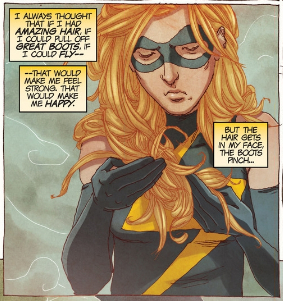 Wilson also subtly incorporates Kamala’s religious perspective within the context of her family and manages to avoid being preachy. Kamala’s father often quotes a verse from the Qur’an: “Whoever saves one person, it is as if he has saved all of mankind.” This is a source of inspiration for Kamala’s heroism and highlights her connection to her father. I like how this contrasts with Kamala’s brother, Aamir, and his pious yet patronizing comments.
 With so much to analyze from the exposition, I didn’t even get to touch on Adrian Alphona’s beautiful and textured artwork. Spencer, did this issue feel more predictable to you or was Wilson’s exposition as compelling as it was to me? Does Alphona’s artwork complement the overall tone of the book?

Spencer: I don’t think this issue as a whole was predictable, Suzanne, but that final confrontation and “grounded for life” scene certainly felt like something I’ve seen a million times before. Fortunately, there’s enough nuance to it to still make the scene more interesting than the average use of this trope.
First of all, I love the little peeks it gives us into the family’s dynamic and history. We didn’t really get to see Kamala and Aamir interact in the first issue, so I appreciate how Wilson opens the scene on the two and allows us to witness Aamir’s goofier side and his older brother dynamic (Suzanne summed it up perfectly as “pious yet patronizing”). We also got to see Kamala’s mother open up, her tongue loosened by anger and lack of sleep. While in issue one she defended Aamir’s choices when criticized by his father, here she turns on him, saying he dresses like a “penniless mullah.”
Then there’s the power dynamic between Kamala and her parents. As an (almost) 27-year-old with vivid memories (nightmares?) of teenager-dom, it’s easy for me to take Kamala’s side, especially when she’s such a good kid who took just one risk and went through the most bizarre night of her life as consequence. But I’m also getting old enough to realize the fear her parents must have been going through (whether justified or not), not to mention the fact that, no matter what the reason or consequences, she still disobeyed her parents, snuck out of the house, and put herself in danger.
Ultimately, I still probably sympathize with Kamala more, if only because it’s always felt to me like the best behaved kids get punished the hardest when they screw up (story of my life, man), not to mention that her parents’ reactions seem unnecessarily hysteric; sneaking out once shouldn’t make Kamala unrecognizable to her father (it’s not like there’s a pattern of this), her mother’s impression that she snuck out because of boys is completely misinformed, and when her father punishes her until “she proves she can be trusted again”, he leaves her no guideline on how to prove it, which will just lead to more conflict. Still, I appreciate how Wilson has made it easy to understand why Kamala’s parents react the way they do, even if I can’t agree with every decision they make. As I mentioned last month, there’s a specificity to the events of this scene that helps it rise above the trope it’s aping.
To answer your other question, Suzanne, yes, I do think the artwork complements the tone of the book. Adrian Alphona’s energetic artwork and Ian Herring’s bright (but not harsh) colors help to set the book’s lively, young tone. I’m in love with Alphona’s facial expressions and body language, as well as his numerous charming background gags. Both shine in the scene where Kamala shrinks — check out how she jumps away from the cockroach in the final panel here:
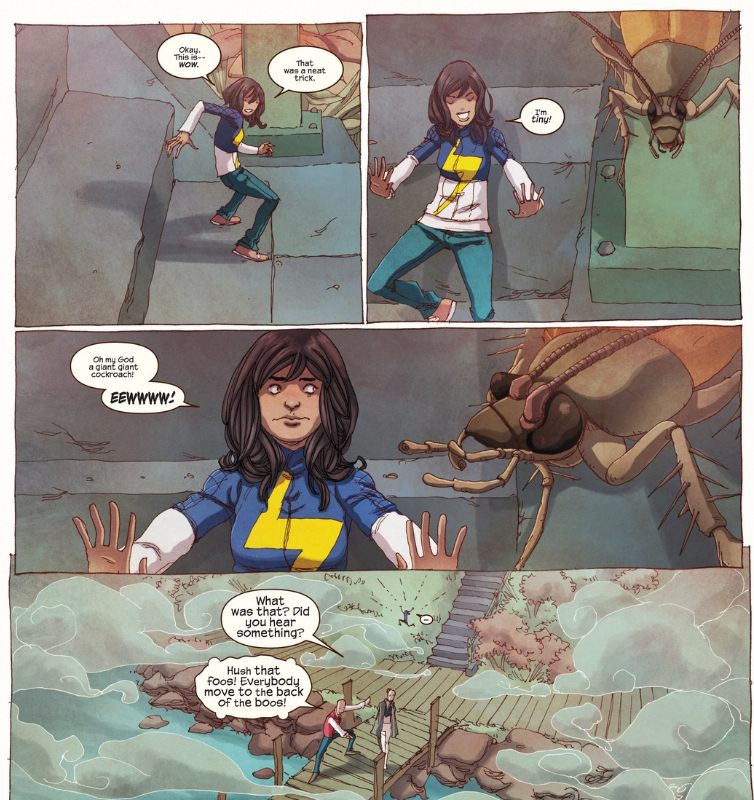
Joe Caramagna’s lettering also helps keep up this tone; the font and word balloons grow and shrink along with Kamala, bubble up when Josh is drunk, capitalize when things get urgent, and in general morph to suit every situation in the same energetic fashion as the art (and as Kamala herself!).
I think my favorite touch artwise, though, has to be the sketchy, irregular panel borders. When I wrote about issue one I mentioned how the fact that Alphona used the same art style for both the fantasy sequences and the regular proceedings hinted that there was an element of fantasy to all of Kamala’s story, and the borders help reinforce that feeling, at least for me; the first thing that springs to mind when I see them is the shaky art of the fairy tales I remember reading when I was young.
The shaky, malleable feel of the panel borders could also be viewed as a reference to Kamala’s shapeshifting abilities, since they seem unstable, like they could change direction or shape at any second, much like Kamala often does. Speaking of which, another aspect of Alphona’s art that I appreciate is how uncomfortable, perhaps even painful, he makes the shapeshifting sequences look.
 It just goes to show that having powers isn’t as glamorous as Kamala thought it would be. Her fantasy that becoming someone else would make her strong or happy is proven wrong in this issue, but that just leads to her discovering a better reason for becoming a superhero. All teenage superheroes inevitably get compared to Peter Parker, so let’s get it out of the way: if wanting to change herself to better fit in with Zoe and her crew is Kamala’s “letting a mugger kill Uncle Ben”, then her father’s Qur’an quote is Kamala’s “With Great Power Comes Great Responsibility.”
When I went to my comic book shop on Wednesday they were asking the customers to vote for their favorite size-changing character for their “Question of the Week”, and despite having only two issues out, Kamala was in second place and rising (even against long established characters such as The Atom, Mr. Fantastic and Ant-Man!). Kamala’s journey so far has been familiar and relatable to almost any comic fan, but also specific enough to make Kamala a unique character with tons of personality, so I can see why she’s taking off in popularity. Personally, I’m thrilled. When I finished issue one I felt an instant kinship with Kamala that only intensified with this issue, and the letters page makes it obvious that many others feel the same. Our new Ms. Marvel is shaping up to be an important character to a lot of people, and I hope she sticks around for a long time.
For a complete list of what we’re reading, head on over to our Pull List page. Whenever possible, buy your comics from your local mom and pop comic bookstore. If you want to rock digital copies, head on over to Comixology and download issues there. There’s no need to pirate, right?
 Retcon Punch
It speaks to my general disinterest in origin stories that I was so nonplused by the first issue, but it also speaks to the quality of this series that this issue has won me over in spite of myself. The tropes do feel a little staid, but Wilson is clearly taking them in new directions, so just requires a little patience to reinforce those expectations before yanking them out from under us. That is to say, I also cringed at the “you’re grounded forever, young lady” scene, but I’m sure it’s only the set-up that we’ve seen before. There’s a lot more going on here than I gave the first issue credit for, but the most important one is the strength of Kamala’s voice. She’s clearly going to be making a lot of mistakes and figuring a lot of things out, but her story is already surprisingly empowering. I get that Kamala’s origins are ultimately unrelated to Captain Marvel, but it sure seems like the “Marvel” corner of Marvel’s universe is turning into a bastion of throwback-with-a-twist empowering heroes.
My girlfriend and I were talking about how many Marvel characters have their origins tied up in very historically specific perspectives. The two examples we were using were Magneto (who’s outlook on humanity’s reaction to mutants is necessarily tied to his experience in the holocaust) and Captain American (who has an antiquated view of both military service AND America, because he’s a weapon designed to fight WWII). Kamala is a different perspective entirely, but no less specific. But, given how big those first two examples are, I was wondering why we don’t have more of that from other eras (heroes born out of the 50s, 60s 70s, whatever – they all have generic, non-historically important perspectives).
TWO POSSIBLE EXPLANATIONS: 1) those characters exist, but they have disappeared and/or changed since their invention. I just wasn’t reading comics to witness them when they flared up. 2) creators have been gunning for universal experiences and the more specific the perspective, the less relatable it becomes as we move further away from it in time.
Interesting points, Patrick.
I think part of it is because comics were simply younger in the 40s through 60. In the 40s particularly the creators had no idea that these characters would last 50+ years. As time passed creators have become more nervous about connecting characters to historic events because it causes issues as time passes (for example, Punisher’s origin was originally explicitly connected to the Vietnam War, but has since been retconned to several different wars as time passes). But in the 40s the creators had no idea this would happen. Moreover, World War II as all-encompassing. Every comic felt the need to acknowledge the war in one way or another. Captain America and the other proto-Marvel characters straight-up fought Hitler, but DC took the other route; although their characters shilled for the war effort, they generally didn’t fight in the war in their own books, and DC came up with the excuse that Hitler had found the Spear of Destiny, said to be the spear that pierced Jesus’ side but that, in the context of DC Comics, would cause any hero that got within its sphere of influence to lose their superpowers and/or fall under Hitler’s mental control.
I suppose that’s another point: World War II was an event that we’ve never seen the likes of again. It connected the entire country against a common enemy in a way that just never happens anymore. The conflicts that have sprouted up since then (with the possible exception of 9/11) have been too gray and have split the population into different factions, and it’s likely that comic creators don’t want to be too controversial by siding with one or the other.
That said, there are a lot of characters whose origins are tied to the time they were created if you look hard enough. In the 40s most characters’ origins were magical in nature, but as the 50s and 60s dawned, the heroes became much more sci-fi to keep up with the times (for example, the 40s Green Lantern, Alan Scott, had a “magic” ring connected to the energy of the Earth, while the 60s Green Lantern, Hal Jordan, was straight-up a space cop). Marvel took things a step further, connecting its heroes origins to the fears of the 60s. Spider-Man and the Hulk both gained their powers due to mishaps with radiation. Reed, Sue, Ben, and Johnny rushed their mission into space because they “wanted to beat the communists” to the punch, and because of their carelessness, they ended up getting into the accident that turned them into the Fantastic Four. There’s even characters designed to tie into specific fads of the time, like Dazzler’s disco motif or Vibe’s breakdancing shtick, but they generally don’t stick. It’s just that these elements have mostly been downplayed or ignored as times gone on because it would unduly age the characters.
Again, it’s really only those World War II origins that stick in a way most don’t. Again, I think it’s just because of the way we perceive WWII, and the way that no other war has replicated it since. Cap remains tied to WWII because we haven’t since had a war with such clear cut enemies and consequences to make him look heroic. Magneto remains tied to WWII because we’ve never again had a war with consequences as horrendous and well-known as the Holocaust (thank god).
I guess there’s more long-term planning nowadays. As time passes you can always just increase the amount of time Cap spent trapped in the iceberg, but I don’t know how they’re going to convincingly keep Magneto alive as the decades continue to pass.
MAGNETOCICLE
An iron-rich diet and/or those magnetic arthritis bracelets help keep him young.
Although she isn’t Marvel, Batwoman has a pretty definitive place in history with her origin tied to the “Don’t Ask, Don’t Tell” policy of the 1990s. I hope they don’t retcon it!