
 Today, Drew and Patrick are discussing Cyclops 1, originally released May 7th, 2014.
 Drew: Leaders are often defined by their circumstances than any personal characteristics. Abraham Lincoln may be remembered as a persuasive orator, but that reputation takes a back seat to his role in the Civil War. That tendency can flatten out historical leaders, but absolutely steamrolls fictional ones, turning “leadership” into a character trait at the expense of any others. Raphael may be “cool, but rude,” and Michelangelo may be “a party dude,” but “Leonardo leads.” I’ve long had this association with Scott Summers, who I know is the de facto leader of the X-Men, but that’s kind of it. Oh, and he shoots lasers from his eyes. Complicating his circumstances (transporting him in time, taking him to outer space) have multiplied the potential for elucidating his personality, but I was still unconvinced that there was enough to him to support his own title. Fortunately, writer Greg Rucka manages to find an incredibly relatable handhold — Scott’s relationship to his father — delivering a confident statement of purpose in Cyclops 1.
The issue finds Scott and Christopher in the classic estranged father/son dynamic — neither is comfortable talking to the other, fearing their own inadequacy. Fortunately, Christopher happens to be a super-cool space-pirate, so he at least doesn’t have to convince his 16-year-old son that he’s not totally lame. Indeed, much of the trepidation seems to come from Scott, who is keenly aware that he is not at all a super-cool space-pirate. The two get to bond over an attack on a Badoon ship, and decide to go on a father/son road trip to reconnect.
It’s a solid premise, but the real thrill here is how quickly Rucka establishes a voice for Scott. Some of the heavy lifting is done by the circumstance — it’s hard to be a cocky martyr when you’re actually a 16-year-old out of his element in both time and space — but much of it is because Rucka just writes a good 16-year-old kid. He’s conflicted, he’s uncertain, he lacks confidence — he’s basically the opposite of the alpha leader we’ve come to know, which immediately brings him to life. Suddenly, he has inner thoughts, hopes and dreams, even insecurities. It’s boilerplate 16-year-old-isms, but they go a long way to humanizing him, and again, Rucka just handles them incredibly well.
Take, for example, his voiceover, which in an extremely age-appropriate turn, we learn is actually his attempts at writing a letter to Jean.
 It’s on-the-nose for sure, but I only find myself wincing because I can remember writing similar letters when I was in high school. I think the fact that he’s writing to Jean speaks to how alone he is, both on the ship, but also in this time. His world has been turned on his head, and he only has a few relationships now to orient him.
Obviously, the beating heart of this issue is the other big relationship in Scott’s life: the one with his father. It’s both newer and much older than the one he has with Jean, but it’s also more universal (even if it is dressed up with spaceships and alien girlfriends). Scott, seeing his father for the first time in years, he’s able to admire him for the first time in years, offering a cathartic “I hope to grow up to be just like my dad” moment, which doubles as a way to address the elephant in the room: Scott’s older present-day self. This series seems disinterested in that relationship (easily the least relatable, at least when read literally), but Rucka provides an elegant pivot here, providing Scott with a much more appealing role-model in his own father.
Russell Dauterman is a brilliant choice for a series poised for so much emotional openness — we were recently praising his similarly introspective work on Nightwing 29, both on our own, and with writer Kyle Higgins. There aren’t a ton of father/son moments in this issue, but Dauterman manages to find the childlike qualities of Scott wherever he can.
 Those childlike qualities — especially his dreams of becoming an astronaut, pirate, and hero — prove vital for Scott’s admiration of his father, a kind of shorthand for the ways kids lionize their parents. That childlike enthusiasm is infectious, reminding us that, hey, being a space pirate in space would be pretty cool. Indeed, the credits, which list everyone as “space writer” or “space colorist,” might just be my favorite part of this issue. This may be an emotional road trip, but it’s also going to be a ton of fun. I’m hoping you’re as excited for this as I am, Patrick.
 Patrick: Definitely. Before I put the pieces together and really paid a little extra attention to Nightwing 29, I hadn’t really moved past the “Rucka” on the title to the equally-compelling “Dauterman” right next to it. Not only is Dauterman capable of delivering the naked emotion that this relationship requires, he’s able to stage some damn dynamic motion – as evidenced by those three panels Drew just posted. The previously-squared off panels come alive and bounce off at odd angles the Scott sends them shooting around space. There may not have been many chances for proper swashbuckling in this issue — after a Star Trek-y space ship combat scene, the Badoon fold pretty easily — but the promise of adventure, and the ability to execute that adventure in exciting ways, lights up all the right pleasure centers in my brain.
Drew’s not joking about how relatable Scott is in this issue. One of the things I’ve never totally understood about teenage superheroes is that they’re often written as dopey, but outwardly confident. Blue Beetle, Kid Flash, Nova, even Spider-Man — they all end up embodying a youthful cockiness that’s at least mildly off-putting. Teenagers might lack the perspective to realize that they’re not masters of the universe, but they’re also alone, out-of-place and desperately seeking approval. If any of those other guys I mentioned had blasted a hole in the hull of a space ship to win their father’s approval, it would have been accompanied by some punny trash talk. But Scott? He’s more thoughtful, more guarded, and only let’s the sliest smile sneak out.

Notice that the moment isn’t without some quippy rejoinders, they just come out of Corsair’s mouth. Scott’s silence is a specific character choice, one totally in line with what we know about Old, Evil Scott, but it’s a million times more illuminating here than it was around his fellow X-Men. Drew’s right: when he has to be the leader, a staid tongue just means he’s got more important things to do than crack wise, but as his father’s son, that silence reads as contentment.
I’m interested to see just how much like his father Scott really wants to be. His letter to Jean suggests that he’s not 100% convinced that staying in space was the best possible course of action. That’s a totally reasonable position, but it is at odds with Corsair’s gentleman-pirate lifestyle. In fact, Scott’s not even that much of a superhero in this issue. For as many times as the characters call Chris “Corsair,” the word “Cyclops” only appears on the cover and title page. The series feels pregnant with potential: Scott could learn to be a care-free adventurer, he could learn that he has to become the stern revolutionary we all recognize, but he could also learn that he needs to forge a new path, separate from both of those laid out for him.
That’s all pretty nuanced, subtle stuff, and I was a little worried that the supporting Star Jammers were going to weird up the storytelling. They’re plenty strange, but introduced gradually enough that they don’t overwhelm the fundamental relationship at the heart of the issue. I was double-relieved to see the Summer’s taking their leave of the rest of the Jammers, even if it is hilarious that Hepzibha insists on pronouncing both Sc’ott and Chr’is with superfluous apostrophees.
I know I’ve made this observation before, but someone at Marvel is generating some damn gorgeous star fields. The backgrounds in all of the Cosmic books are uniformly breathtaking, and I just never know whom we should credit with this detail. They’re definitely computer aided, so I don’t know if it’s something a colorist tackles or if everyone just submits a request with the star guy. It’s an easily overlookable detail, but it grants color and shape to something that inherently has neither.
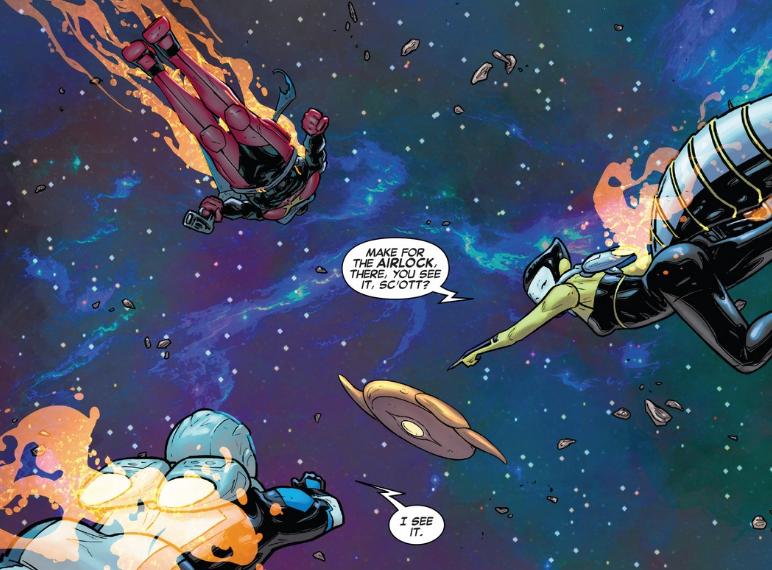 Seriously, compare that to any issue of Green Lantern or the first issue of Future’s End, and you’ll see what I’m taking about. Marvel just invests a little time in making space look good. Consequently, it also feels good.
 For a complete list of what we’re reading, head on over to our Pull List page. Whenever possible, buy your comics from your local mom and pop comic bookstore. If you want to rock digital copies, head on over to Comixology and download issues there. There’s no need to pirate, right?
 Retcon Punch
Scott’s obviously been watching Wall-E.
His crush on his “stepmother” is adorable beyond words. There’s something relatable about that though, even if most stepmothers (or most inappropriate crushes) aren’t fantastic alien warriors from outer space. Though that does make it cooler.