
 Today, Drew and Patrick are discussing Fables 140, originally released May 14th, 2014.
 Patrick: As Bill Willingham nears the end of his fairy-tale epic, it appears the writer has endings on the brain. By the time it wraps up early next year, the series will have been in print for over a dozen years and spawned numerous spin-offs, original graphic novels and video games. It’s an enormous, multi-platform franchise that needs a compelling conclusion. The problem, and one that Willingham articulates exceptionally well in the two-issue Boys in the Band story arc, is that modern audiences might not know what we want from endings anymore. A happy ending? A mind-blowing twist? A meaningful loss? After over a decade, any real resolution feels cheap, even dishonest. Time will tell how exactly Willingham pulls it off, but he uses this issue to identify all the pitfalls he’s prepared to avoid.
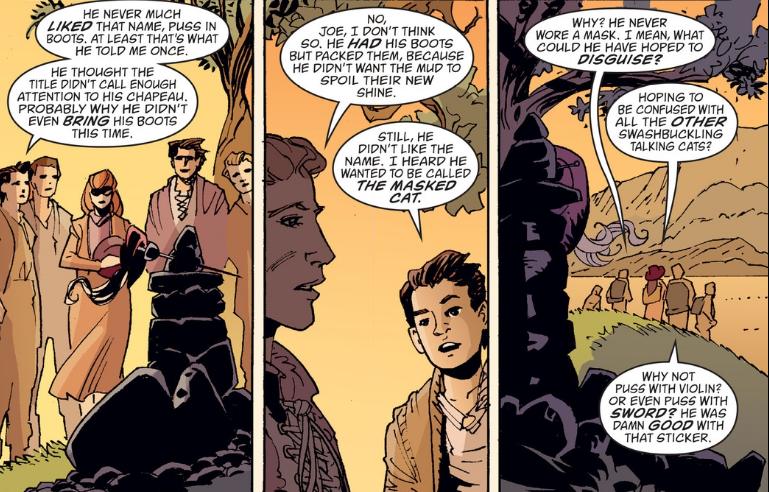
The issue about endings fittingly beings with a sunset funeral for Puss in Boots, who appeared to have been killed during the events of the previous issue. The sequence itself is all of a page long, but Willingham and artist Steve Leialoha absolutely nail the tone of this scene, with a keen mix of sentiment and humor that reveals just how much that character meant to his friends. Even for someone like me — who had really only known the character in the previous issue — the scene is an effective exercise in characterization and reflection. And of course, Lee Loughridge’s colors sell the everloving shit out of that sunset. It would be trite, if the whole thing weren’t so well executed.
 But the team can’t dwell on this for very long — the setting sun means it’s only a matter of time before the Brochan Weir stalks the highway. Who’s the Brochan Weir? A quick recap of his legend sets him up as some kind of wayfaring highwayman, killable by “no man.” Briar Rose knows the legend well, and has been trained by TV and movies to be looking for the twist, so she correctly guesses that “no man” could easily refer to a woman. (Even without TV, MacBeth‘s “no man of woman born” could have served as a model for Briar Rose.) She Indiana Joneses her way through the duel and handily wins by shooting her opponent with a fucking gun.
All throughout the duel, Briar Rose lets the both the Brochan Weir and the audience know that she’s planning to exploit a painfully obvious trope in this encounter. “Duh,” she seems to say “of course I’m going to survive this fight.” Indeed, she identifies this punny twist as “hack.” Five pages into the issue and we’ve already seen two examples of typical endings, each satisfying in their own right, but pointedly formulaic.
Armed with a new-found confidence (and an impressive cache of technically-forbidden small arms), the band storms the castle of the Baobhan Sith. During the scuffle, Joe’s cornered by the witch — which is kind of okay because he’s got a grenade in-hand. Not only were these grenades dutifully introduced a few pages previous (Chekov would be proud), but the scene feel remarkably like the “you always were an asshole, Gorman” scene from Aliens. Again, it’s another ending-trope: the noble sacrifice which catches the enemy in the blast of the suicide bomb. But the trope parade ain’t over: giants join the fray, coming to our heroes’ aid like they’re the eagles in the Battle of Five Armies. (Hobbit spoilers, I guess.) Leading those giants is none other than Puss in Boots. You know, because the dead hero always has to come back when things look their darkest.
That’s a dizzying number of conclusion tropes all firing at once, and it all feels genuinely exciting as you’re reading. It’s only upon reflection that any of those twists and turns might feel over-played. Even as the battle wraps up, Willingham and Leialoha aren’t done having their fun, and the single greatest page in the issue features multiple Puss in Boots death-psyche-outs.
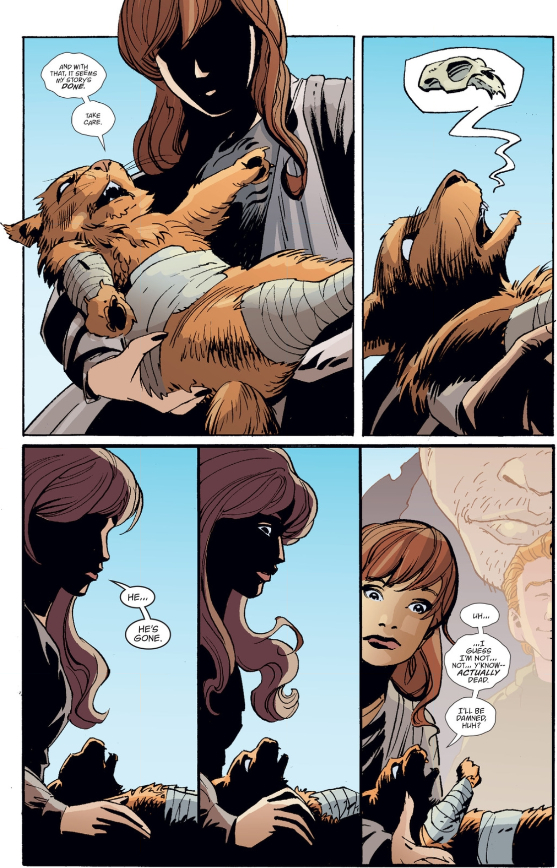 Hilariously, Puss comments on the next page that “that would have been a great exit.” Maybe Willingham is actually saying that all of these options would be a great way to wrap up his epic. What is Fables, after all, if not the embodiment of embracing of all storytelling tropes? Drew, I loved this issue as a commentary on the handful of ways we know to end stories, and it makes me beyond excited to see what exactly Willingham has in store for the final 10 issues. What are you expecting? An even bigger fireworks display of ending tropes? Or are those all out of his system now? How about this question: is this issue a celebration of those tropes or a condemnation of them?
 Drew: I’d say, in true Fables fashion, this issue is a loving tribute to the tropes it riffs on. Sure, he calls some of them out as lame, but he also has seems to acknowledge that “lameness” is ultimately dictated by how he actually handles the scene. Willingham calls out the Brochan Weir twits as hackneyed, but honestly, what’s more hackneyed than a character breaking the fourth wall to comment on how lame the story is? Cleverly, Willingham dismisses this kind of ironic distance, suggesting that we need to forget [our baggage with lame endings] — it’s Fabletown.
 That “yet” seems telling to me — perhaps Willingham intends to return to this particular well before the series is through? Briar Rose sustains an apparently zombifying scratch during the fight, which she keeps secret from her comrades, suggesting that the obvious twists certainly aren’t over.
It’s all very clever, but I think this issue kicks into another gear once Willingham has essentially given up on reassuring the cynics, leaving focusing on our hearts, rather than our brains. As Patrick pointed out, the scenarios that follow are no less trope-y and worn-out than the “no man” twist, but Willingham knows that they’re effective — so long as he sells them with a straight face. This issue really demonstrates that the most important element of an ending is emotional honesty, and Willingham clearly knows how to navigate those waters.
At this point, virtually any ending could be satisfying — having the fight go on, having the characters live happily ever after, even killing all of the characters. That last one doesn’t seem like an emotionally satisfying ending, but note the last panel Patrick posted — I’m not entirely sure who that’s supposed to be in the background, but the faded inkwork sure makes them look like memories (or ghosts), suggesting that Puss just had a very similar experience to what Bigby went through back in Fables 134. It effectively reminds us that there’s a satisfying afterlife for these characters, and that they’ll find peace, even if we never get to see it — or even because we never get to see it.
But I don’t need to hypothesize about the ending just yet — it’s still a good ways off. For me, the primary difference between this issue and whatever we presume that ending to be is the weight Willingham puts on it — this issue couldn’t spin through enough ending tropes, and so never stuck with one for very long. It made for a surprisingly thrilling issue, but for the actual masterclass on ending a 100+ chapter story, I think we’re going to have to wait.
 For a complete list of what we’re reading, head on over to our Pull List page. Whenever possible, buy your comics from your local mom and pop comic bookstore. If you want to rock digital copies, head on over to DC’s website and download issues there. There’s no need to pirate, right?
 Retcon Punch