
 Look, there are a lot of comics out there. Too many. We can never hope to have in-depth conversations about all of them. But, we sure can round up some of the more noteworthy titles we didn’t get around to from the week. Today, Patrick and Spencer are discussing Afterlife with Archie 6, Original Sin: Thor & Loki 2, Amazing Spider-Man 4, Original Sins 4, Deadpool 32, Velvet 6, Storm 1, Batman and Robin 33, Batman Eternal 16, Batman Beyond Universe 12, and The Flash 33 .

Patrick: Quick Retcon Punch history lesson: we take our name from an action taken by Superboy Prime that physically damaged reality and thus altered a handful of character histories. It’s a silly moment — about as comic-booky as you can get — but the reason we gravitated to it so strongly was that the term was invented by the fan community. It’s simultaneously derisive and celebratory, which perfectly encapsulates superhero comic fans’ relationship to their favorite medium. But the more I read comics, the more I realize that medium lends itself so easily to revealing secret histories that it’s only a matter of time before every piece of past is written and re-written over and over again. This can be frustrating as hell, but when applied well, it can also blow out a world into something much more engaging and complex than you could have possibly imagined.
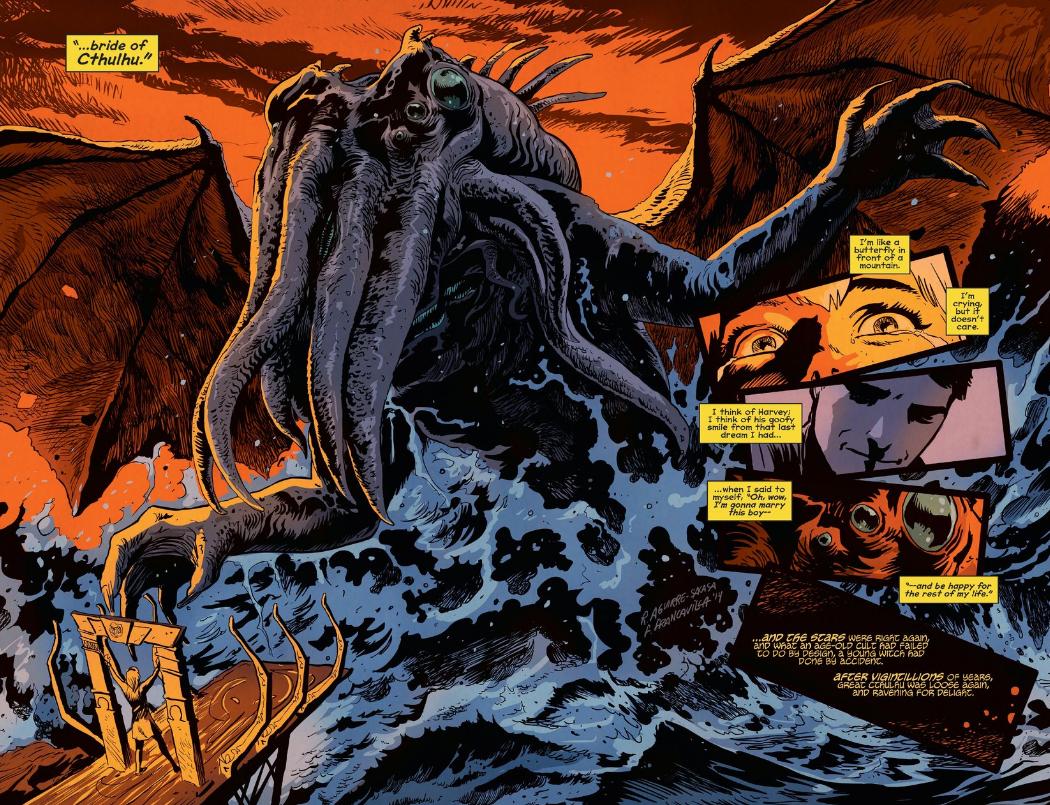
Such is the case with Afterlife with Archie 6, which goes back to explore what happened to Sabrina after she went behind her aunts’ backs and used a demon spell to bring Hot Dog back to life (which, in turn, lead to the zombie outbreak in Riverdale). While Archie and the gang — who are absent in this issue — are stuck in a George Romero scenario, Sabrina has been sentenced to the work of a different horror visionary: H.P. Lovecraft. The teenage witch finds herself at an otherworldly institution where the doctors try to convince her that her memories of her life as a witch in Greendale were false. Roberto Aguirre-Sacasa and Francesco Francavilla wield Lovecraftian details with such a haunting enthusiasm, that I almost totally forgot I was picking up this issue to see zombies destroy Riverdale. In fact, by injecting Lovecraftian mythology into Afterlife, Aguirre-Sacasa immediately separates his zombie-epic from the World War Zs and Walking Deads of the world.
My favorite parts of this issue are Sabrina’s interaction with ethereal violinist Erich Vann and painter-of-the-grotesque Richie Pickman. Both are characters from Lovecraft stories (The Music of Erich Vann and Pickman’s Model, respectively). I just love the idea that artists who are inspired by Lovecraft are using artists created by Lovecraft to explore Lovecraftian Elder Gods. By the end of the issue, the references are just spiraling out of control, with nods to other media and historical events like The Wicker Man and the puritanical witch hunts. It makes Sabrina a weird pivot-point, around which so many different fictions and realities rotate, and it all leads up to the most-earned two-page Cthulhu splash I’ve ever seen. Obviously, Francavilla is having the time of his life.
Over in Original Sin: Thor & Loki 2, the titular pair charge headlong into the Tenth Realm looking for answers. Unsurprisingly, they’re met by a host of angry angels and everyone fights until Angela shows up to defend her people from Thor. I was a lot less enamored with this issue that I was the first in this series, partially because Loki’s role is marginalized and the narrative rests on the assumption that battles between gods and angels are inherently interesting. Adding to the problem: three-quarters of this issue is drawn by Simone Bianchi and colorist Adriano Dall’alpi, and their style is just too muddy to portray anything even remotely approaching clarity of action. The battle is simply a mess of inconsistently applied textures and shading. It’s bizarre – some of the panels seem relatively polished, but others appear incomplete or lacking in detail. It’s especially disappointing considering the first five pages that Loki Agent of Asgard artist Lee Garbit pencilled for the issue so deftly depict Angela in action with the Guardians of the Galaxy (DON’T FORGET: THEY’RE EVERYWHERE).
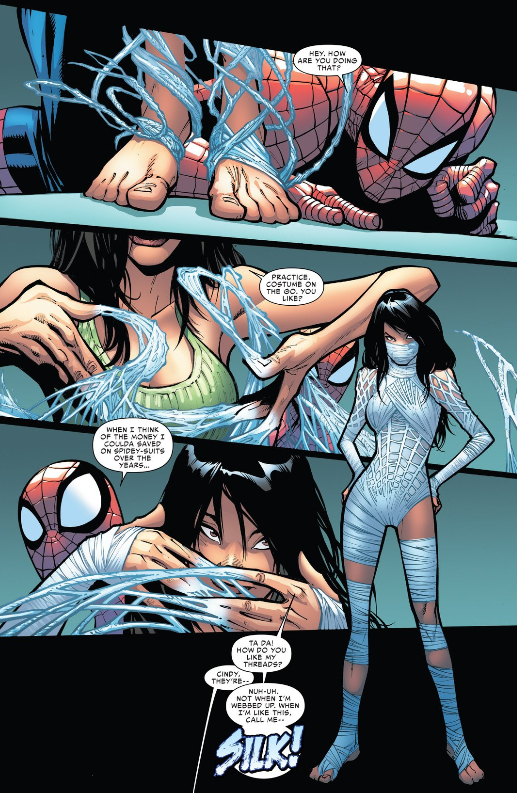
Then there are the revelations that make me feel like I’ve missed on on a crucial piece of information. Amazing Spider-Man 4 finally puts Peter Parker in contact with Cindy, aka Silk, aka that girl that’s been hanging around the edges of ASM for the last three issues. Their relationship immediately snaps into some kind of strange chemistry — which is maybe the result of a shared history with Ezekiel and Morlun (both characters I’m unfamiliar with) — and culminates in an uncomfortably intense make-out session. Actually “uncomfortably intense” might be how I’d describe this whole issue. I cannot get over the ridiculous poses Humberto Ramos draws Cindy in, and the design for Silk in-costume is like some pubescent spider-fuck fantasy.
Spencer: I wonder if this costume is why Slott gave us Peter in nothing but webbing-briefs back in issue one? Anyway, I see where you’re coming from with the costume, and I feel bad for the poor soul who tries to cosplay it, but I still have mixed feelings about it. Like, I think making a costume out of webbing is a super cool idea, but the execution isn’t quite there? Maybe we can blame the whole thing on Ramos; even the process of Cindy putting on her costume is needlessly sexualized:
As for the rest of the issue, I actually think this is the most focused the book has been since Peter returned; I get the impression that Slott’s been impatiently waiting to get to this point, and that it hurt the previous issues a bit. I like that it’s not just the shared history of Ezekiel-shenanigans that ties these two together (and while I didn’t look it up, I believe Ezekiel is a character from JMS’s controversial Spider-Totem storyline), but the fact that both characters are readjusting to New York after absences. Peter just went through what Silk’s going through, and that puts him in a prime position to help her.
After all my talk of the formula behind Original Sins last time we discussed it, I was pleasantly surprised with how issue 4 shook things up. Instead of a teaser, the first story is a chilling, self-contained story of arrogance, displaying why Doctor Doom is one of the most dangerous players in the Marvel Universe, and the final two-page story packs a lot of emotion into its limited space. The Young Avengers story is as charming as ever; writer Ryan North still has a way with jokes and dialogue and displays an impressive grasp of the unseen Young Avengers, but the plot of this one still feels a bit frustrating. I’m not finding Hood as complex or interesting as North clearly does, and four issues of constant “Hood is definitely going to betray us” reminders makes the actual moment when the betrayal comes feel remarkably anti-climatic.
Deadpool 32 has finally started to find a proper balance between humor and pathos; playing the scenes between Wade, Ellie, and Utler mostly straight helps make the drama much more effective, and even the more humorous scenes seem to benefit from not having to deal with the darker parts of the plot (Dazzler and Shiklah make a much more interesting team than Wade and Dazzler, for example). Playing the drama straight also helps alleviate some of the gratuitous violence that bothered me so much in the previous issue, even if penciller John Lucas still fails to make the gore either shocking or frightening; instead he settles for making it look messy and commonplace, and it does the story no favors.
Patrick: Yeah, every globby blood-splosion takes me away from the heart of the issue, which is Deadpool interacting with his daughter. That a shame because a) those jelly-ish splats are everywhere and b) that’s a new dynamic for Deadpool, and one that someone like Brian Posehn should be able to write from experience. Posehn is a reputedly crass and nerdy (maybe we should hyphenate that: crass-n-nerdy) comedian – his most recent Netflix special is titled The Fartist (a reference to the 2011 film The Artist). But he also a a kid a few years ago, so he also knows a thing or two about being a smart, capable, kid-friendly dude. That almost squeaks through to the page, but unfortunately, it’s just soaked in gallons of Lucas’ overeager blood.
With the beginning of his second arc, Ed Brubaker takes Velvet 6 into a much more straight-up espionage narrative. Velvet is betrayed by her agency, but it’s not entirely clear whether that betrayal is systemic or personal, gleefully blurring the line between two of the more well-worn strops in spy fiction. We’ve seen countless stories about double agents and agencies turning on their only agents, but that’s usually a symptom of a long-running series volleying for some new territory to cover. (Seriously, most of the recent Bond movies, and I think all of the Mission Impossible movies, center on the shifting of internal loyalties and not one the actual work the agency does.) It’s a credit to Brubaker that Velvet feels so well-developed that this kind of story feels totally natural. And holy hell, I don’t think there’s anyone else working today that can portray the same level of collected determination that Steve Epting imbues the character with.
Shifting from from bull-headed lady to another, Greg Pak’s Storm 1 kicks off the X-Man’s solo series this week. I’ve always felt that it’s hard to dial into Storm as a character because she never really seems to belong with the rest of her mutant brothers and sisters. Pak makes the same point, but offers her a handful of places where she does fit in — at least for the time being. I was particularly touched by the way she connected with Flourish Creep, which emphasizes how it’s okay not to feel like you belong in the plucky group of outcasts. Y’know, there are so many corners of nerd culture where I still don’t feel totally welcome, and it’s a nice reminder that not everything needs to feel like home all the time.
Of course, sometimes you just want to be with your family again…
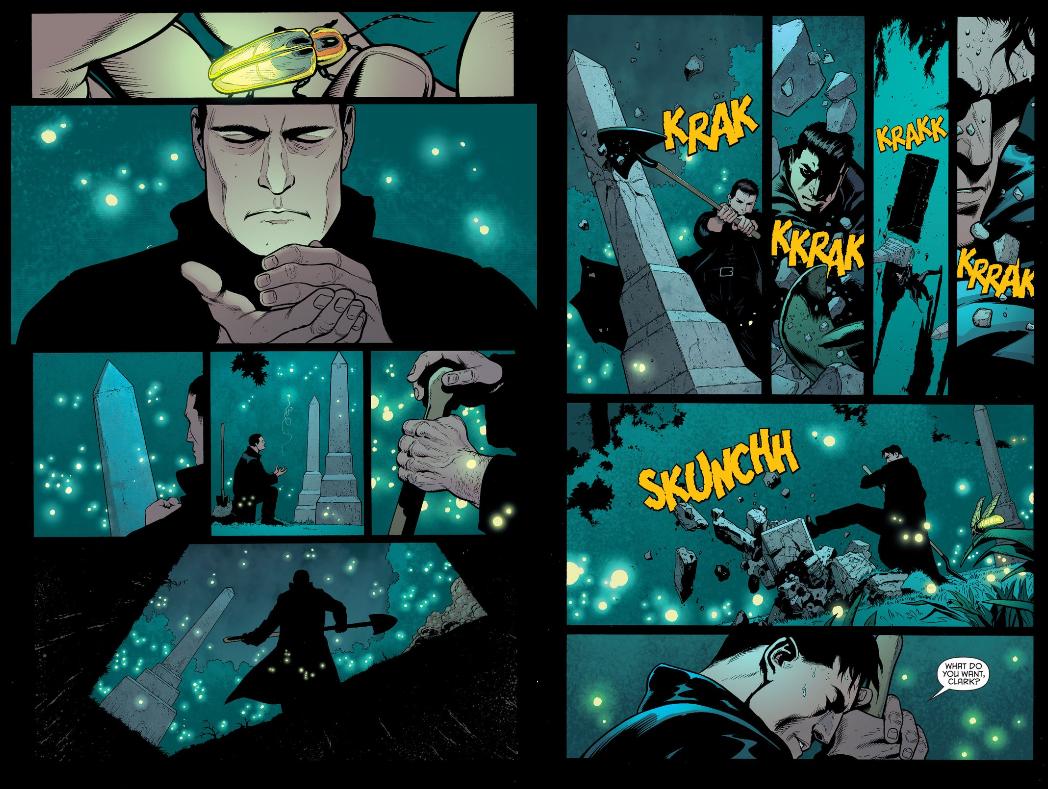
Spencer: I’m always excited for more Bat-family, Patrick — if there’s one element of Batman’s world I love even more than Batman, it’s his sidekicks! I agree with you that family is going to be a large part of this story going forward.

We’ve spent close to a year now with this title sharing its marquee with the likes of Two-Face or the Justice League, and while Tomasi and Gleason even give us the absolutely stunning page I posted above depicting the lengths Batman’s teammates go to protect him — demonstrating the deep connection they have — that connection just isn’t as strong as the one he shares with his family. Batman will lie to the League to get them off his back, and it’s his sidekicks he turns to instead. It’s a clever way to flesh out Bruce’s relationships while also redirecting the focus of the title. Even the scenes set on Apokolips have a strong “family” bent to them.

Look at that first dialogue balloon there: remind you of anyone? Damian struggled to live up to the brutal legacy of Ra’s and Talia as well as the loftier example set by his father, and if Damian is truly returning, then he may be a most fascinating mirror to Darkseid’s brutal-yet-needy son, Kalibak.
There’s an interesting concept at the heart of Batman Eternal 16, the idea that Arkham is more responsible for making monsters than containing or rehabilitating them; unfortunately, the writing team (led this week by Ray Fawkes) does little with it. I admit that I’m not at all invested in this current storyline, and namedropping Deacon Blackfire does little to pique my interest when I know nothing about the character. This might be more my problem than the book’s though, especially since they approached Falcone with the same kind of name recognition; the only difference is that I’ve read Long Halloween, and I haven’t read whatever Blackfire’s shown up in before. Still, I would appreciate knowing a little more about why this guy is so scary and dangerous instead of just taking their word for it.
There’s a few other elements of this issue that don’t add up either. I’m still clueless about what’s going on with Jason Bard and Batman; the current state of affairs with these characters doesn’t feel like a natural progression from where they stood at the end of issue 14 (unless Batman’s using Vicki Vale to infiltrate Bard’s police force, which is an idea I can get behind). Fortunately, Tim and Harper’s plot is beginning to pick up, Batwing is growing on me more and more, and Dustin Nguyen is still knocking these pages out of the park. There’s some fun stuff going on here, but this is still a bit of an uneven issue.
So hey, I don’t think we’ve ever talked about Batman Beyond Universe before, but it’s well worth discussing. The title takes place in the same continuity as the Batman Beyond animated series (obviously), and writers Kyle Higgins and Christos Gage are obviously having a ball playing around in this sandbox. This issue is the epic finale to a long-running storyline that saw the Justice League Beyond taking on their tyrant counterparts from an alternate universe (as previously seen in the Justice League episode “A Better World“), and it explores their various moralities in interesting way; what I really like about this story, though, is its focus on legacy. The issue closes on our aged trinity — Batman, Superman, and Wonder Woman — looking over the new Justice League that has assembled around them with pride, but it doesn’t avoid addressing the difficulties that can arise while raising the next generation either (such as Wonder Woman’s conflict with her son). While this isn’t advertised as an “all ages” book, it still fills that niche quite nicely, consistently churning out fun, exciting stories month after month.
Likewise, Robert Venditti and Van Jensen continue to explore the same themes they’ve been tackling since the beginning of their run over in Flash 33, but this time Flash makes progress on the “Mashup” case only to lose ground with Wally West. I’m guessing the reveal of Seborn as Mashup might have been too obvious for some readers, but for me it was paced perfectly; the realization dawned on me right before it hit Barry. Actually, I’m rather satisfied overall with this issue; Venditti, Van Jensen, and penciller Brett Booth jam-pack this issue with energetic action sequences, creative designs (coin robots!!!), and even some unexpected humor.
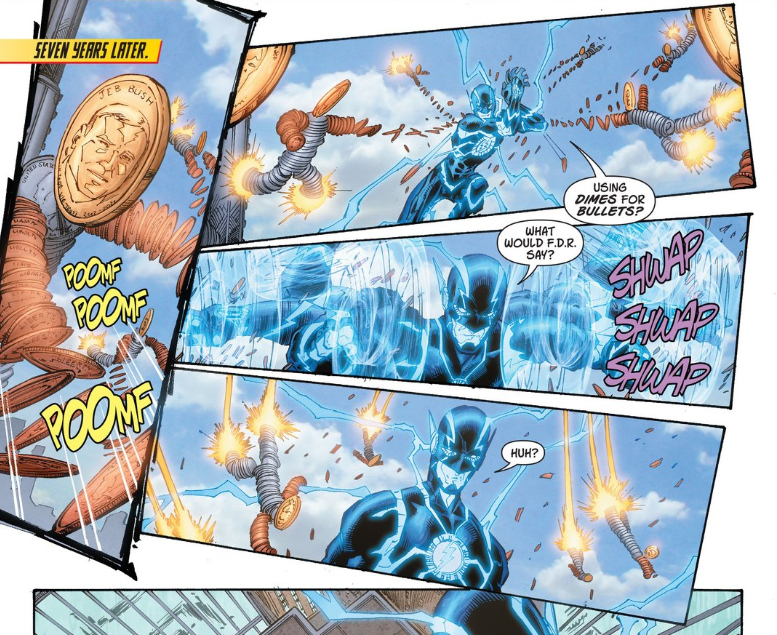
Moreover, I feel like I know our Future Flash much better now. He’s less “Punisher” and more “weary, regretful old man”; I can still be horrified by the actions this version of Barry has taken, but I can also understand completely why he acts the way he does.
The conversation doesn’t stop there, because you certainly read something that we didn’t. What do you wanna talk about from this week?
 Retcon Punch
Also, look how much we love Gleason’s art – we shared like 20% of that issue of B&R (and that’s in a ROUNDUP). He’s on fire right now.
ASM still feels like it’s knee-deep in transition between Superior and ‘Verse. I think Spencer’s right to say that 4 is the most focused the series has been since it restarted, but it’s still just kind of aimlessly bobbling about. I think I’m losing patience for comics that don’t appear to have clear beginnings and endings to stories. There’s something so exhausting about knowing that we’re just in Peter’s life again, and the story is just the adventure of being Spider-Man. Obviously that allows for a lot of things to snowball into the kind of long-in-the-works stuff Slott is famous for, but as of this moment, I don’t totally know “why” I’m reading Spider-Man.
This is a pretty weak time in ASM. Too bad, there could be great things, but I think there are too many plates in the air getting ready for Spider-Verse. Poor timing on the big Spider-Man event considering we just got Peter back. I haven’t loved the regular issues or the Learning to Crawl issues at all. I have faith in Slott and I believe all will be ok, and I was one that complained that reading Spider-Man meant seeing the same villains doing the same things they’d done for 40 years, and now I don’t like the new villain or new Spider-Person.
Ultimate Spidey has been a great comic for the last three years, however.
I don’t know if anyone is going to read this here, but what the hell.
Read “And Then Emily Was Gone” this week. One of the best first issues of anything I’ve ever read. It’s chapter one of a five part mini-series and I don’t want to spoil a single panel, but it’s weird, creepy, intense, legitimately disturbing in a couple of parts, and I CAN NOT WAIT for part two. Do yourself a favor and get it now.
You’ll thank me.