
 Look, there are a lot of comics out there. Too many. We can never hope to have in-depth conversations about all of them. But, we sure can round up some of the more noteworthy titles we didn’t get around to from the week. Today, Patrick, Drew, Spencer and Shane discuss Sonic BOOM 1, Inhuman 7, Bob’s Burgers 3, Harley Quinn Annual 1, Nova 22, Thunderbolts 33, and Justice League United Annual 1.
 Patrick: 90% of what we end up reading in mainstream comics is the expression of a brand. The New 52, Marvel Now — we can call those bold new storytelling initiatives if we want, but they’re driven by a desire to rebrand the material. Even the dreaded “reboot” has more to do with cleaning up a brand than it does cleaning up a character’s continuity. Which brings me to the rather opaque rebranding of Sonic The Hedgehog — it’s going to be permeating video games, movies and TV shows, but it starts in the comics at Sonic BOOM 1.
It’s clear from the very first page that the artistic team is working from a very specific model sheet, as Evan Stanley’s pencils faithfully recreate every spike on Sonic’s head and every fold on his fashionable new neck scarf. I’ll echo the common complaint for all modern Sonic the Hedgehog media — the comic never feels fast. Writer Ian Flynn is sure to pack the script with jokes, including quite a few meta jokes about lettering and sound effects, but they more often serve to slow down the narrative, rather than imbue it with any kinetic energy. Here’s an example: Sticks the Badger (oh, yeah, they’re introducing new characters too) appears to be tracking their enemy by scent for an entire page, and when Sonic and Tails comment on how extraordinary that is, Sticks replies that she “just thought the grass smelled nice.” That’s not a bad joke in an of itself, but it is the only thing that happens for the entire page.
The script is also relentlessly mean to poor Knuckles, who is just dumber than a bucket of hammers. Flynn takes this single character trait and tries to play it for laughs, but everyone reacts to his slowness with such impatient aggression. Instead of allowing the readers to have fun with Knuckle’s dim-witticisms, Sonic, Tails, Sticks and especially Amy set the example that we’re to be annoyed with him. I don’t know, maybe I’m asking too much that Sonic comic be fun and fast?
Hey, speaking of books that might be a little too mean for me to really sink my teeth into, we finally got to see what Black Bolt has been up to in Inhumans 7. Actually, “what he’s been up to” implies quite a bit more agency than the issue presents — he’s tied up and mildly mind-controlled by his brother Maximus. I find it a little frustrating that Soule isn’t really cluing us into Maximus’ plans: right now, it seems like he’s just happy to be fucking with Black Bolt. The buddy-cop pairing of Auranp and Nur Frank McGhee is a lot more fun story to follow. Fleshing out Frank plays to Soule’s strengths, and I love this little exchange:
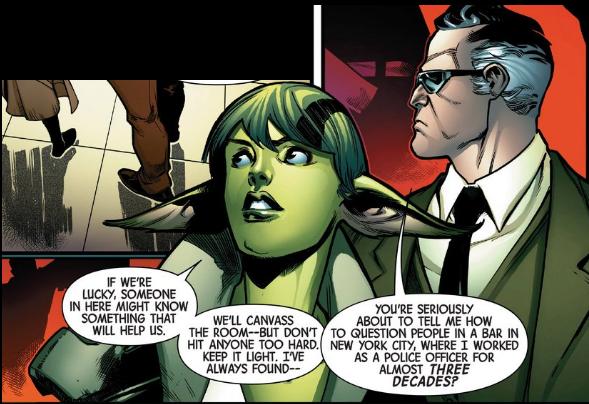 I also find the unfixed perspective approach to this series kind of fascinating. Soule isn’t married to any individual characters, instead letting the greater drama of New Atillan drive the focus of his stories. Means I might be missing Dante this month, but hey: we get to spend some time with Frank — Drew does that work for you?
Drew: Actually, as someone who hasn’t picked up this series in a while, it was kind of a pleasant surprise that I didn’t recognize any of the new Inhumans from those first few issues — not that I didn’t like them, but plunging in with a different set of characters with clearly established voices goes a long way to building out the world of this series. I, too, was much more enamored of the Auranp/Frank scenes than the Maximus/Black Bolt ones, though that may just be my latent preference of dialogue over monologue — I’ve got nothing against Black Bolt as a character, but he’s not exactly the best conversationalist.
Whatever charms were present in Bob’s Burgers 1 and 2 have thoroughly worn off by this week’s third installment, which returns to the same parameters of the previous two to ever-diminishing returns. I’d probably be inclined to dismiss the repetition as lazy, anyway, but the stories here felt especially derivative: Tina’s western utterly fails to build any sense of drama (or emotional investment in the non-drama), establishing Tina as the sharpest shooter in the west, then asking her to solve a problem with sharp-shooting; Bob’s Burger of the Day Ideas, once crammed with dozens of jokes, wastes its entire page on one lame joke; and Gene’s musical barely even bothers to rhyme this time around (and seems to rely even more heavily on sound this month than previously). My fondness for these characters goes a long way, but it really felt like this issue wasn’t even trying. Were you as disappointed with this as I was, Spencer?
Spencer: Actually, Drew, I enjoyed this issue a lot more than you did, but I can absolutely see where you’re coming from. Tina’s story, while still quite funny, is far from her strongest friend-fiction, and I agree with you that the strange sometimes-a-musical/sometimes-not-a-musical aspect of Gene’s story feels a little half-baked. I feel bad saying this, but there are definitely a few moments throughout the book that feel lazy and rushed, much of it to do with the lettering, of all things.

Check out these two panels, for example. Artists Frank Forte and Tyler Garrison reuse the same bit of art, even though it doesn’t fit Bob’s dialogue in the second panel at all, and Forte’s forgotten to give any of the speech balloons tails — there’s a similar mistake on the preceding page where one of Gene’s balloons is credited to Bob. Hector Reynoso and Tony Gennaro give Tina’s story some wonky lettering too:
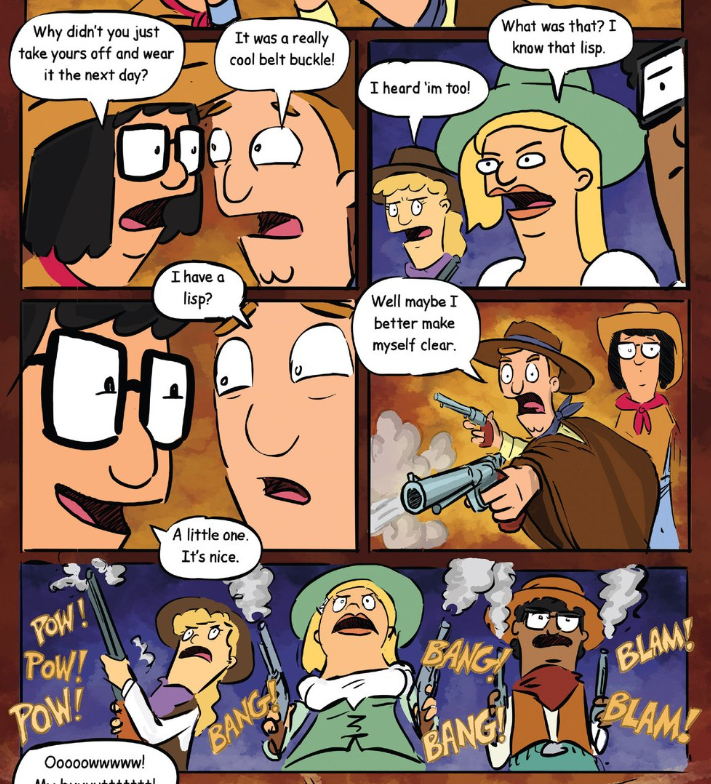
Comics Sans aside, I’m mostly mad at how unintuitive the balloon placement is here. The speech balloons aren’t laid out in a way that leads the eye, and the balloons breaking out of the panels throws off the reading order. For example, in the fourth and fifth panels I keep reading “Well maybe I better make myself clear” before “A little one. It’s nice,” even though the latter clearly comes first, because the former breaks into panel four, while the latter has practically drifted into panel six. It’s confusing, to say the least.
Yet, after all that, I can say without hesitation that this is probably my favorite issue of Bob’s Burgers yet, and it’s all thanks to Louise’s story. Artist Kat Kosmala’s characters stretch and distort as their emotions surge, her hand-written lettering — in a different font for each character — morphs and changes with their mood, and the story itself is absolutely bonkers in the best way possible.
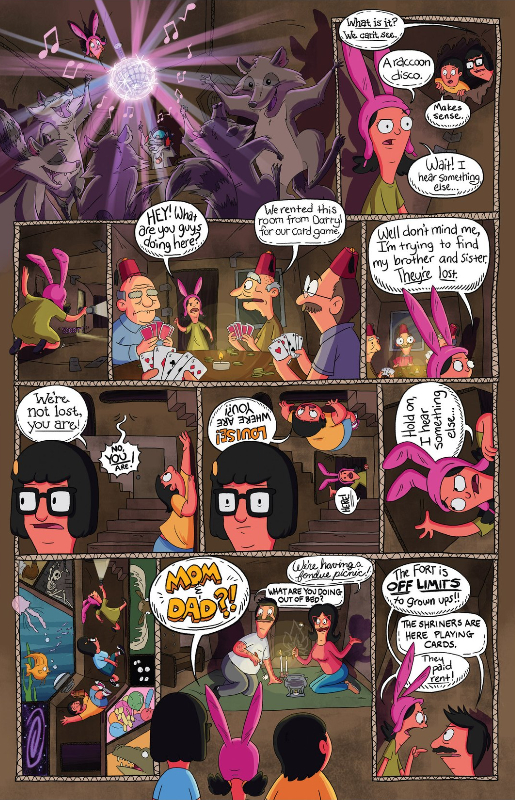 This one story catches the frenetic energy of the show better than anything this comic’s done thus far; I practically gave it a standing ovation when I finished. The creators behind this title would do well to look to this story as an example of the types of stories they can tell and the amount of work that should go into them.
So yeah, Harley Quinn Annual 1 is the scratch-n-sniff issue, but fortunately it’s about more than just the gimmick. Of course, there’s still plenty of rub-n-smell action: the scratching part is easy to pull off, the smells are strong and accurate (even if they become a little too similar in the book’s second half), and while the gimmick is a little obtrusive, I think that’s part of the joke. The story itself finds Harley attempting to rescue Poison Ivy from some scientists who have brainwashed her into developing a new hallucinogen for them. Harley Quinn is always at its best when Harley has Ivy to bounce off, and that’s just as true here, but the issue also benefits from a sense of sheer lunacy; its second half is devoted to the various characters’ hallucinations that allow the humor to stretch beyond its usual parameters. Gimmick or not, this is one of the strongest issues of Harley Quinn in quite a while.
Nova 22 is another fun issue, with most of its space devoted to a sweet and funny tale about Sam trick-or-treating with the kids from the Jean Grey Academy. It’s a bummer that writer Gerry Duggan never properly introduces the students Sam hangs with (only Nature Girl’s name and powers are mentioned), but I still got a kick out of their role in the candy rescue mission. Federico Santagati’s art is strangely angular and his Sam looks a little too old for my tastes, but he absolutely nails most of the jokes, especially Principal Philbin’s resigned look of defeat as he lets Sam back into school. The cliffhanger finds Sam sucked into the Avengers’ current troubles; this is a refreshing change of pace from Sam’s many recent cosmic adventures, and I’m interested to see what Duggan does with the idea.
Thunderbolts 32 finds Ben Acker, Ben Blacker, and artist Kim Jacinto bringing the series to a close, and it ends the only way it ever really could have, with the Red Leader finally going too far, and the Thunderbolts taking him down and immediately disbanding. Acker and Blacker have a fine handle on Red Leader, keeping him incredibly dangerous while still letting some of his more pathetic traits shine through, and I love how his final downfall all comes down to his own mistakes, even tying-in to his deal with Mephisto back in Soule’s run. Much of the issue is also some rather pointed commentary about the purpose of the Thunderbolts, and while some of the criticism of this current team comes across as rather harsh, I do like the continued critique of Ross’ role on the team and the way he views himself compared to how everyone else views him. Shane, you were recently discussing with me how this team’s M.O. compares to its previous iterations, so I expect that much of is is right up your alley. Thoughts?
Shane: It was a genuine treat to see Hawkeye brought in for this final arc of the Thunderbolts, because although he wasn’t involved in the original team’s first major arcs, he’s certainly the most famous member of any earlier incarnation. As both an Avenger and a former Thunderbolt, of course he’d get involved when a teammate of his formed his own Thunderbolts squad, and I absolutely loved that Acker and Blacker made a point to show us his reaction to it. There’s been little connection in this series to previous volumes, and that’s alright: strong work by various creatives, including a notable run by Charles Soule, made it worth reading, but it wasn’t until this final issue that we really got why it was a worthy addition to the Thunderbolts saga, and not just another co-opting of the Thunderbolts name for something totally separate (I’m looking at you, “Fight Club” run.)
Hawkeye and Red Hulk talk and it becomes pretty clear why the latter named his team what he did (and not just because Ross’ old nickname was “Thunderbolt”.) He took all these damaged characters, none of whom could be considered heroes in any real sense, and gave them a chance to do some good in one way or another. It may be clandestine, it may involve killing people, but Ross seemed to really believe that it was important work. But the other Thunderbolts were all fine the way they were. They didn’t want redemption, and Hawkeye saw straight to the root of the problem within moments. Once upon a time, the original Thunderbolts pretended to be heroes, and learned to want to be heroes. They put themselves on the right path. In what appears to be the team’s final chapter, Red Hulk tries to force that same result, and fails miserably. It’s a great moment, but I’m a little bummed at how quickly it ends. As the end of a story, it’s solid. But as the last Thunderbolts issue ever? Everything just feels a little lost.
As iffy as I may have found the ending of one epic, I absolutely loved the beginning of another, as Jeff Lemire and Neil Edwards use Justice League United Annual 1 to not only kick off a major event for the title, but to bring the Legion of Super-Heroes — a team very near and dear to my heart — back from comic book limbo. The issue isn’t necessarily perfect: there’s a bit of stiff dialogue, and although I usually like Neil Edwards, some of the artwork looked a little rushed (including one odd panel of Mon-El smiling at the complete wrong moment.)
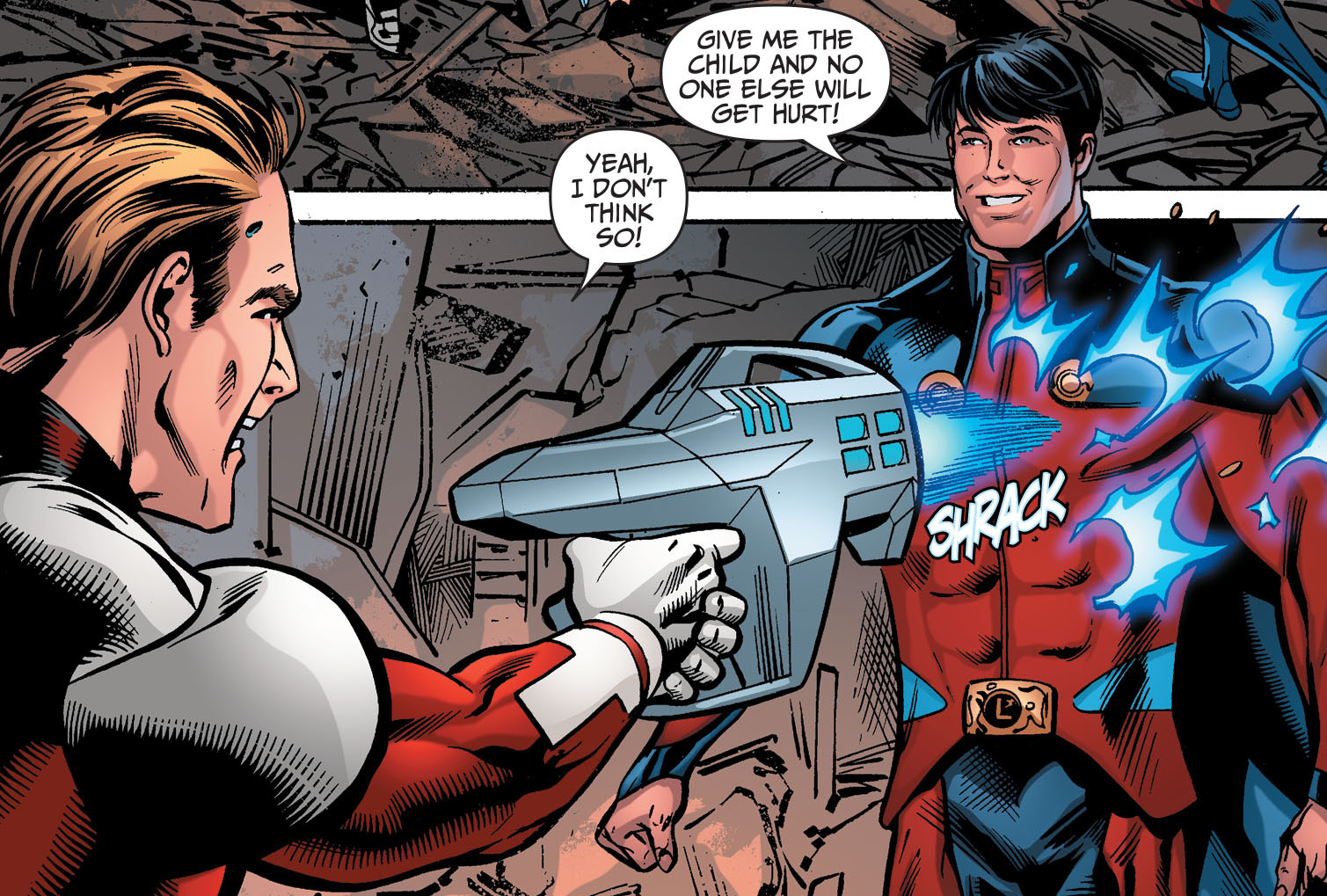 But outside of a few small problems, this annual is a great way to launch a story. Stories seeded in the first arc of the series, including Hawkman’s death and the birth of Ultra the Multi-Alien, quickly step up their significance as trouble emerges from all fronts. There are at least three different factions with their own conflicting agendas, multiple sources of imminent danger, and a ticking clock before the Justice League United and the Legion of Super-Heroes are forced to go to war. I’ll even go so far as to say that it’s the best first issue to a major storyline since the New 52 launched, and I eagerly look forward to the rest of it, and to seeing how one of my favorite writers reinvigorates one of my favorite superhero teams.
The conversation doesn’t stop there, because you certainly read something that we didn’t. What do you wanna talk about from this week?
 Retcon Punch
I did enjoy the Louise story — particularly the lettering. Still, the rest of the issue was SO MUCH weaker than the previous two installments. That fortune cookie burger idea should have been rejected outright for needing more jokes.
Yeah, maybe “my favorite issue yet” is too strong of praise (even though it’s what I legitimately thought when I finished reading it, based upon the Louise story alone) but that Louise story certainly is the best thing the comic’s produced by a long shot.
It is sad how lazy some of the rest of the book feels, though. Those lettering errors I pointed out are REALLY bad.
But there was one other thing that I DID appreciate about the issue, and that’s how much of Bob and Linda we got to see. They were integrated pretty heavily and seamlessly into Louise and Gene’s story (and Teddy, too!) and this is the first issue where these two felt like an integral part of it. So much of this issue is a step back, but in this way it still feels like it’s taking a step forward to me too.
I really loved that JLU annual. The LOSH haven’t been handled very well in an extremely long time, and I would argue that Lemire is the guy to launch a new team book for them. His first JLU arc had plenty of charms (even when it was diminished by the many necessary beats involved with organizing a disparate team, basing them in Canada, establishing their mission statement, introducing a few character origins, and sending them all into space while also trying to deliver a story arc), and I’m ready for Lemire to just have fun now. I know he’s good for it, and he’s written an overly serious iteration of at least 2 of these characters, so I’m sure this is the book where he’ll be letting off the steam.
Also, anybody been following Grayson? Firearms aside, it’s really hitting my sweet spot. Janin is infallible, and his depiction of the acrobatics works really well with his more realistic character proportions and poses. And the Midnighter plot they’ve been slowly easing into is a real fanboy dream for me. Best use of a WildStorm character since the merge, IMO. Sure, the real Midnigher should be OP compared to Grayson, but Midnighter’s allusion to how their battle has ended in his mind awesome foreboding. I love it!
Oh, I adore Grayson. I even think the firearm stuff has been working well — I mean, issue 3 is basically a 20 page anti-gun propaganda piece, and I’m all over that.
Drew and I are actually writing about issue four on Wednesday, so be sure to check back for it!
Right on, Piv. Sorry, I looked through the Pull List but missed that, or I would have waited