
Look, there are a lot of comics out there. Too many. We can never hope to have in-depth conversations about all of them. But, we sure can round up some of the more noteworthy titles we didn’t get around to from the week. Today, Drew, Spencer, and Patrick are discussing Uncanny Inhumans 0, Arkham Manor: Endgame 1, Batman Superman Annual 2, Ufology 1, The Woods 12, and Kanan: The Last Padawan 1.

Drew: Jonathan Hickman’s dueling runs of Avengers and New Avengers has at many times served as an extended exploration of what Neitzsche called “master morality.” Specifically, those titles have examined how the morals of rulers might be at odds with what we understand to be moral in our everyday lives. Charles Soule tweaks this notion slightly in Uncanny Inhumans 0, examining how Black Bolt’s Kingly duties — especially dealing with the end of the world — conflicts with his familial ones.
I’m always surprised to be moved by a Black Bolt story — not because he’s a weak character, but because it takes some doing to get us into the head of a character who can’t speak. Soule cleverly stays over Bolt’s shoulder for the whole issue, allowing us to really absorb his situation long before the reveal of his final act. Of course, it helps to have an artist like Steve McNiven offering another avenue into Black Bolt’s head: his face.

Not many artists can pull off that mime routine so clearly or so seriously, but McNiven sells every second of it. That expression in the first panel is enough to tell us exactly how important this message is to Black Bolt. His sacrifice is a profound one, and promises to set up a new status quo for the Inhumans going forward.
Arkham Manor: Endgame 1 is not nearly as momentous, though it is unfortunately just as self-serious. Following in the wake of what looks like an outbreak of the Joker virus in the titular manor, this issue takes the form of an interrogation of one of the Arkham guards. That framing device turns out to be utterly irrelevant to the story, but the story is also irrelevant on its own terms, as the Joker virus, and indeed the Joker, turn out to be false alarms. Spencer, I’m actually at a bit of a loss for this issue — it certainly defied my expectations as an “Endgame” tie-in, but I’m not sure it did much else. Did you find more to like here?
Spencer: Well, if nothing else, I’m pretty fond of that Rafael Albuquerque cover.

The rest of the issue is rather befuddling. The major villains get nothing to do, sidelined to focus on the Arkham guard, who turns out to be a bland, unmemorable character, and Arkham’s transformation into “The Joker” doesn’t make any sense — why does it happen? Why doesn’t it happen to anyone else? Is it going to have any effect on the character or the title moving forward, or is it just a twist for the sake of having a twist? No matter what the answers, this issue doesn’t really succeed as either a part of Arkham Manor or a stand-alone “Endgame” tie-in. It’s not the worst issue I read this week (cough cough), but it’s easily the least essential.
After being absent for all of Arkham Manor: Endgame, Batman plays a slightly bigger role in Batman Superman Annual 2, but much like the most recent storyline, this is still Superman’s show. I still can’t say I’m all that taken by the Phantom King, but I do like how Pak uses him here, more as an instigator than as the primary villain. The story finds Phantom King enlisting some of the world’s deadliest mercenaries to kill Clark Kent, who, at the moment, is powerless for 24 hours after using his Solar Flare ability to eradicate some Doomsday Mist. It’s a tense battle for survival as Clark has to use his wits (and a bit of help from Batman and some civilians) to survive, and while Pak does attempt to address meatier ideas (like trust being both Superman’s greatest strength and his greatest weakness), the annual works best as a pure action piece. It’s also got a bit of an offbeat, but rather compelling cliffhanger — while I know Superman isn’t dying, there’s something about seeing him powerless and gravely wounded that’s surprisingly affecting, especially when I have to wait two months for the resolution.
Meanwhile, James Tynion IV, Noah J. Yuenkel, and Matthew Fox’s Ufology 1, the first installment of a six issue mini-series from Boom! Studios, deals with aliens far more inhuman than our beloved Kal-El. Truthfully, though, the aliens don’t come into the picture until near the end of the issue — instead, Tynion and Yuenkel focus more on establishing their two leads and the world in which they live. There’s a fun dichotomy to the leads — Becky, a homebody with no desire to be anything special, is marked by the aliens, while poor Malcolm, a conspiracy theorist with dreams of a bigger destiny, is passed over — but it’s Fox’s sparse Midwestern landscapes that draw me in more than anything. Fox’s work — especially when punctuated with snippets from Malcolm’s father’s radio show — perfectly captures the feeling of a dull small town and the kind of undefinable unease that often comes with being an adolescent. I don’t yet have much of an idea what the sci-fi elements of Ufology will add up to, but based on the strength of the rest of the issue, I’ll definitely be back next month to find out.
Tynion’s other sci-fi series, The Woods, brings its first year to a close in a much more action-packed manner. I’m just as impressed by the art here as I am in Ufology, albeit for different reasons. Michael Dialynas and colorist Josan Gonzalez seem to be having a ball bringing to life Adrian’s newfound powers, but Dialynas is just as adept at capturing the emotions and nuances of the characters. At their best, the art team manages to do both at the same time, with spectacular results.

Storywise, I’m impressed by how Adrian seems more human than ever even as he finally leaves his humanity behind. There’s a complexity to him as a character that’s fascinating to delve into, even if, after the events of this issue, we may never be able to find any concrete answers. I also like the parallels Tynion draws between Adrian (and his fate) and the Duchess who once played the same role a few centuries prior — it definitely feels like destiny has a major role in guiding these children right now, or, if not destiny, then at least some kind of omniscient figure (perhaps whoever is behind the school’s abduction in the first place?). With much of the driving storyline of the first twelve issues now resolved I have no idea where The Woods may go next, but I can’t wait to find out.
Patrick: Well, dude, I think we may need to look back at the other story being developed New London team has reached the school, where there’s a powder keg of political instability. After so many issues of leaving that location — and many of its characters — on the back burner, it’s fascinating to consider that there’s so much from our heroes’ previous lives that literally followed them here. FUN EXAMPLE: Calder’s brother is there. Or is he? The dude’s a bad influence, for sure, and I don’t remember him being at the school during the inciting incident. Maybe Tynion is playing the Jack’s Dad card, and having the Woods manifest itself as our heroes’ loved ones. Either way, it means a loaded and promising future. The kids may have drawn blood, but the real watershed moment is in them claiming their agency back at the school.
Let me tell y’all what totally sneaked up on me: Kanan – The Last Padawan 1, the latest new series out of Marvel bearing the Star Wars banner. Unlike its brothers-in-arms, Kanan does not take place after the events of A New Hope. In stead, it tells the story of young Kanan – a character with whom I am wholly unfamiliar. Evidently, he’s a member of the titular rebels from the recent Disney Channel animated series, which takes place between Revenge of the Sith and A New Hope. Hold on though, because we are yet another step removed, as the events of this issue — and by the looks of things, the events of the whole series — take place during Kanan’s Jedi training during the Clone Wars. It’s a marvelously disorienting series of boxes to unpack, and by the time I was able to orient myself within the story, the world seemed brimming with possibilities, rather than restricted by the franchise’s baggage. Writer Greg Weisman does a phenomenal job exploring some of the philosophical dilemmas regarding Jedi serving in the military. The Jedi are fundamentally a monastic order, but their utility on the battle field is just too great to allow them to be the spiritual leaders they perceive themselves to be. Artist Pepe Larraz poses his Jedi like noble samurai, emphasizing the dance-like meditation, over swash-bucklery.
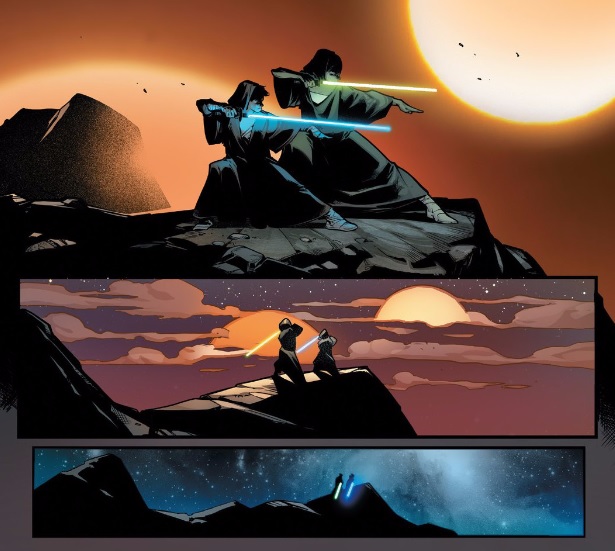
That’s a nice assist from David Curiel’s coloring too. I haven’t been this moved by the depiction of Jedi since… well, shit – this may be the most I’ve ever been interested in the Jedi as a living, breathing, conflicted order. They’re not simply magical ninjas here, but men of the cloth uncertain of their place in a galaxy torn apart by war. That’s an excellent reminder of why I liked Star Wars in the first place, and while I’m a little weary at the mention of Order 66 (ugh), I have some high hopes set by this first issue.
The conversation doesn’t stop there, because you certainly read something that we didn’t. What do you wanna talk about from this week?
 Retcon Punch
I really liked Uncanny Inhumans – it seemed like a much more meaningful addition to the other Fraction / Soule -penned Inhuman stuff. Black Bolt is a strong choice for lead character, even if it means having to put his thoughts and feelings reflexively in the mouths of Medusa, Ahura and Kang the Conqueror. That’s a fun trick, and never feels quite as cheap as it probably should. Turns out, people have a lot to say to Black Bolt, that takes a lot of pressure off his silence.