
Look, there are a lot of comics out there. Too many. We can never hope to have in-depth conversations about all of them. But, we sure can round up some of the more noteworthy titles we didn’t get around to from the week. Today, Patrick, Drew and Spencer discuss The Surface 2, ODY-C 4, Descender 2, Darth Vader 4, Spider-Woman 6, and Ant-Man 4.

Drew: I couldn’t tell you why, but in 5th grade, my teacher had the class watch Phase IV, a ’70s sci-fi film where a team of scientists battles a hive of sentient ants. I’m sure I watched plenty of movies that year that I can’t remember, but something about the images of Phase IV have stuck with me — a testament to director Saul Bass’s background in graphic design. Then again, I think I’m also intrigued at the melding of sci-fi and bugs, these tiny aliens that move unnoticed beneath our feet. That combination — sci-fi and bugs — are exactly what this Round-Up is all about.
The Surface 2:
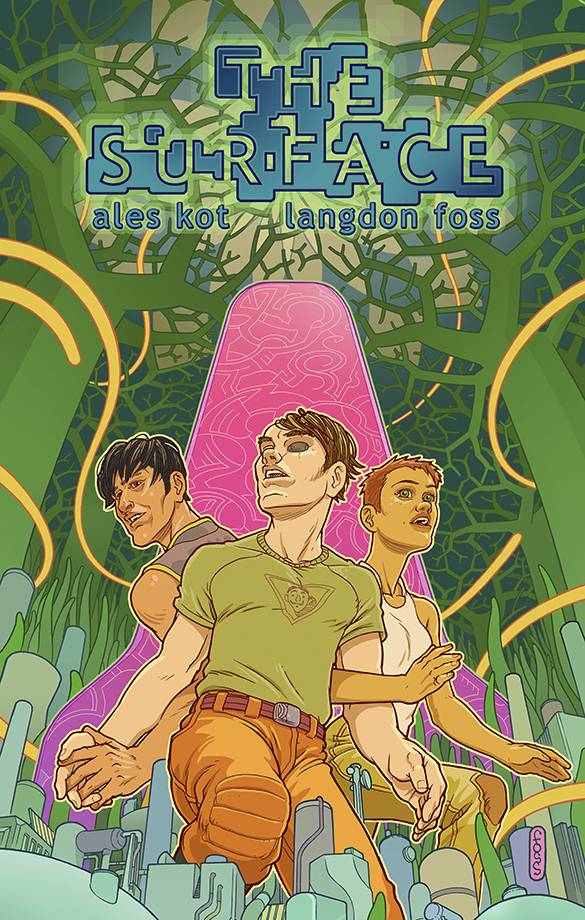 Drew: We tend to disregard authorial intentions around here — not that it’s wrong to care about what an artist meant, we just tend to be more interested in what the audience experiences. The Surface 2 continues to force us to confront not only how an artist relates to their work, but how that work relates back to the artist. Continuing writer Ales Kot’s philosophical riffing on psychomagic, this issue finds our heroes in the phantasmagorical world of the Surface, where every memory and desire is seemingly made real. That’s a strikingly literal translation of Kot’s psychomagic, but he adds another wrinkle, as Nasia’s visit to the “giant dick” in the jungle allows her to communicate with fictional author Robert Doublehead, who may be writing the story we’re reading. That we can’t tell the difference between the story and what might be a story within that story might be the point of including Doublehead, but forcing us to confront the writer leaves me with fewer conclusions about my experience as a reader. I know I’m fascinated by it, but I’m not sure I can say much else.
ODY-C 4:
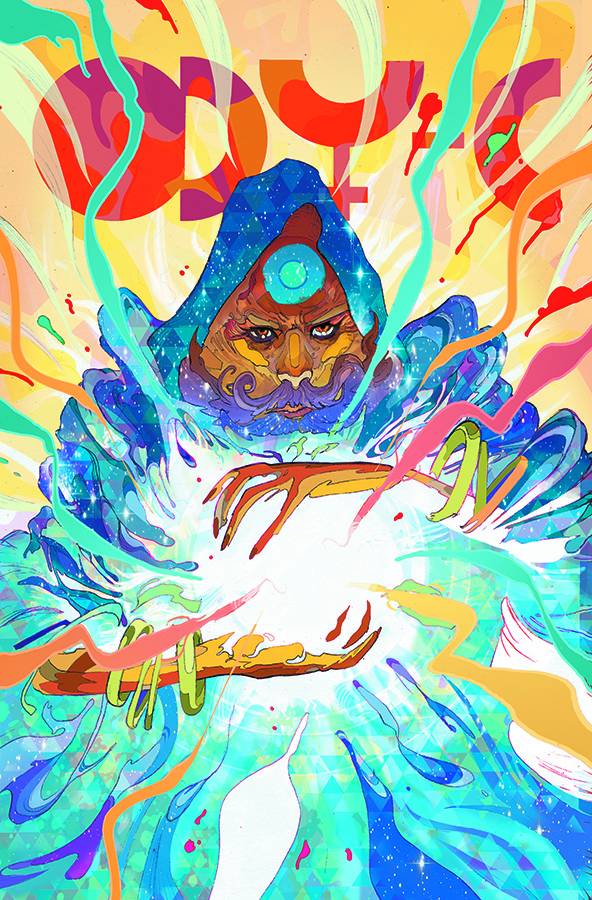 Drew: What is it we look for in an adaptation? This is the question I keep returning to with ODY-C, Matt Fraction and Christian Ward’s riff on The Odyssey, as it continues to swirl cryptically around its source material. Issue 4 delivers some of the most straightforward parallels, as Odyssia and her crew escape the cave of the Cyclops, but also piles on a whole slew of gruesome images, not the least of which details the makeup of the Cyclops’ vomit after consuming much of Odyssia’s crew. Ward doesn’t shy from making those images truly horrific, relishing every crimson and purple he can coat the Cyclops in. It’s gnarly stuff, made all the harder to stomach by Fraction’s interpretations of Homer’s text (and the various translations he’s transcribed in the backs of each issue). I’m still struggling with Fraction’s affectation of telling the story almost all in captions, but the moments when he doesn’t reveals a great deal about who might be telling this story and why. Like most of my favorite series, ODY-C celebrates that it is a story, even if that means it behaves like no other story I’ve ever read.
Descender 2:
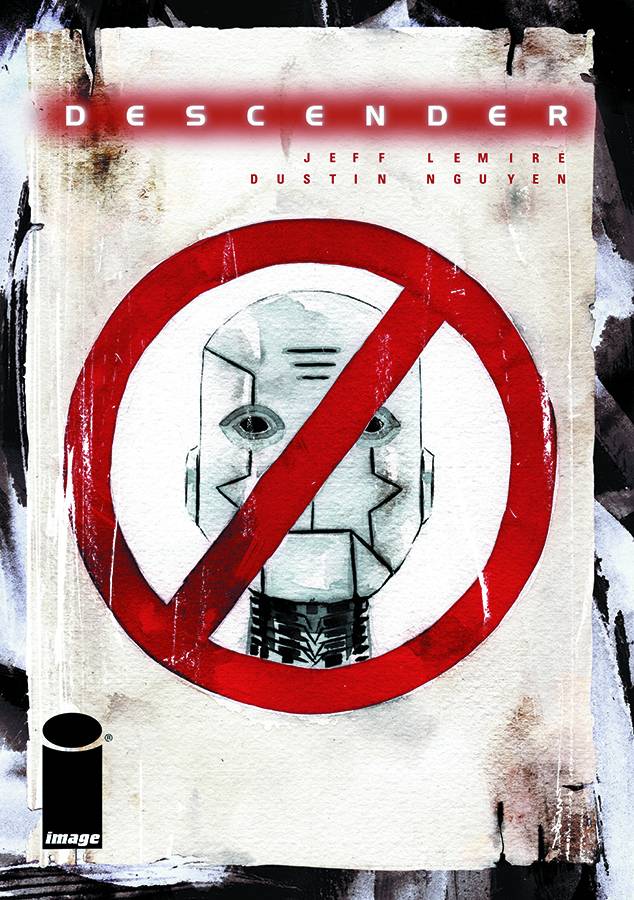 Spencer: What does it mean to be alive? Early in Descender 2, Tim-21’s creator, Dr. Jin Quon, tells the tiny robot that he’s not alive, but the rest of the issue seems to argue otherwise. Flashbacks of Tim’s life depict his transformation from a Tabula Rasa to a being that genuinely loves his human family and has been accepted as one of them, and if love doesn’t equal life, then what does? These flashbacks also makes the present-day sequence, where Tim’s pursued by bounty hunters, all the more tragic. While Jeff Lemire and Dustin Nguyen don’t hesitate to remind us of Tim-21’s robotic nature and the power inherent in it (he actually kills two of his attackers), we’re still seeing what amounts to a child chased by monstrous, murderous creatures. How could anyone not feel for him? I can’t help but to see this issue as a cry for compassion, empathy, and understanding; it’s easy to persecute “others” (like how Descender‘s populous has essentially instigated a robotic genocide) when they’re simply a faceless threat, but getting to know them as individuals with their own feelings and personalities can turn that dynamic on its head.
Needless to say, I found this to be another emotionally effective, gorgeous issue (even if there were one or two moments when I had trouble following the storytelling — there’s a scene where Tim-21 saves his “brother’s” life, but I have no idea from what) — how about you, Patrick?
Patrick: Oh yeah – it might be tough to follow those flashback and understand the incident in them verbatim, but I suppose that’s the price you pay for 10 panel-divider-less pages full of emotionally resonant imagery. In fact, I think it only goes toward humanizing Tim even further. The text on the bottom of the page shows what percentage of this memory back-up is complete, reminding the reader that Tim’s a robot and these images are just 1s and 0s being stored in the cloud. But, like human memories, these aren’t crystal clear recollections of every single detail. The memories are a jumble of sleepovers and Mom and Trinket Tocket and his Tin Rocket. All of that is so beautiful that it’s kind of startling when the Driller comes to life and eliminates Tim’s attackers.
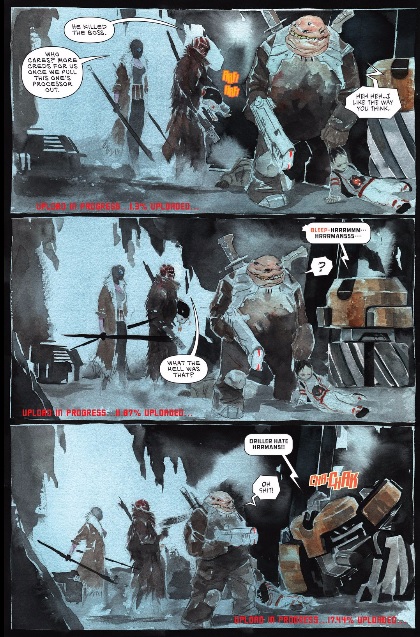
It’s such an alarming turn, and it comes out of nowhere – Nguyen has that machine resting in the background the whole page and it’s not a threat until it’s ready to be a threat.
Darth Vader 4:
Get away from her, you bitch.
Ellen Ripley, Aliens
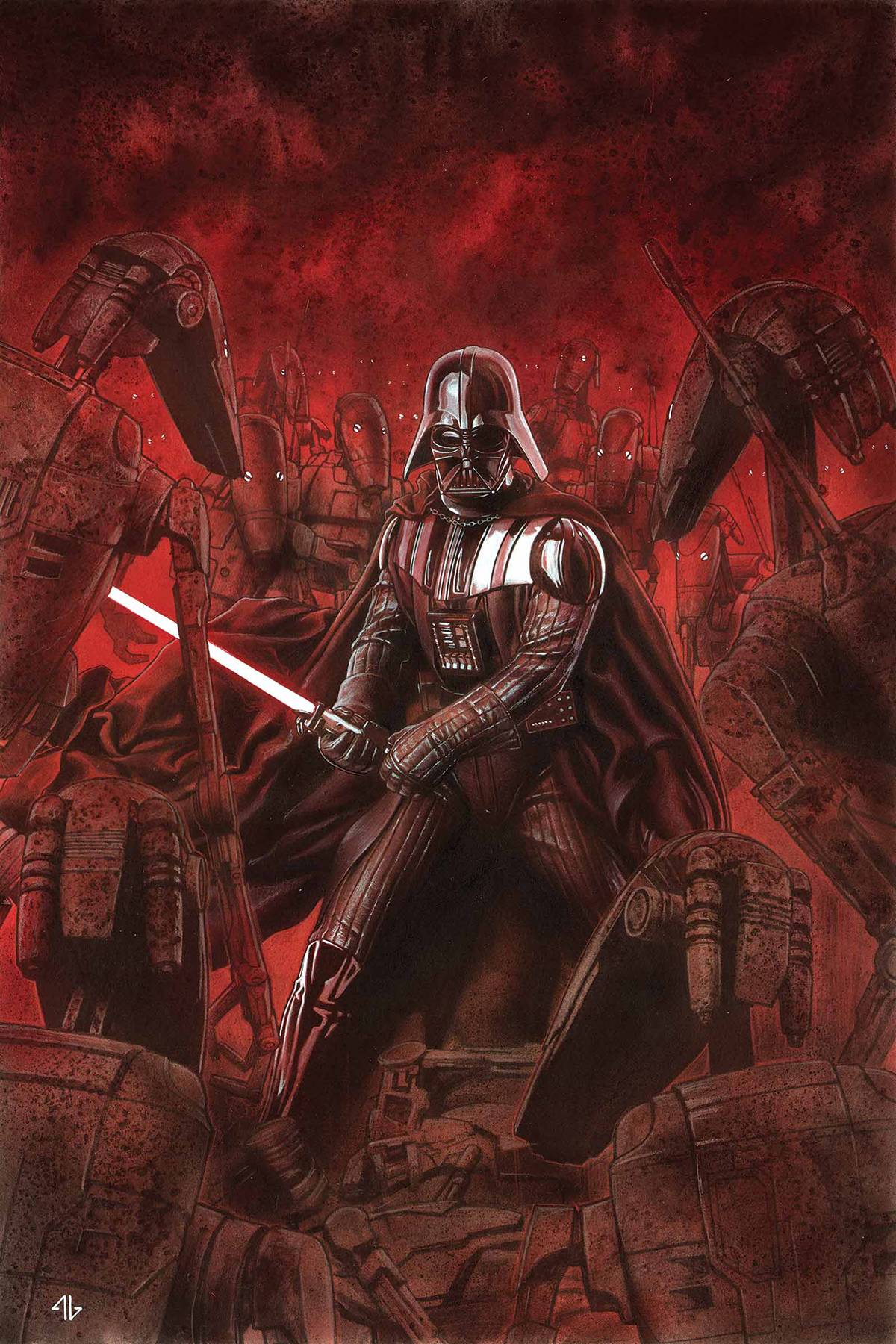 Drew: Kieron Gillen has mined a surprising amount of fun from presenting twisted re-imaginings from classic action movies, from Raiders of the Lost Ark to Star Wars itself in Darth Vader, but issue 4 may have hit the point of diminishing returns. Gender-swapping the climactic fight from Aliens seems like a great idea, but it necessarily loses the maternal overtones that make that scene so strong. That leaves the issue without any real stakes for Vader, aside from the quick flashback to Attack of the Clones, which isn’t the best totem of emotional investment. We get stakes aplenty by the issues end, as Vader discovers a target just as he comes into the possession of a newly minted droid army, but this issue left me feeling largely nonplussed. Patrick, I know the connections to the prequels have worked a bit better for you (or, at least, you’ve managed to push past the initial distaste to accept them for what they are), so I’m curious if you found more meaning in all of this Genosis business. Is Vader stealing that egg-sac supposed to somehow represent his relationship with Padme, or what?
Patrick: I think it speaks to his general lack of reverence for and understanding of love and reproduction. Plus, it does keep with the theme of mothers dying giving birth to children. Again, that means taking emotional cues from the prequels, but I maintain that there’s nothing inherently wrong with the information we got in those movies. That information is presented to us poorly, that’s all. Let’s throw that flashback to Attack of the Clones up here so we can talk about it.
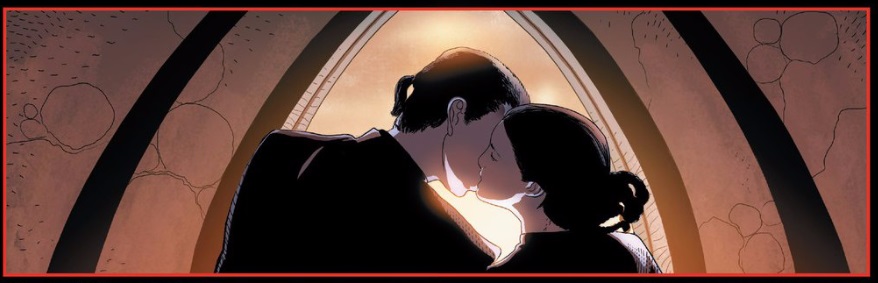
That’s a great image, and the fuzzier your memory of that movie, the better the emotional associations you can make with it. Look, it doesn’t matter how bad that CGI tiger-spider thing looked when I saw this flick a dozen years ago, in this moment, I’m remembering that this was two kids being sent into an arena to die. That Vader insists that we “cease […] probing” speaks to this point even further – the image is strong enough to elicit a response.
Spider-Woman 6:
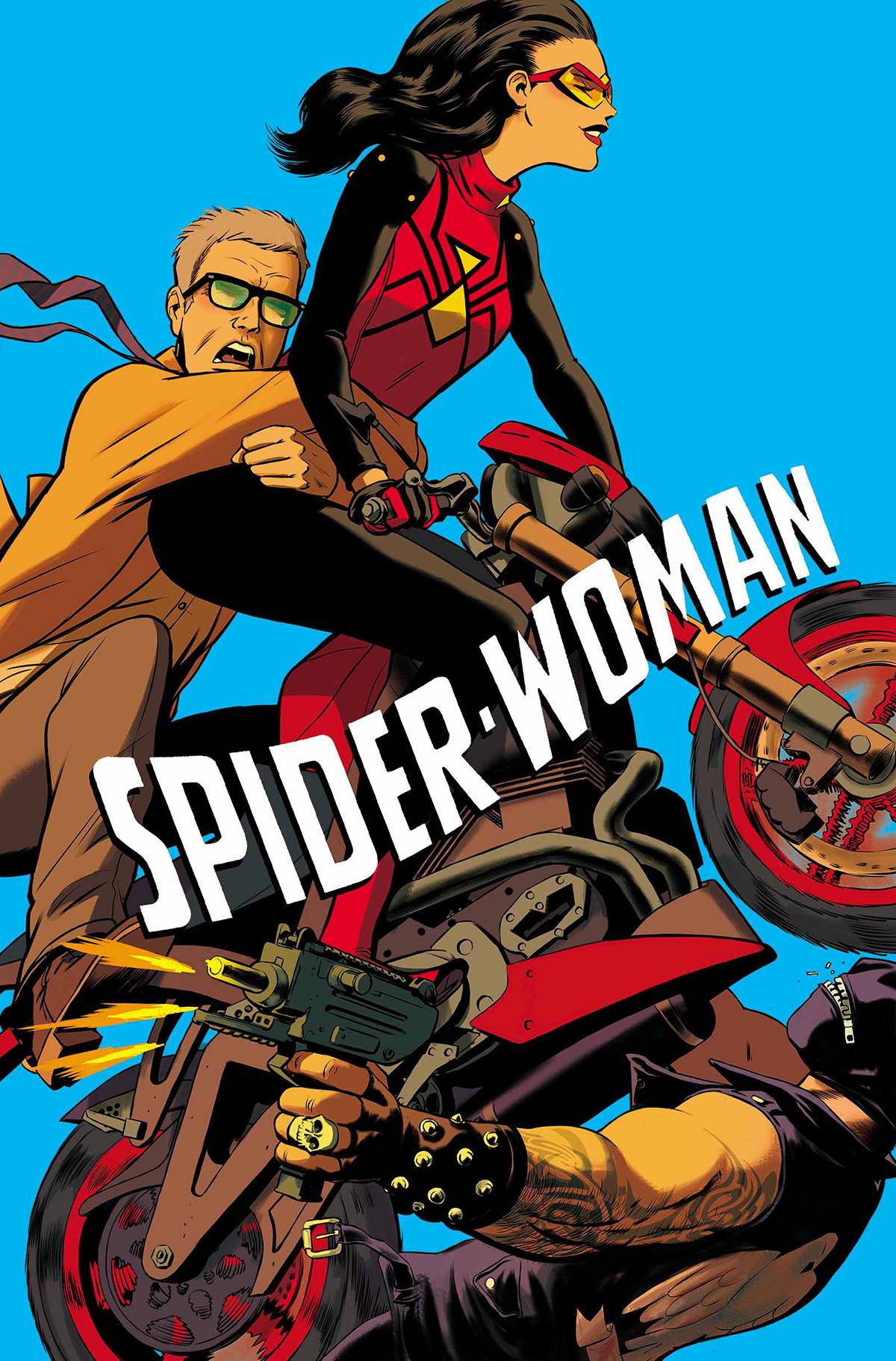 Spencer: There’s always been a weird contradiction at the heart of Jessica Drew — raised as a spy, she’s a top-notch strategist and infiltrator, but since she was also raised in isolation, she’s socially awkward and often a bit naive. These seemingly conflicting traits could easily trip up a writer, leading to a situation where Jess is either too “normal” or too naive. The latter’s a trap Dennis Hopeless nearly falls prey to in Spider-Woman 6 (when Jess almost blunders into an obvious trap), but fortunately, Hopeless easily makes up for this not only via Jess’s natural charm and humor, but by showing how Jessica’s temper and stubborn streak often get the better of her. It’s very human, and Spider-Woman‘s vastly relatable central character and intriguing mystery alone make it a title worth reading — still, Javier Rodriguez’s art and colors have a lot to do with what makes this book so fun. As always, I love his intuitive layouts and energetic action scenes, but this month I think my favorite touches are the silly designs and humorous touches Rodriguez throws in.
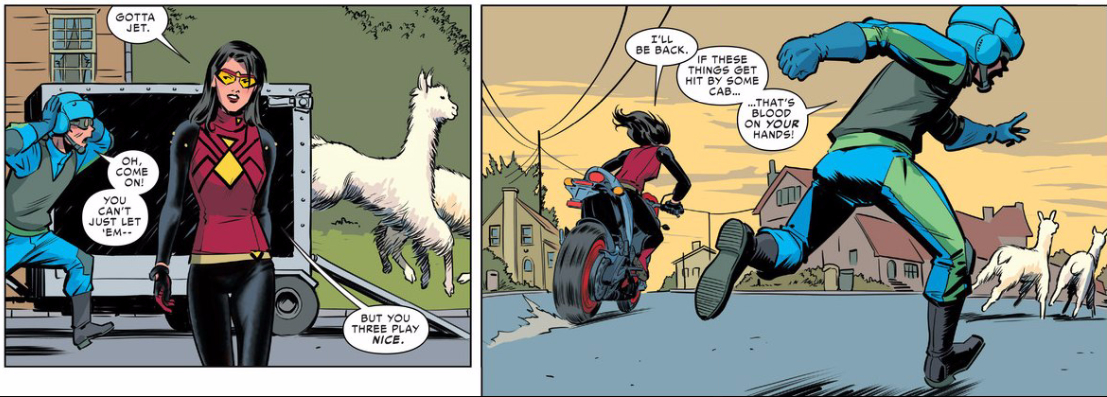
Look at those lil’ Alpacas run!
Ant-Man 4:
 Patrick: Darkness is a necessary feature in joke-based superhero comics. We’ve seen this pretty stunningly realized in Nick Spencer’ Superior Foes of Spider-Man, and Ant-Man is usually exemplary in that maintaining that balance. Issue four has a slightly more tenuous grasp on that golden tone, with much of that necessary darkness swirling around a “do this thing or I’ll murder you and two children” hostage situation. I don’t know if a series leaning on “Tricky” jokes should really be trading on material that’s quite so dark. The business with Machinesmith asking for a job and Scott being pre-occupied with the specifics of running a small business are all so delightfully accessible, it’s kind of a bummer to have this Saw-esque situation playing out in the background. Plus Augustine gets really chatty, which might clearly establish his motivation, but it sure does start this thing off with some weird pacing a tone that’s a smidge too dark for me.
Spencer: Yeah, my biggest problem with this issue is Augustine’s chattiness — I actually really like the manic, happily insane voice Spencer gives him, but it takes him so long to get around to his points that most readers will have figured out what he’s going to say a page or two before he actually says it. Other than that, I don’t really have a problem with the contrasting tones, at least not until the last page or two.
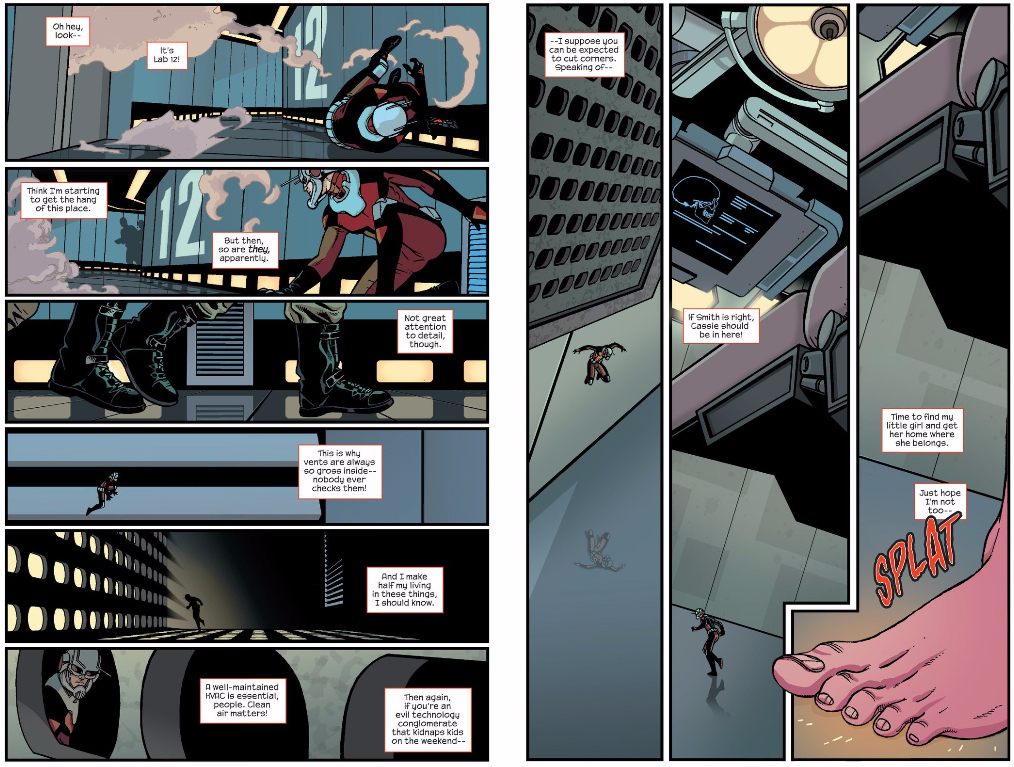
As I’ve come to expect from this title, Scott’s monologue is a hilarious look into the trials of traveling through air vents (which shows an insightful understanding of Ant-Man’s skill set on Spencer’s part), but Scott’s almost chipper attitude and the silly gag that ends the second page both feel out of place when you take into consideration that the cliffhanger on the next page involves Cassie’s heart being transplanted against her will. In many ways this is a very funny issue, but I think this is the point where the jokes start to feel inappropriate to me.
Spencer’s too funny a writer to cut the humor out of this book completely, but I do hope Scott’s confrontation with Cross next issue is played more straight. Maybe Grizzly or Machinesmith can provide comic relief in a B-Plot, but Scott and Cassie’s relationship is the heart of this title, and even if every other element of Ant-Man is mined for jokes, the danger Cassie is in needs to be taken seriously.
The conversation doesn’t stop there, because you certainly read something that we didn’t. What do you wanna talk about from this week?
 Retcon Punch
Ant-Man: I don’t know how it happened or when, but somewhere along the line I’ve started reading Grizzly’s dialogue in the voice of Teddy from “Bob’s Burgers”
That’s perfect. I’ve been giving him kind of a gruff voice, and then backing away from it every issue. Like I start with a very clear idea of who he is and then something in the text negates it. Teddy might be the key here.
Hey, so I’ve seen people bring up the “voices” they read certain characters in, but this is generally not something I do. Do people have voices for every character they read, or is it just certain ones that seem to warrant really specific casting?
Not every character. I do find that i have voices that end up popping up for specific writers. I’m certain I use the same voice for Ant-Man as I did for Boomerang (for example). But it’s by no means a requirement for me to have developed a voice, it just happens some times.
Yeah, I generally don’t “cast” voices for characters, they just kind of naturally develop. It doesn’t happen for every character and most of them aren’t based off people or actors I know, but there’s, for example, a very specific voice I have for Wally West that just developed after reading his comics for ages.
Sometimes other adaptations slip in too. I’ve heard Kevin Conroy and Arleen Sorkin as Batman and Harley Quinn on more than one occasion, though it tends to happen when the characters are really well written.
Actually, I often use whether or not I can “hear” the usual voice I have for a character when I’m reading them as a test as to whether they’re being written properly or not.