

Today, Shelby and Mark are discussing Mad Max: Fury Road: Nux and Immortan Joe 1, originally released May 20th, 2015.

Shelby: I’ve always liked the Mad Max franchise. I saw Beyond the Thunderdome first, and I remember being startled by the bleakness of the first movie in comparison to that pageantry. When I saw Fury Road, I realized it was a combination of the bleakness of the first movie and the nonsense of the third, and I loved it. When Patrick asked, “If you love it so much, why don’t you…write a post on the forthcoming comic book?” I obviously said yes, especially when I saw the first issue was written about the villain Immortan Joe. Everyone knows I’m a sucker for a complex villain, and I couldn’t wait to see if this monster was ever anything more than that. I reference the movie a lot below, so if you haven’t seen it yet, here there be spoilers.
This is the story of Nux and Immortan Joe. Told as a history lesson by a man who has what little written word left to the world tattooed over every inch of his body, the story begins first with Nux as a baby. His parents doted on him, his father promising to one day get his family “up there” to the top of the citadel. That goes about as well as you’d suspect, and our intrepid infant found himself clinging to the lift into the citadel; the kid’s no dummy, he knows how “up there” works. The henchmen manning the lift made sport of it, wondering how long it would take the child to let go, but as he clung on the chants of the watching War Boys turned from mocking to admiring, then finally to calls of “Witness!” The impressed henchmen yanked him aboard, and from that point he was transformed into the worshipful Nux we all know and love.

Next up is Immortan Joe, known as Colonel Joe Moore in his younger days. War hero turned vigilante turned cold-hearted monster, he and his crew roamed the wasteland, killing the weak and taking the strong and the women for themselves. They get wind of the citadel and its massive store of water, and lay siege. After failing to take the rock, and with only three days water left, Moore manages to get himself and some men inside. The rest of his men can only watch, helpless below, as the bodies of their comrades are hung from the side of the citadel. After three days, they have no choice but to abandon their presumed dead leader and retreat. Lo and behold, the colonel rose from the ashes on the third day, and the rest pretty much writes itself: Gas Town and the Bullet Farm are established, the Dome is built for Immortan Joe’s wives, he rules over the wasteland as a tyrant, etc.
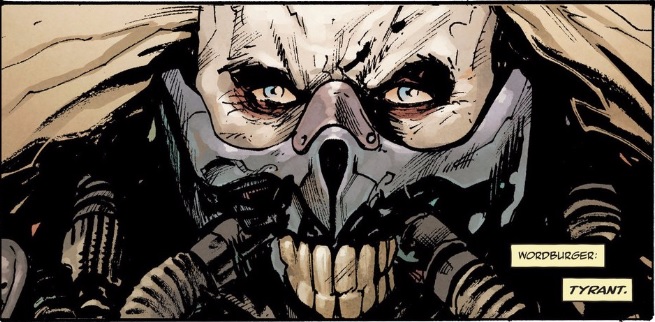
I’ll start with Immortan Joe, as that was the story I was most interested to hear in this book. In the movie, Ol’ Joe is nothing short of a monster, pure and simple; people are objects for him to use. He uses the strong to fuel his war machine, the weak as disposable trash, and women as either baby-making machines or milk machines. I wanted to read this book to see if there was anything more to this character, if he was anything more than that monster. Flash Fact: he is not, but I can understand why. The ultimate end goal of the Mad Max universe is survival, and ruthless cruelty is a very efficient ticket toward survival. In a situation like the one the world was facing, there’s a fine line between a strong leader and a tyrant, and to the lost and desperate it might not matter what side of that line their leader falls on. Not at first, anyway.
As badly as I wanted some insight into Immortan Joe, it was Nux’s story that really drew me into this book. In the movie, it did not take much at all for him to switch sides; my theory was that since there was no love and compassion in his life, that it didn’t take much of it to get through to him. It’s actually far more complicated; he once knew actual, real love, he just had to replace it with fanatic, idol-worshiping love. There’s an awesome comparison between the lives of these two men. On the one hand, Nux, whose parents loved him and would do anything for him, anything to give him something more than what they had. They wanted him to not just survive, but to really live. On the other hand, Joe Moore, a man who fought tooth and nail to get what was needed to survive, going so far as “returning from the dead” to get it. And yet, the only love in his life is derived from fear and oppression. Nux’s parents had less than nothing, but they loved their son; Immortan Joe has everything in the world, except the son he wants to actually love.
After I saw Fury Road, the one thing I wanted more of was time with that universe, with those characters. That’s what George Miller is giving us here; he’s taken these characters that already felt fleshed out and whole in the movie and showing us why they felt that way. He showed us the end result of these characters in the theater, and now we get to see what made them the way they were. As horrible as the Mad Max universe is, I’m super pumped that I got to spend some more time with it. Mark, what did you think of the comic? Patrick mentioned to me you LOVED the movie, did you think the issue enhanced your opinion of these characters at all? Are you as stupid excited for the Furiosa book like I am?
Mark: In his conversations with François Truffaut, Alfred Hitchcock talks about the problem with “ghost ship” stories. You know, where a mystery ship comes ashore with all of the crew and passengers missing? Hitchcock talks about the problem with those stories being that the answers provided by the narrative are never as interesting or satisfying as what we have built up in our head.
I really do love Fury Road. I love how it drops its audience into a fully formed world, but doesn’t feel the need to explain everything. Like the swamp stilt guys. I love those guys! Sure, part of me is super curious about what their deal is, but really I’m happy to not have an explanation. The unexplained stories at the periphery of the world make it feel that much more complete.

So while I’m all for having the chance to spend more time in the Mad Max universe, I wouldn’t say either of these stories enhanced my appreciation for the movie or its characters. There’s nothing wrong with them, but of all the things I wanted more of from Fury Road I didn’t need more back story. Take Immortan Joe, for instance. He has such a strong presence in the film, and we know everything we need to know about him. While the comic does provide him with a bit of an origin, I found it disappointing that the origin is so normal. Again, it tracks and all makes sense, but it pales in comparison to the unknown.
The same goes for Nux’s story, although I found his more interesting and less rote. I think that’s partly because it exists in the world of the movie in a way that Immortan’s didn’t really. It’s not trying to tell us where the Warboys originated or why they look the way they look or anything like that. Remove the storyteller’s narration and it’s almost just another inexplicable vignette in a movie full of them.
I’m not really looking forward to the Furiosa issue or really any additional issues set in the Fury Road universe, but I’m not opposed to them. Having backstory for these characters doesn’t diminish my enjoyment of the Mad Max universe. They’re not bad, just unnecessary.
For a complete list of what we’re reading, head on over to our Pull List page. Whenever possible, buy your comics from your local mom and pop comic bookstore. If you want to rock digital copies, head on over to Comixology and download issues there. There’s no need to pirate, right?
 Retcon Punch
Put me down as another one who loved the movie.
I didn’t really need the backstory for either character, but I appreciated the insight into how Immortan Joe built his empire and where all his servants came from and how intense, exactly, his search for a perfect son was. So I don’t regret checking this one out at all.
Yeah, I liked seeing how elements of the movie came to be. The start of the “bloodbag” method was the one that resonated the most; I didn’t NEED any background info on the practice, I get it, but it was cool to see it’s origin as a necessity in the heat of the battle for the citadel.
I really loved the art in this issue. The Nux piece in particular reminded me of Eduardo Risso — I had to double check that it wasn’t.
Who normally colors Risso? That’s how the Nux story felt the most Risso-y to me – that flat flat flat coloring.
Interesting. I see what you mean — not a lot of highlights, shadows, or modeling — but I actually notice the gradients the most in Risso’s stuff (and here).
I didn’t get a chance to talk about it, but I loved the history man with the tattoos. It’s like he’s somehow a living embodiment of oral history.
“I love how it drops its audience into a fully formed world, but doesn’t feel the need to explain everything. Like the swamp stilt guys. I love those guys! Sure, part of me is super curious about what their deal is, but really I’m happy to not have an explanation.”
I second this point. One thing I really liked was the emphasis on the story and letting the weird be out there, many times for the sake of being weird. The unanswered questions are better than exposition in this type of movie. (Are you listening, nearly every superhero movie franchise over the past fifty years?)