
Today, Patrick, Spencer and Drew discuss E is for Extinction 1, Age of Ultron vs. Marvel Zombies 1, Infinity Gauntlet 2, Planet Hulk 2, M.O.D.O.K. Assassin 2, X-Men ’92 Infinite Comics 3, Black Widow 18 and Loki: Agent of Asgard 15

Patrick: How do you tell an alternate-reality version of a story? What elements of the original do you need to keep and which do you need to invert? How different is too different? How samey is too samey? Secret Wars is starting to show the full depth of its commitment playing with concepts that we’ve become so comfortable with over the years. Maybe now it’s cool to be a mutant. Maybe now M.O.D.O.K. stands for Mental Organism Designed Only for Kissing. More than simple re-imaginings, Secret Wars gets to explore some truly re-invented and re-conceptualized worlds.
E is for Extinction 1
 Patrick: God, if there’s one thing the Chris Burnham (writer) / Ian Bertram (cover artist) / Ramon Villalobos (penciler) puffy, sweaty art style can communicate better than anything else it is fragile lumpiness of human aging. Er… mutant aging, as the case may be. E is for Extinction posit’s a corner of Battleworld, appropriately called Mutopia, in which mutants are no longer pariahs, but aspirational figures for homo sapiens. It’s a fascinating evolution of the mutant / human dynamic, which feels immediately recognizable as a analogue for the proliferation of (and mainstream co-opting of) black culture or gay culture. Suddenly, it’s not only acceptable to be a mutant, but desirable. Human beings are going to mutant doctors to make sure that their children are born with their x-genes fully expressed. That’s a cool world for Magneto and his X-Men to inhabit, but when Burnham pulls back the curtain, it’s clear that not all of our heroes are adapting to this new world so well. Scott, Emma and Logan are all old and pathetic, their powers waning as though rejecting them for not evolving with the zeitgeist. They’re relics of an era that has long-since passed, and Scott’s greatest personal achievement in this issue is using his mutant power to change the channel on the TV.
I love the artwork in this issue – not only is it unspeakably beautiful, but that aforementioned style is the perfect fit for a story about the game leaving old men behind. Villalobos’ pencils evoke that same combination of ambitious, fragile and ugly that Nick Pitarra taps in Manhattan Projects.

All you need to do to make Cyclops look lame is draw the zipper on his yellow shorts.
Spencer, there’s also just a ton of cool small tweeks to the x-mythology — such as that opening tease to (what I believe to be) Xavier shooting himself in the head to stop Cassandra Nova from… doing something… Or, if that’s not mysterious enough for you, how about that last-page reveal of Xorn?
Spencer: Patrick, that shot of Xavier killing himself is essentially straight out of Grant Morrison’s New X-Men run. In a way, this entire series is a follow-up to that run, an answer to the question “What if Xavier had succeeded in stopping Cassandra Nova by killing himself instead of failing?” The Xorn reveal takes on a whole extra meaning in that context — while it was later retconned, during Morrison’s run Xorn was eventually revealed to be Magneto in disguise, infiltrating Xavier’s school. How can Magneto and Xorn coexist? Maybe Burnham’s just working with the retcons that later established Xorn as his own character — but maybe not. I’m certainly suspicious.
It was also great seeing a lot of the supporting cast from Morrison’s run — especially Beak and Angel. I really can’t tell what’s going on with them — whether they’re in an open relationship, whether they’ve broken up and are just working/raising their kids together, or whether they’re still together and Beak’s just looking for some side action — but I look forward to figuring it out.
If it isn’t already obvious, the biggest draw of this series for me is the nostalgia factor. It’s great revisiting old friends from a past era, but fortunately, Burnham and Villalobos also infuse the book with more than enough new tweaks and ideas to allow it to stand on its own. E is for Extinction is as complex and challenging (yet rewarding) as its inspiration without ever feeling like a rip-off; that’s a success to me.
Age of Ultron vs. Marvel Zombies 1
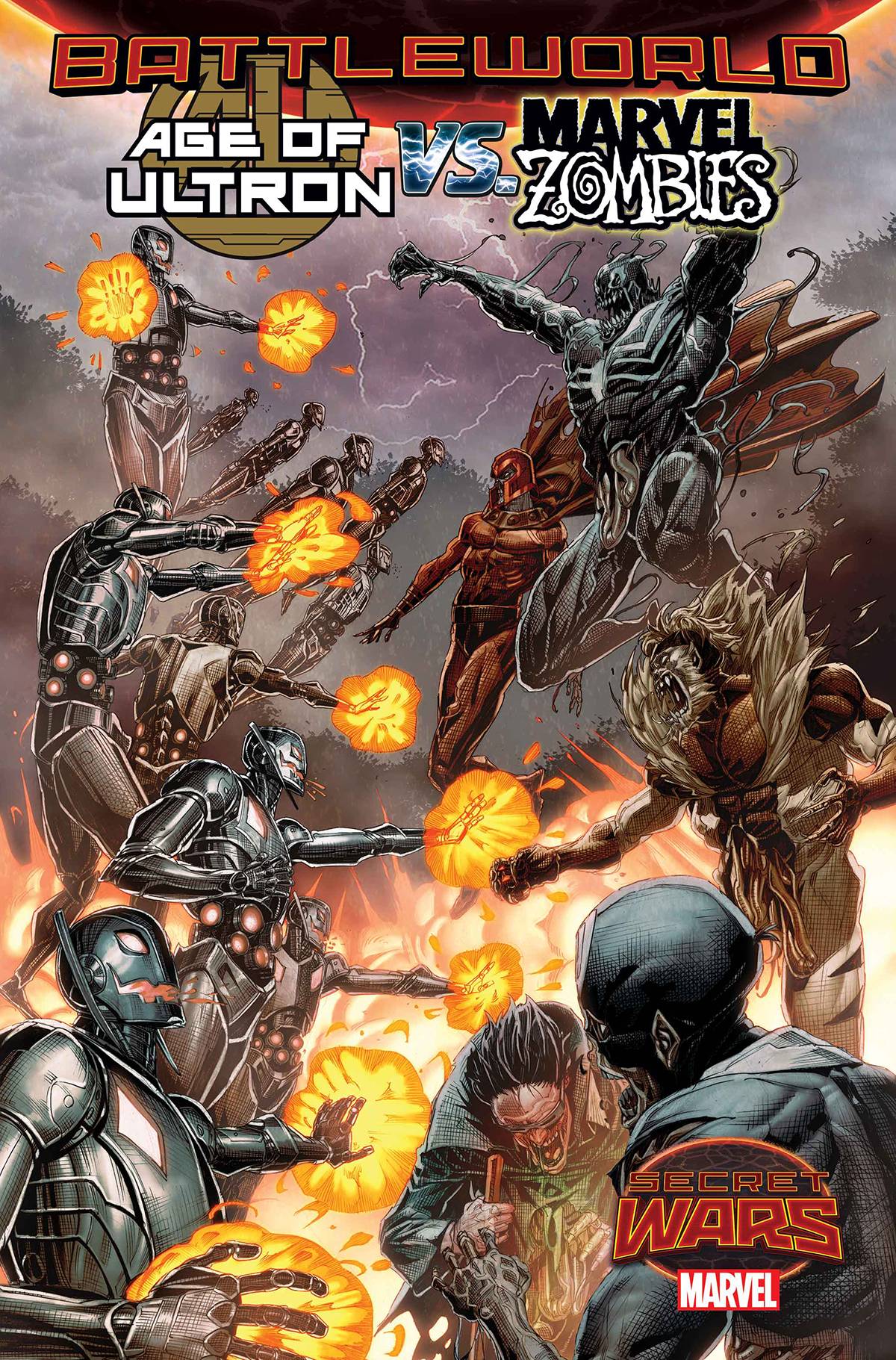 Patrick: Classic conundrum: artist Steve Pugh is on my Always Read list (between his excellent run on Animal Man as his turn writing the surprisingly fun and touching Convergence: Harley Quinn); but writer James Robinson is on my Always Pick Up One Issue Before Remembering That I Don’t Like His Writing list. Robinson’s worst instincts are on display throughout this issue: continuity-obsessed voice-over narration; an over-reliance on contractions (some of which I’m convinced are either punctuated incorrectly or simply the wrong contraction) and; a strange sense of narrative and conversational cause and effect. The biggest sin the issue commits is bothering to explain why there was a timeline full of Ultrons in the first place – head’s up: that’s not a hypothetical scenario that needs to be explained. Plus, that needless backstory burns a Pugh two-page splash on Ultrons defeating the Avengers. It’s imagery that we were inundated with during the run-up to the release of Avengers: Age of Ultron — which itself isn’t that bad — but that kind of large scale brawlin’ doesn’t play to Pugh’s strengths. It’s the Zombie side of the titular equation that brings out Pugh’s well-honed talent for stomach-churning gore.
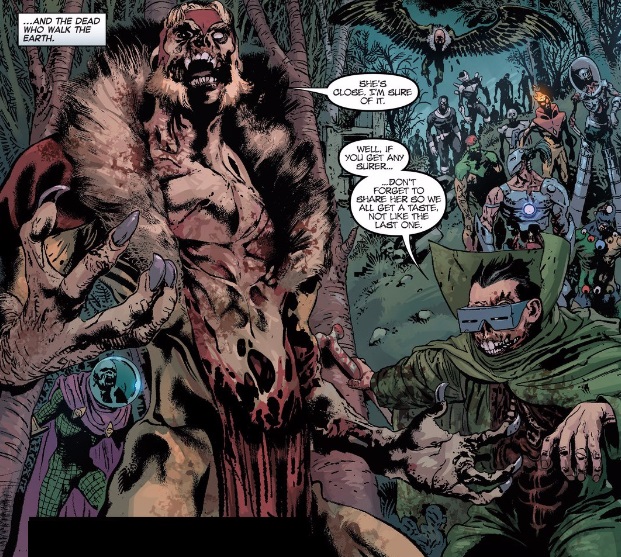
Zombie Sabertooth! Zombie Mole Man! Zombie Stilt-Man! If only Pugh could just draw the flesh dripping off their bodies for 20 pages, I’d be a happy camper.
Infinity Gauntlet 2
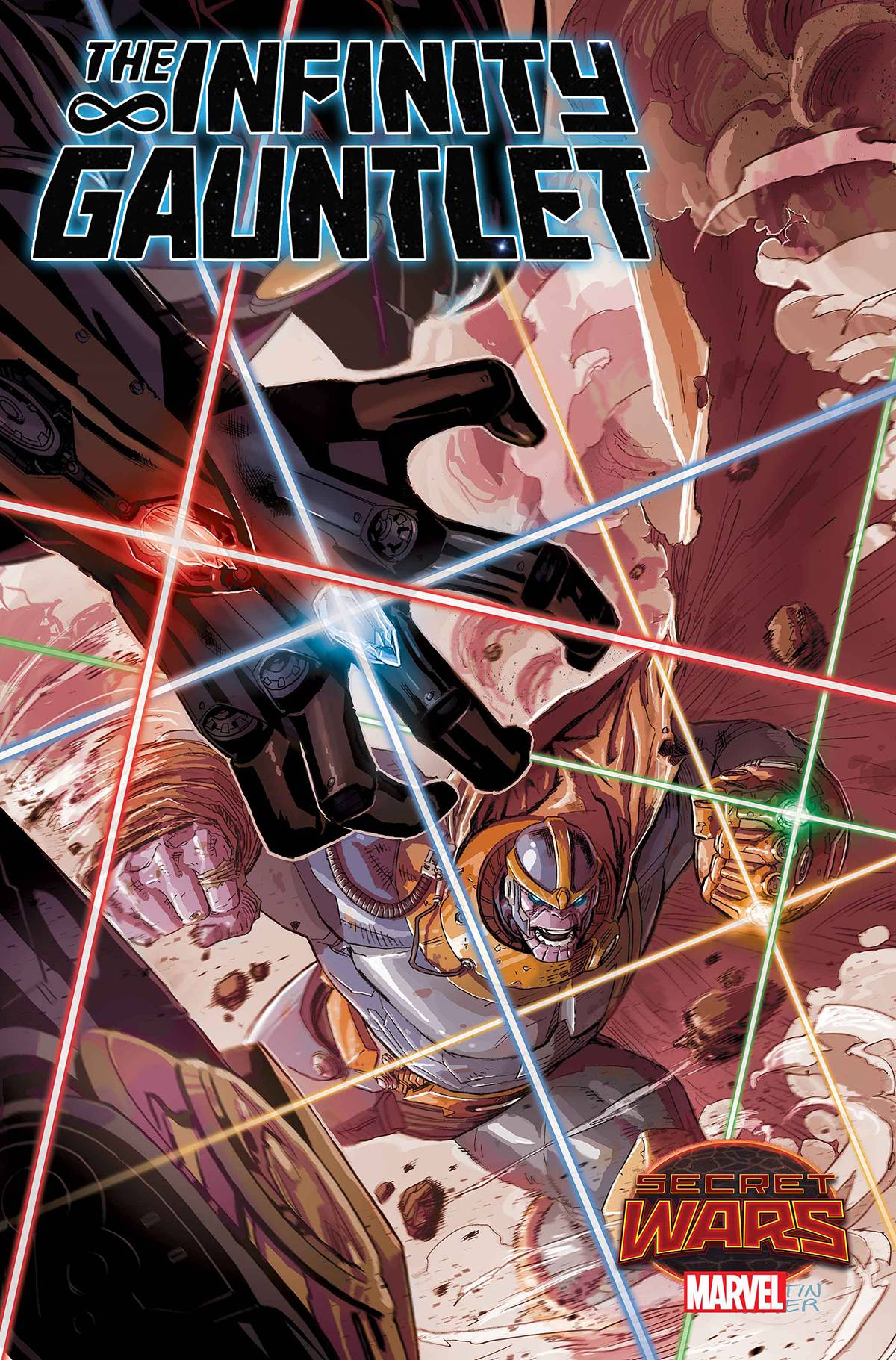 Drew: If you were ever looking for the value of committing to a single perspective, you need look no further than Infinity Gauntlet 2. That’s both a compliment and a criticism, as the issue is incredibly strong when sticking to Anwen’s subjectivity, but totally aimless when it drifts away from her family. I’m straight up confused as to how the Guardians of the Galaxy and Thanos fit in to their story, and while I’m confident that writer Gerry Duggan will pull it all together in the end, it’s a jarring contrast to the crystal clarity of Anwen’s family adventure. We get a quick sense of the family dynamic, watching long-simmering fights start to boil over, and witnessing two young women asserting their independence from a frightful father. Plus, there’s a dog in a Nova suit, an idea so deliciously absurd that I couldn’t help but love it.
Patrick: Made all the better by the fact that — right up to the moment that it actually happens — Eve is pretty sure it’s not going to work.
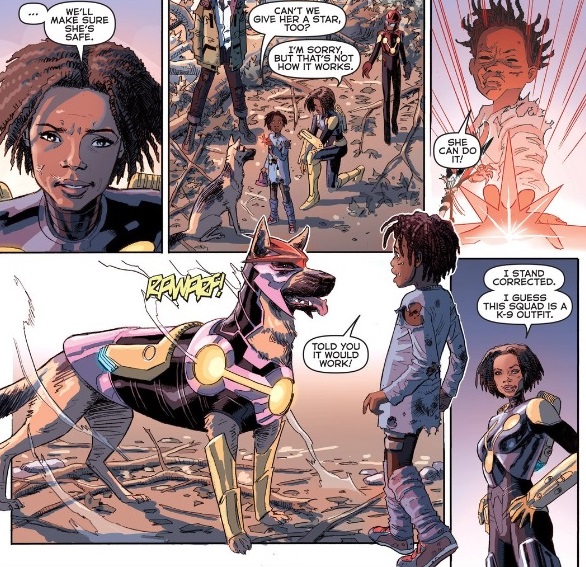
I also like that each family member is color-coded so we can tell them apart at a distance (and adorably, Fawne and and Zigzag are both purple). I’m not quite to the point where the colors automatically line up with the characters, a la Teenage Mutant Ninja Turtles or Power Rangers, but I can already see the benefit of that kind of shorthand.
Drew, I’ll agree that the Guardians bit felt a little off topic — especially when Gramps is maybe still out there — but the “The Future” section that starts with Thanos fighting a mysterious Nova and then teleporting to… the past (?) to kill a a version of himself comes wildly out of nowhere. Still, if what Duggan is setting up is a full-blown crazy cosmic story, but he’s subbing in this normal family for superheroes, that’s pretty rad.
Planet Hulk 2
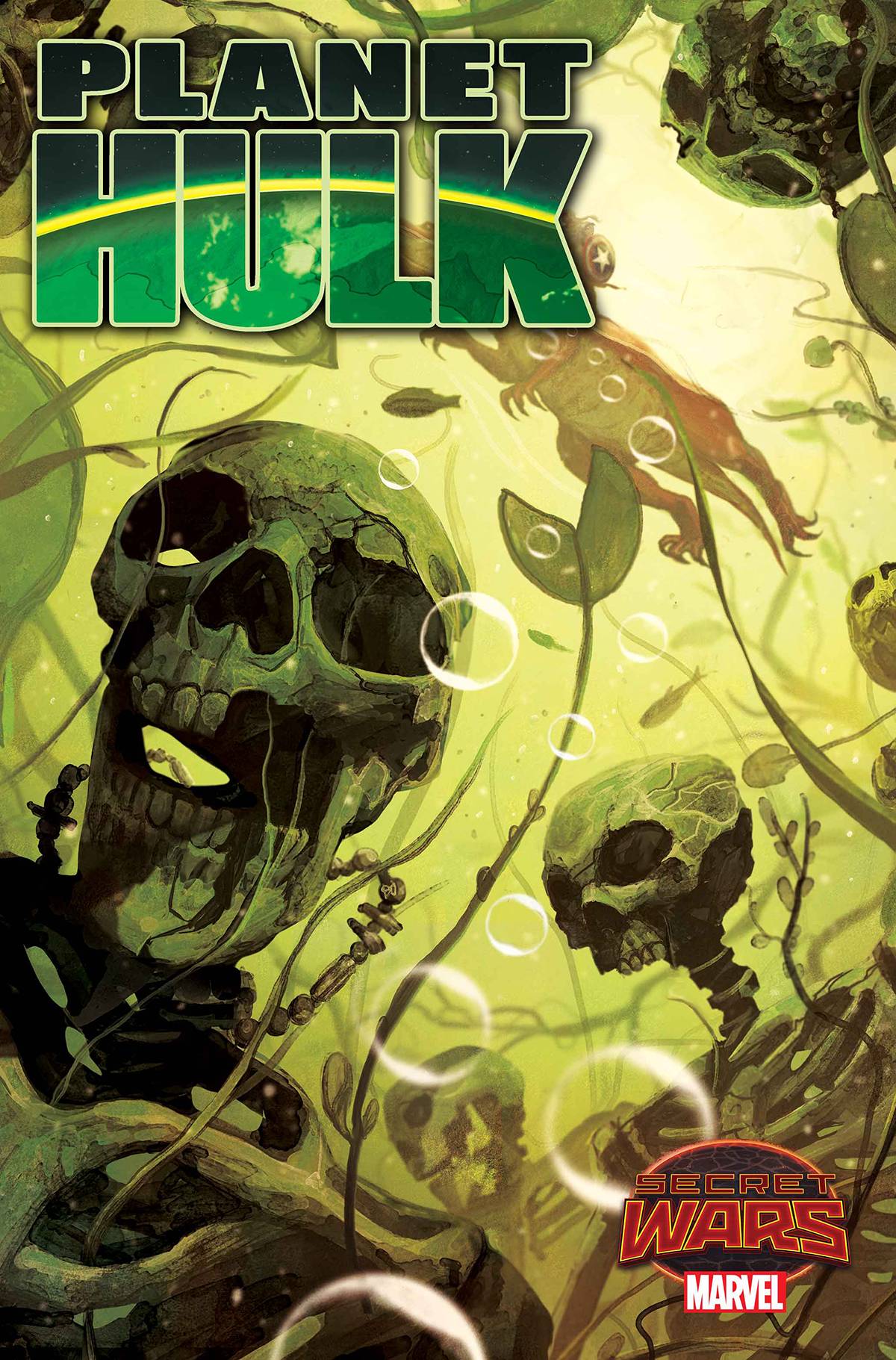 Patrick: You know what I didn’t realize I needed? A team up between a sophisticated Hulk and a barbaric Captain America. The majority of this issue is just these two warped versions of these characters discussing the warped world they find themselves in. It’s a lot of nonsense-on-top-of-other-nonsense, but writer Sam Humphries wisely keeps all of the emotions honest. Even though he’s a barbarian warrior riding a dinosaur named Devil, Steve is still a sweetheart and objects to killing – even gamma irradiated bugs. Banner ends up playing the role of basically any scientist in the face of such moral optimism: the pragmatist. It’s pretty crazy to hear the rational voice of the issue speaking of Doom as though he’s a literal creator god, even though, I know that he is. Again, that’s another warped thing about this world: there actually is a God and the scientists have proof of that fact. And, least any of that feel too heady for you, there’s a fair amount of fighting giant versions of animals. For all the bells and whistles, my favorite has to be Steve’s flashback sequence, which re-imagines his and Bucky’s origin story and flips their power dynamic. Bucky is the go-getter, eager to sign up for the supersoldier program and inspired by the likes of Sam Wilson, seemingly the original Captain America in this world.
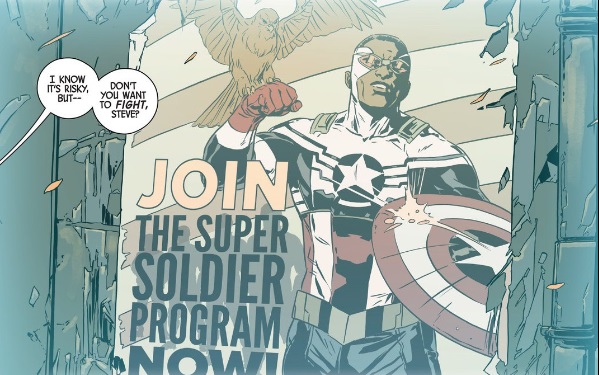
And why the fuck not, right? If we’re reimgining characters, why not reimagine who inspired who? I love the idea of screwing around with the entire concept of a legacy character – it takes the power off some weird platonic ideal of Captain America.
M.O.D.O.K. Assassin 2
 Spencer: There’s just something inherently appealing about the idea of M.O.D.O.K. falling in love — it’s too ridiculous not to love. Maybe that’s why we’ve seen this idea in two different stories this year, but Christopher Yost and Amilcar Pinna’s M.O.D.O.K. Assassin 2 separates itself from the heady Secret Avengers by focusing almost solely on the humor to be found in M.O.D.O.K.’s sudden crush.
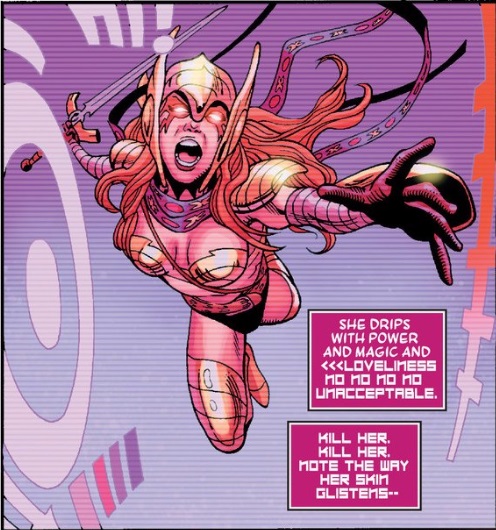
Yet, this crush also works to humanize M.O.D.O.K. There’s a running threat throughout the issue of the Assassins’ Guild, who are out to get revenge for Bullseye’s death. Would we care if they killed the murder-happy machine from issue one? Probably not. But this new, lovestruck M.O.D.O.K.? Yeah, I’d think I’d like to see him come out on top.
Drew: Especially because his story is now wrapped up in the mystery of whatever is happening to Angela-Thor. She was struck by lightning, then couldn’t summon her sword, suggesting that someone with more power than either Angela or M.O.D.O.K. was working to pit these two against one another. It makes their unlikely team-up even more unlikely, but for me, the real fun of this issue lies in M.O.D.O.K. trying to overcome his nature. That’s both an internal struggle — he instinctively counterattacks, even as he tries to clarify that he’s not attacking her — and an external one, as he fights to prove that he might be capable of things he wasn’t “designed only for.” Their partnership is hard-earned in this issue, which makes me all the more excited to see it tested next month, when the entire Assassin’s Guild comes calling. That’s gonna be fun.
X-Men ’92 Infinite Comics 3
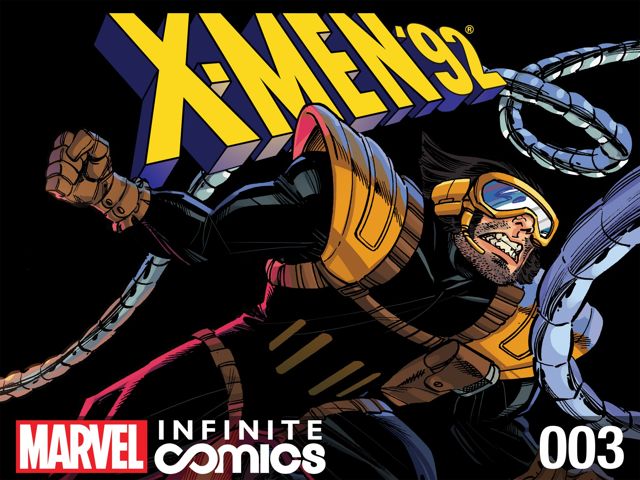 Patrick: I don’t know how this series went from being so sugary and light in its first issue to so being so dire by its third. Cassandra Nova continues her crusade against the idea that the X-Men are somehow morally superior mutants by spending a lot of time in their subconsciousness. For Wolverine, this ends up being a violent fight with different versions of himself, and he’s ultimately defeated when Cassandra turns his claws into a bouquet of roses. The implication is that she was able to change him, but is unsuccessful with someone more willful, like Storm. Slight variations of willfullness notwithstanding, it’s kind of a toothless, actionless issue. Cassandra’s just not a fun foil for the X-Men, who are always most fun playing off of each other.
 Black Widow 18
 Drew: I have to admit to some apprehensions about how Nathan Edmonson and Phil Noto could tie their tightly-conceived series into the universe-spanning event that is Secret Wars. Black Widow 18 proves my concerns wrong, as Natasha is sent on a rescue mission and is reminded of an earlier mission she must atone for. It’s admittedly only tangentially related to the events of Secret Wars, but that’s a smart choice for a series that has otherwise been so much about Natasha’s personal journey.
I’m particularly impressed at how Edmonson slowly pushes the issue of Natasha having to kill her best friend, inching us closer to that inevitable conclusion but never quite giving away the game before that final image. It’s a clever trick that fools us into worrying about the fate of the Comienza family before revealing the true emotional stakes. The fact that Natasha is thinking about this in the midst of her absolution tour suggests that the story probably doesn’t have a happy ending, but I’m fascinated to see what twists it takes between now and then.
Spencer: I think there still might be a bit more coming with the Comienza family than we’ve been led to expect, Drew — there has to be some sort of parallel between the extraction mission Natasha’s taken at the end of the universe and this very first extraction mission of hers. I’m sure you’re right, though, that the big emotional punch here will come from whatever goes down between Natasha and Marina, and what makes that so hard to stomach is how happy Natasha seems with her.
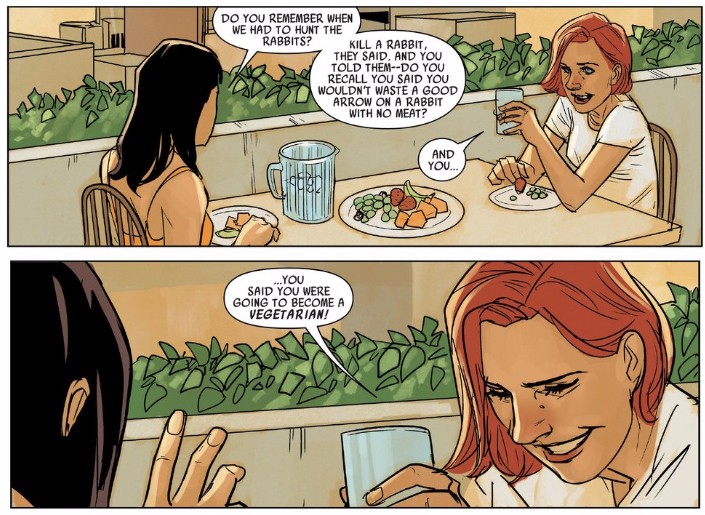
We never see Natasha like this in the present-day. This is a Natasha Romanoff who hasn’t yet become desensitized by her job and the world, who hasn’t yet learned to push people away as a defense mechanism (look how easily she admits that she likes cats compared to how long she kept Liho at a distance). I have a feeling that this mission is a formative moment of Natasha’s life, and probably for the worse. It’s almost certainly going to be hard to watch go down, but maybe we have to go back to the beginning before we can see Natasha’s end.
Loki: Agent of Asgard 15
 Spencer: I’m one of those guys who hoards items when he plays RPGs. I’m always afraid that I’ll use an one-of-a-kind item right before really needing it — sure I could use my Master Ball now, but what it the next legendary is even harder? — but I just end up never using them at all.
That kind of mentality is much easier to combat when you know what lies ahead — and if what lies ahead is the end of the world, well then, pretty much anything goes. That’s the situation Odin, Freyja, and the rest of Asgard’s mightiest find themselves in throughout Al Ewing and Lee Garbett’s Loki: Agent of Asgard 15. Freyja’s (successful) move against King Loki and his world serpent would be unthinkable if they were trying to keep Asgard alive, but knowing that their deaths are inevitable gives these warriors room to take drastic measures. Hell, Odin even uses his “Master Ball,” so to speak.

Meanwhile, Loki, our new Goddess of Stories, seems to have a scheme that equally revolves around the end of all things. We don’t know for sure what her motive is for transforming Verity into a “story” (and removing her soul from her body in the process), but I’d like to think she’s trying to save Verity’s life. Last issue Loki explicitly stated that stories even have a way of surviving the end of the universe, but with the final Incursion at hand, their bodies do not have that chance. Is “The Tale of Loki and Verity Willis” a story that survives the end of everything? I certainly hope so.
Patrick: Well and whether or not that story will survive is kind of secondary to the fact that we’re introduced to the story before we totally understand what Loki has done. The issue opens on “Chapter One,” a brief episode about Verity’s grandfather gifting a truth-seeing ring to his son. There’s even an editor’s note that places these events within the context of the greater Marvel Universe – specifically issue 345 of Thor. That’s a deep cut, going all the way back to July of 1984. The editor’s note is so glib: it actually ends with the phrase “if you’re curious,” like it’s teasing you with this knowledge. That carefree-yet-diligent approach to mythology is all part of what makes stories — and particularly these kinds of stories — feel so meaningful. As we move through Verity’s Story, I love seeing other editorial notes that actually seem to be run through Verity’s own lie detector. The line between storyteller and character is already razor thin, and Ewing is able to emphasize that with each subsequent chapter.
Did you read some Secret Wars tie-ins that we didn’t? Sure you did! There are holes in our pull list. Holes that you’re encouraged to fill with your comments. Let’s keep talking about Secret Wars.
 Retcon Punch