
Look, there are a lot of comics out there. Too many. We can never hope to have in-depth conversations about all of them. But, we sure can round up some of the more noteworthy titles we didn’t get around to from the week. Today, Spencer, Patrick, Drew, and Michael discuss Darth Vader 7, Groot 2, Guardians of the Galaxy Team-Up 7, Unbeatable Squirrel Girl 7, Outcast 10, Jupiter’s Circle 4, Onyx 1, Teenage Mutant Ninja Turtles 47, Action Comics 42, Bizarro 2, The Woods 14, and The Spire 1.

Drew: I used to write questions for a trivia competition, and I was absolutely terrified of questions where you had to say what a list of items (or songs, or people) had in common. Not because they were hard to write, but because it was nearly impossible to make only one answer correct. “Things not in my kitchen” or “people who aren’t me” are obviously wrong, but also technically correct. Trivia players would only put down an answer like this when they couldn’t think of the right answer, but it came up often enough to put me off of writing those kinds of questions. All that is to say, I’m sure there’s a common thread more meaningful to this week’s comics than “comics I didn’t write,” but man, I can’t think of that right answer. Can I still get some points, or what?
Darth Vader 7
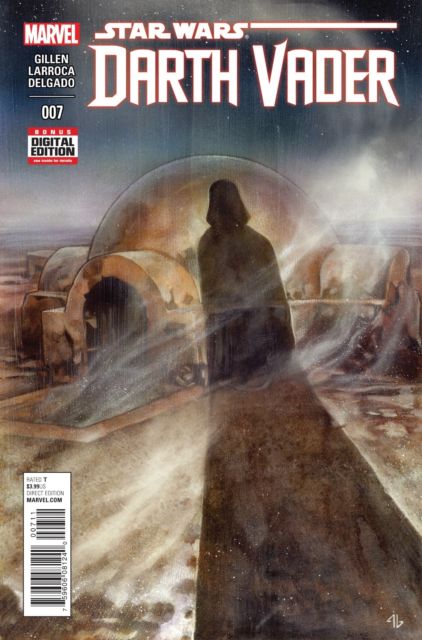 Drew: It can be hard to relate to Darth Vader. I suppose that he’s a Sith lord with a penchant for strangling coworkers to death are the most obvious reasons, but I think the most important one is his mask. Without a face to broadcast his emotions, we’re left only with body language and James Earl Jones’ vocal performance. That works like gangbusters when building up a seemingly heartless villain, but makes basing a story around Vader decidedly more difficult.
Artist Salvador Larroca continues to use camera placement and blocking to its full effect, simulating the acting and directing that made Vader so imposing in the films, but without Jones’ voice, it’s hard to guess at Vader’s thoughts. Closeups of Vader’s mask reminds us of how good Larroca is at drawing that mask, but doesn’t offer much in the way of character insight.
Vader is meant to be a distant figure, so being hard to read isn’t necessarily a handicap, but with so much of this series built around his own machinations, it can be hard to understand what’s going on when we can’t really guess his plans. I think he’s putting Aphra up to raiding the goods he just confiscated from Son-tuul, but since it’s never stated explicitly, there’s really no way of knowing.
Patrick: That’s not a failing of Darth Vader as an expressive character, though. I believe we’re kept in-the-dark on that slice of information intentionally. Writer Kieron Gillen has demonstrated in the past that he has no problem putting expository dialogue is Aphra’s mouth if it means clarifying the action a little bit. The last thing Vader said that might indicate that he was seeding the idea to Aphra was “I will have a task for you soon enough.” Honestly, if it is all a set-up, I expect that to be it’s own dramatic reveal.
I really like seeing flashes of Luke and Boba Fett’s fight contextualized from Vader’s perspective. First of all, I get excited any time Larroca gets to draw events from the movies as an ever-so-brief insight into Vader’s character, but I double-love that the event being recreated here originated in the main Star Wars comic series. It’s like getting an all-on-island flashback on an episode of LOST.

I also think Vader’s stoicism investigating that event, and subsequent vaporizing of the site, says a lot about how emotionally unavailable the character is meant to be. He knows Luke is his son, and he can see him struggling with the force, struggling with a lightsaber, struggling to make his way in the galaxy. So what’s he do with all those feelings? He nukes ’em.
Groot 2
 Patrick: And while Darth Vader willfully chooses not to express himself in words, things are sadly not so simple for Groot. Issue two gives us more insight into how tough the whole “I am Groot” thing has got to be for everyone’s favorite tree. We start, appropriately enough, in a dream sequence, where everyone is just like Groot – every single aspect of his otherness is stripped away. The dream conveys a lot of information about the character — which is good because the readers can’t understand his “I am Groot”s any more than those saps on the bus. Doubly great to see Brian Kesinger’s Groot-ified designs of so many classic Marvel characters.

Weirdly X-Men-heavy – maybe Kesinger’s a fan. But the point of the fantasy is to realize that Groot actually is frustrated by his constant language barrier. It can be hard to empathize with an invincible tree-man, but this issue makes his personal wants and desires incredibly clear, making the pay-off when Rocket finally starts to understand him all the more meaningful.
Guardians of the Galaxy Team-Up 7
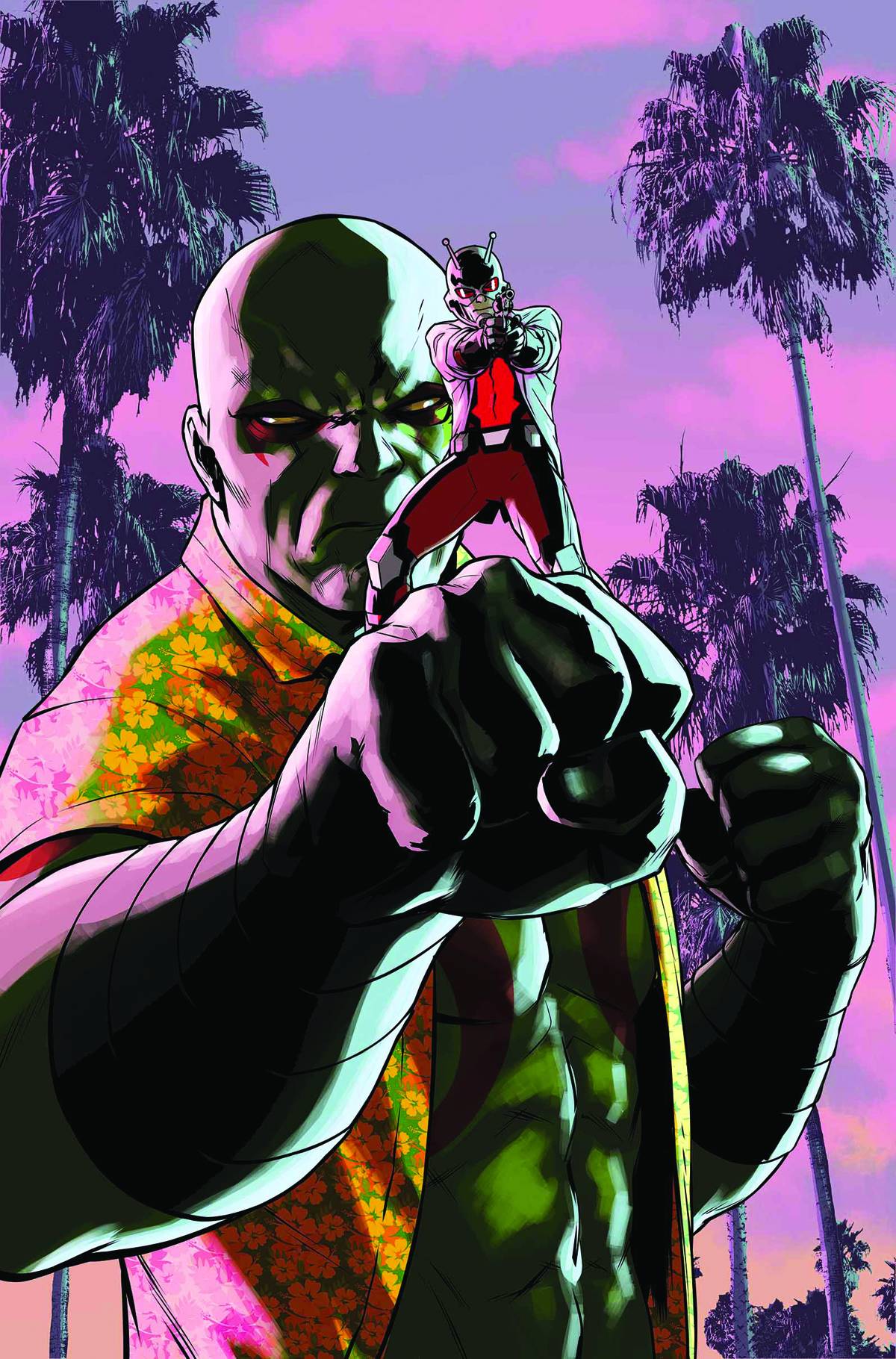 Patrick: Poor Drax just doesn’t fit in on Earth, does he? Not even when he’s hunting his doppelganger from some kind of Bizarro-Guardians of the Galaxy. Still, if there’s one place that his muscle-bound uber-machismo is going to assimilate him rather than expose him, it’s in Miami. The script, by comics vet Nick Giovannetti and comedian Paul Scheer, is packed with jokes.The pair clearly have a handle on the various humorous voices their channeling here, from Rocket’s casual uber-violence to Drax’s hyper-literalism to Ant-Mans put-upon everyman-ness. There are also a bunch of Thor jokes, my favorite being a shirt we should really have printed up:

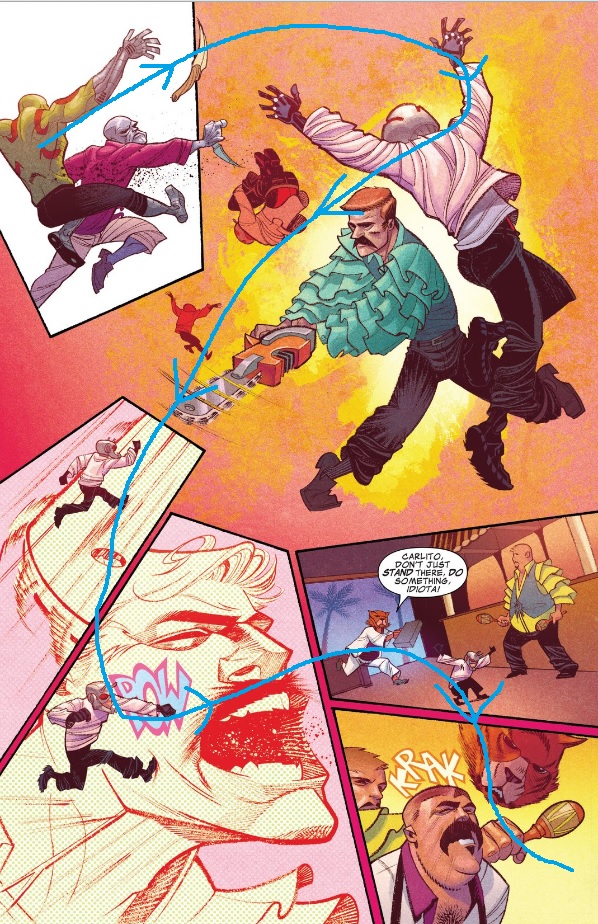
The adventure itself is pretty slight and feels low-stakes, even with the added danger represented by the Ultimate Nullifier. The story is also hampered a bit by the sheer volume of jokes, which frequently slows the pace of the storytelling – usually it’s all done in the name of having fun, but I found myself wishing we could split the difference. I found this doubly true later in the issue when artist Shawn Crystal gets to show off his comedic acumen in the final four-way brawl – the juxtaposition between Drax ripping his shirt and Ant-Man not plays as both swift and funny. And there’s a great page where Ant-Man shrinks and runs up the blade of a chainsaw to punch a dude in the face, and Crystal’s command over the direction the reader’s eye travels is damn impressive.
So the team can be very funny and clever without getting so wordy.
The Unbeatable Squirrel Girl 7
 Spencer: Bizarro, Reverse Flash, Sinestro; every great hero has a villain who is their antithesis, and for Doreen Green, that villain comes along in the pages of Ryan North and Erica Henderson’s The Unbeatable Squirrel Girl 7. The Ratatoskr — first introduced last month as Girl Squirrel — is Doreen’s exact opposite, and not just because their names are reversed. One of Squirrel Girl’s greatest strengths is the ability to talk her opponents down, to use her words to solve problems and make people better — Ratatoskr too is empowered by her words, but with the opposite effect.
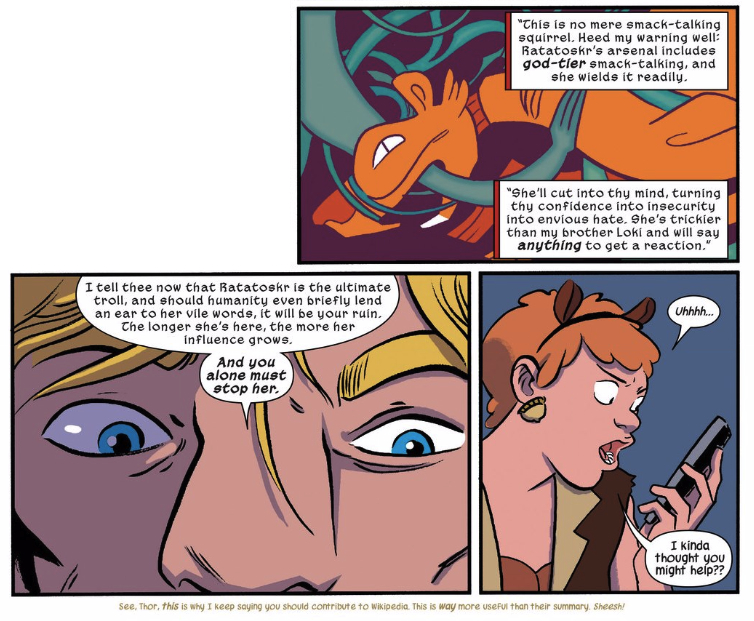
If there is one thing Doreen is not, it’s a troll — she’s enthusiastic and genuine while the Ratatoskr is manipulative and cynical. The introduction of what is sure to be a quintessential Squirrel Girl villain is only the icing on top of the cake that is this issue, yet another stellar installment in a series that’s quickly become one of my favorite books on the stands. What other comics out there can bring you Cat Thor fanfiction, college-level database lectures, and an epic 26 second Avengers beatdown? None! None, I say!
Outcast 10
 Patrick: There’s really no predicting Robert Kirkman’s pacing, is there? After reading the previous issue, I was sort of in shock about the nature of demonic possession and Kyle’s role in technically freeing possessees from their demon but leaving them catatonic. This issue mostly shows Kyle catching up with my shock at the same revelation. Naturally, Kyle redirects this as anger toward Reverend Anderson. Interestingly enough, Kirkman redirects a lot of character’s attentions to the Reverend – it was his visit that sparks this totally enigmatic meating.

It’s unclear exactly who these men are to each other (or even what they are), but it is clear that they view themselves a vulnerable to the Reverend’s actions. In a weird way, Kirkman and Azaceta are flipping the script and making the Kyle and Rev. Anderson the aggressors — possibly even the bad guys — in this series. Is is possible to paint demons (fucking demons) as victims? The creative team ends the issue by reminding us just how messed up Kyle’s family situation is, with a visit to Kyle’s ex-wife an daughter. It’s a heartbreaking scene, and she narrows in on the saddest part when she says “…if I could erase ten minutes from our lives together… it’d be perfect.” That’s some powerful writing, but it’s also a reminder that actions — however brief they may seem in the moment — have consequences. Kyle’s continually not learning this lesson.
Jupiter’s Circle 4
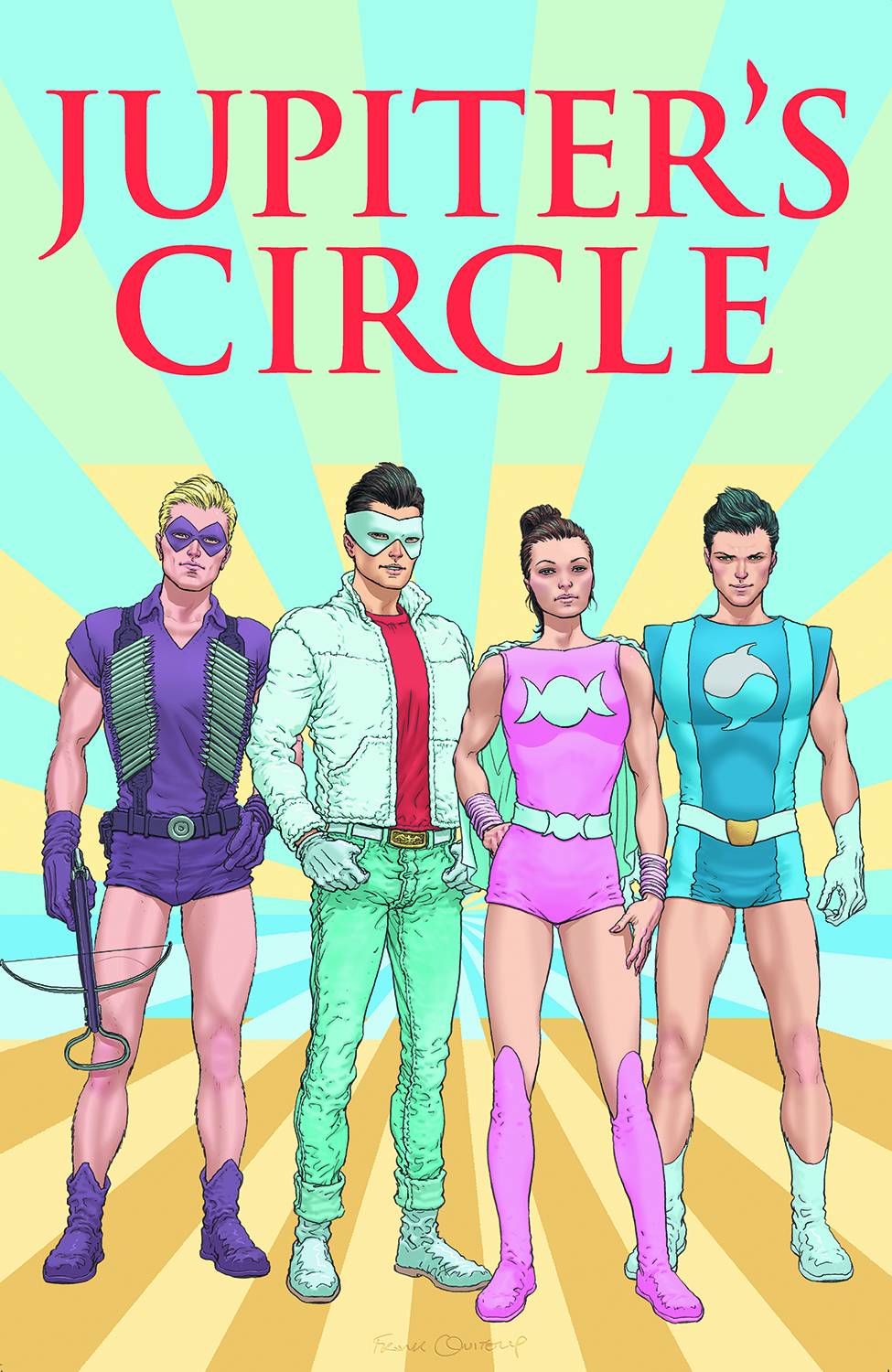 Spencer: Last month’s installment of Mark Millar and Davide Gianfelice’s Jupiter’s Circle played Fitz’s marriage-shattering romance with his 19-year-old fan as a bit of a tragedy — if not for him, than at least for his (now ex) wife and children. This month’s installment finds Fitz slowly coming to the same conclusion, mainly because of the divide the gap in their ages creates between them. April is young enough to join this world’s equivalent of the Teen Titans, and though Fitz smokes weed with them, he doesn’t really fit in, and that difference in their ages and perspectives only becomes more pronounced when Fitz thinks Liberace is hitting on April, but April knows he isn’t (probably because Liberace’s gay, which isn’t pointed out in the issue, but seems like something someone young like April would pick up, but Fitz may not consider). After an accident, April leaves Fitz — she just wanted fun out of this relationship, while Fitz, at his age and with his career, needs somebody more permanent and more reliable. As much as he wanted to fool himself that this was true love, it was never more of a fling, and that’s a painful realization for Fitz to come to, especially when he threw so much away to be with April. His ex-wife is ready to forgive him, but I’m not so sure about Fitz’s son, Peter — Peter’s reaction will determine whether Fitz’s fling is a simply regrettable, but easily forgiven chapter in their lives, or a family-shattering mistake.
Onyx 1
 Drew: What do you get when you combine the “marines vs. aliens” bombast of Aliens with the “humans team up with one alien race to fight another” spectacle of Alien vs. Predator and throw in a little of the “alien infects and mutates everything it touches in bid to take over the world” creepiness of The Thing? Onyx 1 is clearly all of those things, but to call it derivative would be missing the point of borrowing all of those ideas. There’s never any doubt that writer Chris Rayall knows exactly which details he’s borrowing from which classic sci-fi movies, and they make for a simple enough shorthand to get the point across quickly. Efficiency is the name of the game in a four-issue miniseries, and Rayall clearly knows it, giving each character a handy nickname that reminds us what it is they do: Maps is the navigator, Cosmo is the astrophysicist, etc. That’s almost certainly a little on the nose for some folks, but I found it charming. It puts all of the exposition in the simplest way possible, opening up the next three issues to actually dig into the plot.
Patrick: That’s interesting: I totally agree with you when you say that efficiency is the name of the game, and I agree that there are some spectacularly efficient shortcuts being taken in this issue, but very few of them are shortcuts to meaningful characters or situations. What’s more is that we sometimes mill about and spend a whole page on “I’m going to attack it with my electro-tonfa” / “oh no, my electo-tonfa doesn’t work.”
All that being said, the issue certainly does become more interesting once all that set-up is out of the way and it’s just about a bunch of bad-asses having to fight fungally mutated animals. If the second issue can deliver more of that men-on-a-mission feeling, then I might be interested in the rest of the series.
Teenage Mutant Ninja Turtles 47
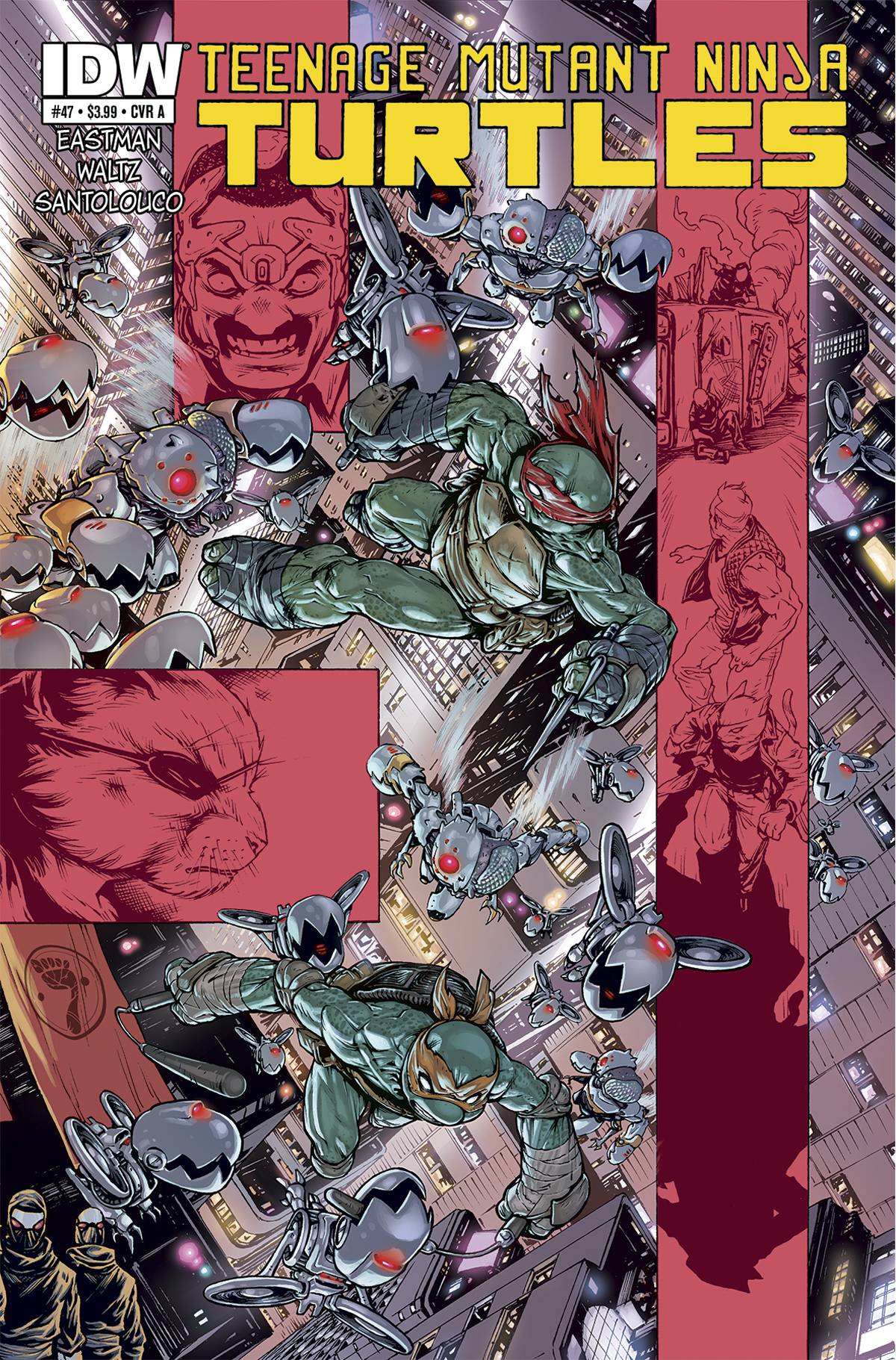 Spencer: To claim that the central theme of Kevin Eastman, Bobby Curnow, Tom Waltz, and Mateus Santolouco’s Teenage Mutant Ninja Turtles 47 is “family” almost sound cliché at this point, but it’s absolutely true. The first half of the issue, featuring the confrontation between Casey and Hun, is as explicitly about family as you can get. It’s not just Casey’s rejection of Hun as his father, but both men’s attempts to build a new family that drives the conflict. Casey seems victorious as his neighbors flock to his aid and get his father arrested, but Hun somehow manages to get in the last word anyway.

Hun’s hit on what I imagine must be Casey’s worst fear — that despite all the work he’s done to reject his father, deep down he’s just like him. Now I know that Casey’s use of violence is far different, far more noble than Hun’s, but I don’t think Casey’s quite able to grasp that point yet. The poor guy’s gonna be hung up on this for a while — maybe that’s why he’s so distant to April in their new miniseries?
The idea of family also takes a prominent role in Shredder’s targeting of Splinter and Karai’s reaction to the plan, but I’m just about out of space here. Drew, do you want to tackle that one — or any of the other plots I just didn’t have time to fully discuss?
Drew: Man, leave it to this creative team to pack a totally satisfying story about a community pulling together to save itself into the first third of this book, leaving plenty of space to ruminate on the themes of vengeance, pack in some key exposition, and leave us in the midst of an attack on the Turtles’ home. Not all of it is as elegant as Casey’s confrontation with his dad (Donnie’s quick explanation of why he might be able to control the lair’s security systems was clunky enough to pull me out of the story), but with Santolouco on art duties, even the talking head pages are dynamic. And pretty. Colorist Ronda Pattison continues to be a key storyteller, managing to somehow stay true to the cartoony colors of this world and the gritty tone it strikes. I’m particularly enamored of Pattison’s choice to wash key moments in the Casey/Hun fight in warm colors, lending those beats an extra urgency, further enhancing Santolouco’s impeccable-as-ever choices.
Action Comics 42
 Michael: While the “whys” and “hows” of Superman’s new status quo have yet to be revealed in Superman, Greg Pak’s Action Comics keeps on moving forward with a very significant “what.” Superman has to defeat the shadow monster that he engaged at the end of last issue and the citizens of “Kentville” must peacefully stand their ground as Officer Binghamton and his SWAT team order them to disperse. As far as plots go Action Comics 42 is pretty basic, but Pak gives the events such a weight and significance that the tension is palpable. Currently in the 3-dimensional world, America “minority” communities are struggling to be recognized as human beings and address the greater evils that we as a society are facing. We’re at a boiling point with a lot of injustices in society: racism, sexism, homophobia, police brutality. With all of that in mind it’s awesome to see Superman stand with the people again.
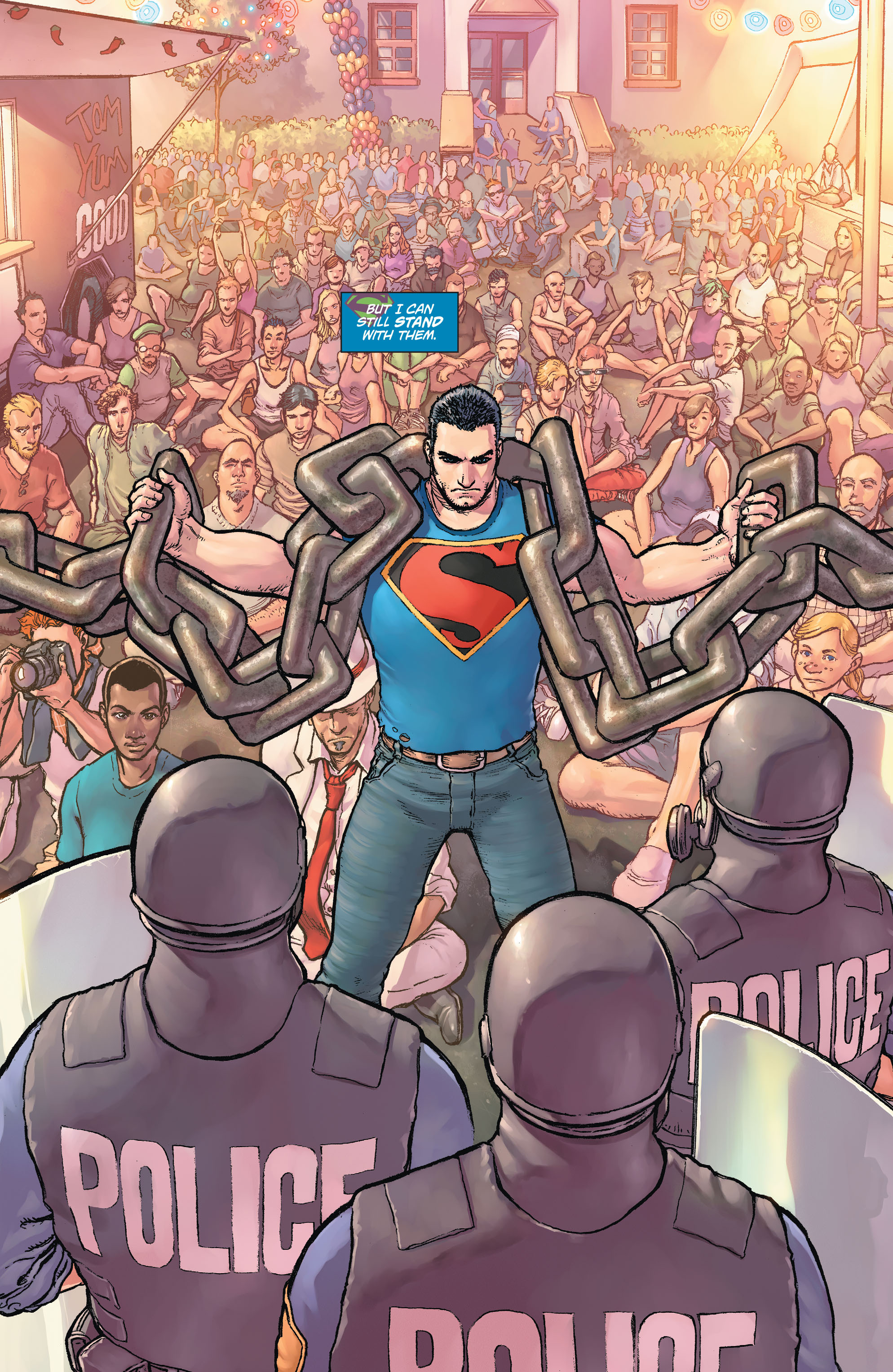
Pak shows major balls by inserting a struggle between an overbearing police force and an oppressed community into a Superman book. Pak is not flat-out making this into a PSA but I think it’s a beautiful example of mapping a societal problem into a superhero book – Kudos Mr. Pak. The importance of this subject is enhanced by the heavy chains that Superman weighs himself down with in solidarity. Artist Aaron Kuder takes the iconic image of “Superman breaking chains” and turns it into a powerful inversion of standing strong. Conversely, by removing the chains of a secret identity, Clark has become a more relatable hero. Who would’ve thought that the answer to the “How do we humanize Superman?” conundrum would be…making him human(ish)? I really dig this rugged Clark whose anger, mistakes and sacrifice feel so much more meaningful now that he’s been de-powered. I think it’s a great concept that in a way Clark appreciates and embraces life more because now it has become more precious to him. He can feel pain now – and it makes him feel alive.
Bizarro 2
 Michael: In its second outing Bizarro loses a little bit of steam and cohesion that made the first so much fun. It feels a little disjointed because Heath Corson writes a script that is part resolution to last month’s King Tut conflict, part funny road trip segue and part setup for next issue. I suppose that’s what you want out of any given chapter of an ongoing story but it comes together in a cluttered manner – much like Bizarro really. Nevertheless I am still very interested in the exploits of Bizarro, Jimmy and chupacabra Colin. It’s obvious that Corson is having a good time with the comical elements such as King Tut’s unintentional self-flagellation with lines like “By the yarn ball of Bast” etc. I’m not sure if the sudden character shift in Tut’s daughter is mystical in nature but she’s definitely being set up to be an antagonist for our heroes in the future. Bizarro 2 has the most fun when it’s looking at the DCU through the book’s satirical lens.
We see Jimmy and Bizarro visiting Gotham and Central City and snapshots of poking fun at other DC locales and characters including the Arrow show, Gorilla City and Swamp Thing. Gustavo Duarte continues to shine with the book’s cartoony character renderings and action. Duarte uses an interesting comedic device that I’m not sure I’ve seen before. Both in Central City and Gotham, there are moments where Bizarro engages in some action off-page/panel; actions that we don’t fully understand until the next full page. In Gotham Bizarro is hit by a batarang and in Central City he inadvertently smacks The Flash across the face – the pages are drawn by guest artists Kelley Jones and Francis Manapul respectively.
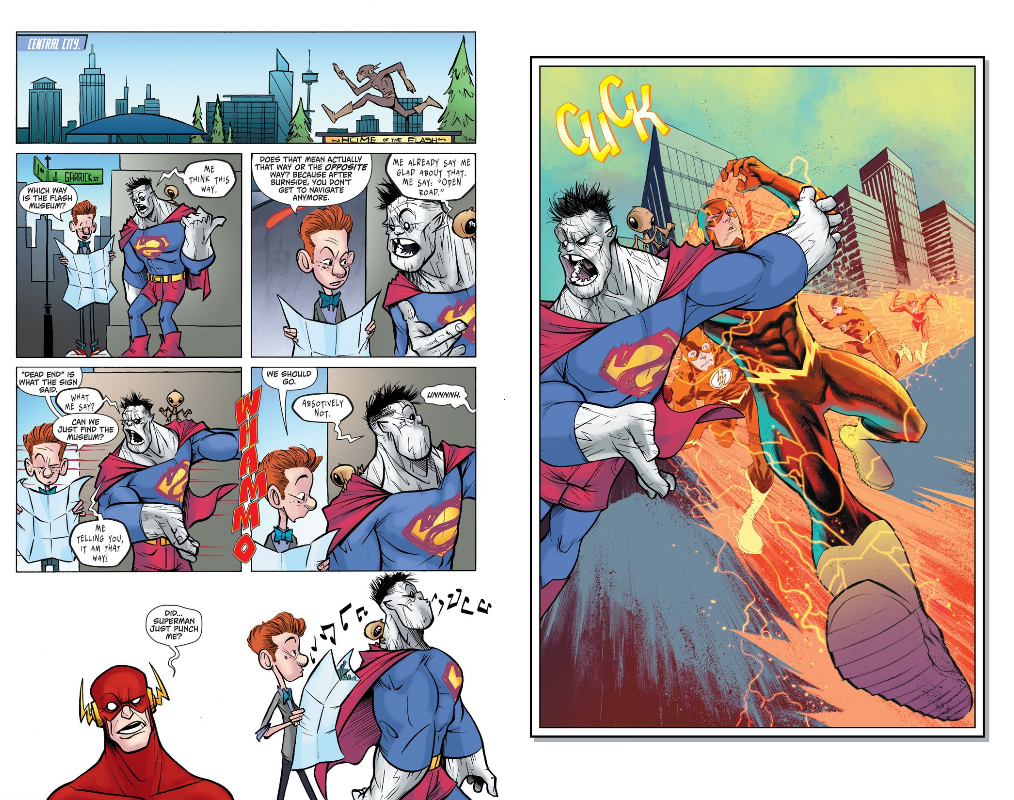
It’s a visual joke that is very unique, but I don’t think lands the way the creators intended. I think next month will be a little more interesting, as our dynamic duo traverses the more obscure corners of the DC Universe: cowboy ghosts!
The Woods 14
 Spencer: I’ve always been amazed (and absolutely terrified) by manipulators, by people who are cunning and charismatic enough to tell a bald-faced lie and make everyone believe it in an instant. Casey Macready, from James Tynion IV and Michael Dialynas’ The Woods 14, is one of the most frighteningly impressive manipulators I’ve ever seen — with every word he speaks he effortlessly turns the students of Bay Point against Maria and Sanami.

How do you refute that? Is there anything anyone can say to discredit Casey without making themselves look worse in the process? Without concrete evidence of Casey’s maliciousness they’re absolutely lost. Honestly, I find Casey more frightening than any of the alien creatures these kids have faced thus far. The terror that can be caused by normal humans, the pain people can cause, is a bit of a reoccurring theme throughout the issue; Karen’s still haunted by her own actions (be it her murder of Adrian or something more romantic in nature), and Ben’s tortured by the fact that his boyfriend isn’t living up to the grand expectations he built up for him in his head. That juxtaposition of human problems against a monster-filled sci-fi landscape has always been a large part of what makes The Woods such a fantastic series, and I’m elated to see it carry through into this new arc.
The Spire 1
 Patrick: I can’t say that I have much of a handle on what’s going on in Jeff Stokely and Simon Spurrier’s The Spire, but the world they’ve starting building in issue 1 is absolutely fascinating. The titular spire is an enormous city, stacked high into the sky. Naturally, there’s a sort of caste system based on where inhabitants of the Spire live – tier 41 is home to the royals, and tier 6 is a slum. But Stokely and Spurrier’s socio-economic divisions are made all the more engaging by the types of creatures living on these various tiers. Most of them are variations on plain ol’ human beings, but some, like our protagonist Shå, were genetically modified and display special powers or characteristics. Shå has string-like tentacles that come out of her back, but there are evidently all kinds of them out there. There’s no single word they use to identify themselves – Shå prefers the term “sculpted,” but many of the more hateful (or ignorant) seems to use the term “skew.” Both imply that the mutations are intentional, possibly even purchased, which begs the question: who purchased these products? But the rest of the characters are just as fascinating – there’s a race of fungus people that wear glass eyes to be more effective salesmen; there are ugly cherub dudes that deliver messages; there are even gangs that speak in old timey dialects called “Antiki-Talk.” Letterist Steve Wands gets in on the fun of the Antiki-Talkers and renders their speech in a much fancier font. Actually, Wands gets to be pretty creative throughout, applying different coloring to words that are meant to be quieter asides or decorating more ornate speeches with flowers and hearts.

There’s a mystery and some political drama at the heart of this thing too, but for right now, I’m just enjoying the world!
Spencer: And the world Stokely and Spurrier have created here is a perfect one in which to explore these kind of political and social themes. A setting where the high society types actually physically live above the poor is remarkably literal, but also helps lay the xenophobia of this society bare from the very start. I love the dilemma that living in this kind of city raises for Shå, who is both a peacekeeper who works for the highest members of society and one of sculpted who those same people despise. How will Shå reconcile those two facets of her job, especially in the light of the new Baroness’s incredible bigotry? How will this loose murderer play into all of this — and if the murderer is sculpted itself, what kind of heat will that bring down on Shå? I’m eager to find the answers, especially since it means exploring this thematically rich, wonderfully creative world even further.
The conversation doesn’t stop there, because you certainly read something that we didn’t. What do you wanna talk about from this week?
 Retcon Punch
I really didn’t like Onyx. So far it’s just a mish-mash of things I’ve seen before, with none of those elements surpassing the original, and the dialogue is really bad. Patrick highlighted one of my favorite examples with the electric tomfas, but that goes throughout the entire issue — all the dialogue has a really expository, comic booky cadence to it that just turns me off.
Also, Michael’s point about Tut’s daughter’s turn in Bizarro feeling off is spot on. She didn’t even like her father and hated their business — what’s with the sudden embrace of both as soon as Bizarro hypnotizes Tut?