

Today, Peter and Drew are discussing Batman and Robin 4-6, originally released December 14th, 2011, January 11th, and February 8th, 2012.
 Peter: Prior to the reboot, for me, Batman was in a little bit of a limbo. I enjoyed post-Final Crisis arcs enough, but I wasn’t completely drawn in by them. They just did not feel exciting to me. The Return of Bruce Wayne felt forced. I actually dropped all Batman books from my personal pull except for Batman, Inc. when it was released. With the advent of the New 52, Batman and Robin has quickly risen to become one of my favorite books. Peter Tomasi’s writing, and Patrick Gleason’s art, have revitalized these characters, and most importantly, the ever evolving relationship between them.
Since we are covering three issues in this post, I’ll try to keep the recap to just the bare essentials, since I would much rather spend my time writing (and your time reading) discussing the HUGE amount that goes on in these issues.
Batman and Robin, have been captured by the mysterious killer calling himself NoBody. NoBody is actually Morgan Ducard, the son of one of the men who trained Batman in his formative years. NoBody believes that Batman has failed in his mission by locking up rather than killing the villains and psychopaths that plague Gotham City. As the story opens, NoBody is attempting to get Batman to see the error of his ways by showing him what his continued tactics have done to Gotham. With every escape, Batman’s rogues gallery have harmed and killed innocent people. NoBody says that everything they do is Batman’s fault. More importantly, Robin hears NoBody’s murderous opinions, and is given the option to leave Bruce behind and join him instead.
At the beginning of issue 5 we find that Damian has made the choice to leave Bruce and join NoBody. NoBody and Damian infiltrate an embassy to stop a corrupt official who deals in human trafficking. This issue provides us with an intense and in-depth history of how Bruce came to know Morgan and learn manhunting from Henri Ducard, Morgans father. A few issues back, when NoBody was revealed to be the son of the man who trained Bruce in the art of tracking, Bruce chose to withhold information from Damian. In doing so, Bruce tipped the domino that has led to his son stepping out from beneath his shadow into a world that the boy may not yet understand. This issue, Bruce is attempting to track down Ducard and Damian; a task that is made ever more difficult by the fact that Ducard is a master tracker who doesn’t want to be found and Damian knows all of Bruce’s blind spots in Gotham. Meanwhile, Damian swears his fealty to Ducard in exchange for training. As the issue closes, Damian faces a choice that may irrevocably alter his path as Robin, which is not only killing someone (a corrupt Ambassador), but using a gun, which Bruce has always made the line he wouldn’t cross.
In issue 6, we see that Damian would try to fire the gun, only to discover that there was no round chambered, and thus, Damian did not kill the Ambassador. We also get the full story on Batman’s actual relationship with NoBody, who Bruce almost killed in self-defense, after disagreeing with Henri’s practice of killing those he hunts down. Morgan and Damian then take the Ambassador to NoBody’s hideout. When Damian discovers that, after getting the information they need from him, NoBody is going to kill the Ambassador. He objects, revealing that Damian has been perpetrating an elaborate ruse. The fallout from Damian’s decision leads Batman towards a confrontation with NoBody that may end in more than one death before the night is through.

This series really does live up to its name of ‘Batman and Robin’, since it has focused on the interactions between Damian and Bruce and its development from father and son into partners. Tomasi is also doing a very good job of playing on the inner conflict of Damian and his upbringing under his mother and the League of Assassins. He has created the polar opposite of Bruce in Morgan, and is using them to represent the choices that Damian must make as he moves on with his new life in Gotham.
I have loved this story arc as it has been very much a ‘Robin’ book, treating Damian as the central character. He obviously does not trust his father, and assumes that since he is his son, that he is entitled to know everything, even if Bruce is unwilling to share. Thus, Damian feels that their relationship is be built on lies. This goes both ways, with Damian harboring some intense feelings that he is expressing with his secret killing of bats, or the grotesque drawings in his sketchbook. These lies and feelings ultimately are what lead to Damian’s ‘betrayal.’

building characters from the ground up. I love that he has taken Batman through the reboot and out the other side a new man. Making Bruce seem less invincible and less infallible, less of a ‘Batman’ and more of a man. He also lets us know that this is his comic, almost talking directly to the reader in true Full Metal Jacket fashion.

arc. I am anxious to see to what lengths Bruce will go to save Damian from NoBody. This is something that Bruce has never really faced before, since it his own flesh and blood that is in danger here. This reminds me a lot of the ‘Death in the Family’ storyline, which if you haven’t read, go do it, now, I’ll wait for you to finish. SPOILER. In this story, Batman is faced with losing Jason Todd, the second Robin, and current Red Hood, as he is brutally beaten and left for dead in a warehouse rigged to blow by the Joker. It has been reinterpreted a couple different times, but the main message is all the same; that Bruce forever regrets that he was unable to save Jason, and it has scarred him for life. I am really glad that Tomasi is brave enough to revisit a similar style of story writing, and in doing so, is elevating the character of Damian to new heights, and showing us sides of Bruce that have rarely been seen, which are almost perfectly complemented by Gleason’s art, which feels very organic and combined with Mick Gray’s inking and John Kalisz’s colors set a perfect tone for the story that is unraveling.
 Drew: I’m thrilled you’re enjoying this title so much, Peter. Between the first few issues of this title and Green Lantern Corps, I wasn’t totally sold on Tomasi, but I think he’s crafted a really fine story here. There’s much more going on than first impressions might suggest, and I’ve found myself regularly rewarded by closely rereading this title.
I’m particularly impressed with Tomasi’s understanding of his characters, which is on no better display than with NoBody. Villains are too often condemned to amoral gaps in logic or out-and-out insanity (even in the hands of really good writers), but Tomasi has kept NoBody grounded on just the other side of the line Bruce refuses to cross. In The Dark Knight Returns, Batman asks himself how many people have died because he has allowed Joker to live, more or less the same question Morgan poses to Bruce at the start of issue 4. Arkham’s revolving doors turn this question from a hypothetical to a moral dilemma, as Ducard’s methods ultimately result in a lower body count. The lines are drawn in the sand, and given Damian’s previous flippancy with killing, Ducard’s argument may make more sense.
What really impresses me about NoBody, though, are the other differences: Batman is theatrical, using fear to control crime; NoBody is all-but-invisible, preferring to go about his work unnoticed. There’s a beat in issue 6 where Damian is impressed with Morgan’s efficient interrogation techniques, which involve a potent truth serum and giving the suspect hope. More importantly, fear actually gets in the way, suggesting that Bruce’s interrogation techniques may not be the most effective. It’s a fun little detail that gives Damian a reason to respect Morgan, and also serves to suggest that, as you mentioned, Batman is not infallible.
I also really appreciate the amount of respect Tomasi has for Damian. Damian running off with Morgan made enough sense for me to believe it, but the reveal that he was faking all along feels much truer to what we know about him. He’s incredibly competent, so I totally buy that he could hatch this plan on the fly, even realizing that Ducard had handed him an empty gun. Interestingly, this doesn’t explain away Damian’s disturbing journal, suggesting that, while he did the right thing here, he is still a profoundly screwed-up individual. He seems more motivated by loyalty to his father than any actual morality, which is a scary thought given how often he seems to resent Bruce.
Issue 6 leaves us in a place that feels very much like A Death in the Family: Bruce is racing to save Robin from the hands of a murdering madman with a vendetta. That drama is only heightened by Bruce’s baggage from Jason’s death (which I personally think is a bigger factor than the fact that Damian is his son), making for an incredibly exciting next few issues.
You’re right to cite the entire art team for their work here — Gleason’s pencils are great, but they’re really enhanced by Gray and Kalisz’s work. I’m most impressed by the lighting throughout this title. It helps that Tomasi writes some dramatically-lit scenes — a drive-in theater, a huge explosion, a Batcave lit only by computer monitors — but the art team comes together to really pull these effects off. It’s hard to pick a favorite, but I am fond of this gem from the end of issue 4, where Morgan and Damian’s meeting is lit only by fireflies. There’s a lot to love in that scene, but the closing images, where Damian seemingly makes his decision to join NoBody, is as strong as any I’ve seen in the New 52.
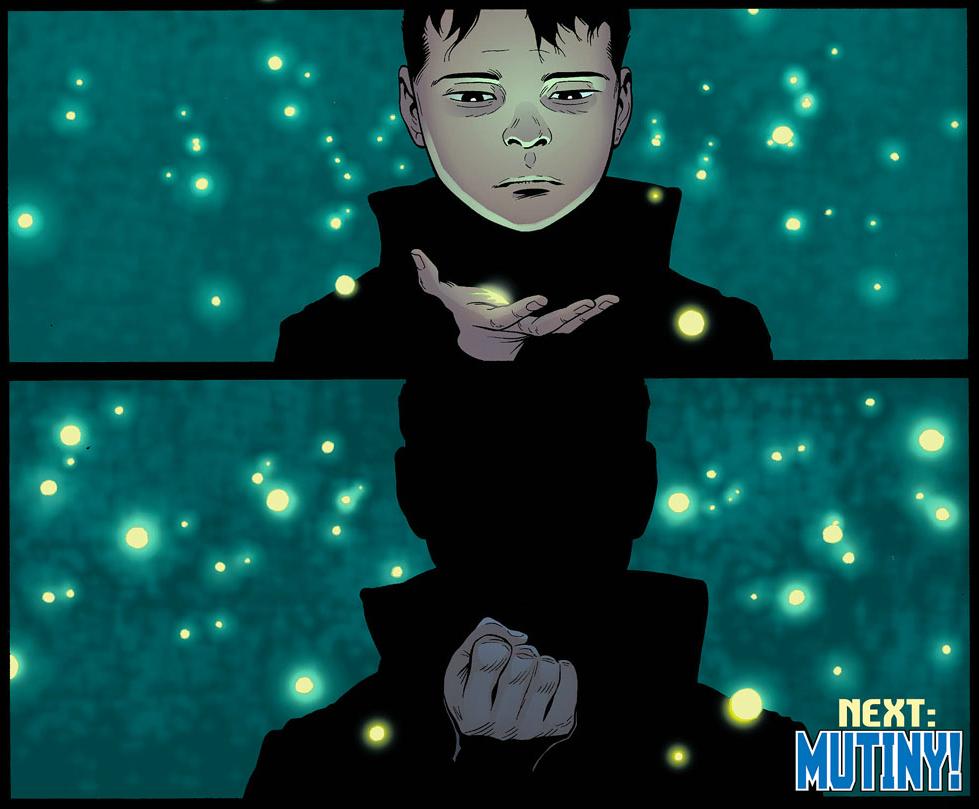
Damian considers the light, but ultimately chooses to crush it out, leaving him in shadow. That shadow takes on additional meanings as we learn that his decision was ultimately a ruse, but even as I read it the first time, it was clear that Damian was unknowable. He wasn’t just opting to join Ducard, he was opting to hide himself from the world. It’s a compelling image, and a compelling thought, and it’s the frequency of those two phenomena that keep me coming back to this title.
 For a complete list of what we’re reading, head on over to our Pull List page. Whenever possible, buy your comics from your local mom and pop comic bookstore. If you want to rock digital copies, head on over to DC’s website and download issues there. There’s no need to pirate, right?
 Retcon Punch
I really like the concept of Damian as a peerless. Drew, you note that he’s alarmingly competent, and that makes for a really dynamic character. Especially when you couple his abilities with the fact that he’s still a kid, and draws weird pictures because it’s hard to express himself in a world where the closest thing he has to friend his a Batman who is also his astranged father.
I also like how this series (especially in the latter issues) focused on NoBody and Damian and not so much on Batman. Obviously, we’ve got Batmen coming out our long pointy ears at this point, so it’s a welcome change to spend time with what is essentially a new character.
There are a lot of sneaky ways that DC introduces new characters to off-set, you know, 70 fucking years of Batman. Damian fits that bill pretty well, even if he gets the title of “Robin.” He’s unlike any of the Robins I’ve known.
Drew, I really enjoyed what you wrote in your final paragraph and the metaphor of Damian crushing the firefly. I would also like to put forth that, in addition to Damian hiding himself from the world, do you think he might be hiding from himself? We see that Damian is making a very consistent effort to change his fighting style from that of a trained assassin to a non-lethal approach which is in keeping with Batman’s ideals. But as we saw in an earlier issue, he struggles with this, and when he believes no one is looking, kills a bat in the cave. Between this idea, and the book of weird drawings I feel as though Damian is repressing a lot of emotion, confusion and anger, and I hope that will be revisited somehow.
I love this idea. For all of his competency, Damian is still a 10-year-old boy emotionally. He was raised under a set of morals where killing wasn’t just okay, it was accepted, but with Batman, he has to adjust to a new set of morals. His sketchbook and secret animal killings suggest that he might just be a sociopath. He doesn’t have a great sense of what’s right and wrong, but it’s because he hasn’t been taught it. He knows enough to hide these thoughts, but he’s not equipped to deal with them on his own. In the end, all he can do is repress them, which probably only makes his outbursts more violent. It’s a strange, ballsy head-space to explore, but one that makes perfect sense for a 10-year-old assassin-turned-crime-fighter.