
 Today, Drew and Patrick are discussing Daredevil 18-19, originally released September 19th, and October 17th, 2012.
 Drew: You know that feeling where, for the life of you, you can’t remember where you put something you just had? When I was a kid, it was always my shoes; nine times out of ten they were right by the door, but every once in a while, they weren’t, prompting a lot of frustrated running around as we were rushing out the door to school. If it wasn’t your shoes, maybe it was your keys or your glasses — the point is, it’s a universal sensation, prompting the equally universal (though usually facetious) response of “Am I going crazy?” This is essentially the problem Matt Murdoch finds himself in as of Daredevil 18-19, only instead of the TV remote, he’s misplaced his father’s remains, his estranged wife, and his own body. Understandably, this has him — and those around him — considering his own insanity a bit more seriously.
Issue 18 makes a fantastic jumping in point, hooking the reader with two mysteries right up front: the killing of a drug kingpin by spontaneous exsanguination and the unexplained return of Milla Murdoch in Matt’s bed. Foggy Nelson, now of the hilariously rechristened Nelson & Murdoch Attorneys at Law, begrudgingly agrees to investigate the latter in exchange for Matt’s help investigating the former. Matt confronts Salazar, the drug kingpin’s second in command, but he falls down an empty elevator shaft in the scuffle — an empty shaft where the elevator car mysteriously reappears moments later. The weirdness continues as Matt misplaces and finds his billy club mid-fall, and ends up landing in his apartment, from where Milla has disappeared without a trace. When Foggy finds her in the mental institution — exactly where she should be — he assumes Matt has lost his mind, and spills the beans to ADA Kirsten McDuffie (Matt’s girlfriend), which starts a manhunt for Daredevil. Meanwhile, Matt’s self-doubt quickly turns to self-confidence as he realizes the Spot — a teleporter he confronted in issue 1 — is responsible for everything. Unfortunately, he isn’t able to stop the Spot from taking out the rest of the drug syndicate. In fact, he’s overwhelmed in combat, waking to discover himself the captive of a baddie calling himself Coyote. Oh, also, Matt’s head has been removed from his body.
Mark Waid’s entire run on this series has been fantastic — I encourage anyone not already reading it to pick it up (issue 18 is actually a fantastic starting point) — but this arc really takes advantage of the effort Waid has put into giving us a sense of how Matt experiences the world. Making blindness compelling in a visual medium can be a daunting task, such that some wave it all away with “radar sense,” essentially giving Matt the ability to see. Waid certainly takes advantage of the radar sense, but takes care to place it in the larger context of Matt’s other senses. He recognizes Milla by her heartbeat and smell, and knows when the Spot arrives based on “a half-decibel shift in the acoustics.”
Chris Samnee does a brilliant job keeping us close to Matt, keeping the focus on actions and sensations. Take the scene where Matt drugs Milla’s tea:
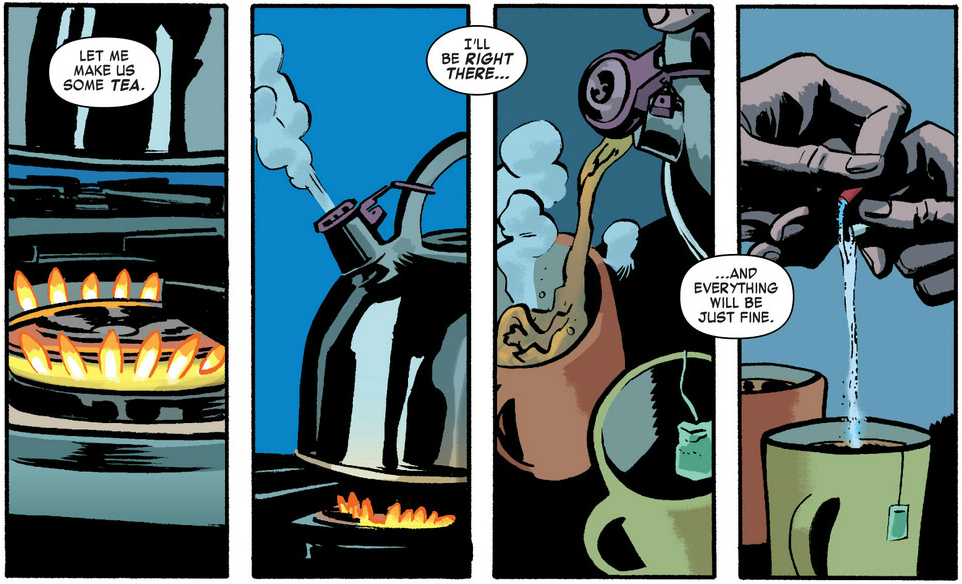 Something more straightforward would probably make sense for someone who can see what he’s doing, but Samnee instead focuses us on the actual sensations of making tea. I can feel the heat in the first panel, hear the kettle in the second, smell the tea in the third. This prepares us for the silent, secret action of slipping the contents of a sleeping pill into the tea. These moments work to put us in Matt’s shoes, making us as confused as he is when his senses start to betray him.
Keeping us aligned with Matt makes for some exciting sequences. The story of the dried-up drug kingpin has all the trappings of a great mystery: a locked room, an inexplicable crime, a hapless witness everyone assumes is the suspect. The fact that longtime readers have the clues to piece it together is a nice bonus, but it’s a fun ride, either way. For proof of this, you need look no further than how exciting the action is after we know the Spot is behind everything.
 That’s SUPER disorienting, a feeling that is enhanced by the jagged, angular panels. More importantly, it’s brilliantly paced; we feel each of those “BLAM”s, but Waid and Samnee goose us with the last one, emphasizing just what each of those gunshots really represents. It’s a daring sequence, and totally unlike anything else on my pull right now.
The issue also gains a lot of momentum heading into the next issue. Sure, Matt’s head is literally in the hands of a brand new bad guy, but I’m much more excited at the prospect of him being hunted by Foggy and Kirsten. His relationship with Foggy has been really dragged through the gutter of late, and seeing Matt finally exonerate himself will be a pleasure. His relationship with Kirsten has been less troubled, but much of their flirtation has been about Matt denying that he’s Daredevil — I’m not sure what happens now that that info is out in the open.
There’s just so much to love about this title, from its clever tone to its deft balancing of Matt’s costumed an civilian life. It’s a mature title, but I don’t mean that in the gratuitously grim way we normally do when talking about comics. Instead, I mean to suggest that it addresses themes of subjectivity and trust with confidence, creating a rich world filled with complex characters that manages to still be appropriate for all ages (well, most ages). It’s not something we always get in our DC-heavy diet, and something I wouldn’t even have missed without picking this up, but it’s one of the things that makes this such a pleasure to read month-to-month. How’s that balance working for you, Patrick?
 Patrick: “Balance” is exactly the word I’d use to describe what I find so fucking enjoyable about this series. It balances action with humor, fun with pathos, and Matt Murdock with Daredevil. That last high-wire act is the most impressive to me: Matt is almost as excited about being a blind super-lawyer as he is about being a blind super-hero. And Mark Waid spends as much time carefully laying out the stakes for the law firm (and their clients) as for Daredevil. Which means that we can have a story like this that hinges on Matt’s deteriorating partnership with Foggy. Any other superhero you can name is going to have a personal life that revolves around a) pretending they’re not a superhero b) getting a girl (and hiding from the girl the fact that they’re a superhero) and/or c) having a family. None of these are particularly active pursuits, but Matt Murdock is a different animal entirely.
It breaks my heart to see Matt and Foggy fighting like this, but — as a fan of smart fiction — I love how powerful this relationship is. It doesn’t rest on any of the usual tropes – for example: there are no misplaced daddy issues in this relationship. This is a pair of friends with a deep history, mutual respect and a common ambition. Maybe it’s because I tend to pull my friends in around me to work on creative projects (and therefore form even stronger friendships), but this relationship just rings especially true for me. Chris Samnee acts these characters just beautifully. I love seeing that — even in the middle of their Biggest Fight EVAR — Foggy’s face can’t hold a stern frown when he realizes that his best friend is in serious trouble.
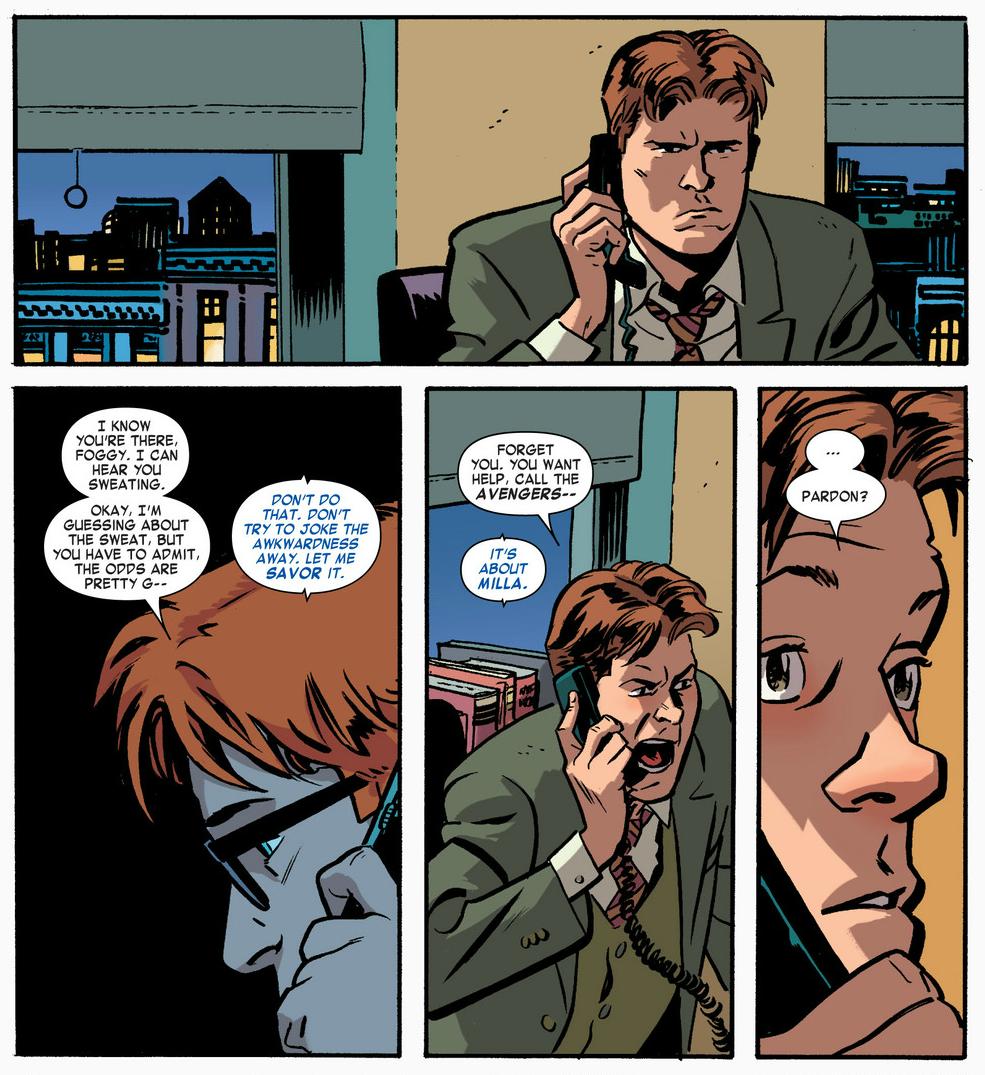 How great is that writing, by the way? Matt goes for a cheap shot: “I can hear you sweating,” but he’s such a good guy AND cares about his friend’s feelings enough to immediately backpedal. And Foggy’s suggestion of “call the Avengers” is yet another telling line about the series. Matt does eventually take Foggy’s advice and head over to the Avengers Tower for diagnosis, and it seems like he’s going to be rescued from Coyote by the task force that Foggy helped set in motion. Matt Murdock needs Daredevil and Daredevil needs Matt Murdock, but they both need Foggy Nelson.
While issue 18 would serve as an easy entry point, I’m thrilled by how much of this plays on pieces of storytelling that have been unfolding episodically for months. Lots of comics will build on their own narratives for a year and a half, but Daredevil pulled off this feat invisibly. At no point during the previous 17 issues did it seem like Mark Waid was world-building for the purpose of one big pay-off here and yet that’s exactly what we’re getting. The Spot is back and wants revenge; Matt’s father’s remains are an issue; Matt continues to doubt his senses in light of his experience in Latveria. As a new reader to the series that just binged on all the issues this was an incredibly rewarding way to see all these disparate threads come together.
It’s also amazing to me how well these creators can depict self-doubt. Especially considering the confidence they move with elsewhere. Just after Daredevil nearly falls to his death, Matt considers going back out to see a doctor.
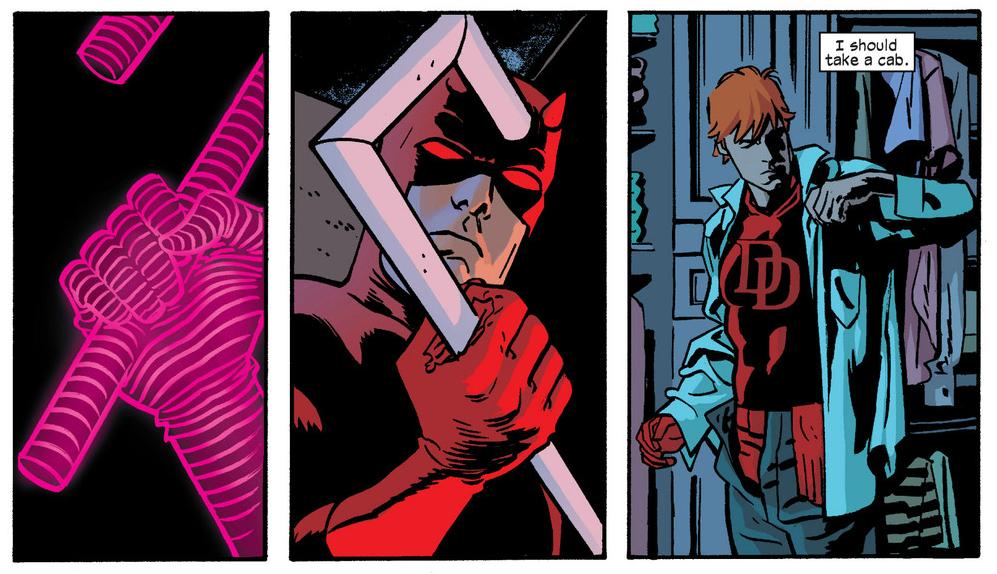 Even after he’s examined the club with his super-powered radar sense, Matt has to put on civilian clothes (like a schlub) and hop in a taxi like every other jerk in Manhattan. He sorta hates the decision, but he just can’t trust himself in this moment.
Also, I just thought this was neat: you know how so many comic book covers show really sensationalist images of the heroes being defeated by the villain? You can’t really fault artists for that, it always looks pretty exciting. So when I saw that issue 19 of Daredevil had a creepy dude holding Daredevil’s head on the cover I was like “yeah, that’s not actually going to happen.” BUT THEN IT DID. Pretty cool.
 For a complete list of what we’re reading, head on over to our Pull List page. Whenever possible, buy your comics from your local mom and pop comic bookstore. If you want to rock digital copies, head on over to DC’s website and download issues there. There’s no need to pirate, right?
 Retcon Punch
The downside to quick turnover in these stories is that they kind of cycle through similar conflicts rather quickly. Waid has balanced this by playing a longer game with the drama between Foggy and Matt, or the slow simmer of Matt’s courtship with Kirsten, but it’s hard not to notice that Daredevil gets captured by bad guys an awful lot. Maybe that makes sense for someone who leaps first, asks questions later, but it’s hard not to feel like we’re retreading the same types of cliffhangers pretty often. To Waid’s credit, they’ve all been drastically different scenarios, but the general feel of our hero trapped/tied-up/caged has become a familiar one on this title.
I hadn’t considered that, but this is like the third time we’ve seen DD tied up, huh? And here I was chastising Talon for just the possibility that they’d tie up the character again and again. The last like 6 issues have all dealt with some amount Daredevil thinking he’s crazy. Huh. Don’t notice the patterns until we’re past them…
I think it’s a common thing for really episodic narratives to revisit the same tropes over and over again. That’s super obvious from case-of-the-week-type medical/legal stories, but it’s also true of comics (the Joker got out again? Somebody else has kryptonite?) It’s not exactly a complaint — I’m far from bored with anything in this title — but more an observation on one of the things that make serialized stories different from more episodic ones that had never occurred to me before.
There are a few comics that I think are *must* reads if you’re a comics fan. This is one of them. (Included on the list are Saga, Batman, Invincible, Dial H, Ultimate Comics Spider-Man and a couple more that I can’t think of. (Swamp Thing/Animal Man are close, Amazing Spider-Man is close, Journey Into Mystery was close. . .))
I could prattle on and on about this book. Every issue (with one exception) has been excellent. I have no idea what’s going to happen next and every week there’s a new Daredevil I have to force myself not to read it until I get home. This is what a comic should be.
I’ll agree this that is basically a must-read. It is interesting to me how something like publisher affiliation would have kept this out of my pull list indefinitely.
Hey, the only Amazing Spider-Man I read was that one issue Waid wrote that crossed into Daredevil (with Black Cat) – you’re telling me I should read more?
In 1982 Roger Stern wrote for Amazing Spider Man one of the most beautiful story arcs I’ve ever read. It is rather short (it starts in issue # 226 and ends in the following one), but every single panel of it is pure awesomeness.
Spider Man and Black Cat were the leading characters of that arc.
In that period Spidey had started to become more and more similar to Batman: the series passed from a sunny setting to a dark one, Peter started to cooperate with a female version of Commissioner Gordon (Jean De Wolff), and, most of all, he developed a detective approach he never had before. His relationship with Black Cat was a part of this project: Black Cat is Marvel’s Catwoman, so the affair between her and Peter deliberately reminded of the one between Batman and Catwoman.
This magic period ended with the death of Jean De Wolff. She is one of the Spider Man characters who should have been employed more and in a far better way, along with Eddie Brock, Cletus Kasady, Betty Brant and so on.
Amazing Spider-Man is reaching issue 700 (I think 697 comes out in 2 weeks) and ends there, to be restarted as The Superior Spider-Man. There is a great deal of prognosticating as to what will happen the next few issues as well as what ‘Superior’ is actually referring to. I would recommend Ultimate Spider-Man before Amazing right now, but I completely love Miles Morales and what Bendis is doing with him.