

Today, Scott and Drew are discussing The Movement 4, originally released August 7th, 2013.

Scott: Think about your favorite comic book hero. What do you know about their past? Whether it’s every little detail or just the basics, it’s almost impossible to separate that hero from the event (usually a tragedy (possibly the death of a parental figure?)) that set them on the path to become a hero. In The Movement 4, writer Gail Simone makes time to explore the important events in the lives of a few main characters, while also trying to advance the story she’s established over three issues, and the effect raises some questions. It’s certainly important, crucial even, to develop a character’s past, but when is the right time to do it? And how many characters can you look back at at once? Simone overshoots, but not terribly — she’s not biting off more than she can chew so much as taking too many bites too quickly. It’s a climactic issue for this young series, but presented in a way that isn’t as seamless as previous issues.
A masked mob is raiding the Coral City Police Department. Inside, Captain Meers calls for reinforcements, while James Cannon continues to interrogate Katharsis to no avail in the sub-basement. Cannon flees just before the mob breaks through the doors, threatening to burn the building down. Virtue finds Tremor and asks her to stop the oncoming police tank (the aforementioned reinforcements), while she goes to rescue Katharsis. Tremor, realizing Virtue & Co are her only real friends, decides to quit being a government spy and obliterates the tank, only to discover a fleet of police choppers are also on the way. Luckily, Rainmaker returns and quickly takes them out of commission. Meanwhile, Virtue, Mouse and Burden rescue Katharsis from the sub-basement and Captain Meers has no choice but to let them all go. The raid ends quietly, but noise has been made across the country, as new cells of The Movement are popping up in every major city.
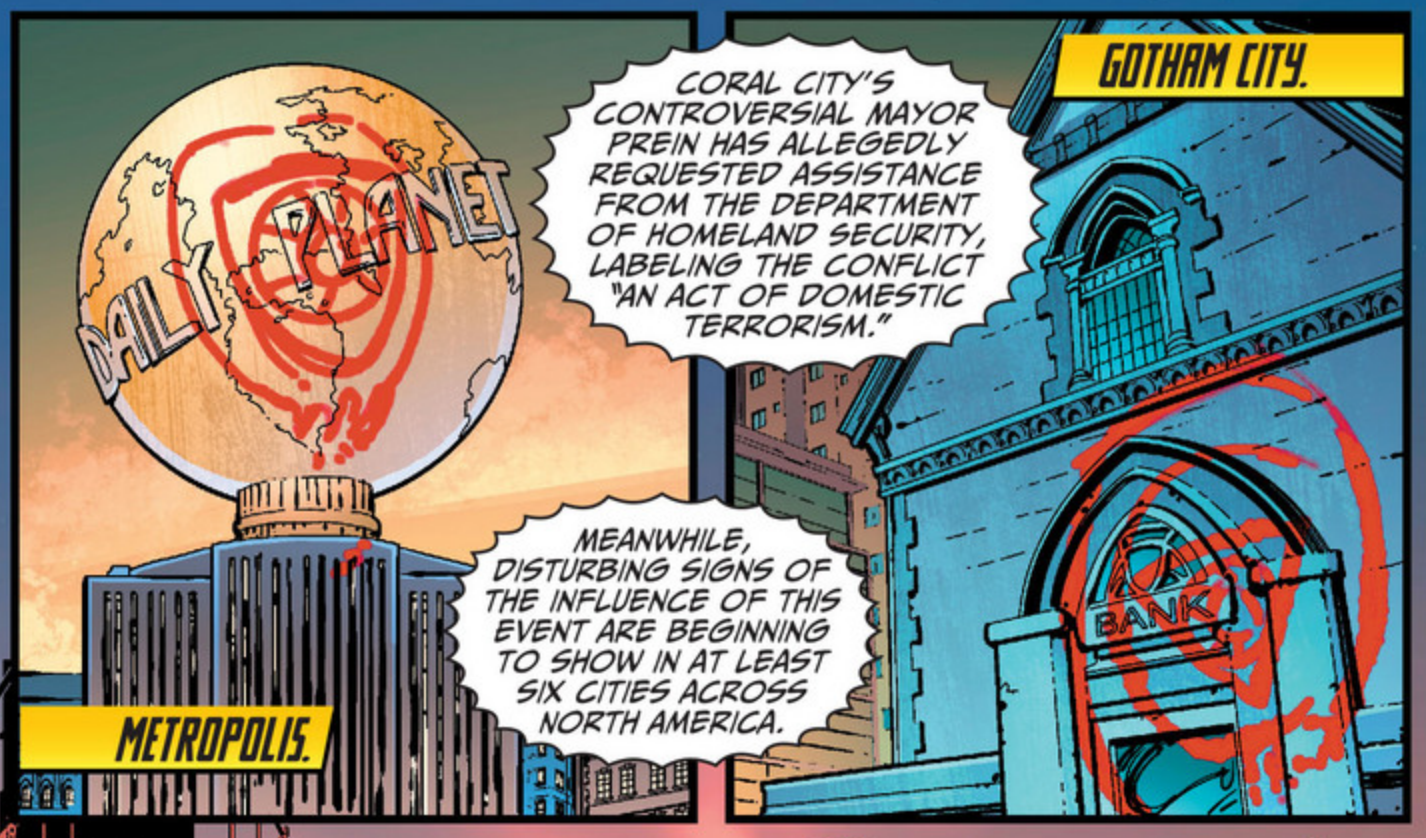
That’s a ton of action packed into one issue, and I haven’t even taken into account the roughly 40 percent of the page-space devoted to various characters’ backstories. Simone offers a brief rundown of the early lives of Mouse, Katharsis, Burden, and Tremor. I’m glad I got to know and care for these characters a little bit before delving deeply into their histories. Too often in the stories we read, characters are defined by their pasts and, in many cases, they seem one-dimensional because of that. That’s not the way we get to know people in real life. When you meet someone, you experience them as they are at that specific point in their life and that’s all you get to know about them. Bit by bit, you learn more about their past, which informs the person they’ve become today. This is how Simone is approaching the backstories of her characters; they are informative, not definitive.
Nonetheless, I can’t figure out why Simone chose to include so much backstory in this particular issue. This is a climactic moment — the moment this title has been building to since it began — and the four flashback sequences serve as hiccups in the story’s action and don’t seem to work better as supplements to this issue than they would have to any other. Despite the attempts to smoothly weave the flashbacks into the action, the set-ups that transition into the sequences begin to feel forced after the first one. The most successful of the four is Tremor, whose story of the mistake that caused her to run from her family helps explain how she became a spy and nicely sets up her reversal later in the issue.

It’s interesting to learn that Tremor has been ridden by guilt throughout her life. She’s guilty about taking her Indian father away from his happy life as a farmer, guilty about surviving the car crash that killed her friends, guilty about falling in with those friends in the first place. Now, she’s guilty about lying to her new friends about who she is. When Virtue puts her complete trust in Tremor, the guilt becomes unbearable. Tremor is given her defining moment: she has the power to destroy the Movement just by doing nothing to stop the tank. Instead, she decides to destroy the tank by doing, well, something…I’m not exactly sure what you’d call it. She tremors it, I guess.
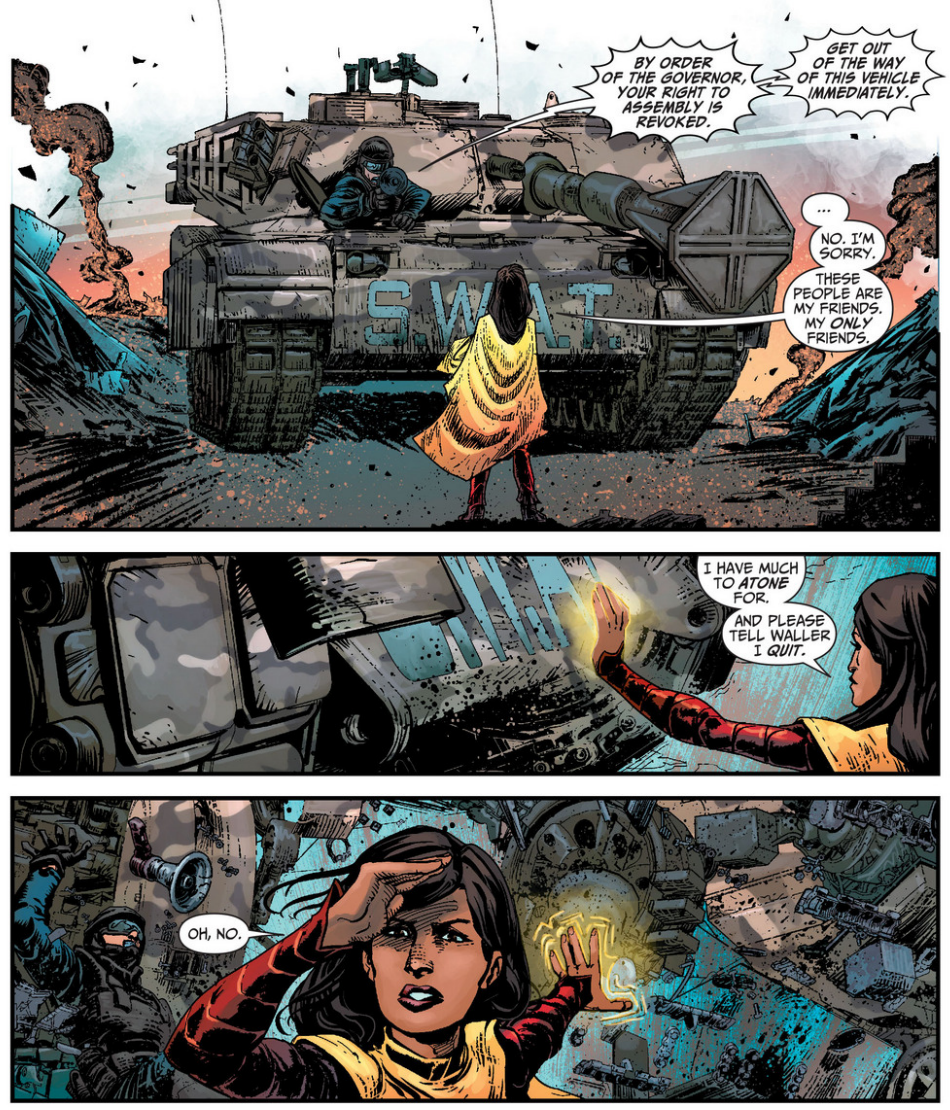
Combine that with the successful rescue of Katharsis, and this makes for a surprisingly uplifting ending for an issue of The Movement. At the start, Captain Meers tells Virtue her people will never win. Well, they’ve won this battle. I’m curious to see where Simone takes things next, especially with The Movement gaining traction across the country. Will the additional support offer validity to the cause of the characters we know, or will these new cells misinterpret the message?
So Drew, I guess I’m a little bit torn about this issue. I hate it when my biggest complaint about a comic has to do with structure rather than content, but it’s an important factor in how I experience a story. Were you as distracted as I was by the sudden turns into Backstoryland? Furthermore, how many rats in a crib is too many rats in a crib?

Drew: You know, I tend to think of nurseries as rat-free zones, but then again, I’m not Freddie Williams II, who seems to have some kind of rat clause in his contract (basing this only on this series and the rat-monster arc from Captain Atom). He seems to favor drawing particularly aggressive-looking rats, which is an interesting choice given how sympathetic Mouse is to them.
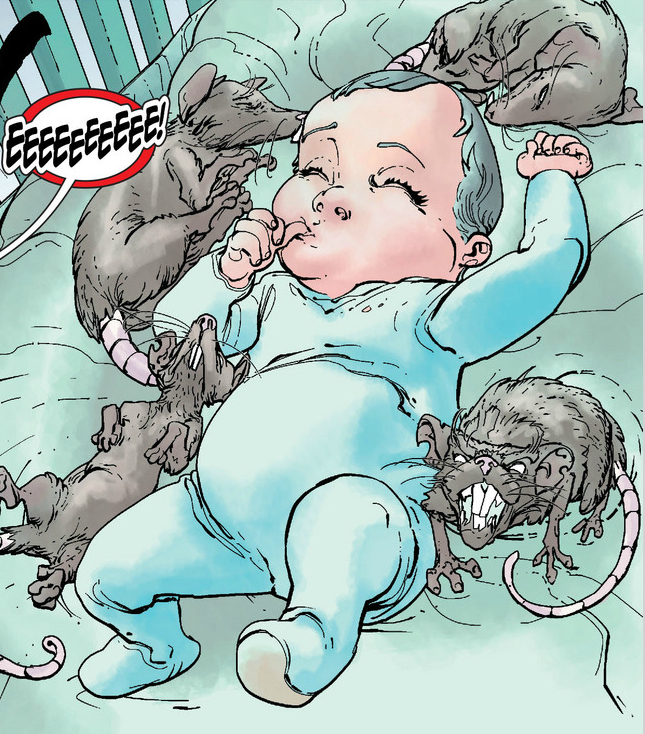
Actually, that panel has both cute and cuddly rats AND scarier, intimidating rats, which I think plays into the problems this issue had finding a single message. Curiously, this was the primary problem with the Occupy movement this series is inspired by. There are too many messages — some of them conflicting — for any one to really stick.
It’s a clever move on Simone’s part to tie that scattershot perception to examining her characters. Team stories inherently have a number of messages going on at once — different characters are experiencing different things at the same time — something we’re generally forgiving of. Simone lays the schizophrenia of her approach on particularly thick, drawing our attention to just how many stories she’s attempting to juggle, effectively drawing the connection between her own narrative muddiness and the confusion over the purpose of Occupy Wall Street. The key is that she connects both to her characters — of course there are different stories; these are different people — reminding us that Occupy Wall Street’s demands were diverse because the people making them were diverse.
It may not make for an effective political movement, but I believe that more democratic approach could make for a refreshing approach to a team story. I keep finding myself assuming Virtue is the lead of this title — she is the leader of the Movement, after all — but it’s clear at the end of this issue that we know the least about her. It looks like she somehow taps into the emotional electromagnetic spectrum of the Green Lantern mythology — she turns yellow while sensing fear — but we don’t know how or why.
I suppose it’s a little off-message that a movement by the people, of the people, and for the people, should be led by a bunch of super-powered kids, but hey, it’s a comic book. That said, I appreciate that Simone is going out of her way to include characters like Vengance Moth — a clear (and welcome) reincarnation of Oracle — who seems to have no superpowers, but proves invaluable to the team nonetheless.
There are a lot of interesting parts here, but I’m not yet convinced the pull together to make any kind of coherent whole. The scope of this title is varied, but that may hinder our investment in ny onw od its parts. Scott called this issue the moment this series has been building towards since it began, but we’ve yet to see any resolution on the Cornea Killer — heck, we’ve yet to get so much as a lead. Now may not be the time to care about that just yet, but it better come soon, or it may just miss its window.

For a complete list of what we’re reading, head on over to our Pull List page. Whenever possible, buy your comics from your local mom and pop comic bookstore. If you want to rock digital copies, head on over to DC’s website and download issues there. There’s no need to pirate, right?
 Retcon Punch
I’ve read other people who were also not enamored with the 2 page backstories but I found it really effective. I felt that it started to tie these characters together and that this was an appropriate time for it. For many of these characters this is the biggest moments of their young ‘hero’ life and it seemed only natural that they would reflect on how they got there and ensured that we the reader were rooting for them even as they were engaging in an act (storming a police station) that a lot of people would associate with villians.
Well said. I wasn’t thinking too much about the timing of the flashbacks when I was reading the book (which means it worked for me), but I’m glad they happened sooner rather than later. We already knew much of what Burden and Katharsis told us (If only in broad strokes), but Mouse and Tremor really benefitted from getting fleshed out some more. When I wrote about Issue 2 I was a little worried about Mouse being a part of this team seeing as he seemed a little “off” mentally, but this shows him to be a lot more coherent and self-aware than I’d have given him credit for, so my bad on that one.