

Today, Drew and Ethan are discussing The Rocketeer & The Spirit: Pulp Friction 3, originally released November 13th, 2013.

“It’s the moment, when the movie … becomes an entirely different movie.”
DJ McCarthey
Drew: I’ve said it before (and I’m sure I’ll say it again): I love thinking about form. It’s one of the most fundamental elements of storytelling, and I believe that studying a narrative’s form informs us more about our own experience reading it than even the best plot or character analyses. I’m always looking for new perspectives on form, and was happy to see John Roger’s post on 3-Point Plotting on Mark Waid’s own Thrillbent. It’s a fairly straightforward introduction to the standard three act structure, but I had never seen it broken down so succinctly into “disruption, reversal, and conclusion.” I was particularly intrigued by Roger’s discussion on the reversal — which he defines using that McCarthey quote — as it explains the all-too familiar experience of a narrative changing direction abruptly after I’m already invested in what was going to happen. What happens when you liked what a story was more than the story it becomes?
The example that’s coming to mind at the moment is Rian Johnson’s Looper (so my apologies to anyone who hasn’t seen it): I was excited at the causality and paradoxes set up by the story’s time travel narrative, only to be dismayed when the story is highjacked by the specter of a telekinetic toddler (sure, the film ultimately re-reverses that conceit, revealing that it was always about causality, but I was already up in arms that there were other sci-fi elements in this time-travel story). I found myself in a similar place as I read Pulp Friction 3, as the straightforward punch-em-up suddenly becomes mired in teleporters and mind-control.
As the issue opens, the investigation has taken our cast back to Central City, where Cliff gets an uncomfortable tour of The Spirit’s graveyard hideout. Meanwhile, Trask sets Betty up in a swanky hotel suite, but instructs her to avoid seeing Cliff. Trask then heads to a warehouse to demonstrate his new television technology to investors. Enter the reversal: Trask’s televisions double as teleportation devices, and can be used for smuggling and all other kinds of illegal activity. As a demonstration to foreign investors, Trask heads back to the hotel to teleport Betty. Cliff fails to stop him, but fortunately, The Spirit is back at the warehouse when Betty arrives. Of course, so are a ton of goons, and The Spirit is quickly overwhelmed. Enter the second reversal: the teleportation somehow made Betty a mindless zombie, and has been instructed to kill a tied up Spirit.
Now, I suppose a teleportation device was necessitated by the disruption — that is, the discovery of Alderman Cunningham’s body 3,000 miles from where he was last seen alive — but hypnotized drones somehow strikes me as a bridge too far. I’ve always respected Waid’s attention to detail when creating believable obstacles in his stories, but a teleportation device that happens to blank people’s minds feels contrived, especially compared to the real-world problems Cliff faces trying to navigate Central City’s narrow streets with his rocket pack.
Or maybe my problem is that having television both transport people AND turn them into mindless zombies seems far too on-the-nose compared to the lighter touch Waid took in the first issue. In our discussion of that issue, I posited that television was actually standing in for the comics industry, but the notion that the audience’s experience is the most valuable consideration can be true of any medium. The first reversal — that television is a powerful tool of transportation — seems to work for any type of storytelling. Indeed, when Trask refers to it as “the greatest power history has ever known,” we understand that he’s actually talking about the concept of narrative.
Maybe the mind control piece can speak for all media, too (at least when controlled by a few malevolent corporations), but it feels oddly reserved for television. Or maybe it’s just the ubiquity of television in our lives that makes it most often vilified for brainwashing people. There are plenty of moviegoers that are highly susceptible to suggestion (think about how rich Michael Bay is), and this could still be a cutting commentary about the Big Two in the comics industry. Unfortunately (or maybe fortunately), the commentary doesn’t extend to all media. I don’t think I’ve ever heard a parent concerned that books are rotting their child’s brains. Plays, poetry, operas, ballets and puppet shows are also somewhat immune to these criticisms. This story by no means needs to comment on all types of media, but the fact that it doesn’t makes that specificity feel intentional — that is, I think television really is the target of these barbs, in which case, it’s not saying anything we haven’t all heard before.
That aimless quality is actually broadcast from the very first scene, where The Spirit seems to enjoy creeping Cliff out. Actually, it’s not even clear to me why Cliff is creeped out — everything Spirit says is completely logical, given the circumstances. Of course, that doesn’t stop The Spirit from having some fun with Cliff when they run into each other later.
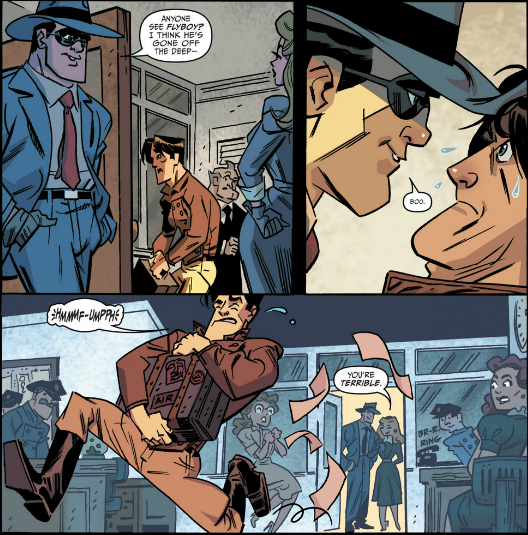
Don’t they have a murder to solve?
I don’t know, Ethan, as much as I liked what this series was, I’m not so sure about what it’s become. Are you having trouble adjusting, too, or am I just over-thinking what’s supposed to be some frivolous fun? Ethan: I’m guessing that the aimless introduction of random, new ideas like using television to broadcast bullets and brainwash people is a function of the era and medium that the issue is imitating. My (admittedly limited) understanding of this kind of pulp fiction is that it capitalized on story over plot. Start with a basic plot – Nazis are plotting to blow something up, Soviets are plotting to poison someone, whatever – and it’s up to the good guy to stop them. Novels of the time tend to handle this thing by making the hero a really good marksman, or happen to have the loyalties of a crack team of war buddies, and they overcome the odds by just being so good at what they do. The mileage comes from basic narrative funcitons like building up interesting characters and using the standard escalation/resolution format. In pulp magazine stories, that doesn’t quite cut it, because A) you don’t have the number pages to do that and B) the point is to present something sensational that will get someone to impulse buy it off the rack.
With those limitations, authors tended to turn to crazy, outlandish gadgets, paranormal phenomena, or extreme/superhuman characters to get their sales. I remember devouring the Doc Savage books of the 30s because I couldn’t wait to see how the Man of Bronze was going to use his impossible strength and absurdly enhanced martial arts skills to punch the next villain in the face. He was a kind of Khan Noonien Singh of the World War years. In that respect, this issue of Rocketeer & Spirit is staying true to form: sure, there’s a murder that’s supposed to be under investigation, but look! Brainwashing teleportation beams! Wouldn’t it be amazing if you could send physical objects through the airwaves just like you can send pictures and sound? Wowee!
After such a heavy diet of straight-up hero comics with ridiculous superpowers and machines, it was equal parts disorienting and refreshing to read about characters that are a little more earthly, regardless of the zany devices introduced in this issue. The best example of that is in Spirit’s self-introduction to the Rocketeer:
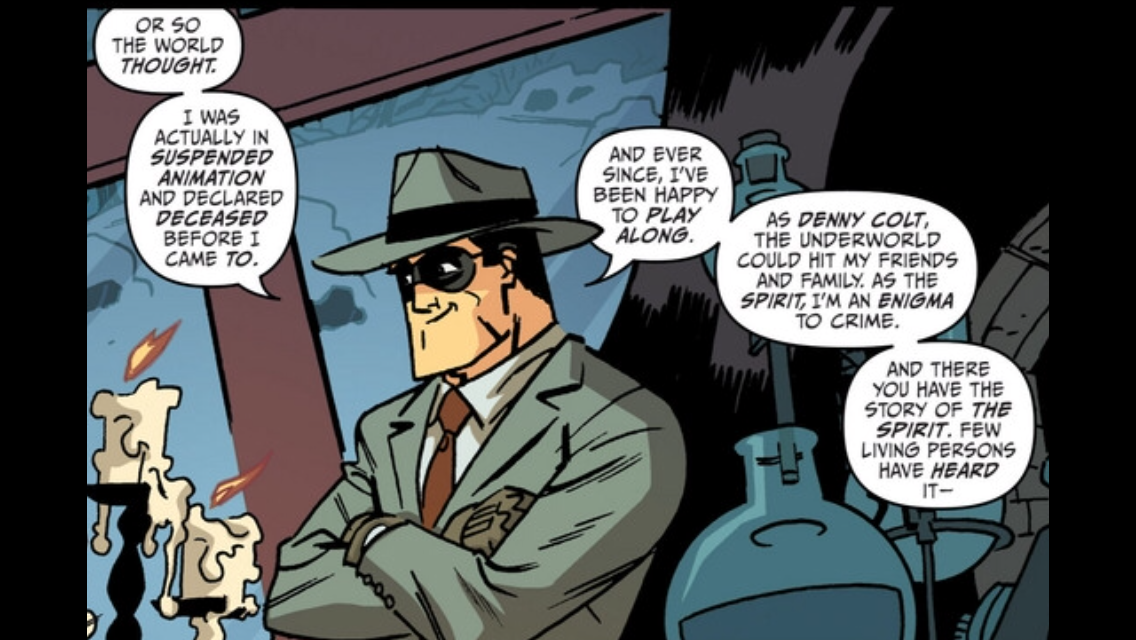
So, the core of the Spirit’s identity (including his name) is the origin story that he was killed and came back to life to fight crime. Cool! Except, wait, he didn’t actually die, it was just “suspended animation” and the resurrection story is just a PR thing. Ok, well, if he didn’t actually die, maybe the near-death experience gave him superpowers – made him bulletproof, or super-smart, or super-strong? No? Ok… what is it about this guy that’s special, again? The answer seems to be that there isn’t anything that especially sets him apart in a useful sense; his identity as the Spirit is more of a character trait than a crime-fighting asset. Sure, he says that being officially dead frees him from the cares of the world like a career and romance, but he still seems to spend an awful lot of time around that Ellen girl. At least the Rocketeer has his jetpack to make him stand out: again, the attention grabber isn’t necessarily the person, it’s the gadget. How DOES he fit a chemical rocket AND the fuel AND his helmet into that little briefcase? The world may never know.
Now that Trask has an hideously unrealistic toy of his own, he’s got big plans: “transmitting not just pictures but matter electronically,” “smuggle cash and jewels and precious metals across the tightest borders in a world at war!” Yet, given what we see of what the teleporting and brainwashing gizmo does, I say he’s actually thinking a bit small.
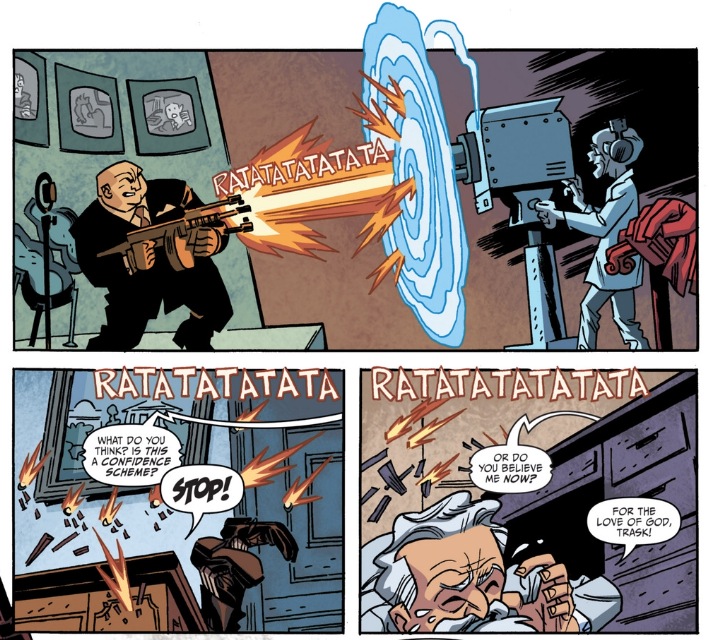
Let’s break that down: Trask points one (1) tommy gun into the lens and fires. Meanwhile, in six (6) separate locations, the bullets exit the screen and riddle the walls with bulletholes. Trask has found not just a teleporter; his scientists have provided him with a replicator, a way to blatantly disregard the law of conservation of mass. Whether or not it has the ability to destroy matter, it certainly seems to have the power to create it. The only limiting factors seem to be the object you feed into the system and the number of screens you have. Even if you’re just trying to do some crime, never mind sending a diamond from point A to point B when you could instead send the same diamond to points A, B, C, D, E, ad infinitum. Once you’re in the business of replicating mass, it follows that you can do the same with energy. This thing is by definition a ticket to a post-scarcity civilization!
Drew – I do think that the mish-mash of effects and commentaries the television-ray seems to contain do result in a less focused story. Even so, I’m glad Waid’s writing it instead of me, because I would clearly be unable to resist spinning this sucker off into the technological singularity in a heartbeat, and that would be a much odder thing to read.

For a complete list of what we’re reading, head on over to our Pull List page. Whenever possible, buy your comics from your local mom and pop comic bookstore. If you want to rock digital copies, head on over to DC’s website and download issues there. There’s no need to pirate, right?
 Retcon Punch
Ethan, I’m glad you brought up the replicator aspects of this device — they distracted me, too. Like, even if it literally only worked for bullets, you could still start a bullet factory that was 100% profit. Also, just thinking about how it might work if you put your arm through it, but your arm interacted with different things in the different locations kind of blows my mind. That’s some quantum mechanics, Schrodinger’s cat shit.
I fully agree with the thinking small comment by Ethan. Comics do this all the time and the older I get the harder it is for me to deal with. It is silly when a smart villain has a device they use for crime when they could make far more money using it in a legitimate business. You can have this sort of silliness if the stories are not terribly grounded but the more reality you bring the less this will work.
I don’t think anyone was asking for a story where TV to also teleports matter. That seems to bring so much more baggage then it does good narrative potential.
Still I much enjoy the interactions between these characters and it is enough for me that what ever story puts these forward is fine by me.