

Today, Drew and Greg are discussing Velvet 3, originally released January 15th, 2014.

Drew: It’s amazing how easily gender-bending a trope can force us to confront ingrained assumptions about gender. No matter how progressive our views are, watching a female character rescue a male, or seeing a guy in the kind of revealing clothing women are expected to wear as a matter of course, continues to feel incredibly alien. Spy stories, with their own unique set of gendered tropes, are a particularly ripe subject for gender-bending, and Ed Brubaker struck upon a brilliant one with Velvet‘s premise: what if James Bond (or any other beloved british spy) was a woman? It has allowed him to subvert many of the stereotypes we often accept as part of the genre (and its period setting), but issue 3 reveals that it also allows him a fresh perspective on the collateral damage of all that spying fun.
This issue finds Velvet attempting to track down a “missing day” in Jefferson’s reports, which she’s hoping will lead to his killer. Her only lead is Marina Stepanov, the trophy wife of a Yugoslovian General, who Jefferson had spent the previous night with, so with the help of Burke, Velvet heads to Belgrade. She infiltrates an event the General is attending, but discovers that he’s there with a different woman — he must have turned Marina in for treason in the wake of whatever damage Jefferson caused with the information he extracted.

I know this kind of collateral damage comes up in Bond films pretty regularly — sometimes the girl is killed by the bad guy, sometimes Bond rushes to her rescue — but it’s almost always a matter of emotional significance, not of strategy. Bond has some amount of affection for the damsel in question, so opts to come to her aid (while working to destroy her captors/would-be killers). Here, Velvet’s only interest in Marina is for whatever information she might have. The fact that she’s in prison just establishes a different type of obstacle for getting to her.
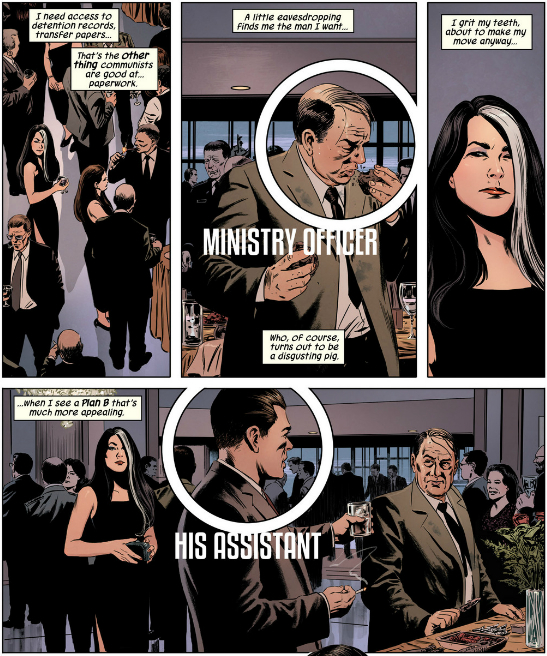
Of course, first she has to learn where she’s being held, which gives Velvet the opportunity to do some seducing of her own. She’s able to convince the assistant to a Ministry Officer to take her back to his office, where she can find the paperwork she needs to track down Marina. It’s boilerplate spy stuff, so I’ll spare us any discussion on the gender reversal, but I do think this turn is remarkable in light of the damage Velvet is already in the process of cleaning up. Whatever punishment Marina received, this assistant’s actions are much more knowingly irresponsible, and he’ll likely receive much harsher penalties. To me, this really drives home the fact that Velvet’s rescue of Marina has nothing to do with a sense of duty or justice — she needs Marina, so she’ll help her escape, but that doesn’t mean she won’t gladly put some other schmuck in the same situation.
Velvet ably extracts Marina — who is significantly worse for wear — and pumps her for questions. She’s willing to cooperate on the condition that she is able to see her son one last time. Velvet acknowledges that it’s a stupid risk, but it’s the path of least resistance, so she agrees to help break in to the General’s apartment. Only, the General doesn’t have a son — Marina was just hoping to get close enough to the General in hopes of exacting some revenge. Things…don’t exactly go to plan.
 Velvet shoots the General, but it’s too late to save Marina. She does finally agree to tell Velvet everything she wants to know, but with a knife-wound to the gut, it’s easy to imagine that they may not have the time to be as thorough as Velvet would like. Oh, and they’re still inside the General’s heavily guarded apartment.
It seems Brubaker is setting up another sketchy lead for Velvet to pursue, but I’m totally on-board. If this issue is any indication of what this series could be as a lead-of-the-month thriller, I would gladly watch Velvet globe-trotting with little to go on besides a name and a location. This issue is brimming with procedural exposition –basically all of the information here is new to us — but it never once feels boring or overly explanatory. Half of that is some very taught writing from Brubaker, but the other half is Steve Epting’s impeccable art, which is able to turn each of Brubaker’s words into the thousands he realizes in each panel.
Greg, I had an absolute blast with this issue, and I continue to be impressed with this series. It has everything I want in a spy thriller, yet feels unlike anything I’ve seen before. We still don’t have any clue what Jefferson got himself into, but I’m loving all of the mystery and intrigue in the meantime. Are you enjoying this series as much as I am?
Greg: I don’t know about you, Drew, but when a narrative work is this immediately engaging, propulsive, and invigorating, most of the functions of my “critic brain” are shut off. In their stead, my “this is just super duper cool brain” kicks in overdrive. I can’t recommend this issue enough for the sheer amount of badass joy derived from it. Stuff like this is the reason I’m into stuff like this. Also, quick Sidebar: I enjoyed your analysis of the spy gender flip; if you’re looking for a filmic exploration into that, look no further than Stephen Soderbergh’s Haywire.
Epting’s art is indeed impeccable, to say the least, and I am struck by a simple yet brilliantly absorbing choice he makes. In the, as Velvet puts it, subversive world of the intelligence field, actions made and decided are metaphorically dark, shady, and cloaked in ambiguity. Thus, Epting renders this stylish world as being literally dark, shady, and cloaked in ambiguity; which is to say, in many of the panels where important plot elements take place, lots of visual information is obscured by shadows and darkness. Such a simple visual realization of Brubaker’s world; such a staggeringly effective execution.

I’ve always been interested in what these spies must be like just to hang out with, as human beings. I mean, they can’t communicate exclusively in cleverly badass banter and compassionless killing, right? These people are actual people, right? Here, we’re presented with two intriguingly dissimilar glimpses into the psyche of Velvet, and how she (and perhaps representatively, spies in general) deals with her unorthodox work.
Velvet finds the target of her extraction mission: Marina, lying in a dank jail cell. She begins to introduce herself as a friend of… then, brilliantly, Velvet realizes she doesn’t have the information of X-14’s cover at hand. It requires a moment of recollection, of utterly human forgetfulness and realization, rendered brilliantly by Epting shoving a brightly colored reminder panel into the middle of the external action, and Velvet’s internal dialogue. This moment, followed immediately by Velvet’s admission to feeling rage at Marina’s abuse and pain, does so much in terms of empathizing with our hero, rather than merely admiring her from afar. Because she sometimes overlooks or forgets things in the heat of the moment, because she admits to not being a blank superhero, her actions are that much more thrilling, because we recognize traces of ourself in her. I might call this The McClane Effect.
However, we later see a jarringly dark example of how Velvet deals with her job, one that feels foreign and emotionally cold to me. Marina’s request to see her son for one final moment before agreeing to give up information and leave her old identity behind forever seemed reasonable. The least someone could do, really. Yet Velvet treats this as an annoyance at best, and a potentially deadly mission failure at worst. She refers to following through on the request as being stupid, and when assessing the psychology of the recently traumatized Marina, she merely concedes that “handling assets is a delicate thing.” I can understand having to rationalize charged elements of a job to keep your sanity, but damn, calling a human being an asset instead of a human being is frigid.
Ultimately, though, Velvet is right and I’m wrong, because Marina was straight up lying about having a son, resulting in her failed quest for revenge and probable death. So where does this put Velvet on the Spies As Normal Human Beings Continuum? I’d say she’s healthily in the middle between the stone-faced emotional repression of Daniel Craig’s Bond, and the lemon-faced emotionally volatile explosiveness of Claire Danes’ Carrie Mathison. Perhaps its this measuredness, this ability to draw the best of all worlds in terms of playing with the spy genre, that makes this issue such a marked success.
Probably, though, it’s just ‘cause of how awesome it is. Like, seriously, super awesome.
For a complete list of what we’re reading, head on over to our Pull List page. Whenever possible, buy your comics from your local mom and pop comic bookstore. If you want to rock digital copies, head on over to Comixology and download issues there. There’s no need to pirate, right?
 Retcon Punch
Hey, so I didn’t think this was a big enough deal to mention in the write-up, but Im having a hard time following the “dialogue in italic font should be read as a foreign language” affect. Like, I’m still not sure what dialogue in this issue is italicized. Frankly, I don’t think comics lettering ever does italics that clearly — lettering is always slanty, and asking us to parse degrees of slantiness just seems too subtle — which means I’m either failing to notice when it happens, or am paying WAY too close attention to the specific slant of the letters in hopes of picking up on it. That’s a shitty either-or, and I know it’s not what Brubaker and Epting are going for. I don’t really get what the aversion to the “less than” and “greater than” symbols are, but another workable option would be a different color for foreign language text. I get that this is petty and ultimately doesn’t matter, but when the title page and the letters introduction directs my attention to an affect, it makes me think it must be worth paying attention to. Anyone else have difficulty with this?
Yes I sure did! Thank you for bringing that up.
Admittedly I read this online and wasn’t enlarging every panel, so some of the typing looks a little scrunched no matter what, but yeah, I had a hard time as well. It appeared to me that all the dialogue in Velvet’s internal narration was in italics, but I know she wasn’t thinking in a foreign language the whole issue, so…yeah.
I’m assuming at least half the dialogue this issue was in a foreign tongue, so I can understanding wanting to find a way to indicate that that’s slightly less distracting than , but I agree that the italics aren’t working as much as they probably should.
I actually wondered if we were supposed to be reading all of her internal monologue as in another language (wouldn’t that be an interesting twist Brubaker wouldn’t want to draw our attention to?). Then again, they seem to be implying that she’s writing this in a journal or something (note the use of lowercase letters throughout her voiceover), and italics are a pretty standard shorthand for handwriting in comics. Just goes to show how confusing the “italics as foreign language” thing really is.
Honestly, unless other characters aren’t going to be able to understand them, I don’t think it’s necessary to indicate when something’s in another language. Like, it always bugs me when a superman flashback issue takes place entirely on Krypton and there are brackets around everything. Who cares?
Ultimately, the fewer times the fonts change and the fewer extraneous marks, the easier the dialogue is to process. If it’s of the utmost import that I know that someone is speaking Russian (like it’s a clue or they’re sharing information that we’re supposed to know, but the other characters aren’t) then, by all means, indicate it. Otherwise, I’m happy to pretend it doesn’t matter what language they’re speaking.
Oh, I totally agree, which is why it bothers me so much that it’s so subtle — if it’s important enough to make a distinction, it must be important, right? I wouldn’t think twice about it just all being in English, but the fact that it’s mentioned on the title page and in the letters draws my attention to it in the most frustrating way possible.
I agree with Greg that when something is this good, it can be hard to keep the critic side of the brain going. Brubaker and Epting know exactly what they are doing, and this book is an absolute thrill ride from beginning to end. They make this look easy, when I know that it definitely can’t be.