
 Today, Drew and Patrick are discussing 100 Bullets: Brother Lono 8, originally released February 26th, 2014.

We are what he made us to be. To try and be something else…is the greatest sin of all.
Lono
Drew: I didn’t know religion growing up. My parents never took me to church, and somehow, none of my childhood friends ever went, either. It wasn’t until I entered middle school that I made friends with people of any kind of faith — run of the mill midwest Lutheranism, but they might as well have been the pope in my sheltered mind. Being both 13 and an asshole (I know that seems redundant, but I only grew out of one of those), I enjoyed picking fights with them over simple religious tenants. The simplest — why do bad things happen to good people? — was most commonly answered with the wimpy cop-out of “God works in mysterious ways.” That seems like a simple enough “we’ll never know” (and was probably only ever invoked to get me off their backs), but as with most religious answers, that simplicity masks a world infinitely more complex than the question itself. Is everything that ever happens part of God’s “mysterious” workings? If “bad” things can be part of God’s plan, doesn’t that throw the whole notion of morality out the window? These questions lie at the heart of Brother Lono 8, though the answers Brian Azzarello and Eduardo Risso come up with may not be what anyone suspected.
The plot here is as straightforward as can be — Lono rains fiery vengeance upon the likes of Las Torres Gemelas — but as with the rest of the series, it’s the details that really matter. Take, for example, Father Manny’s quasi-crucifixion. I noted last month its bizarre combination of christian and anti-christian imagery (and the loadedness of making the most overtly religious figure a sacrificial lamb the month before that), but Azzarello and Risso take it a step further here, cursing Father Manny with boils and blindness.

Effectively, he’s been the recipient of an anti-miracle, thoroughly punishing the most devout character in this series.
Lono, on the other hand, suffers a crisis of faith so profound, one might call it a conversion, yet he ends the issue kicking back with a big cigar. The implication is that maybe amoral, even faithless men, are necessary to do (and are rewarded for doing) God’s work. Manny was too passive to stand up to the evil Las Torres represented, but Lono had the strength and ability to do so on his own. He is able to affect justice against those that would threaten a mild-mannered priest and an orphanage full of innocent kids because he is neither mild-mannered nor innocent. He’s exactly the necessary evil, no more, no less.
Azzarello fills in the contrast between Manny’s piety and Lono’s descent (and their respective rewards) with Sister June (who we learn here is actually Linda May). June’s faith was a put-on, and while she ultimately isn’t without some kind of morality, she is more than capable of getting her hands dirty. Her reward? A gunshot wound to the belly — somewhere in between permanent blindness and a relaxing stogie.
If we can take everyone’s status at the end of the issue — dead, wounded, or alive — as indicative of God’s desires (and that’s a big “if”), it’s clear that the ability to do what needs to get done is paramount. That is, so long as you aren’t also threatening a bunch of orphans. Lono is similar to the men he’s fighting in many ways (as Maddon points out around this issue’s midpoint), but because they’ve been established as being evil, we understand their enacting of their own will as bad, while we understand Lono’s enacting of his will as justice. Actually, with Las Torres being so overtly, unequivocally evil, the moral here of doing what needs to be done may not require the judgement (or even existence) of God.
That’s a moral that’s thrilling right down to the 13-year-old atheist in me. Not because it disavows the existence of God, but because it’s so deeply ambivalent about it. Maybe there’s a God, maybe there isn’t. Maybe he punishes the bad, maybe he doesn’t. Maybe our concepts of good and bad hold true, maybe they don’t. It edges “God works in mysterious ways” a little closer to just flat-out accepting that the universe is a chaotic, random place. Again, it doesn’t mean there is no God, but it suggests that there ultimately may not be much of a difference.
Of course, for Lono, it’s not so much that he doesn’t believe in God, but that he may no longer believe in the kind of prescribed lifestyle that the Catholic church would like him to. Inasmuch as there is a plan, Lono is part of it, no matter what. Indeed, according to the quote I opened with, it would be wrong for Lono to restrain himself. To paraphrase Oscar Hammerstein, fish gotta swim, birds gotta fly/Lono gotta cut a hand off some guy.
Oh boy, Patrick, I’ve rambled on here, and still left plenty of juicy tidbits on the table (just like that hand I mentioned). I didn’t really dig into Cortez’s ultimate fate, or even Maddon’s monologue, though both illuminate Lono’s actions in interesting ways. I also neglected to talk about Risso’s art in any meaningful way. Or that Craeno’s ringtone for Cortez was a love song whose refrain translates to “do not tell me no, please just say yes.” Did any of these details catch your fancy?
 Patrick: Oooh! So many details to choose from! From that list, my absolute favorite is Maddon’s monologue to Lono — partially because of the powerful poetry of Azzarello’s language, but also how it expands on your idea of whether or not it matters if there is a God. Let’s pull the whole speech out and look at it here.
I’m not going to turn around. I’m not going to see your face. I’m not sure that’s going to spare me but, what the fuck… it might.
Already, we’re off to an interesting start – Maddon’s making the choice to not look at Lono. This is like God, you can either acknowledge a God or ignore it, the end result (regardless of the existence of God) is the same. Whatever’s going to happen to Maddon is going to happen anyway. This turn where he decides that not engaging with Lono might possibly save him is classic denial. Just as denying the existence of Lono won’t save him from a brutal death, so too will denying the existence of God not save him from judgment.
You’re obviously here to kill everyone. I don’t know why exactly, and I don’t fucking care. There’s a lot of blood on your hands, I’m guessing… Mine too. I been in yer shoes. What I never get is why someone with a gun pointed at them begs to know what they did to get it there. At that point, why would you fucking care? It’s as fucking real as reality fucking gets, and you want to know “how did I get into this spot?”
This is is the situation Lono has found himself in for the majority of this series: faced with a crisis of faith, Lono does little to actually reform. Sure, he throws himself in the drunk tank every night and actively tries to shut himself down when he’s moved to lust (blood or otherwise), but he can’t actually change.
The only question to ask is, what can I do to get out of it? When you hear that? That fucking question makes the gun heavier, doesn’t it? Yes sir. You start considering options. Most of the time there’s nothing we can do, but still… the gun’s heavier. And the question’s more of a killer than you are. I mean, there will come a point, man, where that gun is too heavy to lift. It’s inevitable. The trick? Is living to that poi[nt].
This is where Azzarello starts playing around with a couple different ideas at once. The gun represents judgment, and the man holding the gun is God. For as much figurative weight as that carries, it’s also almost literally true. The man with the gun decides who lives and who dies. Redemption — or so Maddon claims — comes from asking over and over again for the will to change. That’s part of the reason we are able to buy Lono’s journey as redemptive, even when it ends in a gratuitous bloodbath: he tirelessly fought to find a way to change, even if he never found it. Then there’s the matter of “the gun,” which Maddon attempts to counteract with a knife. And you know the old saying – never bring a knife to a gun fight. Cortez actually makes a similar reference a few pages earlier.
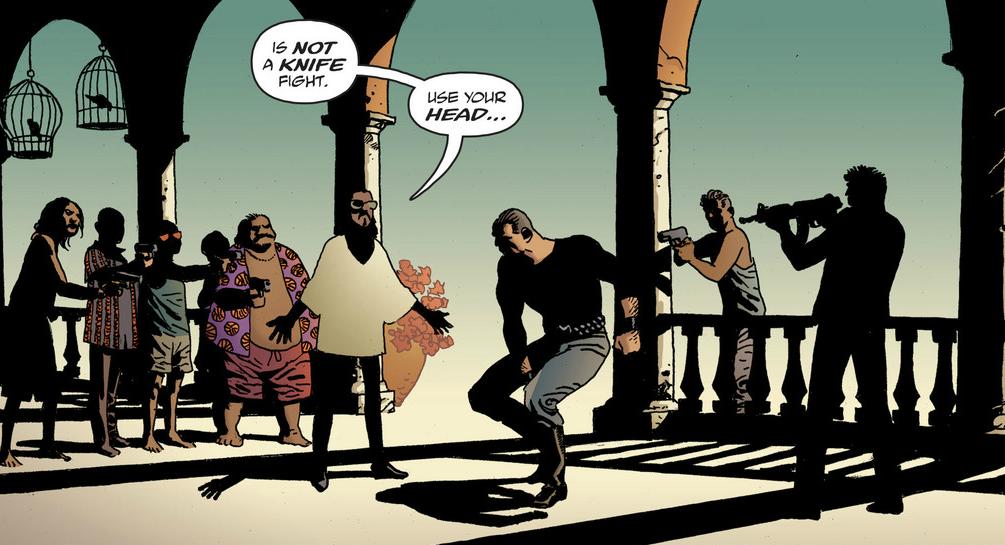
Now, I can’t quite wrap my head around what this means. Perhaps the only point is that fear of judgment by a divine presence isn’t the only thing that motivates people, but the knife is beaten at every turn in this issue. At least as far as Lono is concerned, that judgment is the be all end all. I think it’s interesting that we don’t see Lono collecting Maddon’s hand — one second it’s there and the next, there’s a gush of blood and it’s separated from his arm. You’d think it was a gun, that Lono shot the hand off, but the BAAMs, BOOMs, and BDUDDAs from the other gunfire in the issue is nowhere to be found. Just one strange sound effect that I sure as shit can’t identify: NNTCCCK.
Well, now I’ve rambled on at length without mentioning Risso’s art. Well, we’re all bad people: maybe I can just kick back and smoke a cigar in the ruins of this Alternating Current.
For a complete list of what we’re reading, head on over to our Pull List page. Whenever possible, buy your comics from your local mom and pop comic bookstore. If you want to rock digital copies, head on over to DC’s website and download issues there. There’s no need to pirate, right?
 Retcon Punch
Also, I don’t know about anyone else, but hearing Cortez refer to his bottle-brother as “Miguelito” sorta hit me right in the heart. Rat bastard though he may be — and creepy as shit as jar-infant is — there’s a real vulnerability in the moment the bottle breaks. Just like the hand, it’s an effect where we don’t explicitly see the cause. I think that further emphasizes the idea that Lono is an instrument of God.
For all my talk about this issue being neutral on the presence of an actual God, the action here pretty clearly sees virtue in things happening as they should. Like, Lono isn’t an entirely chaotic force. His actions may be morally grey, but by the issue’s end, the right people have been killed. There’s still some kind of sense of right and wrong. I don’t mean to imply that right and wrong needs to come from religion — I think we can all agree that killing a bunch of orphans would be wrong, regardless of our faith — but that there’s some kind of cosmic justice here. Fate? Karma? Whatever it is, there’s more subtlety to it than simple “might makes right,” which I think gives this series more nuance than it might seem at first blush.
HEll of an issue. Nrealy Blood Meridianesque. It also went back to the 100Bullets jazzy phasing (chopped up and puzzling) instead of Brother Lono’s more meaty way of telling stuff. This is akin, I think, to how Azzarello wrote Rorschach, that when the Kovacs part (the victim part of him, the one who almost seemed to want social justice) of him died the book took on a Watchmen like grid and writing more cold and calculated like the original book’s.
But to the important stuff. What did you think about Brother Lono? I mean. Must been quite a punch in the gut! With nearly 7 issues of Lono holding back as much as he could and then everything exploding in a near hypnotic, brutal as it is brilliant blaze of carnage!
Myself, I loved it. Especially how creepy Lono’s final monolouge was, that instead of letting go of God had a go at “created in his image”.
And what do you think about Pico? Did he live? June/May was driving him in the truck when last seen (and she had tears in her eyes and the fitting caption “You start considering options.”), and Maddon was last seen walking to a medical center nearby (who’s hand Lono took almost as a piece of biblical justice) which I think was meant to show him not only as just a man, but also that the center was nearby (for June being able to drop Pico off at).
And to end this rant. Are you guys thinking about giving 100Bullets a go? While not as brutish as Lono (who got some seriously drokked up moments in the book) and more mysterious, it’s as refreshlingy told. No answers, just questions for the reader to put together (and perhaps him/herself with them). While others love their Watchmen or Dark Knight, I love my 100Bullets. The book is soo good it enabled me to enjoy jazz for one thing!
You know, I’m very interested in picking up 100 Bullets. I have a couple of the trades, but I haven’t gotten around to reading the whole thing (in my defense, 100 issues is a little intimidating on top of what I’m already reading). I really am dedicated to reading everything Azzarello has written, though — I’ve been kicking around the idea of an essay that explores his use of music in comics for a long time, and 100 Bullets would kind of necessarily be the centerpiece of any discussion Azzarello’s work.
Cool that you picked up his use of music! 100Bullets is filled with it. Springsteen’s Atlantic city even having an integral part of it.
I recommend reading Bullets something like this. Gives you a good grip without being overwhelmed by it’s ambiguity of what it’s about. (something I don’t think anybody knows 100% besides Azzarello)
(1-2-3) the main players, (4-5) world building, (6-7-8) Shepherd’s play, (10-11) Lono’s step’s up, (12-13) end game/how it began.
And I noticed you on RcP picked up quite a bit about it in his Comedian. I especially love his use of Killing Joke – Eighties (the band akin to Alan Moore’s joker, and the chorus “I had to push” fitting what they say about Blake in the first issue)
I’v been toying with the idea to write a review blog about 100B. Reviewing each issue and some analysis.
What I meant by showing Maddon “as a man” was that he too only was one in the end. Same thing with Cortez and Craneo. While easy to fear due to their lack of fear, they where still capable of it. It just took someone as Lono to give em that, whom it took the whole of 100Bullets to introduce it into.
Some notes/ ideas/questions as I read Brother Lono as a whole and tie it to the original series:
On pages 1 and 2 of issue 1, I feel like this is Lono burying everyone he just killed in this issue. He is grim and sober, not the grinning hellion from the 100B series proper. It seems then that whatever station he achieved at the culmination of the series, it is worn with a heavy crown ( A crown of thorns? Haha)
This issue also shows what a scumbag Cortez is right off the bat, what a savage as opposed to the cool, smooth veneer he shows to Maddon, Fr Manny and his “business associates”. He is a liar, a two-face, a Jekyll and Hyde figure as hinted at by the “Las Torres Gemelas” facade he hides behind (and, eventually, symbolized and juxtaposed by the innocent, long dead corpse of his own twin)
I like how Muerte could possibly be fingering (ha– snip snip) Sr June– er, Linda May– at the bus terminal but she slips by because Craneo thought he was identifying Señor Butler
In issue 2 Cortez asks Butler if he’d be able to move product in Chicago. His betrayal of Butler (scumbag!) foreshadows his attempts to put the screws to Maddon.. is it fair to assume that Maddon is from Chicago or has some connection there since Cortez turns to him achieve what Butler could or would not? At the mention of Chicago, I think of four particular characters from the original series: Dizzy (sadly deceased), Loop, Victor Ray and his daddy Will Slaughter… more on this in a minute. As Lono rips through Cortez’ men (and brings down yet another “House” as he did in the original series) he encounters Maddon, whose “How do I get out of this spot/start considering options” speech mirrors his own predicament at the hands of the Dog as well as Lono’s own position throughout the series: Forget how I got here, how the fuck do I get out alive? In the end, Lono succumbs to his true nature and not only destroys Cortez’ world BUT USURPS IT. Maddon is allowed to live, as we see him staggering towards some medical help, but WHY is Maddon alive? Because Lono is now Cortez and Maddon is working with (for?) HIM now. Lono, who only wanted to be left alone at the start of the series, got himself into Cortez’ compound and took it apart from the inside out. He now severs Maddon’s hand (his RIGHT hand, wink wink) and keeps it as his own Cortez-like trophy.
The severing of Maddon’s hand, by the way, is the coolest two panels maybe in the history of comics. Are we to infer that Lono snatched the knife out of midair and cut Maddon’s hand off while it was still extended from the throw? Pure Minuteman badassery right there.
Now, Azz has mentioned that he might revisit the 100 Bullets world in another series, and who is still alive from the original series? Oh yes, Loop, Victor Ray and daddy Will Slaughter. Would a future series bring Victor and Will and/or Loop into contact with Maddon and, by extension, Lono? I notice Trish went out of her way to give Maddon green eyes. Could be related to the Ray/Slaughter clan? (Distant cousin perhaps, in my best Irina Spalko impression?) I like to think of the 100 Bullets story continuing, even in these small spurts, so cool to think as this story as the precursor to a larger story Azz might be developing.
You know, doing these discussions issue-by-issue, we sometimes lose scope of the kind of call-backs and foreshadowing you mention here — something that is especially important for a miniseries like this. I haven’t had a chance to go back and re-read the series (I got a little distracted Wednesday night tracking down the song Craeno had as a ringtone), but I’m looking forward thinking about it as a whole. Parsing the themes issue-by-issue has been an illuminating exercise, but I think it will hold together in a different way when taken together.