
 Look, there are a lot of comics out there. Too many. We can never hope to have in-depth conversations about all of them. But, we sure can round up some of the more noteworthy titles we didn’t get around to from the week. Today, Drew and Patrick discuss Forever Evil: Arkham War 6, Green Arrow 29, Action Comics 29, Batman Superman Annual 1, Punisher 3, Nova 14, Uncanny X-Men 18, Starlight 1, Velvet 4, and Daredevil: Road Warrior Infinite Comic 2.
 Patrick: The tagline for Alien Vs. Predator was “whoever wins, we lose.” It’s an oddly aware criticism of the film itself, but it’s meant to sound menacing — as though the only thing we liked about Alien and Predator movies was watching people die. As it comes to a close, it’s clear that Forever Evil: Arkham War suffered from this same problem. Even as Peter Tomasi attempts to ground Bane, by dressing him up as Batman, and tries to make monstrous the other side — Scarecrow et. al get doused with Venom — it’s still totally unclear who we’re supposed to root for. Who exactly the Talons are fighting for seems to switch on a dime, and the utter pointlessness of the whole conflict is underlined by the way Penguin is able to swoop in at the last second to gently request that the fighting stop. The whole journey has been fueled by such stupid shit, and I think Tomasi might be making that point by having the brainier villains turn into hulking venom-beasts for the finale. It’s hard not to take the Penguin’s side when shows up, sarcastically clapping for all the senseless violence. You’re right, Oswald, let’s move on.
After a few months of staying the same place, Green Arrow 29, eschews set-up for release, cashing in many of the emotional chips laid out since Lemire took the series over last year. The storytelling takes a little bit of a leap, and we catch up with Ollie in Prague as he’s about to finally confront the Outsiders head on. This way, we’ve actually got all of the most emotionally relevant pieces on the same board and interacting for the first time. Andrea Sorrentino is a master at depicting the schematic precision of Green Arrow’s attack, and there he’s able to show that skill off a couple times throughout the issue.
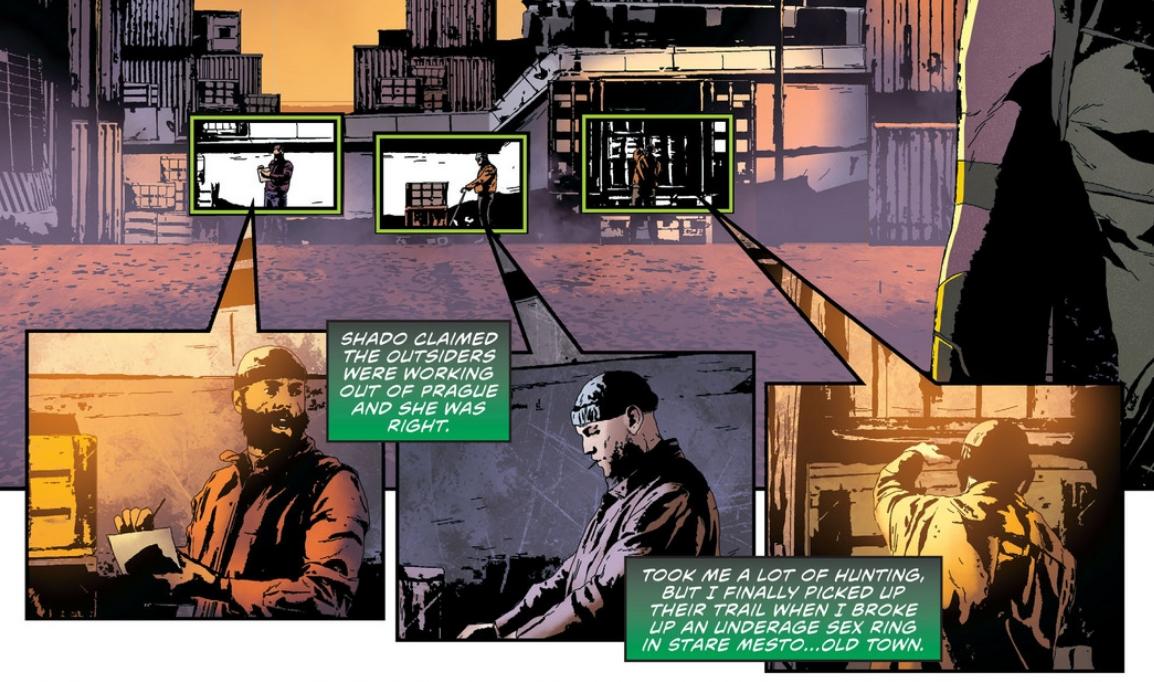
As the heavier shit settles in towards the end of the issue, Sorrentino affects a churchy stained glass window boarder, giving that final moment all the space and solemnity it needs. Drew, don’t be coy — out and address that arrow to the forehead right away.
Drew: Yeah, an arrow through the head seems pretty dire, but don’t forget: Ollie has come back from worse — remember how this series was written by Ann Nocenti? In all seriousness, though, I was a bit thrown by the emphasis this issue puts on Emiko, poor, ignorant Emiko. Her loyalty is in question when she learns the truth, but that only serves to emphasize how fragile the truth is in this series. That is to say, Ollie’s appreciation for the “truth” has no more authority than Emiko’s — he believes what he’s been told by someone who has plenty of reason to lie (oh, and also he doesn’t fully trust that person now, anyway). Literally anything can happen, which makes me way less invested in the threat of an arrow to the head.
Then again, Greg Pak is turning “anything can happen” into a huge asset in Action Comics 29. Pak has managed to hold onto this series focus on Superman’s past AND his relationship to the US Military, all while telling fun, emotionally charged “present day” stories. The wrapping up of the Imperial Subterranea arc is almost inconsequential, affording Pak the space to really let the sparks fly between Clark and Lana. Long-time friendly relationships between a superhero and a civilian are woefully underrepresented in comics (Matt Murdock and Foggy Nelson is the only other example that jumps to mind), and Pak nails it perfectly here, leaning hard on how their childhood memories affect them to this day.
It’s an appropriately nostalgic issue, but Pak demonstrates that nostalgia isn’t inherent to his take on Superman in Batman/Superman Annual 1. The issue itself is kind of a bizarre average of the series as a whole, keeping a focus on the differences between Bruce and Clark, but also paying tribute to that regrettable videogame arc. I wasn’t totally enamored of the Beyond Thunderdome plot here, but a murderers’ row of artists (Jae Lee, Kenneth Rocafort, and Philip Tan) salvage what could have been a total dud. Was that enough for you, Patrick, or did you feel like we were returning to the Batman VERSUS Superman setup a little too quickly?
Patrick: Actually, I really enjoyed this issue and felt that it managed to channel some of that same video-game energy without being so damned explicit (and obnoxious) about it. It’s like Pak knew what was fun about the concept and not just what was “cool.” There’s this hilarious side-business of Superman, Supergirl and Wonder Woman all fighting some kind of octopus monster that plays out in the background of one of their conversations. Y’know, just superheroes doing what they do. I also love Batgirl’s insistence that if Krypto is going along on the adventure, that she’s going too. And then there’s Clark’s “god damn it…” moment of knowing disbelief when Bruce whips out the Kryptonite.
 That murderers’ row is also impressive as shit. I love that they all draw exactly the way you expect them to: Lee’s paneling dictated by baroque emblematic designs; Rocafort’s dictated by jagged, odd-angled lines; and Tan is right angled and orderly. It just emphasizes the idea of teamwork without having to change what’s unique about the individual. And hey: if that’s not what Batman/Superman should be right there, then I don’t know shit about nothing.
Speaking of not knowing shit about nothing, I’m still not convinced Nathan Edmondson knows anything about LA. Which is strange, because Punisher 3 continues Frank Castle’s ultra-violent defense of the city. And actually it’s the whole notion that Los Angeles is a singular city that seems to be at the heart of Edmondson’s confusion. Part of Dos Soles plan involves Electro “blacking out” the city, but brother, I couldn’t even tell you what area they’re talking about there. Earlier in the issue, Frank condemns the US government for letting this criminal activity happen “in LA’s backyard,” but like, again: the metropolitan area of Los Angeles is so huge and so sprawling that there’s thousands upon thousands of miles of “back yard,” most of it ocean or desert. So yeah, no shit the government would miss something.
(I do have less petty complaints, I swear.)
I also think that I might not have the stomach for the Frank Castle type. Punisher gets some useful, actionable intel through torture in this issue, and routinely makes a show of threatening to kill (and then following up on his threats) in order to get more information. It’s just too ugly for me. Edmondson treats it with an appropriate gravity, but that almost makes it worse — I can’t ignore his murderous rampages the way I could ignore Deadpool’s. And it’s made worse by the way Sam pines for Punisher’s efficiency. Heads up lady, he’s not a good guy. I believe I’ll keep coming back to this series, simply because I like Mitch Gerards’ art so much (particularly the coloring, which we went on about at great length last time), but it still makes me squirm.
Just as I was thinking about giving up on Nova, issue 14 introduces a telepathetic space dog into the mix! If that description sounds a little schizophrenic that’s because the whole issue has a hard time settling in on any one thing. Ultimately, the issue is about Sam and Beta Ray Bill tracking Skaarn to the colonized remains of a giant floating space-robot. But there are so many diversions along with way, including a half-hearted origin story for Bill and the aforementioned talking dog. Drew did you find more to latch onto in this issue?
Drew: Not really — which is entirely in keeping with my assessment of last month’s issue, which similarly skipped all over in pursuit of a plot that seems to be rather frantically running in place. It seems like a series of machinations to put Sam closer to Skaarn, then further away, then with one sidekick, then with another. They’re not altogether joyless, but they do lack the kind of cohesion that would make Sam’s decision to fight on for his supporting cast a little more meaningful.
Speaking of supporting casts, Uncanny X-Men 18 is basically all about Scott Summers’ relationship to the cast of All-New X-Men, as a series of flashbacks take us through his interactions with Kitty, Jean, and young Scott in the days leading up to and immediately following their arrival at the New Charles Xavier School. It’s a fascinating (and gorgeous) character study, examining Scott by way of his least relatable relationships, but is ambiguous to the point of thwarting any conclusions we might draw from the issue. Each scene ends with an emotional question mark, building up to Scott’s equally ambiguous frustration at discovering Kitty et al. missing. Is he upset at the loss of his friends he had just made connections with? Is he disappointed that he didn’t have a chance to resolve those issues he encountered with them? Is this just one frustration too many after all of those equally frustrating moments? Without more information, this issue reads less like a cipher, and more like a completely blank page.
Less ambiguous is Mark Millar’s Starlight 1, which places the classic “return to active duty” story in the context of Flash Gordon serials. Millar describes it as “Buzz Lightyear meets Unforgiven,” which seems about right. The story picks up years after ex-adventurer Duke McQueen traded in his ray gun for a wedding band — indeed, it picks up after his wife of 38 years has passed away, leaving him with two fully-grown (and fully-ungrateful) kids and a whole lot of loneliness. This issue is mostly about setting that tone — which Millar and artist Goran Parlov nail the holy living snot out of — but it does end with an intriguing call to action. The issue is fantastic, but part of me is also just excited that this thing is available in digital, thanks to Millar’s recent capitulation that same-day digital might not be so bad, after all. I ended up picking this issue up in print, but as an almost exclusively digital reader, that’s got to be welcome news for you, huh Patrick?
Patrick: Sure is. I love this issue, and the having the space-adventure flashbacks edited by Duke waking up to an alarm clock, as though from a dream, does just enough to gently disorient the reader. By comparison, his waking dreams — which flash back to sweat and vulnerable moments with his wife — come and go without fanfare and without any of that ambiguity. They’re also couched in moments of genuine sadness, and the whole thing hit me like a punch to the gut. I’m actually a little nervous about the series going forward — there’s something so haunting about a space-hero that gave up his life for his love outliving his wife, that I almost don’t want to see the rest of that journey. Drew refers to the end of the issue as an intriguing call to action, but that makes me weary of the impending Hero’s Journey (capital H, capital J). As it stand, this issue plays like a touching epilogue to a story we weren’t witness to, and that is remarkable all by itself.
Also remarkable all by itself: Steve Epting’s covers for Velvet. Issue four finds our hero going undercover in the one place where that’s not at all novel: The Carnival of Fools. Everyone there is wearing a mask, and everyone has something to hide. Awesomely, our girl doesn’t miss a beat and is able to suss out who’s who, and which secrets are worth paying attention to.

That Sherlock Homles-y spy-vision works on my ever time! This issue also contains some of the more gruesome violence Epting has drawn in this series. Brubaker seems to be equally impressed with the level of violence, allowing Velvet to comment on the brutality of close quarters combat as desperate and without discipline. But, hey, she’s a bad-ass spy, of course she’s going to be able to out-CQC some hired goons.
Drew: What’s really impressive about that fight is how immediate that brutality comes across. I’ve seen so many bland, incoherent fight scenes that my eyes start to glaze over the second the first punch is thrown, but Epting manages to keep us oriented (both physically and mentally). Obviously, the biggest gut-punch is the reveal that Keller was looking into Velvet’s husband, but since this is the first we’ve heard of him, we’re going to have to wait to understand exactly what that means.
Thankfully, we don’t have to wait for the next installment of Daredevil: Road Warrior Infinite Comic, which has another issue out today. We’ll talk about that one here next week, but issue 2 takes the chase out of the airport, and reveals just a little bit of the scope of what Matt’s up against. Somehow, his target is also being chased by a truckload of motorcycle goons, a deliciously nonsensical development which leads to an equally nonsensical chase sequence. Matt is able to secure the guy, Frank Senic, but it turns out he’s some kind of homicidal duplicate of the real Frank Senic. This mini is staying closer to the far-fetched edge of the main series, but writer Mark Waid still manages to ground Matt’s actions in his relationship with Foggy, which keeps all of the goofiness from pulling this issue off of the rails. Indeed, when Waid concludes this issue with one of his classic cliffhangers, it feels very much like the Daredevil we know (and love). It’s enough to make me want to make a Daredevil weekly an ongoing reality.
The conversation doesn’t stop there, because you certainly read something that we didn’t. What do you wanna talk about from this week?
 Retcon Punch
Is it just me or does the fidelity of the images on digital comics seem to be lower since comixology switched over to the new reader? I’m noticing a lot more weird little tears and blurriness. I know no one’s really a fan of how slow it is, and how eager the thing is to jump into guided view, but I swear everything just looks worse than it used to. What’s the deal?