
 Today, Drew and Patrick are discussing American Vampire: Second Cycle 1, originally released March 19th, 2014.
The second button literally makes or breaks the shirt, look at it: it’s too high! It’s in no-man’s-land.
Jerry Seinfeld, Seinfeld

Drew: I spend a lot of time (maybe too much) thinking about form in narratives. Why do plot points happen when they do? How are they foreshadowed? How are they recalled? For all of my time and energy spent focused on these questions, however, I don’t have a lot of answers — theories for sure, but no solid explanations. Like, why arch forms are so pleasing to us. The return is an important part of the Heroes’ journey, but I’ve always been more satisfied with the more character-based return, like the Seinfeld quote above. It appears both in the series’ pilot and finale, and while the characters have entered a very different status quo by the series’ end, there’s something incredibly pleasing about the same turn of phrase returning verbatim. I’d like to suggest that it’s because it reinforces some fundamental truth about the characters — such that the very final scene of the very final episode is just as good of an introduction to the characters as the very first scene of the very first episode. That kind of consistency is incredibly difficult in any serialized medium, where the characters may need to settle in a bit before truly becoming themselves (and may change a great deal over the course of the narrative), but writer Scott Snyder manages a similarly impressive reintroduction here at the midpoint of American Vampire.
Confession time: I read this issue having not fully caught up with the series, so that reintroduction is very welcome. The action picks up in 1965, where Pearl (posing as her own daughter) has returned to her family farm, where she now runs an underground railroad of sorts for vampire kids. Meanwhile, Skinner is gleefully ruining a smuggling operation. He gets word of an even bigger shipment coming down the pike, only that turns out to be a trap, perhaps put on by the mysterious “Gray Trader” that has one of Pearl’s kids seriously spooked.
Snyder rushes us past a lot of details to give this issue a true in medias res feel, but he does so with such confidence that there’s never any fear that I don’t know enough to understand what’s going on. Don’t know why Pearl is taking in random kids? Just wait a page. Don’t understand the genealogy stuff Pearl is trying to parse? Doesn’t matter right now. Don’t understand exactly what those monsters are in the cold open? That’s cool, apparently Pearl and Skinner don’t, either. That level of control over our focus is one of the defining characteristics of Snyder’s writing, and is why he’s able to deliver such an assured reintroduction to the series.
Of course, a lot of the heavy lifting for that reintroduction is done by artist Rafael Albuquerque. He delivers not one, but two series-spanning collages — one from Pearl’s perspective, and the other from Skinner’s.
 Between the two of them, those collages paint a surprisingly clear picture of the story so far. It helps that they’re accompanied by summarizing text, but those words serve largely as context for the images — a clever reversal from what you might expect of this kind of retrospective sequence.
I’m not sure where the series had left Pearl and Skinner prior to this issue — was there a jump, or did we already know what they’re up to in 1965? — but this issue does a great job of not making me worry about it. Indeed, any surprises here were likely amplified for me, who was coming in without any context to anticipate them. I suppose I could have anticipated that May was a vampire, but the racial persecution parallel was strong enough to carry the scenes leading up to that reveal.
Actually, what Pearl is up to seems an awful lot like a Vampire Charles Xavier School — she’s taking in her own stand-in for the period-appropriate persecuted class and helping them form a community with each other. That’s a powerful enough message to work even with the glut of X-Men books out there (even if they also occasionally feature vampires). Of course, it helps that this series has Albuquerque, who can sell every affiliated emotion, from stone-faced resolve to terror of bodily harm.
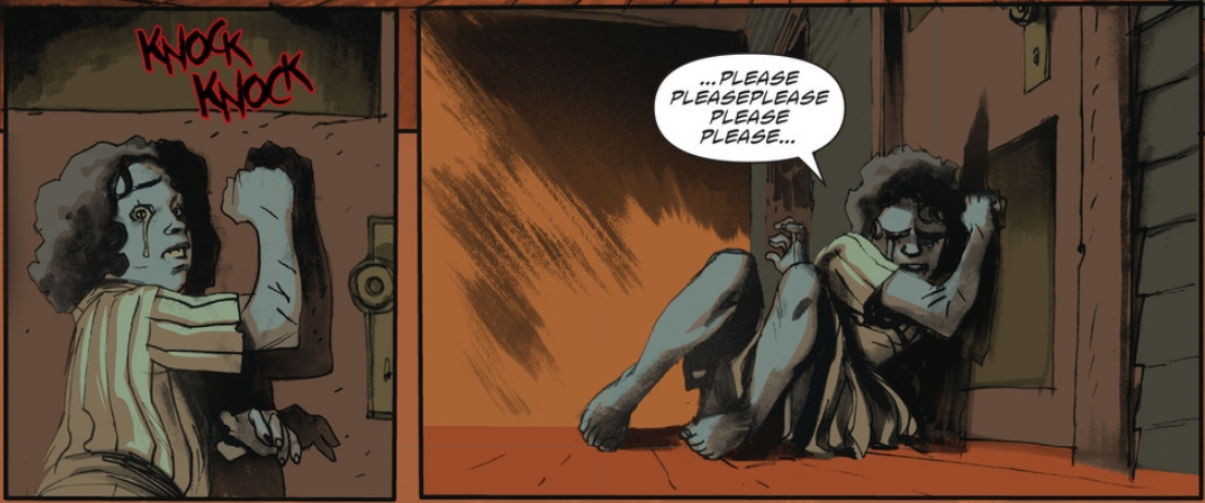 It’s intense stuff — made all the more intense by Dave McCaig’s expressive, phantasmagoric colors.
Patrick! If I’m not mistaken, you have even less experience with American Vampire than I do, though I know you have plenty of love for both Snyder and Albuquerque. Was this issue enough to get you hooked, or am I relying on my limited knowledge of this world more than I think I am? Also, I know moving to California has changed your perspective on winter a bit, but aren’t snow vampires just about the worst thing you’ve ever heard of?
 Patrick: Snow-anything is the worst thing I’ve ever heard of. I’ve been to the beach three times this winter. Three! I wear shorts in February. I complain about the arctic winds when it dips bellow 50. Having lived in Wisconsin for 27 years, I do know a thing or two about the cold and snow — in fact, if I didn’t know better, I would have guessed that we’d been attacked by snow vampires most winters in Appleton.
I realized that’s a privileged position: not everyone is going to have experienced a northern Wisconsin winter. Disorienting though it may be, Snyder and Albuquerque very smartly plant the seeds of these frosty vampires in that cold open (puns, intention, me — you decide the relationship). Drew, you mentioned that I don’t have much experience with American Vampire — I’ll specify that by saying I’ve only read The Long Road to Hell and the American Vampire Anthology — so while I knew the series was historically minded, I didn’t have a solid grasp on exactly what period in history I could expect to see represented. Parsing it out from context clues, the first cycle started in the 20s and now we’re in the 60s, but the first scene takes place a century before.
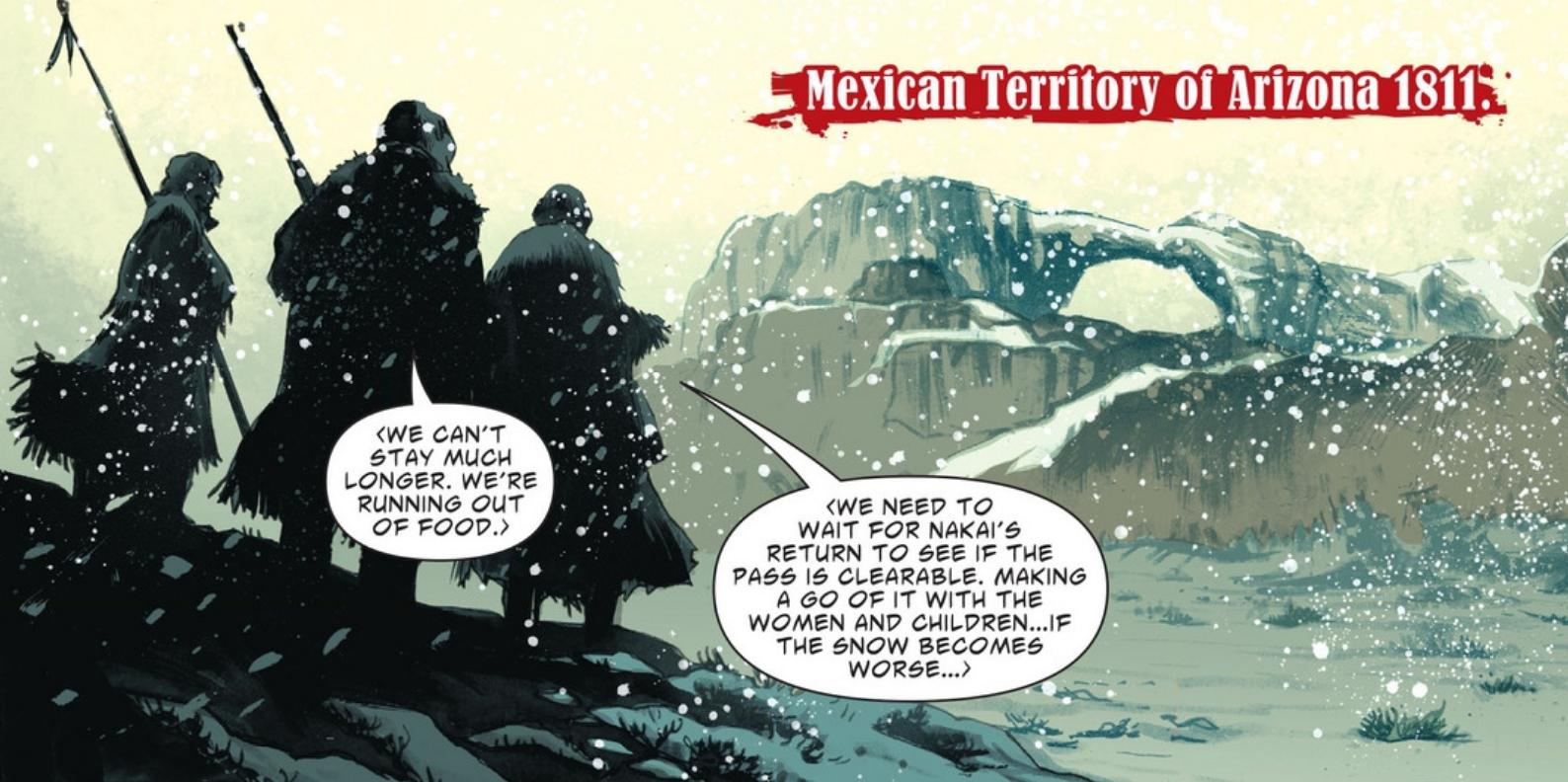 It turns out that this is something of a Snyder stand-by: flashing to a time wildly out of the story’s setting to provide enigmatic context for what you’re about to read. This is the equivalent of making a character tell a ghost story in a scary movie before everyone is attacked by the ghosts. In establishing a mythology, there’s already a thing for us to be afraid of the second we check in on Pearl and Skinner again. Here’s a great example of the effect of this foreshadowing — there aren’t any clues to suggest that the wounds on May’s back have anything to do with these creatures. She attributes her wounds to “The Gray Trader” — itself an evocative term that should have our imaginations flipping the fuck out — but our narrative-addled brains are so hungry for meaning that we make that leap without Snyder having to make that connection explicit. And really, he never does, it’s Albuquerque’s ethereal drawings that recall the creatures in the final pages.
As a newbie to this series, one of the things I find fascinating is the way the characters view their own monsterism. Vampire lineage is not a particularly novel idea — Ann Rice pretty well covered the idea of vampires-as-royalty 40 years ago. I loved seeing the kids discuss their origins as matters of twisted pride, not in a way that they suggested that one vampiric line was superior to another, just in that they all have distinct traits. Albuquerque takes special care to juxtapose the children’s cute human faces with their horrifying vampire faces, forcing the reader to confront our own squeamishness with these monsters. 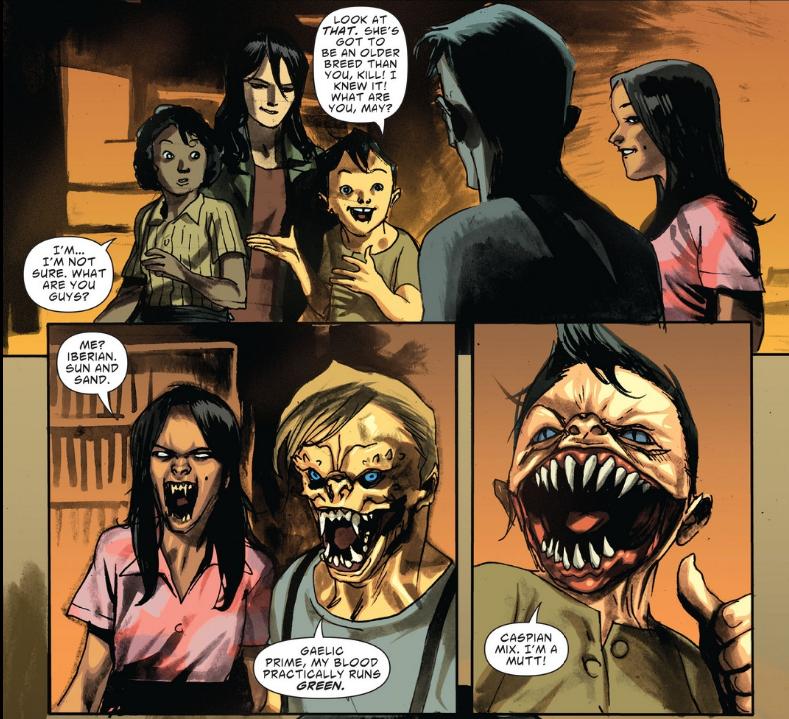 For me, the most effective transformation is Trapp – this little scamp in the green. He’s such a cute kid, but when he shows off his fangs — and by extension, his true identity — he’s absolutely terrifying, and that’s a point of pride for him. In this way, Snyder gives us permission to be fascinated the monsters in the room, even the friendly ones.
Also, I have no idea where this thing is going (or, for that matter, where it’s been), but Pearl’s vampire genealogy promises that basically anything can happen in this world.
 Some of my favorite things on this “family” tree: “Aquatic?” (I guess the Aquatic Ape theory could have a vampire equivalent), “gigantism” (because what’s more fun that HUGE VAMPIRES), and “ghosts” (because, what the hell, right?).
 For a complete list of what we’re reading, head on over to our Pull List page. Whenever possible, buy your comics from your local mom and pop comic bookstore. If you want to rock digital copies, head on over to Comixology and download issues there. There’s no need to pirate, right?
 Retcon Punch
This was a fantastic re-intro/intro issue. I have been following the series from the start and I thought this was a great issue. It built on the old while bringing in some new mysteries and a very logical progression of the vampire culture. As stated by Drew and Patrick what is great is how not knowing the previous material does not hurt the enjoyment of this first issue. The characters are presented in a way that gives you a sense of who they are what drives there goals and fears. Perfect stuff for a first issue. The art is particularly good. I think some of the best in the series. It is great to see the art got better especially when it was very solid to start with.
I am not sure how long Snyder has planned out for this arc but I am excited for the ride. One of the things the series has done so well in the past is keeping stories as long as they need to be. The stories vary in length which means there is very little spinning wheels. I would love to see Snyder put this at the front of his work load since this and the Wake I enjoy far more then his tights and flights work. He is much better suited to Vertigo and the closed story structures that the stories there tend to follow.
As Patrick pointed out and posted the children’s introduction to each other was just so damned cool and well handled. It also sums up very well what kind of a world of vampires this is. Though I generally don’t like vamps I do love what this series does with them. Vamps as reflection of America works really well for me.