
 Today, Patrick and Drew are discussing The Manhattan Projects 20, originally released April 23, 2014.
“Now I am become death, destroyer of worlds.”
Robert Oppenheimer, actual American History

Patrick: J. Robert Oppenheimer repeated this phrase, which he had read in the Bhadavad Gita, when we witnessed the first test of the atomic bomb. This is recorded in actual history text books, and widely believed to be true, but what exactly he meant by invoking the passage remains up to interpretation. Is he calmly asserting his own will over the strength of human life? Is he mourning his eternal loss of innocence? The odd syntax and the double verb make it an ungainly sentence, and speaking it aloud feels just as strange as the realization itself. Manhattan Projects has long been a series about an alternate American History, but this is the first issue to make a point of a similarity between all universes: Robert Oppenheimer is the face of evil.
The parallel Einsteins are finally sitting down for hard liquor and explanations. Our original Einstein, has spent the last decade-plus traversing alternate realities in an attempt to bring our universe’s pulling way back on-line and return home. Einstein Beta can hardly blame him, the world that he came from was a backwards science-magic shit show that persecuted him at every turn. The one thing consistent in their experiences is that Oppenheimer appears in a place of violent, corrupted power in all possible realities. That explains Einstein Alpha’s no-nonsense shotgunnery in the previous issue. The newly liberated Manhattan Project team seems totally cool welcoming both Einsteins into the fold and celebrate with a characteristically non sequitur cook-out.
This may be the closest thing Jonathan Hickman has ever come to making a singularly clear statement in this series. Oh, there have been just stories upon stories exploring the ideas of power and science corrupting people, or leading to unsavory ends, but this issue actually puts forth a universal constant — the evil of Oppenheimer. Obviously, the Oppenheimer we’re reading about in this series isn’t the same as the historical personage that uttered the quote I pulled for the introduction, but the characters assert, with absolute certainty, that there is one consistent detail throughout the multiverse, and that’s the unsavory nature of J. Robert Oppenheimer. We have to extend that to our own reality, of which Manhattan Projects is but one alternate. Now, is that a comment on the man’s ambition, and by extension, the necessary result of such ambition? Or is Hickman simply putting his heart on his sleeve and saying that Oppenheimer was a rat bastard?
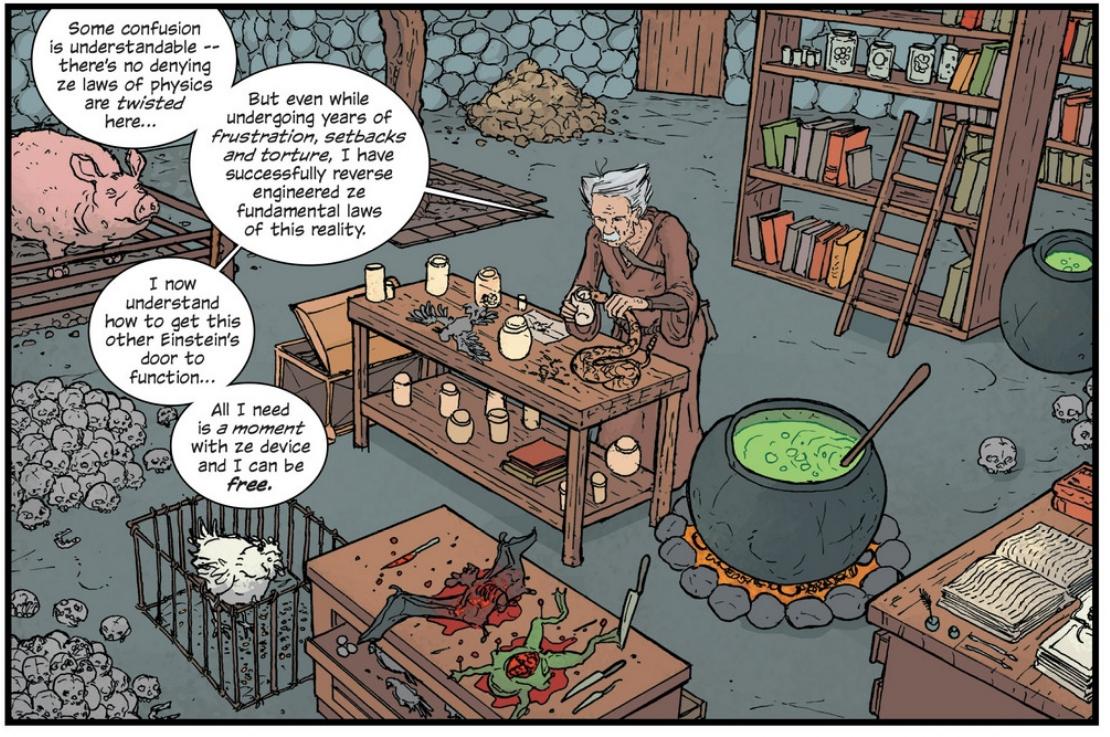
Either way, it’s heavy shit, and not a particularly flattering way to present the birth of the atomic age. Luckily, artist Nick Pitarra is there with a trashbag full of hilarious, interesting details to keep us from focusing too narrowly on the Einsteins’ thesis statement. Alternate realities are always opportunities for exillerating details, and Pitarra packs ’em in with the best of them. I love seeing Einstein’s lab as a weird mix of D&D style magic (bubbling cauldrons, a live pig) and science (he’s properly disceted and pinned that bat and frog).
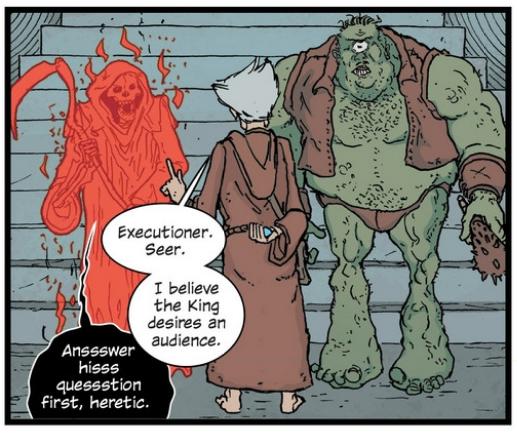
 Pitarra’s redesigns of the characters throughout this issue are also a damn delight. The reinventions that I’m most keen on are Henry Daghlian and Leslie Groves as a Death-esque figure and a cyclops, respectively. Again, especially where Daghlian is concerned, the characters are such creative reinventions to begin with, that it almost seems like showing off to have such immediately evocative alternate versions of the characters on-deck.
 Drew, I can draw a pretty straight line between Hickman’s work on Avengers and New Avengers to these developments. Both of those series seriously explore the ideas of parallel worlds with parallel casts of characters (or occasionally characters from futures or alternate futures), but those ideas are largely presented in a comic-book-y kind of way. They’re superheroes — alternate realities are kind of a foregone conclusion. But this is the first time Hickman has directly confronted the idea of alternate realities in what is so explicitly an alternate history. So, I pose the question: is this a narrative crutch for Hickman? Or has he simply been refining the tool for use here? I will say that I am more than ready to follow a pair of Einsteins around the multiverse as they murder all the Oppenheimers. That’s just too crazy not to work.
 Drew: Sorry to be cagey about answering your question, but I’m actually having a hard time defining a “crutch” — that would just be a creative motif we don’t like, yes? That is, something like, say, the isolation of Kubrik’s protagonists represents something about human nature Kubrik was working out, but Michael Bay’s use of big, stupid CGI is a big, stupid crutch. I understand that it’s also important to consider the originality of the motif (though this may boil down to whether or not we like it) — “parallel dimensions” being a famously common trope in comics — but there’s more than enough specificity here to make the idea feel fresh. It might feel like a crutch if it felt lazy, but Hickman and Pitarra paint into the absolute corners of every panel, making these paralel universes some of the most fully-realized (and hilarious) out there.
Part of that may actually lie in the unoriginality of the ideas here. Einstein finds himself in a number of movie-inspired situations, riffing on everything from Dune to Conan the Barbarian to Bladerunner, but my absolute favorite has to be the opening of the issue, ripped straight out of 2001: A Space Odyssey.
 What’s truly intriguing about these homages, though, is what they say about those narratives. Hickman seems to be drawing parallells between them — note that the Oppenheimer-ape here is the one wielding the infamous bone-club. In that way, the familiarity of these scenes lends a richness to the story — spotting the reference isn’t the reward itself, but acts as a portal to a richer understanding of the narrative at hand.
For me, while the story may follow Einsten through these dimensions, it’s really about the notion of absolute evil. Specifically, it always seems to relate to power. Could it be a case of absolute power corrupting absolutely, or is it that evil men will do what it takes to rise to power? Hickman doesn’t seem particularly interested in how these situations came to be, but what they mean in the here and now. I think that’s actually the right choice, since the issue seems to assert that Oppenheimer himself is the source of evil.
Note that the red/blue dichotomy that has so defined this series is utterly absent from this issue. It had come to represent every conflict in the series — Man vs. Man, Man vs. Self, Man vs. Nature — but is it somehow possible that the very notion of conflict stemmed from Oppenheimer? I wouldn’t have guessed as much, but Jordie Bellaire’s color work seems to suggest that our long-established notions of conflict no longer apply. When we first met our two Einsteins way back at the beginning of the series, one was red and the other blue, but here, they meet in black and brown — not a color and all colors — it seems they’ve transcended the simple, primary-color conflicts that defined their lives when Oppenheimer was around.
It’s intriguing to me, then, that the Einstein from another world (I hesitate to call either “our Einstein,” because we’ve heretofore only really known the impostor, arguably making him “our Einstein”), Albrecht (as Albert calls him), dyes his hair black at the end. He suggests that it might be Albert’s suggestion, but in either case, it clads the two in an even more classic symbol of conflict, with one black, and the other white.
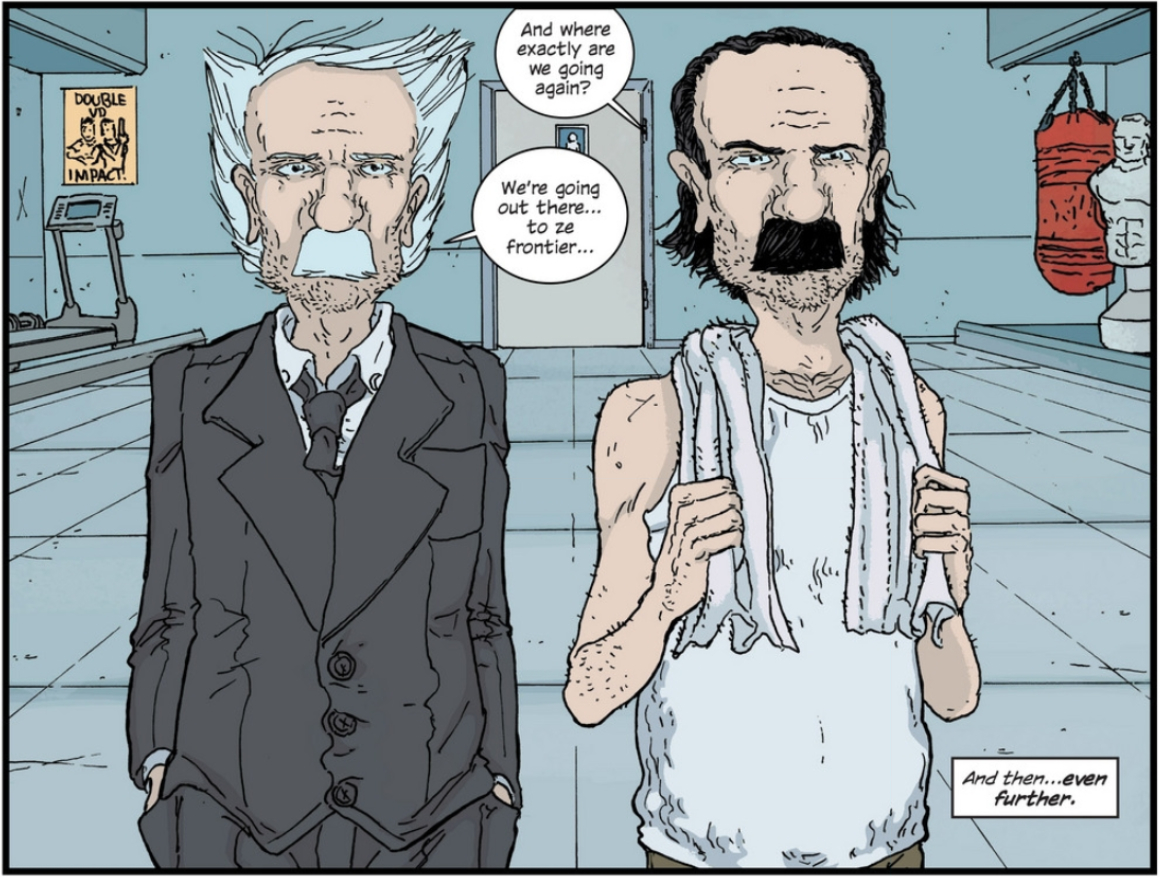 Only, they represent an entirely united front. My read is that this strengthens the notion that the Einsteins have transcended the kinds of conflicts represented by Oppenheimer’s reds and blues. It also looks pretty badass. (Incidentally, I think black hair Einstein might just be my Halloween costume this year).
Man, I never know what I’m going to get out of this series. I thought for sure we’d be getting some kind of Einstein fight here, but instead, the Einsteins are sitting down for drinks. I certainly thought we’d be getting more red/blue storytelling, but I was wrong there, too. This series continues to be smart, thrilling and unpredictable — but consistently top notch. Now I just need a white-haired friend to go with me for Halloween…
 For a complete list of what we’re reading, head on over to our Pull List page. Whenever possible, buy your comics from your local mom and pop comic bookstore. If you want to rock digital copies, head on over to Comixology and download issues there. There’s no need to pirate, right?
 Retcon Punch
That’s a great question about my use of the term “crutch.” I guess I was asking whether it worked for you here. It actually feels more at home to me in this series than in any other Hickman work I’ve read. Not that it’s been bad elsewhere – that issue of New Avengers that basically took place in the DCU was genius. I just like seeing writers’ pet themes.
I like that we’re officially 1/3rd of the way through the series, but I don’t like that they’re just now getting to the common goal of destroying multiversal oppenheimers. The outcome of the conflict between the Einsteins was unexpected and very cool
Oh, yes, I totally love that the Einsteins are just sort of casually allies. Maybe they should be enemies, but eh – who cares?
Also, I’m not totally convinced that murdering Oppenheimers will be the main goal of the series going forward. If I know anything about Jonathan Hickman, it’s ALL important. Remember Laika? Still drifting out there in space.