
 Today, Drew and Patrick are discussing The Wake 8, originally released May 7th, 2014.
 Drew: What would you say Hamlet is about? “Hamlet” is the obvious answer, but would you consider it a character study, or is it really “about” its themes of powerlessness and despondency? Is it about Hamlet himself, or the events that follow in the wake of his father’s murder? Obviously, these options aren’t mutually exclusive, but how a narrative emphasizes its focus on any of these elements establishes a contract with the audience, setting up expectations that encourage the appropriately interested fans to stick around. Confusion about that contract can lead to disappointment (it’s easy to think of all those LOST fans who would have liked the final episode to focus on the show’s mythology rather than its characters), but may be essential for a mystery. Between its radical shifts in perspective and steady build-up of questions, it’s hard to know exactly what The Wake is about — the monsters? the characters? the plot? — which may make it difficult to evaluate its chapters until we know how it ends.
Or maybe that’s a charitable way of saying I’m not sure what the point of this issue is. It opens with Leeward at the mercy of the Outliers as both were on the run from the Arm, and ends in more or less the same place. We get a little color — the Outliers are socialists, the Arm has their very own helicarrier — but as far as putting Leeward closer to Lee’s broadcast/saving the world, this issue doesn’t budge an inch. I reserve the right to be totally wrong about what this series is actually about — maybe Marlow’s hallucinations are important somehow — but the context clues lead me to believe that nothing here is particularly important.
Actually, Marlow’s hallucinations are a great example of what I mean. Marlow himself may certainly play a role in whatever denouement this series is driving towards — he’s certainly effective at putting the pressure on our protagonists — but this series ultimately isn’t about him. It’s still difficult to say what this series is about, but given that this series was split between this story and Lee’s, it seems like it’s got to be something common to the two stories. Maybe the monsters, maybe Lee’s message, maybe humanity as a whole.
But again, I could be dead wrong about that. The hallucinations are common to both stories, and Captain Mary makes a point of suggesting that how our hallucinations manifest does matter.
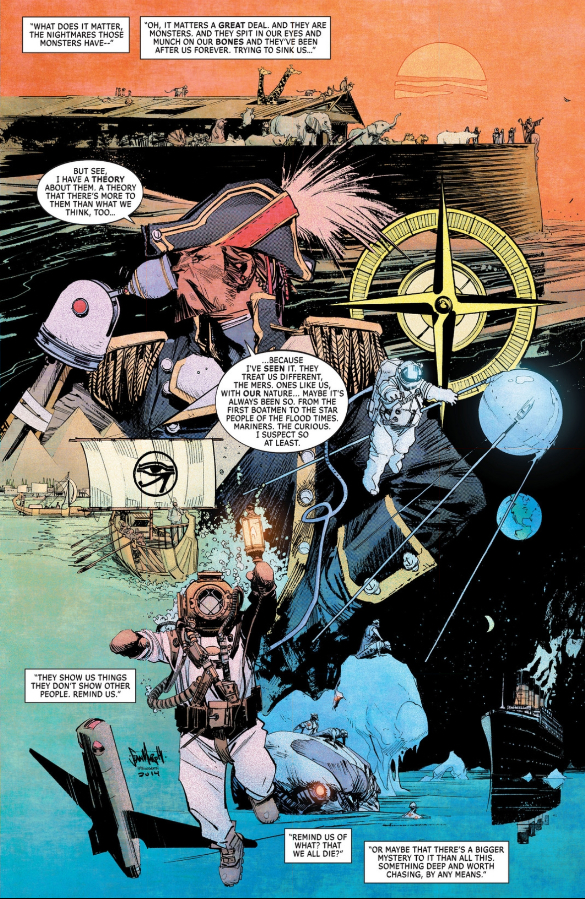 It’s an interesting idea, that the Mers might show adventurers a different type of hallucination, but it can’t mean a whole lot to us. Like, they still kill us either way, right? Could it possibly matter what they show some of us before we die? Or why would they show us different things if they’re going to kill us all the same? I suppose the last two issues will bear this out, but in terms of theories randomly espoused by characters, I’m inclined to think this one is a little cockamamie.
That is a great page, though. Leave it to writer Scott Snyder to tie his fantasy world into real history, but I love the idea that the Mers were responsible for the sinking of the Titanic. More importantly, artist Sean Murphy sells the holy ever-loving shit out of it. It’s an inspiring tribute to human exploration, filled with fun dichotomies. Murphy balances his astronaut with an old-timey deep sea diver, physically linking them with a tether. He balances Sputnik with a ship from Ancient Egypt — some of the earliest known shipbuilders. He even contrasts Noah’s Ark, a fictional tale of a ship that preserves life, with the Titanic, a very real ship that famously did not preserve life. It’s a gorgeous sequence, but it only makes me wish the rest of this issue were as clear or concise in articulating its themes.
Patrick, I may have warmed up to this issue a bit in the course of writing my assessment, but in reading over our discussion of the previous issue, I was struck by how much I just wanted to repeat myself. Maybe that’s a testament to the thematic unity of this series (or its enduring impenetrability), but it feels like a missed opportunity. Am I missing something obvious? Did that hallucination talk click a little more for you? I honestly can’t see why we watch any of what’s going on with Marlow here, but maybe you have a better bead on where this all might be going.
 Patrick: I hesitate to suggest that you might have missed this conclusion about Marlowe’s hallucination, but perhaps you just missed its significance. Marlowe sees the Governess as a gruesome mix of a naked young woman and mer, all while traveling through a menagerie of animal ice-sculptures. These sculptures are also a little extra grotesque, as they have veins running through them. In an effort to snap him back to reality, Vivian tells Marlowe “a story,” only it’s not a story, it’s history. She’s reiterating his own past back to him. The little girl — whose father hand-made animal-shaped ice trays — was Marlowe’s daughter. The story isn’t meant to give Marlowe any new information, and that fact that he protests as the story nears its horrific conclusion speaks to his knowledge of the events.
The nature of the visions in The Wake are a reflection of what occupies the characters’ mind. For Leeward and her new-found pirate friends, that’s exploration, wonder, the unknown. For desperate doomsayers like Marlowe, that’s the most terrifying moment in his life: the afternoon his lost his daughter to this unforgiving mer-world. One dream is the way of hope, and the other is the way of defeat. Contrary to Captain Mary’s theory, the mers don’t much care — nor can they effect — which kind of hallucination their victims experience, it’s simply a matter of perspective.
That’s a charming thought, if a little trite. Drew, like you, I get sort of hung up on what this series is about. If you had told me at any point previous that hope winning out over despair would be a central theme of this series, I would have cocked my head like a curious beagle. In fact, the first five issues seem to be totally comfortable embracing utter hopelessness – especially that final chapter before the break, which slowly ushers in the fall of man as water fills Dr. Archer’s submarine. Again, it suggests that we don’t have enough information about this series to know what it’s actually about, even in the most rudimentary sense. Captain Mary knows the names of both Archer and Meeks, and we’re starting to learn that exposure to mer toxin causes people to hallucinate. What’s that all add up to? Meeks and Archer should be long deceased by the time Captain Mary came on the scene. Is it possible that this future is a projection of someone’s mer-addled addled brain? Or maybe it’s the past that’s the hallucination? The awkward meta-reality, of course, is that they’re both false realities — creations of Scott Snyder and Sean Murphy, those wily mers.
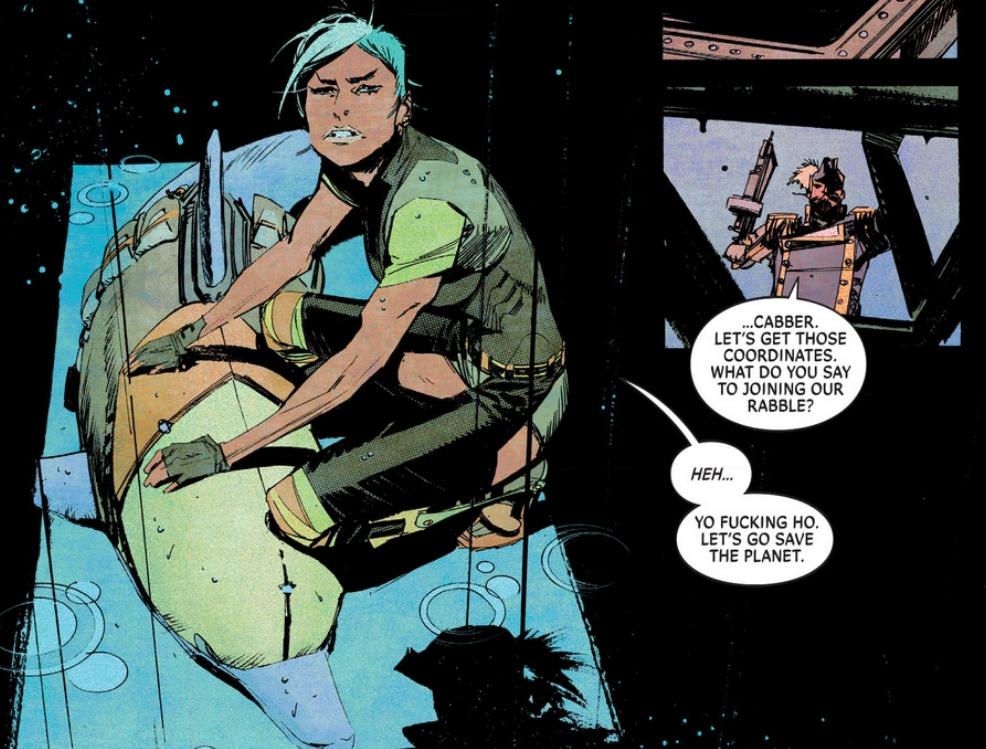
I don’t expect this to be addressed more explicitly by the end of the series. Actually, I suspect that the ending will be even more ambiguous, and we’ll be left to decide the fate of mankind. As readers under the influence of Snyder and Murphy’s venom, we’ll have to decide for ourselves whether we see a message of hope or of despair. The first five issues of this series were a lot easier to enjoy for their intense atmosphere and ambitious storytelling, but it’s only now that the subject matter has really been challenging. I’ll admit that I didn’t properly take on that challenge on my first read-through of this issue, and was left frustrated and disappointed. I was seeing despair. But on closer inspection, and with a greater appetite for narrative adventure, I’m rewarded with the fruits of this closer reading. I may not have any clearer idea of what’s actually happening than anyone else, but I’m more engaged in the material. I’ll let Leeward’s final words in this issue summarize my feeling about the series going forward.
For a complete list of what we’re reading, head on over to our Pull List page. Whenever possible, buy your comics from your local mom and pop comic bookstore. If you want to rock digital copies, head on over to Comixology and download issues there. There’s no need to pirate, right?
 Retcon Punch