
 Look, there are a lot of comics out there. Too many. We can never hope to have in-depth conversations about all of them. But, we sure can round up some of the more noteworthy titles we didn’t get around to from the week. Today, Spencer, Patrick, Shelby and Drew discuss Earth 2 23, The Movement 12, The Woods 1, Magneto 3, Black Widow 6, She-Hulk 4, Red Sonja 9, Batman/Superman 10, Batman Eternal 5, Green Lantern 31, Miles Morales: Ultimate Spider-Man 1, and The Punisher 5.
 Spencer: The world of Earth 2 is vast, and Tom Taylor and Nicola Scott continue to expand their scope even as they begin to unite their disparate groups of characters. Alan Scott has returned (via an absolutely stunning splash page that gives Scott and colorist Pete Pantazis a chance to flex their muscles); he and Batman immediately butt heads even amongst the chaos and carnage of an Apokolips attack. Still, sweet, naive Jimmy Olsen and Val — a pacifist Kryptonian who so far has used his abilities solely for defense — attempt to cut through their posturing and keep things on track, at the same time unknowingly providing this often grim and perhaps even hopeless world (and title) a little light and heart.
There’s also some surprisingly touching moments to be found in Smallville as Superman — who, after being assumed dead for years, returned under Apokolyptian control and destroyed much of the world — and Lois — who did die but was resurrected in the bizarre robotic body of Red Tornado — “visit” Clark’s parents. It’s encouraging that some of Clark Kent still remains and that Lois has the ability to get through to him, and Ma and Pa Kent prove why they’re such remarkable characters; I can’t even imagine the shock they must have felt seeing these two show up on their doorstep, but they keep their cool and remain the same hospitable, generous, loving people they’ve always been. As I said, Earth 2 has often been a rather bleak title, but Taylor is finally showing why this is a world worth saving.
Meanwhile, Gail Simone and Freddie Williams II’s final issue of The Movement is all heart. Sure, the resolution of the Cornea Killer plot suffers due to the series’ truncated run, but that’s to be expected. The characters themselves fare much better, each seeming to find at least some form of happiness, and while I would have liked to have seen Virtue and Captain Meers’ backstory unfold in less of a rush, the reveal of their intertwined past helps to bring to rest one of the primary conflicts of the series in an unexpected, sweet way.
Still, what impressed me the most is how Simone uses this issue as one last chance to get The Movement’s message across. Early on Meers asks Virtue what her “endgame” was for the Movement, and Virtue pictures the Movement fighting side-by-side with the Justice League, all while sheepishly admitting: “I thought that we might be part of something better. Where people cared about each other. Where compassion wasn’t seen as weakness. Where those in power helped people, without judgment. I thought maybe we could remind people, you know? That it’s okay to care.”
Later on, Meers tells Virtue that the Movement will never change enough to fit in with the League, and she replies: “Oh, that was never the plan. But sooner or later, Captain, they’re going to have to change to fit in with us.” This what Simone was attempting to do with The Movement; it wasn’t just about creating one book with a diverse cast that tackled complex ideas in a mature way, but about setting a precedent, about making possible a future where a cast like this is the norm, and even though The Movement is over, that’s a goal worth keeping alive.
Actually, in some ways James Tynion IV and Michael Dialynas’ The Woods 1 seems to be following in The Movement‘s footsteps; Tynion and Dialynas have created a rather diverse cast in their own right. The kids of Bay Point Preparatory High School are not only diverse in areas of race, gender, sexual orientation and body-type, but also in personality, home-life, and goals. Sometimes after I finish the first issue of a comic I still have trouble telling the cast apart — especially in a non-superhero book where there’s no costumes and powers to help differentiate them — but that’s never an issue here, and I appreciate that.
I’m not much of a horror guy, but the attention to character makes it obvious that the horror element of this title isn’t going to be about meaningless gore like, say, the Saw movies, but about how frightening this situation is for our protagonists. There are a couple of jarring, truly terrifying moments in this issue that feel completely removed from the high school shenanigans of the first few pages, but that’s exactly the point; the change is just as sudden for us as it is for the students, and it makes the carnage all the more horrific, the danger all the more real. I’ve gotta say, this issue got me really pumped up, and I can’t wait to see where it goes.
Patrick: It might be because we were following theatre geeks AND computer geeks in a high school in Wisconsin, but I was way too attached to the reality Tynion and Dialynas established in the first half of this book. Like, to the point where I was straight-up bummed out when the what-ever-happened happened. And that’s pretty remarkable, considering that it’s only like six pages before the big shift occurs. Still, I was left pining for the simpler days of not getting into college and not getting into the play and not wanting to play football… Hmmm. Interesting trend — all our characters are defined by a negative. Naturally, they’re all drawn a little thin, but the LOST-esque “surprise! you’re in a magic survival scenario now!” premise should give Tynion ample opportunity to flesh them all out, no matter how dark it gets.
Hey and speaking of getting dark: Magneto 3 sets the titular mutant against a villain with ideology remarkably similar to Magneto’s. Only, you know, exactly the opposite. Cullen Bunn gleefully depicts both ends of this conflict as myopic and misguided, as the human settlement that just wants to live a life free from the dangers of the mutant menace comes off as downright evil. It helps that they’re also developing an army of cyborg sentinels. NO SILLY: not those sentinels, just, y’know, other sentinels. That little bit of narrative handwaving notwithstanding, it’s actually alarming how much fun it is to watch Magneto secret-agent his way around this underground facility, finding innovative ways to use his powers. Sometimes he’s sending out a magnetic pulse to map the compound (sure, he can do that, why not) and other times, he’s forcing a paper clip through someone’s veins to torture them (…).
I also really dig Gabriel Walta’s art. It seems like he might be limited in the number of poses he’s able to draw Magneto in that helmet, but he also might have just realized that nothing beats the head-on menace.
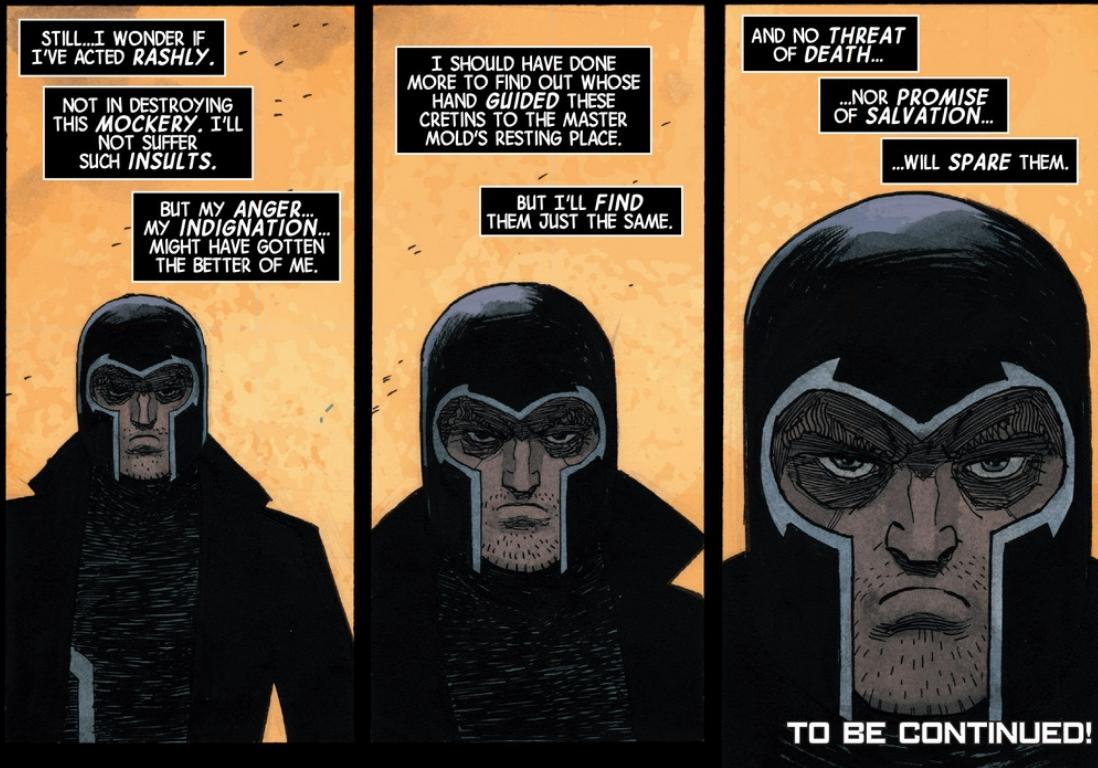 The repeated drawing of Magneto’s face in this one pose emphasizes how iconic his lone presence really is. Considering how the X-Men are always defined as a company of mutants, Magneto still has iconographic power all by himself.
Black Widow has to double down on a similar loneliness after the events of Black Widow 6. Natasha takes a few good hits while strung up in the brig of the Indestructible Man’s floating yacht fortress before breaking free and taking down the whole crew. Phil Noto, not normally known for his dynamic action sequences, draws some pretty mean fisticuffs in this issue. It’s cool, the change between the coloring techniques he employs changes so drastically with the light the characters are in, I almost thought I was reading the wrong book when the opening sequence began with such flat colors. Once she frees herself, Noto switches back to the the more painterly coloring style, which gives a moodiness to the remainder of the story. Once Black Widow gets back to S.H.I.E.L.D., the plot reverses on itself again, as a double-agent kills Indestructible Man in his cell. It’s classic spy-stuff, where the spy needs to even be independent form the organization that supports her. But maybe that’s the way Natasha likes it? There’s a cute moment at the end of the issue where Nat and her lawyer get a glimpse of Hawkeye in the midst of some of his solo-issue shenanigans, and she makes the conscious choice not to help him.
Shelby: I love that little bit with Hawkeye. Not only does he crash onto the scene covered in bandages, we even get a perfunctory, “That looks bad,” from Natasha’s lawyer. With so many competing storylines and histories, it’s easy for comic book characters to get silo’d off in their own books; it’s refreshing to see them encountering each other in the real world like any other young professionals would.
Speaking of young, professional, comic book characters, Jen Walters is in need of some legal advice in She-Hulk 4. Naturally, she turns to friend/lawyer/blind superhero Matt Murdock. She is still thinking about Kristoff von Doom, and whether or not she should go after him. Charles Soule uses a perfect blend of lawyering and superheroics in his approach to this book. Matt advises Jen that, as a lawyer, its her duty to be a zealous advocate for her client; she needs to remember, however, that being a superhero means her definition of “zeal” is potentially a lot broader than most. In the end, she She-Hulks her way into Doom’s castle, blasting guard ships out of the sky with a giant turret gun, but wins her case through use of argument and logic (as applied to a giant Doom-bot). I’ve read some of Dan Slott’s run on She-Hulk; while it’s very good as well, that She-Hulk is more focused on finding the balance between Jen Walters, Esq. and She-Hulk, Avenger. Here, Soule’s She-Hulk has found that balance, and the story is about how Jen maintains it. And who doesn’t love Javier Pulido’s interpretation of Matt’s idea of a fun night out on the town?
 Our favorite Curse of the Hyrcanians Red Sonja is also looking for a fun night on the town as she seeks Princess Aneva, Courtesan in Red Sonja 9. Sonja gets forcibly ejected from the brothel when it’s discovered she doens’t have any money (on top of being dirty and pretty smelly). She scales the castle walls to rescue the princess, only to discover the princess doesn’t actually need rescuing; she’s trying to form a guild for courtesans to protect them from the evil lord who owns the joint. After hearing Sonja’s motivation for her mission, Aneva agrees to come with. There’s a fun little makeover, and then a sweet battle between Sonja, Aneva, and the lord who thinks a “sweet bit of arse” like Sonja couldn’t possibly be a threat.
There’s so much to be excited for in this issue. Gail Simone’s running bit this arc has been that Sonja wants to get laid, but can’t. It’s been played as an amusing bit of role-reversal, but this issue drives home a more bittersweet point about it. As Sonja sees all the beautiful men and women at the brothel eager to please her, she thinks to herself how lonely she’s been. Not horny, lonely. Whether she would ever admit it or not, Sonja hasn’t been just after sex these last couple issues; she wants intimacy. It’s not just the physical aspect of sex she wants, it’s that closeness you share with another human being. It makes it that much more poignant later in the issue when she feels inadequate compared to Aneva, who is everything a woman “should be” in this world. She’s beautiful, graceful, kind; Sonja is (in her own mind, anyway) none of those things. It’s a beautiful take on the idea that women are supposed to “be” a certain way, and if you aren’t than you’re an outsider. We find out in the end that Aneva grew up a peasant girl not far from Sonja’s village, and used to dream of being as brave and tough as the Red Devil. The message of sisterhood, inner beauty, and things not being what they seem is a little on-the-nose, but it speaks to me so much that I find I don’t care in the least.
Nor are things completely what they seem in the Fortress of Solitude, where Batman lies in a coma after space adventures with Superman in Batman/Superman 10. Clark brings in scientist Ray Palmer (!!) to investigate after a quick scan with microscopic vision revealed a dead superhero in Bruce’s blood and a tiny city parked in his brain. Clark and Ray shrink down to investigate, and find it’s actually a tiny spaceship transporting tiny bad guys who got out of tiny jail, killed the tiny hero, and are on a tiny rampage. A fight ensues, and one of the baddies, whose name hilariously translates to Titan Super Gladiator, gets Clark’s embiggening belt and escapes Bruce’s brain. Ray and Clark wrap things up on the ship and hustle their way back to rescue Batman, only to discover that he had woken up and kicked the crap out of T.S. Gladiator despite having no clue what was going on. This issue is fun and charming; no surprise, since it was written by Jeff Lemire. Ray and Clark really hit it off, I love seeing these two hang out in, uh, Bruce’s bloodstream. I also love seeing how weird and funny Ray Palmer is in Lemire’s hands.
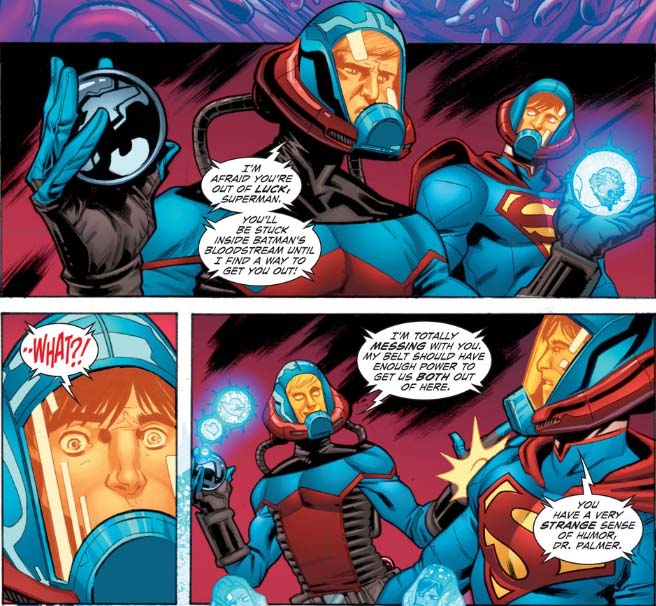 Actually, I just love seeing Ray Palmer at all; is this really the first time we’ve seen him since the New 52 began? More of that, please!
Drew: Oh man, what a bunch of goofy fun. You mention “embiggening,” but the particular Simpsons reference that springs to my mind would call it “re-bigulating” (which is a concept so ridiculous it makes me want to laugh out loud and chortle), which is itself a riff on an old Twilight Zone episode. That particular episode has been riffed on a ton — especially in comic situations — which sets an appropriately silly precedent for this issue. It was exactly the kind of absurd nonsense I expect Batman and Superman to get into with one another — especially when the Atom is around.
Batman Eternal 5 features its own brand of absurd nonsense, with decidedly less charming results. Structurally, the issue is quite sound, focusing on Tim Drake’s quest to pay attention to what Bruce can’t. That quest drags him into the paths of Harper Rowe and Vicki Vale, and here again, the writing is solid. I have my quibbles with “mysterious nanobots” as a villain, but the actual problem with this issue is the way it treats Vicki. James Tynion IV (who’s credited with scripting this issue) goes out of his way to introduce Vicki as an old-school investigative journalist who resents boring assignments or being told about the pageviews of her articles, but later demonstrates that she has exactly zero street smarts when it comes to actually investigating. I suspect that it’s meant to demonstrate bravery, but asking random street thugs about criminal activity they may be involved in at that very moment strikes me as just plain stupid.
It’s a pretty big gaffe, flubbing the introduction to Vicki’s character pretty thoroughly, but Tynion actually has a pretty firm handle on her voice otherwise. Indeed, Tynion handles the final scene — which features all of the major players of this issue — with an assured pen. Each character has their own distinct voice, which allows them to bounce off of one another in fun ways.
Deft character work is the name of the game in Green Lantern 31, which finds Hal asserting his will in what may be the first purely heroic move since Venditti took over the series a year ago. This issue serves as a great anniversary celebration, giving the lanterns an unlikely win, while tipping their hand at some much bigger problems. It looks like the lanterns may have finally rooted out their Durlan infiltrators, but now have a number of missing lanterns to find. Honestly, this issue has everything anyone could want out of a Green Lantern book: epic battles, hints at a larger mythology, Hal being a lovable dick, heck, it even finds time for an introduction to an alien lantern. I’m a little nervous that the details we get about Gorin-Sunn’s physiology will be used to kill him, but for the time being, it was very welcome.
Speaking of welcome, our stuttering attempts to find a foothold in Marvel’s Ultimate Universe may have finally hit home in the most obvious of places, Miles Morales: Ultimate Spider-Man 1. The issue itself serves as a great overview of the character, getting into all of his key relationships, including the relationship he has to the legacy of the late Peter Parker. Only, maybe Peter’s not so late, after all? It’s a great twist, though it seems a little superficial to anyone not immersed in the mythology. Like, I get that it would be miraculous if this was Peter (foreshadowed by a conversation of loading dock dudes earlier in the issue), but I don’t know enough about the rest of the Ultimate Universe to have any clue what else might be going on here. Either way, I enjoyed the heck out of this issue, but you don’t have to take my word for it — I only read it after Patrick declared it “the first Ultimate issue that I’ve actually enjoyed.” What made it work for you, Patrick?
Patrick: Honestly, I think it’s as simple as having a tight focus on an individual character. I think the Ultimate books too often try to make up for the fact that there are only a handful of series set in that universe at any one time, so each series needs to have as many damn characters as possible. This, coupled with a very Bendis-y approach to pacing, means the issue gets a chance to really breathe. Miles spends more time out of the mask than in it, and this might have been the first time I first-hand encountered the special charm of Mr. Morales. I think it’s telling that the name of the series is “Miles Morales” first “Ultimate Spider-Man” second, and not the other way ’round. There’s something so humanizing and wonderful about him going to MJ for advice on being Spider-Man — he’s not there for tactical advice, but for personal advice. It emphasizes the idea that there’s a human struggle to being Spider-Man, and that’s just beautiful! Plus, I nearly threw my Kindle when Parker showed up — even if it’s a trick, it’s one hell of a trick.
And finally this week, the shit hits the fan in Punisher 5. Electro cuts power to the city of Los Angeles (because… y’know, what the hell else is Electro going to do?) and Dos Soles have their bombs placed strategically throughout the city, ready to detonate just as soon as they take out Frank. They even go so far as to track the coyote back to Punisher’s lair, but they might as well have not bothered — all you ever really need to do to summon the Punisher is start blowing stuff up. Much of what we’ve already said about this series remains true — the characterization on Frank Castle isn’t particularly engaging and the creative team doesn’t seem to know the city they’re writing about very well — but as far as bombastic climaxes go, this was actually pretty fun. I may not care that much about “Frank Castle” but it’s hard to deny the character when he’s decked out in his gear, getting shit done. Mitch Gerads remains MVP of this series, giving energy, perspective and excitement to Punisher’s righteous rampage.
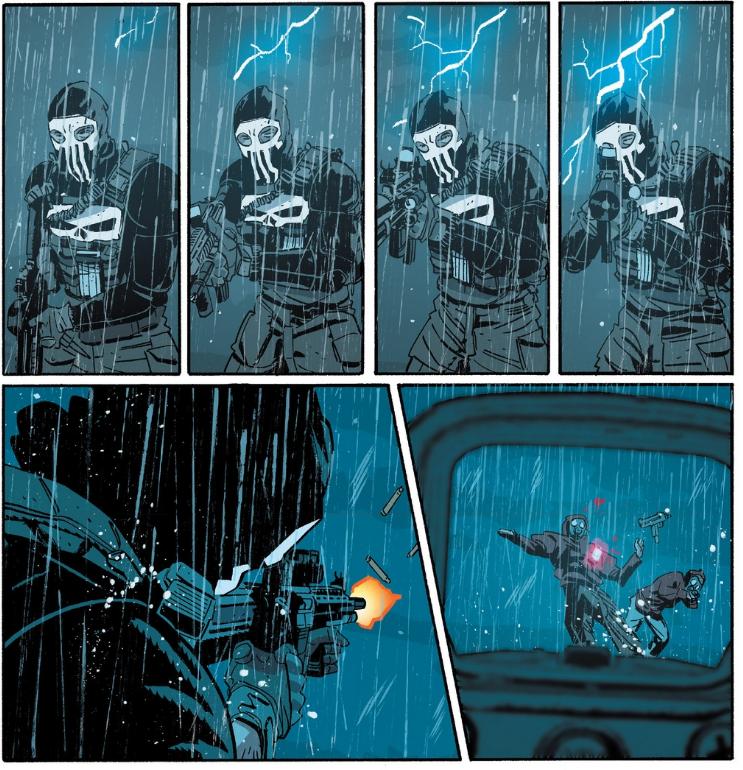 Just like Flipper, Punisher is faster than lightning. He’ll need it too, because issue 6 looks like it’s just going to be a knock-down-drag-out brawl between Frank and Electro. I’d be totally satisfied with the issue if it’s just 20 pages of fighting.
The conversation doesn’t stop there, because you certainly read something that we didn’t. What do you wanna talk about from this week?
 Retcon Punch