
 Today, Taylor and Patrick are discussing Zero 8, originally released May 21st, 2014.
 Taylor: I, an unmarried 29-year-old male, just bought two picture books and I couldn’t be more pleased with my purchase. The books, entitled Mr. Wuffles and Journey were brought to my attention by an NPR article and — due in large part to being able to preview the books in this piece — I snatched them up as soon as they came to my attention. Now, I’m not normally one for picture books. Or rather, I should say, I haven’t been one in the past. “They’re made for kids right?” — went my line of thinking. When I bought the books, though, I realized that picture books and comics have a lot in common. The most obvious commonality between the two mediums is that they both tell stories in large part through pictures. With this in mind, I have a new fascination not only in picture books, but in stories that can be told without words. Zero 8 is one of these stories, showing us just how powerful pictures can be and how, sometimes, the most powerful words are those which go unsaid.
As we learned in the previous issue, Sarah Cooke is in danger of being taken out by operatives. The man behind this plot, Roman Zizek, is now dead — killed by Zero for reasons that are as of yet still unclear. Cooke drives to the middle of nowhere in the UK under the impression she is carrying out business as usual for a secret agent. In reality, she is the target and a showdown ensues when she realizes that she’s in danger. As the gunfight subsides, Zero emerges to tell Sarah that he’s quit the agency. What lies next for him and for Sarah after this small massacre is anyone’s guess.
What impacted me the most about this issue is just how little text graces the pages. The only substantial use of words comes when Sarah meets the head commando, who seems all too eager to inform Cooke that he is going to kill her. Aside from this cheery exchange, the issue is almost solely devoted to showing the bloody fight between Sarah, Zero, and the various commandos. No words are spoken during this battle until Sarah finishes off her last two enemies with a rueful joke.
 Yes, they fell for the ol’ decoy and blast ‘em routine. A tried but true strategy used by all of the action star greats at least once in their careers. The solitary panel, devoted solely to the phrase “the oldest trick in the book” stands out not only because of the stark black and white contrast, but also because it’s a return to the world of the written. Writer Alex Kot seems to preparing us: you just had a lot of visual stuff, now prepare for words again. Also, this could be wink and a nudge by Kot, acknowledging that when you need have deadlines and page quotas, sometimes you need to pull some tricks out of your sleeves to please your publishers. What better way to fill out an issue than with some kick-ass action? Everyone loves it.
But I don’t think that’s what Kot is doing here. He’s too smart and assured of a writer to settle for sophomoric parlor tricks. Rather, I think Kot is just taking advantage of being able to use a different artist every month, which is something I think we’re all happy about. Indeed the previous issue was also light on wordplay, so the choice to use little dialogue here seems like deliberate and meaningful one.
That being said, I love being able to watch artists tell stories through pictures alone. The picture books I bought are both wordless, yet they each tell amazing stories that are complex and interesting. The same can be said of what artist Jorge Coelho does in this issue. While showing action always sounds like an easy task, I’ve found that it can be difficult for artist to draw an action scene that maintains a kinetic feel while also remaining clear. Coelho pulls this balance off remarkably well by giving us unique and multiple viewpoints while providing us interesting and ever-changing panel layouts. Of the former, Coelho switches perspective between Cooke and her would killers with ease and keeps things interesting by showing us scope-views, bullets passing through bodies, and the random panel of inanimate action. The paneling in this issue is just stunning. Two pages in particular struck me:
 The layouts remind me of a Chris Ware graphic novel. Small panels chock-full of detail will do that. The detail makes the reader slow down and really pay attention to what’s happening in each panel and, like a Ware product, rewards the reader for their efforts. While we tend to feel exasperated by anything that demands more of our time, it’s always wonderful to find something that demands we slow down for good reason. It would be easy to dismiss those panels which just show flying glass, but that would take away from the scene being crafted by Coelho. Instead of a hectic cut, it’s like a slow motion shot of compelling destruction (a metaphor for mankind perhaps?)
PATRCIK! A few issues back you mentioned that you thought this series was maybe delving into multiple universes? Do you still think and if so, how does this issue fit into your conception of that? Also, we get a lot of references to eyes in this issue (as in others) — what do you make of that? Also, what stories going unsaid are most compelling to you in this issue?
 Patrick: One of the consistently mind-blowing things about this series is how versatile it is. No two issues affect the same tone, no two issues employ the same storytelling tactics, no two issues even appear to have the same storytelling values. The cast, and Kot’s deft skill weaving compelling episodes in the life of a superspy, are really the only thing that unite the issues. Only two issues ago, I was using our discussion to bring up multiverse theory and doomsday scenarios, but this material clearly forces a much more personal, focused conversation. The issue plays out over twenty minutes that change Cooke and Zero’s lives forever. I love that the extra context Kot gives us consists of flashes from “17 hours earlier” to a debriefing session that was conducted 18 hours after the incident. Even the events surrounding this shootout are in incredibly close orbit.
Coelho and Kot know that the name of the game is immediacy, with the miniscule time between windows shattering and the glass hitting the ground carrying as much weight as the time between 17 hours ago and 18 hours later. We’re clued into this immediacy right way, as we see a bruised-but-not-beaten Cooke running through the woods on the first page. Every broken twig, every crackling leaf, every footfall tells a story of tangible, immediate desperation.
 It’s a survivor’s attention to detail — a moment-to-moment level of perception that Cooke had to exercise in order to survive. I absolutely love seeing it called back a few pages later before she meets with her contact in the woods. She’s got a sniper in place, so Cooke’s already aware of what’s coming, but it’s a subtle hint that simultaneously flashes forward and back.
 This, coupled with the disorienting titles announcing when all these panels are taking place, adds to the sense that time is being stretched out, and all that matters is this moment. Cooke has no specific powers or advantage that gets her through this encounter, and Kot’s not afraid of killing off any of his characters, so the readers are on an honestly invigorating ride as Cooke fights for her life.
Another part of why this gun fight works so well is that its architects have selected a wonderfully evocative and specific location. Kot gives an enormous amount of real estate over to the “A funeral” line — partially because that betrayal needs a second to land, but also because Coelho can give us all the information we need about this space right up top.
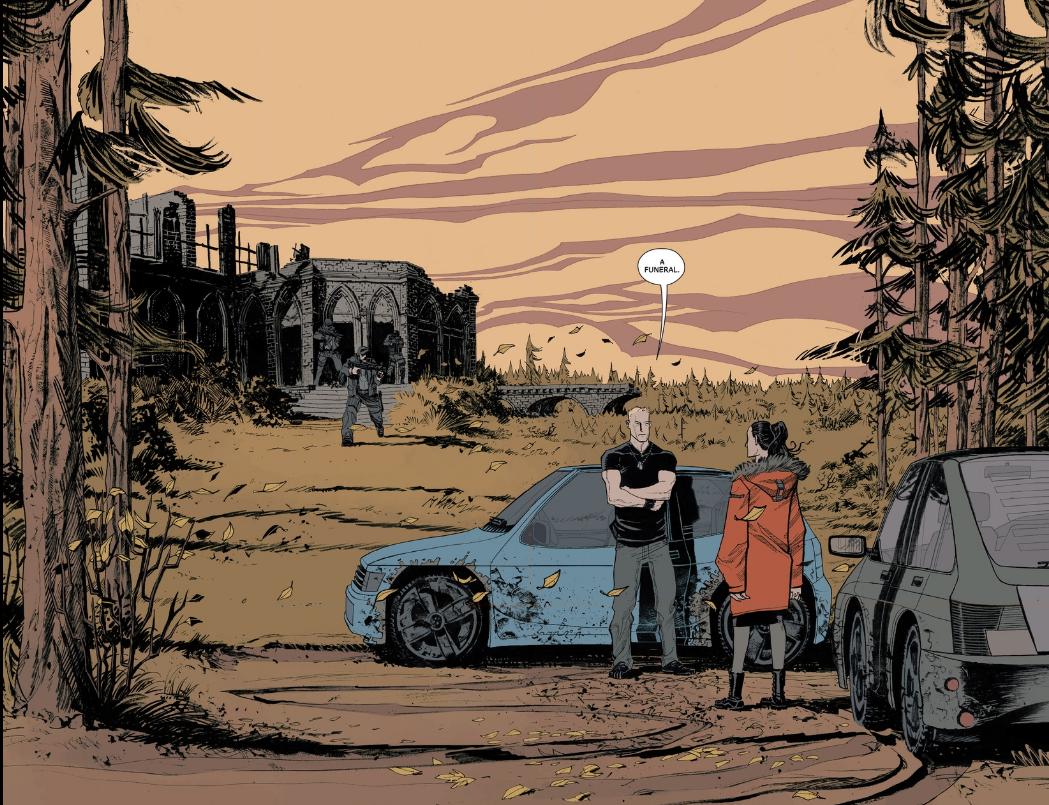 First of all, how about Jordie Bellaire’s coloring work on this spread? The autumnal color palette broadcasts a cold, desperation — death as a kind of change — and a peacefulness that’s seconds away from being intruded upon by violence. The setting itself appears to be a bombed out citadel, long-since abandoned and overgrown. There’s history and nobility built right into the landscape, which is a great tool for Kot, but there’s also cover — an even more effective tool for Cooke.
Taylor, you asked which untold stories in this issue most resonated with me — which is just a wonderful question, by the way — and I think my answer has got to be what’s going on in Zero’s head. I had assumed that he wasn’t going to kill Cooke, but I did think he was going to help her. I mean, he took out that sniper and even offed Zizek when he found out about the plan to murder her. His protective instincts are clearly engaged, but I wonder why he doesn’t see it through to the end. After all, we see Cooke running alone through the forest at the beginning of the issue. Perhaps Zero is just being characteristically pragmatic, as he was on his way to machete those last two guards when Cooke demonstrated that she was capable of handling them on her own.
I’ll leave with a stupid observation that I think speaks volumes about this series’ intelligence. As Taylor points out, the issue is largely copyless. Characters talk when characters would talk, but so much of the action takes place between words that the issue appears silent. The temptation might have been to actually turn in an issue without dialogue, because that’s such a clear gimmick, and could be used to sell the issue. “Behold! The Amazing Silent Issue of Zero!” (You know, like issue 18 of Batman and Robin or the third season opening of the Walking Dead.) Kot’s decision to not force wordlessness on this issue is an inspired show of restraint and allows the issue to escape any of that kind of gimmickry.
For a complete list of what we’re reading, head on over to our Pull List page. Whenever possible, buy your comics from your local mom and pop comic bookstore. If you want to rock digital copies, head on over to Comixology and download issues there. There’s no need to pirate, right?
 Retcon Punch