
 Today, Patrick and Suzanne are discussing Cyclops 2, originally released June 4th, 2014.
 Patrick: When we were in third grade, by buddy Jeff was severely burned by hot coffee. He had accompanied his father to a meeting of some kind, and a giant carafe with boiling hot liquid spilled all over him, giving him second degree burns on his chest and stomach and third degree burns on his arm. Earlier that same evening, I was hoping to have Jeff come over to play video games, but I didn’t get around to calling until he and his dad were just out the door. It’s one of those bizarre “what if”s: what if I had called five minutes earlier? Would Jeff have been spared those burns? How would his life be different if he never experienced that? Obviously, we’ll never know, and this formative experience will always have formed his identity in some way. Greg Rucka and Russel Dauterman’s Cyclops is perfectly positioned to ask those questions of Scott Summers, exploring what forms when one’s formative experiences are entirely different. Scott Summers has always been a principled kid — how could he not be with a mentor like Charles Xavier? — but how does that change when the guiding figure in his life is a drug addicted gentleman pirate?
Scott and Chris Summers have been bopping around the galaxy, having a good ol’ father-son time. They make a pit stop on Yrzt (which is a city, a planet, or a city-planet) so Chris can ask his skeezy friend Baroque for… a little help. Chris is pretty good at keeping this from his son, but they’re there to pick up the purple-y substance Chris has been injecting into his neck. Happily oblivious, Scott helps his father fight off a band of bounty hunters looking to collect on the price(s) on Corsair’s head. Cyclops may not know his way around a blade just yet, but that doesn’t stop this moment from being so bad ass.
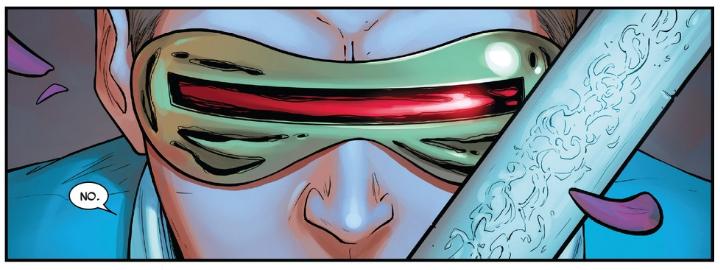 Dauterman even affects the samurai movie trope of populating the scene with gently falling brightly colored leaves. This, coupled with Scott’s defiant “no” and the efficiency with which he dispatches their attackers, makes Scott feel damn righteous in this moment. He’s standing up for his father — what nobler pursuit could there be? Here’s the thing: Scott has yet to really internalize what it means that his father is a pirate. The way he balks at his father’s description of what Baroque does speaks volumes about how much Scott is willing to process when it comes to the amorality of Corsair’s lifestyle. In fact, when Corsair is busy talking shit to the bounty hunters, Scott doesn’t react with revulsion toward his father’s character, but in a typically teenage way: “you are so embarrassing me.”
I’m not going to make the case that Chris Summers is a bad guy, and I’m not convinced that Rucka is making that case, either. Space seems like a tough place to make a living, and we have yet to see Corsair commit any egregious crimes. But I think we can all agree that he’s a less morally grounded person than Xavier. Professor X had a guiding philosophy, one that’s accepting, loving, and ultimately altruistic. By comparison, Corsair is self-serving and opportunistic. Rucka is keen on reminding us of the influence Xavier and the X-Men had previously had on Scott — the issue opens with Cyclops reciting a line from Hamlet, which they had studied at the School for Mutants. Later, when Scott enjoys a chocolate shake with Baroque’s daughter in a simulated reality, he comments on how much better the simulation is than the Danger Room. These experiences are realer than they were on Earth. Curiously, Corsair also introduces Scott to a fruit with an enzyme that makes it taste like vanilla. Throughout, there is an effort made to make Scott’s life in space as much like his life on the ground as possible, but it’s all simulation and approximation.
This is echoed through the choice of villain in the simulator. Scott and Vass are set upon by a (simulated) Skrull, which is something this version of Cyclops has yet to encounter, and is horrified to learn are real. Specifically, he calls out their ability to shapeshift as “terrifying.” Scott doesn’t have the critical thinking skill necessary to determine what is real and what isn’t — that’s why he’s tricked into thinking the Senex’s 1s and 0s are chocolate, and that Corsair is a misunderstood, but fundamentally good, person. And under those circumstances, it’s hard to fault Scott for thinking he’s finally found a role model.
Reminders of how weird this whole situation is are everywhere. Dauterman has a wonderful gift for motion and expression, but I was struck with his attention to some incredible details in this issue. Early in the issue, we see father and son at some kind of sporting event, and rather than eating popcorn, the bag is full of weird purple balls. Or like when Scott meets Baroque, their half-tentacle-/half-hand-shake is delightfully strange.
 It’s a familiar ritual, but it’s weird as hell. Of course, Corsair is literally and figuratively in the middle of this meeting.
We’re left asking the question of what kind of man this will cause Scott Summers to become. If he’s not the principled leader of the X-Men, who is he? A space criminal? An adventurer? Or something else altogether. Suzanne, what do you think? Is it thrilling to see a little more moral ambiguity thrown this character’s way or does it make you nervous to see young, innocent Scotty subjected to these more dubious influences? Also, what do you make of Corsair’s space-drugs? Any chance he’s just diabetic and needs black market insulin shots?
 Suzanne: Frankly, Scott Summers can benefit from having more Corsair in his life. He’s drifted far from his role as the moral compass of the X-Men in recent storylines. Young Cyclops may symbolize a return to innocence, but to what end? Does he have an opportunity to recover from the mistakes of his future self? This may be a bit blasphemous to some, but Cyclops has always been too vanilla for me. But I’m (slowly) learning to appreciate Cyclops’ focus in this series. Specifically, I’m enjoying the juxtaposition between Scott’s naiveté and Corsair’s world-weary cynicism.
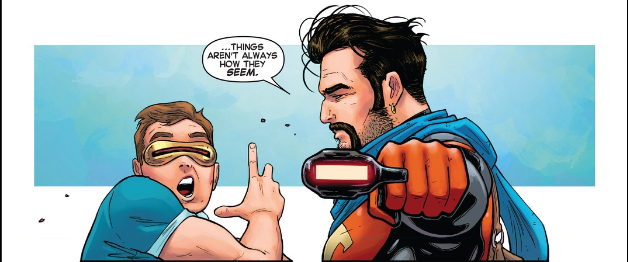 The parent-child relationship between Chris and Scott Summers is a classic example of role reversal. Corsair is a reckless parent, willing to risk both his life and his son’s for some shiny-looking drugs. His lifestyle feels more chaotic, like he hasn’t begun to fully think through his actions. Scott takes some of his cues from his father, learning how to navigate Yrzt and all of its intricate social patterns by his example. There’s a great piece of dialogue when they come across a group of naked aliens. Corsair instructs Scott: “Don’t stare — it’s rude” as if father and teenage son are walking along a nude beach or something equally awkward. Yet Scott’s efforts to gain his father’s approval balance with typical teenage embarrassment. Who doesn’t remember feeling self-conscious about their parents’ comments in public? In turn, Vass’ comments about teenagers being dismissed by adults fits perfectly with these themes about young adulthood.
It’s important for Corsair to be rough around the edges in this series. As drawn by Russell Dauterman, Corsair immediately reminds me of another loveable anti-hero. The handlebar mustache brings out my nostalgia for Deadshot in Secret Six. Corsair seems more firmly camped in the moral grey area than the black though. His poor choices and dependency make him compelling and (hopefully) pushes Scott to make some difficult decisions about becoming a man. I look forward to the progression of Chris and Scott’s relationship and Scott’s eventual realization of his father’s flaws. Who knows, maybe Corsair’s influence will make for a more grounded Cyclops?
 For a complete list of what we’re reading, head on over to our Pull List page. Whenever possible, buy your comics from your local mom and pop comic bookstore. If you want to rock digital copies, head on over to Comixology and download issues there. There’s no need to pirate, right?
 Retcon Punch
Totally nit-picky non-point, but…was anybody else distracted by Scott referring to his dad as a cross between Captain Jack Sparrow and Han Solo? Scott certainly hasn’t had much down time since being displaced in time to catch up on old movies, so he’d need to be familiar with these characters from before Beast grabbed him from the past. Captain Jack stuck out to me as obviously too current for Scott to be aware of, but then it struck me that Han Solo should be, too. LIke, sure, maybe comics time compression makes it so that Scott was just plucked out of the mid-90s or something (making Old, Evil Scott just 20 years older), but it seems like an odd choice to draw our attention to such a thing.
I did pick up on that! But then I remembered that Scott has spent a fair amount of time in the present. All of that time, he’s hanging out with different groups of teenagers and young adults. I can only assume that they’re spending a TON of time catching up on pop-culture.
It certainly does remind the reader that Cyclops is addressing an audience in his VO. “Jack Sparrow meets Han Solo” is a set of references that Scott’s making for our benefit – almost like he’s trying to fit in with us. That’s so in line with what we know about the character.
Interesting — I like the idea that he’s trying to use the most current references he knows, and they’re still decade(s) old.
Huh, I didn’t think about this until you mentioned that, but it’s also odd that both of those references are both old and still totally relevant. I mean, we’ll see Han Solo on movie screens next year. And nothing kills the Pirates series now. Cyclops himself isn’t unlike these characters in this regard – in fact, as you point out, his longevity is actually greater than either of them (also, all owned by Disney).
I think the relevancy of Pirates is debatable. Like, I could see Star Wars being on the must-see list other kids would recommend to someone who hasn’t seen a movie since the ’60s (especially one as keen on space adventures as Scott), but I don’t think the Pirates movies are quite that kind of cultural touchstone. They were incredibly popular when they came out, for sure, but I don’t think anyone even thinks about them anymore. I certainly know I wouldn’t have mentioned it if I was trying to sum up the pop culture of the last 50 years in even a long-ish list of movies.
They start filming Pirates 5 in December. And if there’s anything iconic about those movies, it’s the character of Jack Sparrow.
And Transformers 19 comes out this summer. Let’s not confuse enduring profitability with cultural relevancy.
Although All New X-Men has been having a lot of fun playing with the 60s aesthetic with the original X-Men, Marvel does use a sliding time-line, which means that the time Scott would have been plucked out of would indeed be affected by compression. The general consensus seems to be that around 14 years have passed in the Marvel universe since the Fantastic Four got their powers (signaling the dawn of the current heroic age), which means Scott could have reasonably been plucked out of the year 2000 or 2001 even. He should have seen Star Wars before he was snatched up by Beast; the first Pirates came out in 2003 so MAYBE he could have seen it when he was snatched up, but more likely he watched it in the present day. He has to have SOME downtime.
You guys both mention Corsair as using drugs, but I thought he was just sick? Remember last issue when his wife was telling him to take his medicine? I assumed he has some sort of illness which requires constant medicating. I can see why he wouldn’t want his son to know that, which would explain his “keep it on the DL” nature. Plus, it would not be advantageous to his pirate-y lifestyle for it to become widely known that he has a major weakness like requiring medicine daily.
Yeah, I had jokingly suggested that maybe he’s got space-diabetes, but it is totally possible that his drugs are good drugs. If Corsair’s sick, that implies a totally different trajectory for the story, right? The death of Cyclops’ romantic, space-adventuring father could be DEVASTATING.