

Today, Spencer and Mark are discussing Cyclops 10, originally released February 11th, 2015.

Spencer: When we first started covering Cyclops, Patrick and Suzanne speculated about the kind of influence Scott’s space-pirate father would have on him. Corsair isn’t a “bad guy,” but he is a morally ambiguous figure whose decisions are often based more on pulling off a score or simply staying alive than any of the more traditionally heroic values of Scott’s previous mentors. In the issues since then Scott’s been put through the wringer, but no matter what he’s faced, his humanity and morality have come out on top — in fact, Scott’s influence even seems to be making Corsair a better person, not the other way around. John Layman and Javier Garrόn’s Cyclops 10 makes that fact explicit, but questions whether Scott’s example is enough to end the years of hatred between Corsair and Valesh Malafect. Even though he’s become his own man, is Scott still doomed to repeat the mistakes of his father?
Scott and Corsair have finally escaped the Desolation — where Scott has been working undercover to free his captive father — leaving its crew vastly outnumbered against Shi’ar soldiers. But be it out of sheer humanity or simply because of his crush, Cyclops can’t leave Malafect and his crew to die.
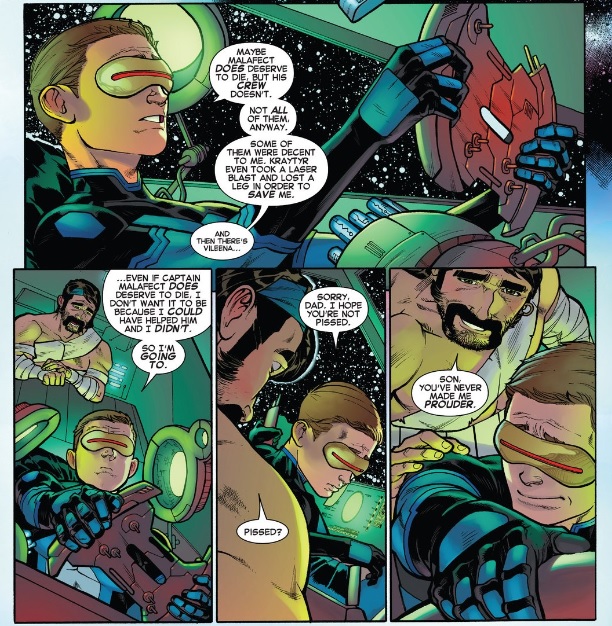
This moment is about as heroic as they come, and it’s significant that Scott’s heroism is something Corsair is proud of. He may be a scoundrel and a rogue, but he’s proud that his son is something more. Of course, Corsair was never the worst to begin with — he explains to Scott that he and Malafect were once actually friends, until Malafect got greedy and Corsair refused to participate in a mutiny he had planned. They’ve been bitter enemies ever since, and that’s why it’s so significant that Corsair is not only eager to help his son rescue Malafect anyway, but that he’s even willing to try to bury the hatchet and put an end to their feud once and for all.
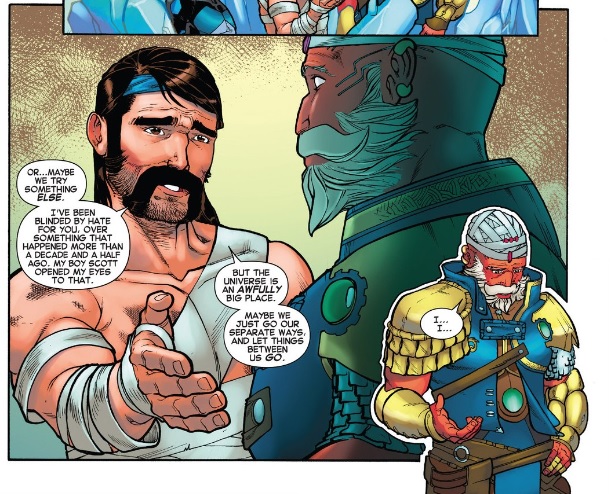
Again, Layman (through Corsair’s dialogue) makes it explicit that it’s Scott’s example that has helped Corsair reach this point, and it may be even more significant that Malafect seems willing to try as well. Scott’s heroism is touching even him, but it’s important to note that this isn’t a one way street — Scott’s learned as much from his father as Corsair has from him, and thankfully, that’s not a bad thing.

Scott’s known to have been a bit tentative in the past, but his time as a pirate — and his time fighting for survival on a barren planet with his father — have given him both the skills and the conviction needed to survive any hostile situation. When we talked about Cyclops 7 I referred to Scott’s time on the Desolation as a rite of passage, and in a way I appear to have been correct, as he’s emerged from the ordeal as a stronger, more composed, well-rounded hero, one capable of leading by example, not just words.
Unfortunately, that might not be enough to save the day this time around. Cyclops may have warmed Malafect’s heart, but he broke his daughter Vileena’s, and she winds up knocking both Scott and Corsair out before Malafect can accept their offer; she wants Scott to pay. It’s a tragic echo of the conflict between their fathers, former friends turned enemies due to clashing ethics, made all the more tragic by the fact that the conflict was nearly resolved, and now appears to be carrying onto the next generation.
It does raise the question, though, of just how effective Scott’s methods have been. Scott “betrayed” Vileena and her crew out of necessity and a pirate-like drive to stay alive, but then returned because his conscience couldn’t bear to let Vileena and the rest of her crew die. Even Corsair admits that it was the “right” thing to do, but is it possible that a pirate may not always be able to do the right thing? After all, as good as his reasons were, Scott did lie to and deceive Vileena (about his identity and role in the crew, not his feelings for her); does coming back to save the day free Scott from the consequences of his deception, as necessary as it is? Or is Vileena’s anger at least a little bit justified?
It should be interesting to see how Layman resolves this conflict. Will it be Scott’s heroic morality that saves the day, or his ruthless pirate conviction? Can people in his and Corsair’s line of work afford to have a conscience? Will Scott be able to resolve his conflict with Vileena, or are they already doomed to repeat their fathers’ feud into eternity? We probably won’t be able to come to a final conclusion about the intersection of heroism and pragmatism until we see how the conflict plays out, but in the meantime, Layman has seeded a fascinating conflict, brought to life ably by Garrόn’s energetic, expressive artwork (which lands just on the right side of cartoony and is a perfect fit for Cyclops’s brand of “sci-fi coming of age” adventures).
Mark, do you have any thoughts on Scott’s ethics and the various questions they raise? Do you have anything you’d like to add about Garrόn’s art or Chris Sotomayer’s colors? Maybe you just want to talk about Scott herding a bunch of intergalactic cats like a laser-eyed sheepdog? “That’ll do, Scott.”

Mark: Spencer, I’m willing to believe that Malafect would be this quick to turn from foe to reluctant friend of the Summers’ (well if not friend, then they at least share a mutual respect and a temporary truce). I’m even willing to believe that intergalactic cats would be cowed so easily. But I am pretty skeptical that Vileena would have such a strong reaction when Scott’s deception is revealed to her.
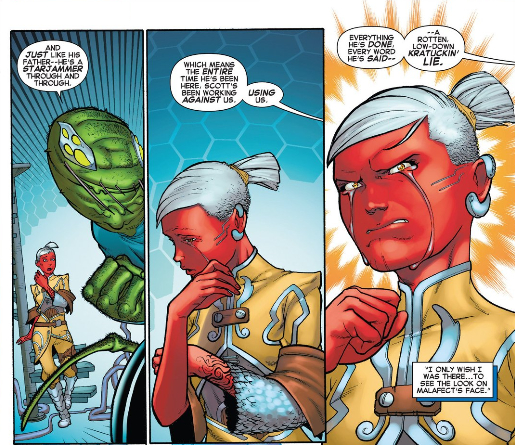
We see her quickly go through a range of emotions: surprise, then sadness, then anger. Surprise? Sure, that makes sense to me. Sadness? Absolutely, being lied to sucks. But anger? I really don’t understand her anger.
I’m willing to admit when you are in a relationship emotionally it’s sometimes very difficult to see things logically. We’ve all had friends or family date the most awful people and be seemingly oblivious to their awfulness. Removed from the emotion of the relationship, it’s easy for us to see why the boy/girlfriend is the worst, but that only makes it all the more infuriating when our friends make boneheaded decisions. So while I understand Vileena being initially upset upon learning she was lied to, I find it very difficult to believe that she would become so furious so fast. Consider the circumstance of Scott’s lies: if he told the truth he and his Dad would have almost definitely been killed. Are you telling me that Vileena, if put in the same circumstances, would have done anything different? And that’s if you believe she, as a fellow space rogue, wouldn’t be impressed by the deftness of Scott’s deception.
So while I agree that the story does have a nice symmetry to it, the emotional acrobatics required to get us to this point ring less than true to me. But also maybe I’m an emotional robot.
I do want to give special mention to Sotomayer’s colors in the issue. Garrόn’s art is effective, but overall pretty barebones. Action sequences in particular are not particularly dynamic. Yet the spreads throughout the issue never feel too stale thanks to the bright background colors applied to many panels.

A similar look is applied to the interior of Malafect’s ship. Garrόn doesn’t draw the Desolation in much detail, but the vagueness is hardly an issue thanks to strong color choices. It’s an effective marriage of line art and coloring, and a good example of how important a capable colorist is.
I’m pretty terrible at predicting where stories are headed, but I’d be willing to put down money that in the end Vileena and Scott patch things up. Anyone want to take that bet?

For a complete list of what we’re reading, head on over to our Pull List page. Whenever possible, buy your comics from your local mom and pop comic bookstore. If you want to rock digital copies, head on over to Comixology and download issues there. There’s no need to pirate, right?
 Retcon Punch