

Look, there are a lot of comics out there. Too many. We can never hope to have in-depth conversations about all of them. But, we sure can round up some of the more noteworthy titles we didn’t get around to from the week. Today, Drew, Patrick, and Spencer discuss Saga 26, Universe 2, The Woods 11, Batman Eternal 48, Operation S.I.N. 3, Spider-Woman 5, Guardians Team-Up 1, Rocket Raccoon 9, and X-Men 25.

Well, I’ve been afraid of changin’
‘Cause I built my life around you
But time makes you bolder
Children get older
I’m getting older, tooStevie Nicks, “Landslide”
Drew: In 1972, Niles Eldredge and Stephen Jay Gould coined the phrase “punctuated equilibria” to describe systems where short burst of change punctuate otherwise stable conditions. They were working in evolutionary biology, but they might as well have been referring to highly episodic narratives like sitcoms and comics. Or, at least as long as there aren’t kids involved. I’m not sure exactly what was the first series to acknowledge that its child stars were aging in real-time (though that would be a fun research project), but everything from For Better or For Worse to Full House benefitted from that precedent. In those situations, the series must evolve along with those characters as they mature, gain independence, and grow into (and out of) age-appropriate storylines. Saga has long been driven by “big” ideas — family, love, war — but as issue 26 reveals, the specific relationship to those ideas will change along with its child characters.
The theme of this issue is the lessons parents learn from their kids. These might be incidental lessons taught by trial-and-error, like the “meeting new people” lesson Hazel articulates in her voiceover, but they can also be more explicit, like the “let’s talk it out” lesson that Sophie saves the day with. Actually, Sophie saves the day by yelling “EVERYONE, BE FRIENDLY!” at the monsters attacking her party, which would feel too on-the-nose if it didn’t resonate so perfectly with the rest of the issue. Still, the issue enters some dangerous “out of the mouths of babes” territory, which might actually irk me more than treating the kids like MacGuffins. Did you pick up on that at all, Patrick, or were you too charmed by the image of Ghüs buttoning his overalls to be bothered?
Patrick: After doing this with me for three years, you certainly do know what tickles me. Ghüs’ overalls go a long way toward charming me, but they’re not alone: Sophie stammering over their need to see a “boy dragon,” Dengo’s sense of dread as he realizes he’s thrown in with characters worse than him, and that reveal that The Brand et. al are being followed by a male version of The Stalk — all super exciting details.

I’m just happy Fiona Staples has the opportunity to draw one of these characters again. The Stalk was one of my favorite early-Saga designs, and it would have been a shame to never see this mix of arachnid and mammalian bodies again. But what really struck me about the issue was the idea that no amount idealism can really change who a person is — for as much as we want to say that having kids changes someone, there’s always going to be a fundamental nature of a person that cannot be changed. Such is how it is with Marko, who cannot keep himself from violence, no matter how abhorrent his paternal instincts make those tendencies seem. In fact, between his fear that violence is inescapable and his newfound drug habit, Marko might just be hitting rock-bottom.
And maybe that’s because he’s a different kind of addict — he’s addicted to the love of his family and he’s experiencing withdrawal. The same idea — withdrawal from love driving a man to crazy things — is at the heart of Albert Montey’s Universe 2. Marital companion robots were introduced in the previous issue, but they’re explored in more nightmarish detail here, suggesting that Montey has an expansive world that he plans to explore one weird detail at a time. The scenario is thus: one particular model of marital companion robot, MRR3, has started attacking and killing their partners during shows of affection. Sometimes, as in this issue’s opening scene, this is absolutely horrifying. The very first thing we see is a robot raping its owner to death. Montey does just about everything he can to soften the scene, but the image of blood splattered on a robot’s crotch is just too evocative.

Even with Montey’s cartoonier style, I had a tough time slogging through the first couple pages and getting to Alan’s scheme to get all those robots recalled, and therefore, back in his heart. There’s a very clear parallel to sexual assault, but I’m not 100% sure what this narrative is implying — and most implications make me uncomfortable. I think there’s a valid reading here that suggests that sexual assaulters are victims of glitches in their own programming — and that’s gross. But the robots are also acting on the will of one selfish asshole who wants his own kind of love at all costs, which puts some of the blame more generally on rape culture — which is a little less gross, but still absolves the individual actors of any responsibility. It’s a fascinating read, and Montey’s writing is sharp; those are just some tough ideas to sit with.
Hey, you remember how The Woods was about a whole high school that was transported to the middle of a mysterious magic woods? Me neither! The series had been so wrapped up in the individual character histories and the greater history of this spooky place, that I had more or less forgotten that there was an entire school full of randos that also needed guidance. Issue 11 reintroduces the drama evolving out of the school as students and staff start to play Lord of the Flies and rebuild society to the best of their abilities. It’s cute, if a bit heavy-handed when the theatre teacher makes an impassioned plea to let him put on the student’s production of Urinetown to ease the tension in the school. Yes, yes, yes: art is important too. Fortunately, writer James Tynion IV is in a mood to bring other elements back too, so we get to see an Act II of Isaac and Adrian’s relationship, which — when it’s allowed to be — can totally be the heart of his series. I loved seeing those kids actually talking to each other and I remain convinced (convinced!) that Adrian’s not as bad of a kid as we’re lead to believe.
Spencer: Despite what I may have said in the past, I can agree with that, Patrick. Adrian may be indifferent to people much of the time, but he doesn’t despise them, and he even seems to be genuinely trying to help them in this situation. Moreover, bad people are rarely able to admit that they’re bad the way Adrian does.

I don’t think Adrian desires to become something more because of his mother’s ambitions or a desire to show people up — I just think he despises who he is and would do anything to be somebody else, somebody better. Truth be told, that’s probably what every single character in this book wants; Adrian’s just taken his quest in a darker direction. As a dark mirror to the rest of the cast, Adrian may be an antagonist for the moment, but I don’t think that makes him a villain, and he certainly still has a chance for redemption (if you think he even needs that sort of thing).
Over at DC, Batman Eternal‘s year-long tale is finally reaching a climax, with most of the characters and plot threads seeded throughout the past 48 issues all coming together just in time to see everything go catastrophically wrong for our heroes. I love the way writer Kyle Higgins and the rest of the Eternal bullpen keep escalating the disaster, with pretty much every character reaching their lowest point; that should make it all the sweeter when they eventually triumph. I also appreciate how carefully they’re doling out clues; the writing bullpen has given us enough information to get the gist of the grand scheme Spoiler’s been privy to all this time, or of how Julia’s going to save the day, but they haven’t spelled everything out, leaving us plenty of room to speculate (which is probably half the fun in a series like this). Artist Fernando Blanco’s smooth figures and clear storytelling and choreography make it a visually impressive issue as well, but I’m most impressed by the opening pages, where Blanco drapes Mayor Hady and Jason Bard in thick shadow, a perfect noir-ish touch for their shady backroom dealings.

Batman Eternal hasn’t always been the most consistent series, and could have benefitted from being trimmed down a bit, but at least it looks like it will have a strong finish.
With its core cast fully assembled, Operation S.I.N. 3 finds the mini-series finally hitting its stride. Writer Kathryn Immonen gets a lot of mileage out of the group dynamic between Peggy, Howard, Woodrow, Tania and Mikhail, and their interactions yield results both humorous and, on occasion, touching. Immonen’s smartest move, though, is finally revealing the villain; using Hydra as an antagonist in a 50’s-era story isn’t the most original idea, but I like how Immonen uses them to show some particularly Soviet methods of punishment, and the mystery behind Shareen’s strange abilities is a much more compelling idea than the generic alien invasion threat of the first two issues.
Likewise, with issue 5, Spider-Woman also finally settles into a groove with what is essentially a second “first” issue. Dennis Hopeless has a lot of information to establish this issue — including the details of this new status quo and background on Jessica’s new case — but he does so without ever veering into clinical exposition dumps. Instead, Hopeless grounds everything in Jessica’s very human point of view, and while there’s a few times where he seems to be writing Jess as a bit more naïve or inexperienced than seems appropriate, the voice he gives her is still warm, funny, and endearingly flawed enough to pull me into the issue. Javier Rodriguez makes his Spider-Woman debut on pencils and colors this month and brings with him the same quality, giving his characters some delightfully realistic and varied features and acting that just makes the book feel alive and lived-in. Rodriguez’s colors are as on-point as they were when he worked on Daredevil, and I’m particularly fond of his layouts — whether it be wrapping his panels around a staircase or tailoring them to Jessica’s particular abilities, they’re always unique and intuitive.
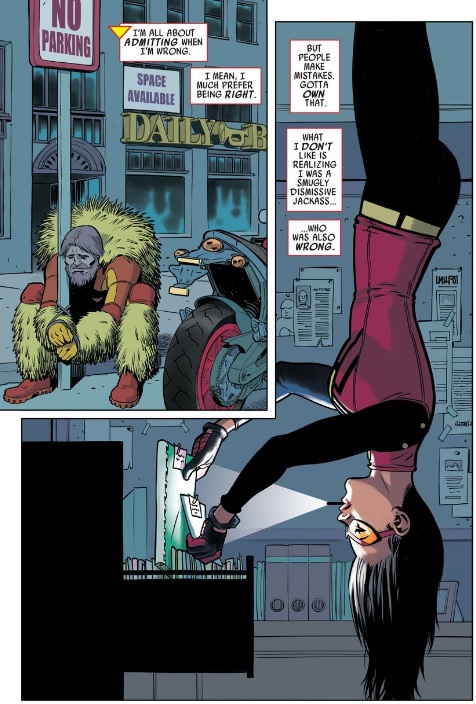
Spider-Woman‘s been a fun book from the start, but it’s great to see it finally gain its own identity separate from “Spider-Verse.”
Guardians Team-Up makes its official debut this week, and it’s not quite what I was expecting — the title led me to believe it would be something in the vein of A+X, but Guardians Team-Up finds writer Brian Michael Bendis throwing pretty much every Guardian and Avenger he can get his hands on together into one gigantic story. I actually think I like it better than the core Guardians book so far, if only because that title is so often focused on Spartax and/or periphery characters, while Guardians Team-Up finds room to give almost everybody something to do. The main story looks to be about Gamora, and even the Avengers (such as Hawkeye and Starbrand, among others) get focus, characterization, and a few big moments to shine. Like much of Bendis’ work — including his current “Black Vortex” storyline — it’s rather slight in terms of plot and themes, but still a lot of fun to read. Drew, was that your take, or did this team-up yield different results for you?
Drew: I certainly had some fun with it, but this is easily the most disposable issue I read this week. I suppose my biggest nit to pick is the same as for the “Black Vortex”: the cast is way too big. I absolutely understand the appeal of playing with ALL THE TOYS, but half of the Avengers have dialogue so generic that anyone could have said it, and I’m pretty sure Thor doesn’t utter a single word of dialogue. I suppose talking isn’t really the point — and again, I had fun — but I think this issue would have benefitted from a slightly smaller cast.
Speaking of smaller casts, Rocket Raccoon is as short as ever in issue 9 (har har). The issue acts as an interesting “what if?”, set in an alternate future (which possibly portends our own future) where Rocket and Groot have parted ways, leaving Groot to run amok when Tony Stark attempts to run some tests on him. Rocket is called in to save the day via friendship, which would be a cheesey conclusion if Skottie Young didn’t undermine it so perfectly by pulling Rocket out of the simulation for the duration of the emotional climax. It ends up being a surprisingly moving meditation on Rocket and Groot’s friendship, all told with the charm and clarity we’ve come to love from Jake Parker’s art.
Last time we talked about X-Men, we lamented not feeling connected to Psylocke, in spite of her narrating the issue. I didn’t have high hopes for issue 25, which focuses on Monet, a character I have no prior experience with, but writer G. Willow Wilson managed to establish a strong voice for her by the first page, helping me absolutely fall in love with her acknowledging her temper by page 2.
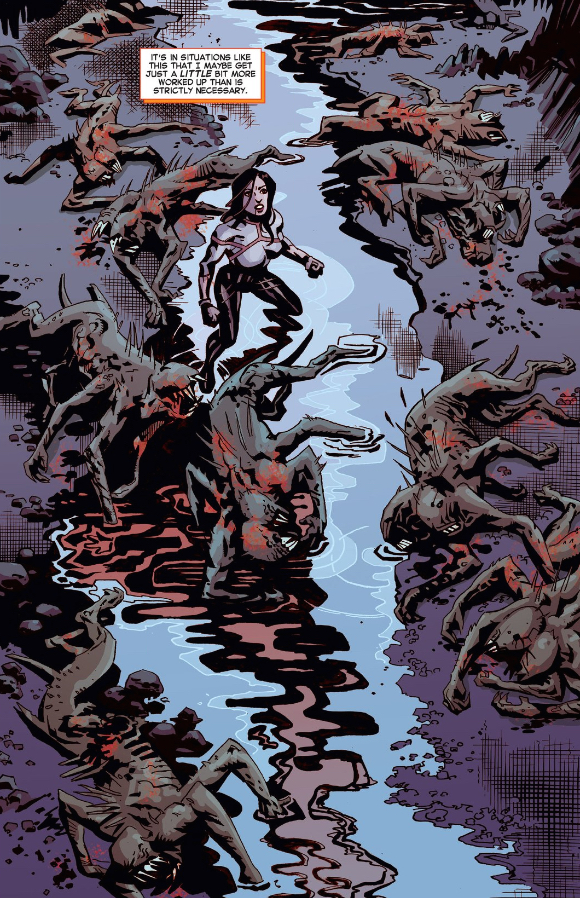
She comes off so strong, in fact, that any scene she’s not in feels thin. Patrick, I can’t say I was particularly fond of that jaunt to New Attilan, which was devoid of both plot points and character insights — am I missing something, or was that totally pointless?
Patrick: I’d say it felt totally pointless too, but it’s possible that Wilson is seeding ideas for the next issue, which could well be from Jubilee’s point of view. (Also, this is an old X-Men thing so I really shouldn’t single out its appearance in this issue as cumbersome, but jesus christ: Jubilee’s real name is Jubilation Lee? Worked real hard on that mutant name, huh? Meet Scosummers and Bodrake.) The actual Atillan portion of Jubilee’s journey only serves to rule out their involvement, and it doesn’t definitively do that, either. I think a lot of problems in this issue could have been resolved with more engaging art-work: if I was actually marveling at the high towers and shiny buildings of Atillan, I wouldn’t have been bothered the Jubilee’s pointless visit; if I had any sense of space in those caverns, I might have worried about where our heroes are in relation to each other. The ubiquity of telepathy also makes it impossible to know when characters are near each other — if they can always talk, they’re never alone. Monet makes a weird crack about how many psychics are on this team, but I’m afraid hanging a lamp on the issue only made me more frustrated.
The conversation doesn’t stop there, because you certainly read something that we didn’t. What do you wanna talk about from this week?
 Retcon Punch
So, in reading Guardians Team-Up and Rocket Raccoon back-to-back made me realize something about Rocket: I absolutely hate it when writers give him fake swears to say. I suppose I’ve mostly read him under the pens of Bendis and Young, but I’m MUCH more in favor of the grawlix Young uses — it’s just as cartoony and absurd, but feels decidedly less like random gibberish, and more like actual swearing. I know Patrick hates the fake swearing of Spider-Man 2099, but at least it’s shocking consistent. Rocket, on the other hand, never seems to repeat the same made-up swear twice.
OH – I meant to bring this up in our conversation about Avengers 41 – but Rocket very conspicuously doesn’t do his made up swears on Hickman’s pen. In fact, he uses “freaking” like four times.The only swear that seems consistent in Rocket’s vocabulary is… uh.. it starts with f and is something like ‘futraking’ and basically means “fucking” (I forget what it is because I’m certain I’ve never actually read the word, just seen it and acknowledged what it is).
I guess my question is just: why no editorial oversight on how a character talks?
Honestly, I think there should just be a policy on how swearing is handled generally. I would personally rather see grawlix (or, in the case of television, bleeping) than see the characters resort to “freaking” or some other made up swear words. The point is to communicate that they’re swearing, not come up with some kind of smartass workaround. I think it’s better to just acknowledge that they can’t actually show real swear words than it is to use a bunch of distracting cheats.
Right – as much as I’m against fake slang, seeing character’s using toned-down swearing is an even bigger pet peeve for me. “Freaking” and “fricking” and “frigging” are just such lame ass words that using them does the exact opposite of actually saying “fucking” when I believe the desired result is approximating it.
Absolutely. Using the word “freaking” can say a lot of things about a character, but that they’re a hardboiled badass sure isn’t one of them.
I was wondering why I didn’t love Universe! #2 the way I did issue one, and I think you hit the nail on the head, Patrick — the satire just isn’t as sharp. I also think this issue suffers a bit from the lack of a real sympathetic/heroic protagonist like issue one had; I guess the creator of the MRR3 could count, but I could hardly get in her head the way I could the employee in issue one.
I still love a lot of the concepts Monteys comes up with, though. The sentient shopping mall who has a personal relationship with every customer is ingenious. I’d love to see an issue just from its point of view.
I just love the conceit that this is like a supplemental comic fleshing out a world that exists in a main series we don’t get to read. That leaves room for so many cool sci fi possibilities, and Montey’s attitude toward his world is just satirical enough to be really interesting. I criticized the second issue, but only because I think the ideas expressed it are so fucking thorny. Montey raises a bunch of great questions, the Round-Up doesn’t really give me adequate space to discuss it.
I was reading Guardians Team Up in bed and my girlfriend asked what I was reading. She had seen that splash page with all the Avengers and all the Guardians on it, and was curious – y’know because she recognized a bunch of the characters. So we had a fun (for me) conversation where I asked which heroes she could identify (Thor tripped her up, and she was convinced that Firebrand was in the Fantastic Four, but overall she did pretty well). Hilariously, Hawkeye ends up having basically the same conversation on the next page. Somehow, Bendis can see into my bedroom.
But Spencer, I like your pitch for a G+A style book. That sounds like more fun than YET ANOTHER TOO MANY CHARACTERS series.