
Today, Drew and Spencer are discussing The Fade Out 5, originally released April 15th, 2015.

One of the most dangerous of literary ventures is the little, shy, unimportant heroine whom none of the other characters value. The danger is that your readers may agree with the other characters.
C.S. Lewis
Drew: I’ve been quick to praise Charlie Parish as the ideal audience surrogate, a virtually featureless cypher we’re free to project all of our emotions on to. Part of that falls out of his role as the protagonist, no more or less aware of the mystery at the heart of The Fade Out, but writer Ed Brubaker has carefully cultivated a character who’s conflicted about just about everything — he supports multiple readings so well because he’s feeling multiple things at any one moment. It’s a remarkable feat, but his openness also makes him a waifish anchor for the series. I’ve often seen that as more of a feature than a bug, allowing the series’ tone to vary widely based on the influence of the supporting cast, but as the cast begins asserting their opinions in issue 5, they run the risk of running away with the story entirely.
The film crew is up in Ojai to shoot some exteriors, which brings some uncomfortable points of comparisons for the last time they were in Ojai — to shoot these same scenes the first time with Valeria. That these reshoots are a pale reflection of the originals becomes an important theme for the issue, from Gil’s tirade about studios regurgitating the same “dumb bullshit,” to Brodsky’s lecture on acting like Don Quixote. Those are both great moments, so I want to pause to dig into those a bit.
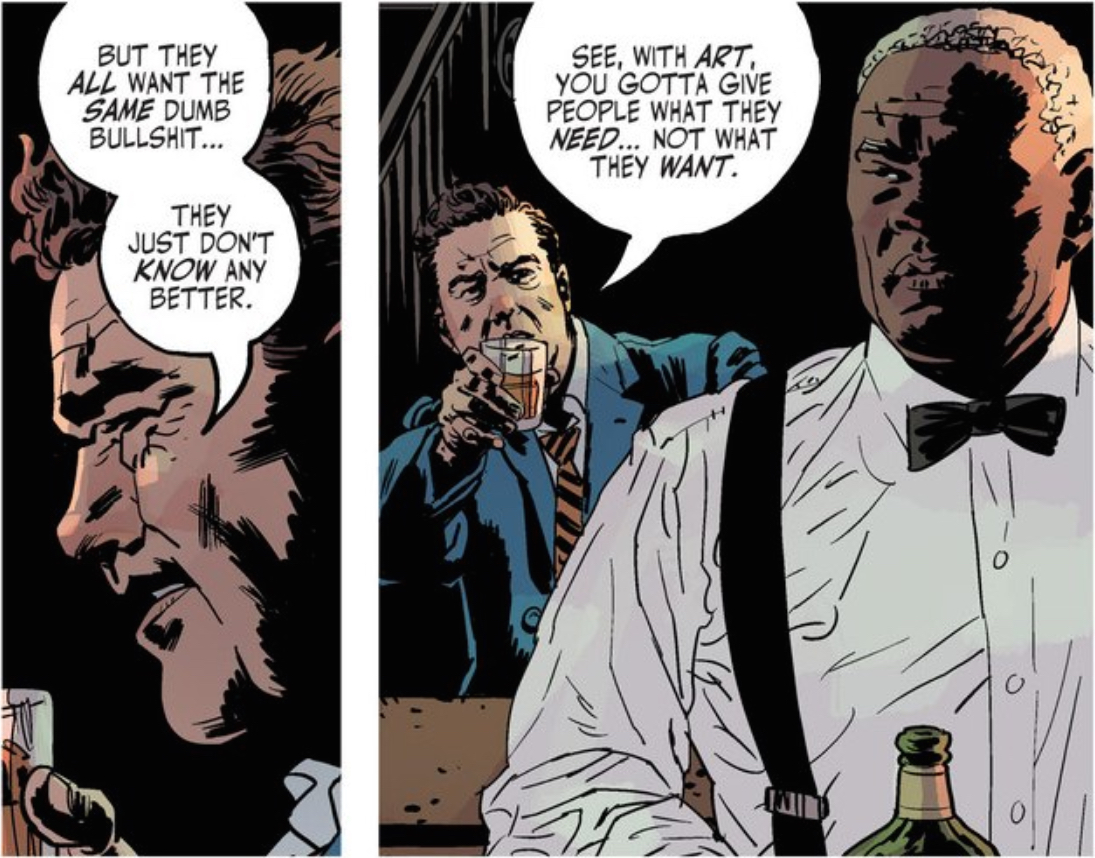
It’s easy enough to read Gil’s entire screed as Brubaker’s own complaints about the comic book industry, but for our purposes, I think it’s simply important to understand that Gil is disaffected with the cycle of the film industry. That dissatisfaction extends well beyond artistic integrity, and by the issue’s end, will include the entire industry (or, at least, this particular studio).
But I’m getting ahead of myself. First, Phil Brodsky reads!
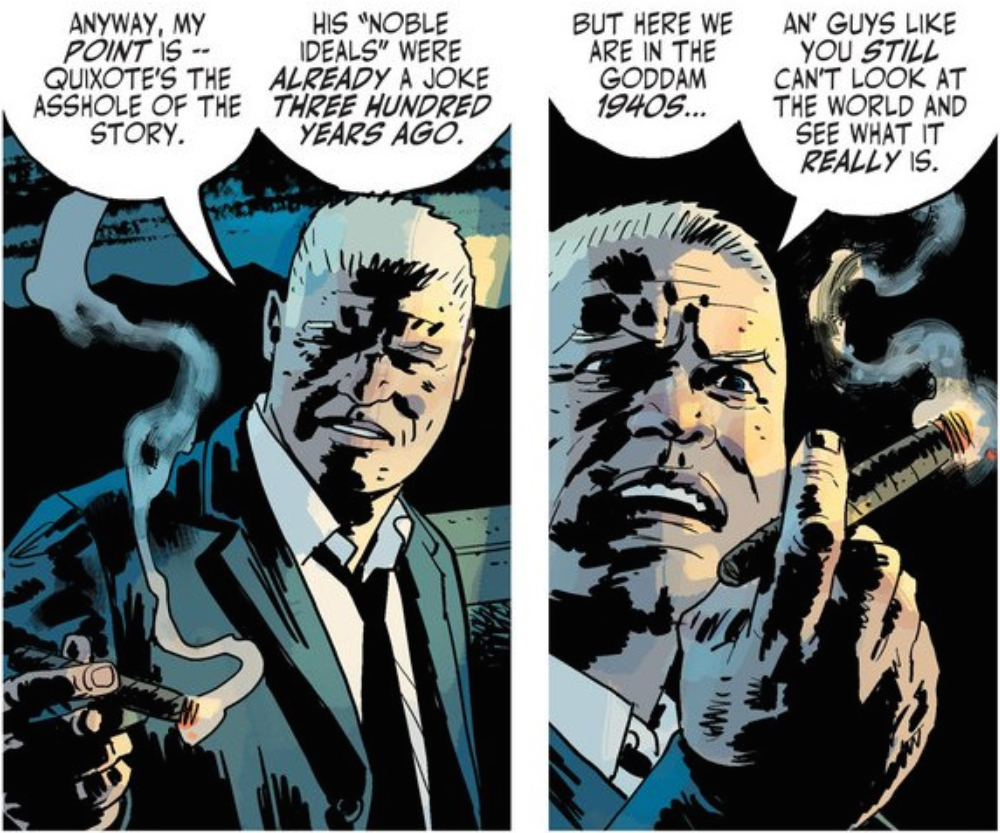
That assessment may be a little glib, but it provides the contrast to the paean to artistic integrity that was Gil’s drunken diatribe. These two provide the philosophical poles that the issue hangs between, setting the intellectual stakes for Gil’s decision to “bring all these bastards down.”
What’s curious about those intellectual stakes is that Charlie doesn’t play a role in them at all. Indeed, I wouldn’t assert Charlie as either the hero or the asshole of his own story — certainly not as presented in this issue. If anything, the slow acceptance of Maya in the place of Valeria may alight him with the studio (or maybe even the youth-chasing Al Kamp). Aside from waiting for Gil and passively flirting with Maya (or, rather, being flirted with), Charlie’s role in this issue is mostly in flashback, where he remembers his last stay in Ojai with Valeria. That flashback provides a possible enemy (and motive) for Valeria, which again, makes that flashback decidedly not Charlie’s story.
As the scope of this series grows, I’m not sure allowing the focus to deviate from Charlie is a weakness, but I was surprised how excited I was at Gil’s resolution at the end of the issue. As much as I’ve loved the slow burn of this series’ central mystery, it was easy for even the hint of decisive action to capture my interest. That bodes well for this new direction for Gil, but threatens to rob the central mystery of its creeping momentum.
Or maybe this is just the post-clue blues. The previous arc ended thrillingly with the hint of a bigger conspiracy and a mysterious man in horn-rimmed glasses, and the closest this issue ever comes to that kind of clue is…mentioning the mysterious man in horn-rimmed glasses. Easing off from the mystery driving the narrative is understandable at the start of a new arc, so I might need to recalibrate my expectations, but it’s hard not to feel like that particular thread has lost its scent.
What do you think, Spencer? Were you able to forgive easing off of the central mystery to make room for Gil and Brodsky, or did their conflict derail it entirely? Can Charlie hold his own against those two, and if so, how does his narrative fit with theirs?
Spencer: Oh boy Drew, I can’t wait to dig into both of those questions. It’s been clear for a while now that The Fade Out is about a lot more than just the murder of Valeria Sommers, so I’ve got no qualms with the mystery being pushed aside. That said, we still seem to get a new clue or two to help progress that plot along.
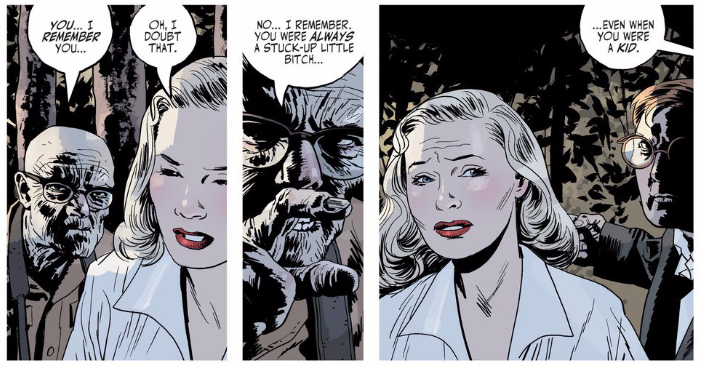
You’ll have to forgive my fuzzy memory — I’d have preferred to reread the first four issues before sitting down to write this, but just didn’t have the time — but Valeria having a connection to Al Kamp and the studio as a child is new information, right? (Valeria does imply that she mentioned growing up near the ranch to Charlie before, but that could have happened off-panel). Drew mentioned that this entire scene gives Al Kamp motive for Valeria’s murder, but I’m more interested in this smaller detail, if only because it adds to the overwhelming intrigue surrounding Valeria’s death — ironically enough, her life may make for a better story than any of her films.
As for Charlie, I don’t think he can hold his own against Gil and Brodsky in pretty much any way, but that’s probably the point. He’s weak-willed, lost, and reactive, which in many ways does make him the perfect audience surrogate, but what seems most significant about Charlie in this particular issue is his determination to follow the rules.

Ultimately, it’s impressive how passive Charlie manages to make the act of following the rules appear. After all, Charlie’s stance here isn’t about respecting the law, it’s about keeping his head down, remaining unnoticed, and staying out of trouble, removing any traces of decisiveness from his actions.
Perhaps more disturbingly, this seems to align Charlie’s values with the studio’s — Brodsky spouts the same complaint as Charlie almost verbatim later in the issue, although he’s more concerned about how people not following the rules affects him personally. Brodsky doesn’t seem to care at all that Tyler Graves is homosexual, for example — in fact, his view of it is downright progressive for the 1940’s — but he certainly cares that Tyler’s promiscuity is going to make a lot of extra work for him. Likewise, Brodsky seems to be legitimately looking out for Gil’s best interests, but is disgusted by Gil’s morality and threatened by his unpredictability.
Gil, of course, falls on the exact opposite end of the spectrum, ending the issue by choosing to rebel and take down the studio. It’s the boldest move anyone makes in the issue, especially since Brubaker’s already established how badly Gil’s decisions usually turn out — in fact, Gil’s decision almost seems destined to fail. Brodsky and the studio’s attempts to use rules and coercion to benefit themselves and keep others in line has obvious parallels to society in general, and especially the more stifling society of the 1940’s, but Gil’s brand of rebellion is still a good twenty years away from really taking hold. Does that doom his efforts before they even begin?
In contrast, Charlie’s non-decision to keep his head down is a much more 1940’s way of dealing with his problems, and likely the safer option in general, but it does come with one downside: there’s no integrity to it.

So we clearly have the two “sides” laid out here: Brodsky and the studio have power and money while Gil has integrity, but Charlie is stuck somewhere in the middle, just frantically reacting to what’s going on around him without making any kind of headway or personal growth. Charlie’s position is more precarious than ever, but it should be interesting to see if he’ll ever be capable of gaining any agency in his life, or if he’ll forever be one of the followers (as opposed to the leaders and rebels represented by Brodsky and Gil, respectively).
Like I said earlier, The Fade Out is much more than just a murder mystery (though those are pretty awesome on their own); Brubaker and artist Sean Phillips seem determined to tear down the nostalgia surrounding both Hollywood and the past brick by brick. Phillips’ work is essential in this regard; he knows how to embrace the aesthetic of the period without ever overly glamorizing it, and likewise, can handle sexually explicit scenes without ever actually sexualizing the (often unwilling) participants. For his part, Brubaker makes sure to highlight how dangerous the repressive and discriminatory mores of the period could be, be it through poor Tyler Graves’ likely suicide or the abysmal treatment of just about every woman in the book.
And like all the best period pieces, The Fade Out challenges us to take a look at the world we live in and see how much has actually changed since the 40’s (sadly, it’s probably not as much as we’d like to think). The fact that Brubaker and Phillips can include this kind of thoughtful material in their story without ever coming across as preachy or heavy-handed is damn impressive; it’s a testament to the realistically flawed characters and expansive, immersive world they’ve created, and it’s all those qualities that keep The Fade Out feeling vital even when it strays a bit from the mystery at its core.
For a complete list of what we’re reading, head on over to our Pull List page. Whenever possible, buy your comics from your local mom and pop comic bookstore. If you want to rock digital copies, head on over to Comixology and download issues there. There’s no need to pirate, right?
 Retcon Punch