

Today, Patrick and Taylor are discussing Zero 17, originally released June 3rd, 2015.

Make art, not war.
Traditional
Patrick: Perhaps it’s because the above statement is so simple that tracking down a specific origin proves so difficult. A little bit of on-line research will keep pointing back to street artist Shepard Fairey — who did design the now-iconic image that often accompanies the phrase. Even if we assume Fairey’s authority, the artist’s populist message and street-art aesthetic makes it hard to credit him with any particular concept or turn of phrase. “Make art, not war” is also clearly a reference to the anti-Vietnam War slogan “make love, not war,” which itself has an origin that is up for debate. Be it art or be it love, there is a persistent need for something that man can consider the opposite of war, so it’s fitting that these slogans should resist a single point of origin. Like the fungus in Zero, they come from everywhere — in all times and all realities — to mitigate the suffering caused by war.
Zero’s fungal trip continues in this issue, grounding the psychedelic journey from issue 16. Actually, the series’ exploration of meta-fiction traces its roots back to issue 10, which had our hero confronted with the idea that his whole experience was simply actors putting on a play. But while those previous forays into layers of narrative have existed for no reason larger than their own glorious mindfuckery, this is the first time I’ve thought of the stories and the storytellers themselves as heroes in their own right with purposes and goals. The issue starts off in flashback — literally a rose-tinted memory — of a young boy meeting Marina on the playground in 1975. Edward, who is projected into the scene in full color and detail, names the boy Vedran — and if that’s a reference to a character we’ve met before, I’m afraid it’s lost on me. It almost doesn’t matter: Edward either knows the boy’s name, or is able to authoritatively give the boy a name. This flashback is, in effect, a story, and Edward is either its teller or its audience, or both.
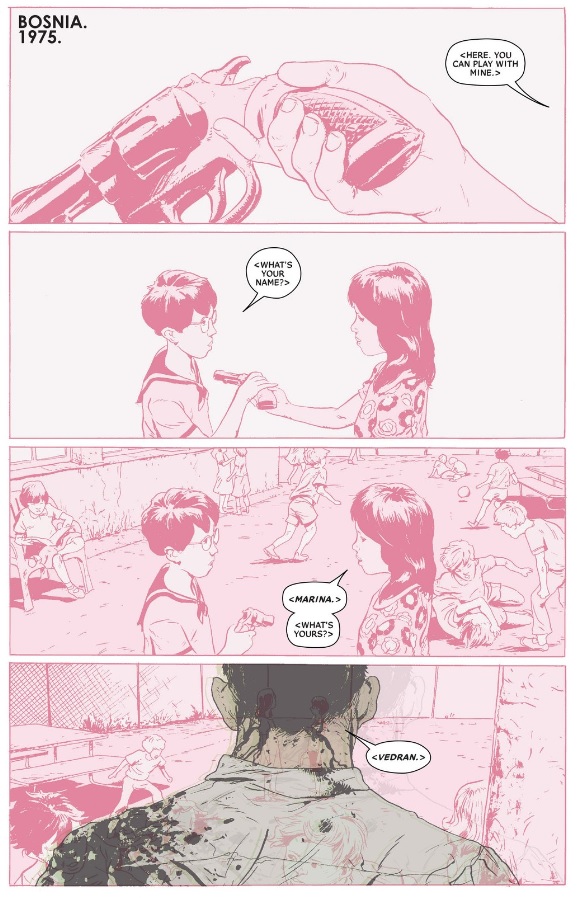
I love just about everything about this page, but let’s just take it one image at a time. First of all, this isn’t the first time we’ve seen this color palette. Issue 9, which told the story of Zizek and Marina’s short relationship, employed the same colors to show Roman and Marina at their most sweet and innocent. While artists rotate between issues, colorist Jordie Bellaire is a constant throughout, and her ability to tie this moment back to a different set of flashbacks from eight issues previous creates a masterful cohesion on a level well above what worlds and incident alone could achieve. We’re tied, not only to the histories of the characters, but our own histories reading those stories.
Kot and artist Robert Sammelin waste no time in establishing the abstract Big Bad of this whole series: war. Check out that first panel — no character, no setting, just a gun in a human hand. Zero, upon viewing this exchange asks — perhaps of the fungus, but perhaps of us — “Why are you doing this to me? Why am I here?” That becomes the prevailing question throughout: why are we experiencing this at all? And actually, we can go one step further to ask who’s experiencing this: Edward? Burroughs? Kot? The reader? Possibly a collapsed amalgamation of all four?
As the fungal entity explains its own history, it sets itself in opposition with the “black thing.” Previous mentions of the black thing have been amorphous — a nondescript badness or weakness of men. Here, the language becomes more specific, at one point identifying the thing as a “war parasite.” By contrast, the fungus represents “myths, stories, life” which is constantly being invaded by the ubiquitous black thing. Sammelin is tasked with embodying the history of the black thing, and he goes for the greatest hits of human atrocities. Notice that the pink tint has darkened to red, and sweetness is replaced with blood and horror.

The black thing is so good at overpowering story and art that this image spills out into the gutter. War cannot be contained, even by the medium expressing it. Pointedly, this is the only panel that breaks its borders. But even with the overpowering disorder of the black thing darkening the corners of this issue, Kot isn’t wholly pessimistic. There is an energy and order to art and storytelling in here too. Take the reversed pages that bookend the chaos for example.

Burroughs, as the sometimes-author of this story, attempts to arrange this chaos through language. The same note about psychomagic accompanies both pages, reinforcing the idea that art has specific, measurable values and purposes. Interestingly, this leads to a climax of men asking for forgiveness of a non-specific “son.” Maybe art cannot prevent us from being horrible war-waging monsters, but it can help us seek forgiveness for our natural violent tendencies.
Taylor, I believe Drew mentioned last time that this series continues to explore subject matter which he feels diminishingly qualified to discuss. And while the literary and culture references continue to pile up (that’s punk-poet Patti Smith singing her song “Land” on page 15), I’m starting to feel like there’s a message here I can get behind: the history, the stories, are our salvation, even if it’s just a story you’re telling yourself.

Taylor: I definitely think that stories are being presented as a healing device here. In the context of this comic, as in other places, it seems like stories are being used to make sense of a world gone mad. In the case of Zero we’ve seen multiple examples of humans behaving in horrible ways. Now we are beginning to revisit those scenes and place them in the context of a story and from there we can finally extract a meaning for it all. While art is touted as being a source of salvation, as you say Patrick, I think it is implied that they can also be used to bring out the savageness in man. When the fungus, via dead people from Zero’s past, informs him about the “Black Thing,” it gives us some history about its evolution.
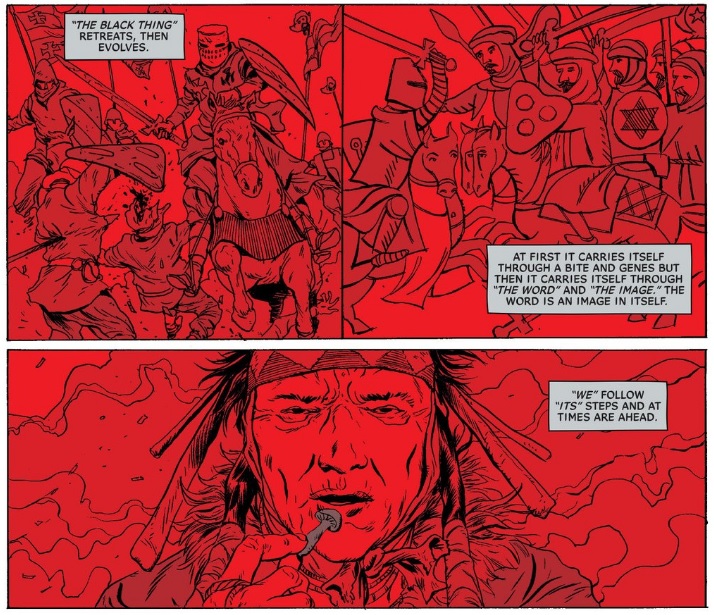
The Black Thing is first known to man via genes and his bite. In other words, it is something that is in man’s nature and later known through blunt physical force. However, the Black Thing evolves and then is transmuted through “the word” and “the image.” I see this this as an assertion that stories, when used negatively, can do just as much harm as good. Just take a look at the images that correspond to this piece of text. There are what look like crusaders effectively murdering people. And what were the crusades if not battles over stories in a couple of different books? Kot seems to be saying that when used to control people, stories are what drive men to violence, to give in to the Black Thing. When I consider the likes of what Russia is doing in the Ukraine and what IS is doing in the middle east, it’s hard not to see the truth of this idea. But the fungus also asserts that it follows the Black Things steps and “at times are ahead of it.” This got me to thinking just why positive stories, those that do save us, are being associated with a fungus.
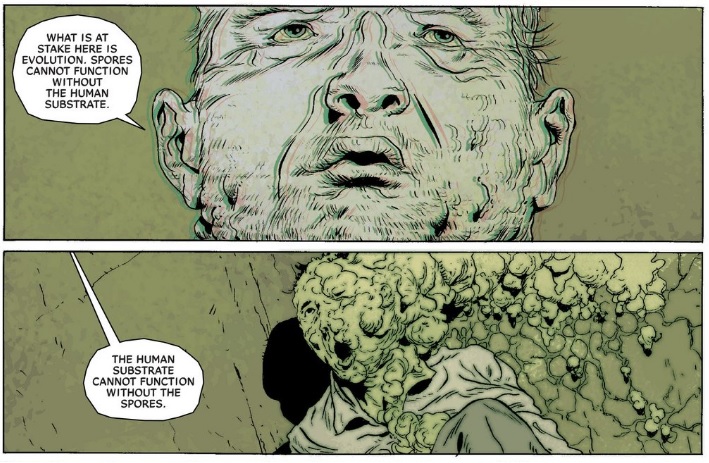
When I think about fungus, I think about my kitchen. Namely, I think about about forgotten foods and other rotten things that begin to grow mold. One of the amazing things about fungus is that it can grow just about anywhere and many times, grows out of the very stuff that used to be alive like a tomato or bread. If the Black Thing causes death, then the fungus brings it back to life, just like Zizek is brought back to life after being killed essentially by a story. Where the redemption comes in for the fungus is that it gives people a second chance to assess their life story. When I read Zero, luckily I don’t have to die to take the messages from it and perhaps that’s Kot’s point. A story saves us by showing us what was or could be.
Patrick, you mentioned coloring earlier and I think there is one final thing to say about that. At the end of the issue there are four pages that are just a sheet of color. In order they are grey, green, red, and then white. Maybe I’m stretching too much to find meaning in those, but don’t those kind of represent the big ideas in this issue? Grey = the Black Thing, green = the fungus, red = man’s tendency towards violence, and white = hope or absolution. Now, that could all be wrong, but when the next issue of Zero comes out I’m going to pay special attention to see if those four colors are used in any significant way. I also wonder if there is a meaning to the order. Could that be some sort message about the order in which stories are made? Like Drew, I have questions but that’s the best thing about this series right now. While I might not know everything that is going on, it still makes me think more than any other title does.
For a complete list of what we’re reading, head on over to our Pull List page. Whenever possible, buy your comics from your local mom and pop comic bookstore. If you want to rock digital copies, head on over to Comixology and download issues there. There’s no need to pirate, right?
 Retcon Punch
Man, this title is increasingly dizzying and sometime I can’t make heads nor tails of it — thank both of you for helping me sort out what exactly happened here. This really helps me remember why I like discussing comics with y’all so much.
Man — stories bringing people together. Thanks, fungus
Some random thoughts, ideas and observations. I am by no means an expert or authority on any of these subject so bare with me.
Let’s start with Burroughs as a character. Why Burroughs? His cut up method works for talking about multiple universes and dimensions, natural for jumping timelines. He was a known drug user and spoke of hallucinogens often. He wrote about the dark side of the human experience, and seemingly coined the phrase “the ugly spirit.” He has a dead son and dead wife, both who’s tragedies can be connected to Burroughs himself. Kot seems to be a fan, and has referenced Burroughs, and “Psychomagic” the title of this issue, in his other works, going so far as to reference him as “Uncle” in The Surface. Where my minimal knowledge of Burroughs fails me is if there is actually any writings by him that reference a character like Edward Zero etc. Some quick research found Burroughs’ son died in 1981 shown here with Burroughs on a rooftop in NYC, mirroring an earlier scene from 1980 in the issue, both specifically reference the cut up method. There are references to “The Black Lodge” usually associated with Twin Peaks, but also attributable to a Burroughs from his book Cities of the Red Night (which is also dedicated to The Ancient Ones, who are also referenced in this issue). Cities of the Red Night is about two different narrators in two different time periods and locations, that is also mirrored by the last few issues of Zero. The “The Healing of past trauma” quote is taken from Last Words: The Final Journals of William S. Burroughs, see link below, and in the same entry of the quote (Aprils 30th, not April 29th, like in the comic) and Burroughs even talks about feeling Allen Ginsberg presence. All the talk of past traumas, stories we tell ourselves in order to live, art being magical and producing results. are running themes of both Burroughs’ work and Kot’s. I’m sure I’m missing something, but all these connections and references make for a compelling parallel for Zero in Burroughs.
Enough about Burroughs though, I’ve been drawn to this title ever since I finished the first trade, and it ended with the shot of giant, tentacled creatures in the water. Zero speaks of perspective, and how that determines if he’s a traitor or not. He’s seemingly responsible for the “The Great Culling,” the death of millions,because of his decision to release the prisoners infected with spores. But is the “The Black Thing” actually to blame? The spores speak of The Black Thing occupying the planet before they get here, how they try to live in peace, but ultimately struggle. The spores say the Black Thing “raped” them, and in the same panel, depicts the tentacled creatures with the text “They are “our” children.” The next panel speaks of The Old Ones and The Great Culling, is this implying that its a combination of the spores and the Black Thing that led to the destruction of mankind? The panel of the Indian eating the mushroom who is “ahead” only to be destroyed on the next page seems to imply that the positive effects of hallucinogens are snuffed out by the unenlightened. The fungus is supposed to be benevolent, but man’s violent nature exploits it and turns it into a weapon. The Black Thing has manipulated both man and nature in an attempt to destroy all.
All right my wife is getting bored of me ignoring her so I’m gonna stop here.
https://books.google.com/books?id=gRxjTBcjRm8C&pg=PA164&lpg=PA164&dq=april+30+1997+william+burroughs&source=bl&ots=8wQVoyCaVh&sig=fAoLjxxdykYzMtMBWsFnHcObgLo&hl=en&sa=X&ved=0CCwQ6AEwAmoVChMIkLiEvbqGxgIVxDisCh08PgBH#v=onepage&q=past%20trauma&f=false