
Retcon Punch is on Summer Hours, which means we’re going to be writing fewer in-depth pieces for the month of August. But we’re addicts at this point, so we need a place for our thoughts on all those comics we can’t stop reading. Some comics fall neatly in the the categories “DC” or “Secret Wars” — these comics don’t! Today, we’re discussing We Stand On Guard 2, Groot 3, The Fade Out 8, The Wicked + The Divine 13, and Outcast 11.

We Stand On Guard 2
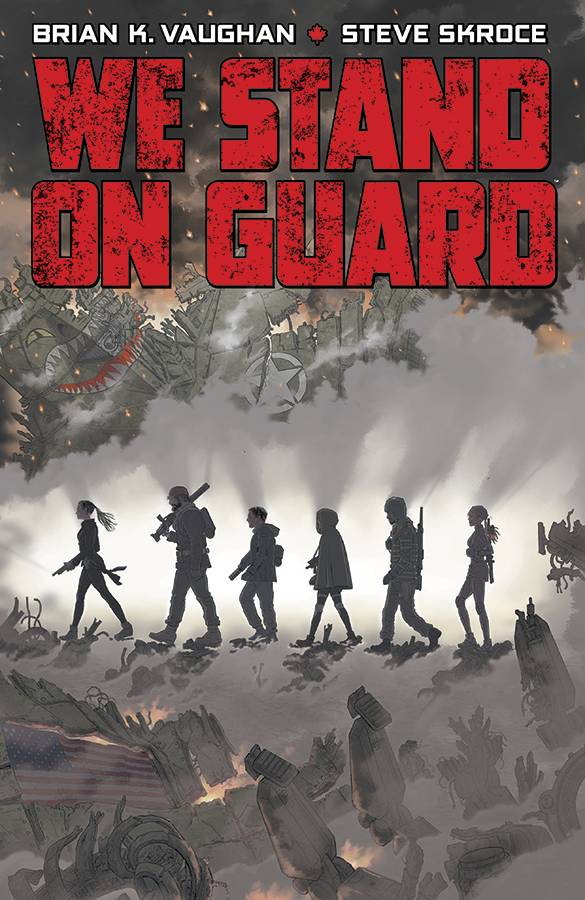 Patrick: As We Stand On Guard moves away from the gory viscera of the hypothetical war between the U.S. and Canada, writer Brian K. Vaughan doubles down on the emotional, political and mechanical realities of these two neighbors at war with one another. Just as in the previous issue, we start in flashback, but this time, instead of seeing the war’s inciting incident play out on the televisions of peaceful Canadians, we get American soldier’s kicking in a door and slaughtering innocent people for owning a hunting rifle. That introduction also artist Steve Skroce and colorist Matt Hollingsworth at their detail-obsessed best. Throughout the issue, Skroce delivers a level of detail almost Quitely-esque, but with an exacting straightness to his lines that simultaneously communicates confidence and coldness. Let’s take a look at that opening panel for a example of how well this works.
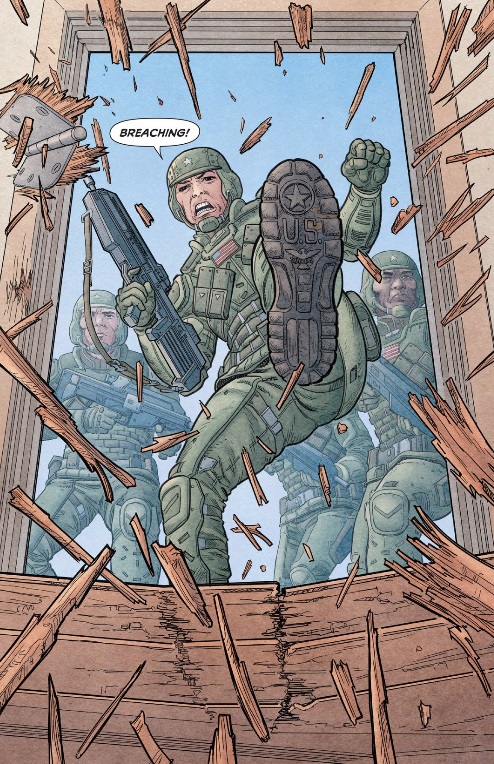
The detail on the splinting door is just phenomenal – there are splinters flying toward the reader and a realistic foot lodged in the door. But the door jamb is also perfectly symmetrical, and frames these four soldiers with haunting precision. Check out the angle at which we’re catching the solider’s boot: perfectly aligned and level to read the letters “U.S.” and their attendant patriotic symbols.
The rest of the issue plays out with that same attention to visual detail, whether we’re seeing an enormous two-page splash of the Canadian rebels’ pristine land rover or Amber in the shower. It’s interesting to me how different those two examples should feel – one is a vehicle and the other is a human woman. Both Vaughan and Skroce are quick to downplay the sexuality in the panels of Amber in the shower — giving her a gay character to interact with might be a bit of a cheat (and feel a little bit like LOST), but it works. It’s like both Amber and the Canadians’ mobile base are both simply machines of war.
Incidentally, it’s fascinating to me how much of Brian K. Vaughan’s output has been deeply influenced by war. This may be the first time that I’m reading a work of his where the characters are all active participants in said war, instead of trying to float above it and somehow exist beside it. Ex Machina, Y the Last Man, and Saga all contain elements of the protagonists not engaging in war as the readers understand it, but We Stand On Guard confronts it directly and constantly.
Groot 3
 Drew: In terms of MacGuffins, a well-established friend is a high-stakes one. That invests us in the larger plotting pretty effectively, but runs the risk of making any adventures on the way feel like distractions. This is exactly the situation Jeff Loveness and Brian Kessinger found themselves in at the start of Groot 3 — a team-up with Dan Slott and Michael Allred’s Silver Surfer (and Dawn Greenwood) sounds like a lot of fun, but how do you excuse “fun” when Rocket is in mortal peril? Fortunately, Dawn has some valuable perspective on that.

Of course, that advise comes just before Groot is put back on Rocket’s trail, but the lesson is clear: adventures-of-the-month aren’t just excusable; they’re downright necessary. I suppose mileage will vary on that argument, but for me, it was more than enough to justify the fun that was seeing Groot surfing on Toomie. Actually, this team-up was so fun, I kind of wish we could have spent another issue with Dawn and Norrin, even if it meant delaying the eventual reunion with Rocket that much longer.
As usual, the art is gorgeous and inviting, but this issue gets a special spark of interest in seeing Kessinger tackling Norrin and Dawn — one who’s been drawn by countless legends, and one who (as far as I know) has only ever been drawn by Michael Allred. They both come across beautifully here, feeling right at home alongside Kessinger’s inventive alien designs. Those parts come together to make for an absolute blast of an issue that sets up more like it down the line.
The Fade Out 8
 Drew: It’s Halloween in Hollywood, and the masks are only hiding more secrets. Gil has some fun wasting Brodsky’s time, and Charlie gets some more information about Valeria’s death (from the not-so-mysterious Tina), but the biggest reveal is Charlie discovering what Gil has been up to. That particular piece of tension has been simmering throughout Act Two, and turns out to be the one boiling over as we round the corner into Act Three.
Indeed, writer Ed Brubaker focuses rather tightly on Gil and Charlie’s relationship at the start of the issue, reminding us both of their recent animosities and of that kind of weird flirty relationship Charlie has with Gil’s wife. I have no idea where the final reveal leaves their relationship — Charlie is obviously pissed, but it’s not like he hasn’t also been poking around trying to figure out what happened. My hope is this will push things up to the surface with these two and finally allow them to work together on cracking this thing. They’ve both got pieces of the puzzle, but they might make more sense of it as a team.
The Wicked + The Divine 13
 Spencer: My friend Dave and I have gotten into some heated debates about musicians/bands that change their sound. Dave’s position is that bands should stick with whatever got them their fans to begin with, but while I’ve been burned by a few strange choices in direction from bands I love/once loved myself, I can never get upset by an artist trying to explore a sound that interests them. With its primary metaphor of Gods-as-rock stars, The Wicked + The Divine is the perfect book to explore the idea of fan entitlement vs. artistic exploration, and in issue 13 Kieron Gillen and Tula Lotay do so through the figure of Tara, whose personal artistic expression is of no interest to her fans; they only want to see her perform miracles. Gillen makes it explicitly clear how damaging being treated as a commodity is to Tara, but also how pervasive it is — she can’t even get her message through in death, as Ananke destroys her suicide note to help shift blame off herself and onto Baphomet.
Yet being treated like a commodity is a problem for many, many more people than just artists — for Tara, it’s just part of being a woman.

Just as Tara’s fans only see her as a God, not a human being, men likewise only see her as a beautiful woman meant to bring them pleasure, not a living, breathing person with her own thoughts and feelings and desires. The previous Pantheon deaths have been tragic due to the amount of time fans have had to grow attached to the characters, but Tara’s actually benefits from the one-issue spotlight — Tara’s time in the series, just like her life, is tragically cut short, and we can feel how unnatural and tragic her demise truly is. This issue is a scathing indictment against a society that treats over half its population like objects, but also a demand for empathy. Tara’s final request, “Try to be kinder,” should be the easiest thing in the world, but it doesn’t quite work out that way, and until we start putting ourselves into others’ shoes and imagining how our words affect them instead of dehumanizing them, nothing’s going to change.
Outcast 11
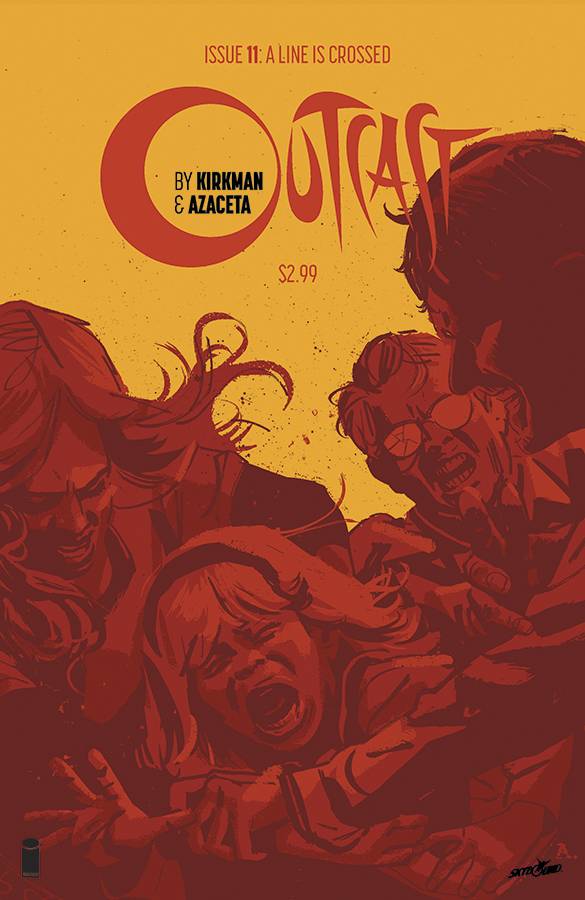 Patrick: Writer Robert Kirkman is known for weaving long, continuous stories that play out over any number of issues, with little regard for how an individual issue stands on its own. Obviously, that’s been a very smart move for him; The Walking Dead is bigger than Jesus (who, coincidentally, also walked while dead). Outcast follows a lot of his regular patterns in that regard, but occasionally an issue like number 11 comes along, which is packaged so neatly as to feel like a one-off character piece, and I start to realize that not all of my blanket generalizations are going to work all the time. While the issue starts with Reverend Anderson and the… devil (?) engaged in some heated, if outwardly friendly, conversation and ends with what appears to be a new possession story, the majority of the page-count is spend with Kyle as he fails to reconnect with his daughter, his ex-wife and his last real friend. Paul Azaceta nails the scene wherein Kyle realizes it’s not right for him to tell his daughter that he loves her too – showing restraint with insert-panel gimmick, and using it to emphasize Kyle’s acting.
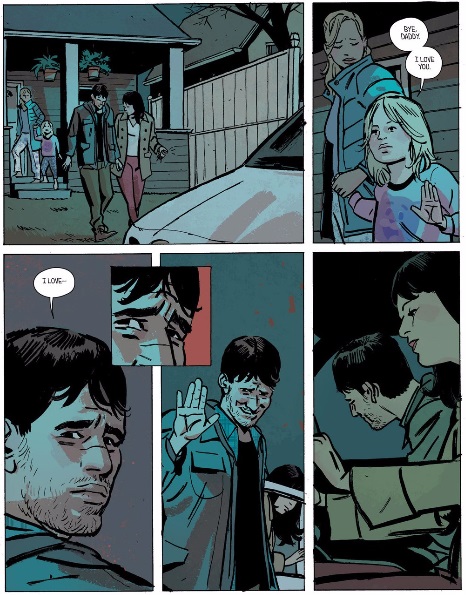
The man is so held back by his secrets, and I can’t imagine a more perfect way to express that than with the strained smile Azaceta puts on his face.
The conversation doesn’t stop there, because you certainly read something that we didn’t. What do you wanna talk about from this week?
 Retcon Punch