

Retcon Punch is on Summer Hours, which means we’re going to be writing fewer in-depth pieces for the month of August. But we’re addicts at this point, so we need a place for our thoughts on all those comics we can’t stop reading. Today, we’re discussing Green Arrow 43, Gotham Academy 9, Batman Superman 23, Action Comics 43, Constantine The Hellblazer 3, and Starfire 3

Green Arrow 43
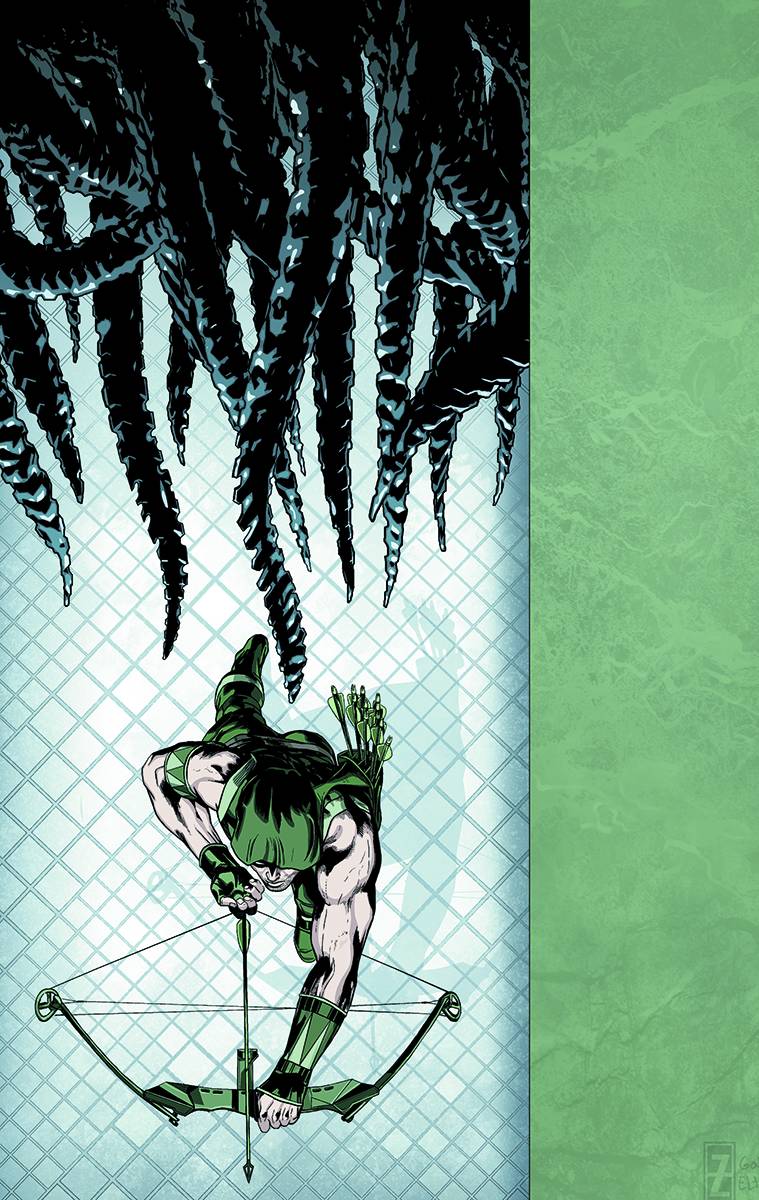 Michael: Green Arrow 43 marks the end of the first arc from new creative team Benjamin Percy and Patrick Zircher. There are a lot of powerful ideas at work here: racial profiling, machines replacing man and the complicated inner-workings of a criminal kingpin master plan. Unfortunately the combination of these things happening simultaneously and a rushed conclusion don’t do this book any favors. Seattle is a city cowering in fear of the Queen-approved Panopticon drones, and the police aren’t planning on doing anything to stop them anytime soon. With Fyffe’s help Emiko and wolf pal George set off in an arrow boat (!) to rescue Oliver from Panopticon mastermind Aaron Zimm. Ollie is rescued, the drones are compromised and Zimm seems to be orca food.
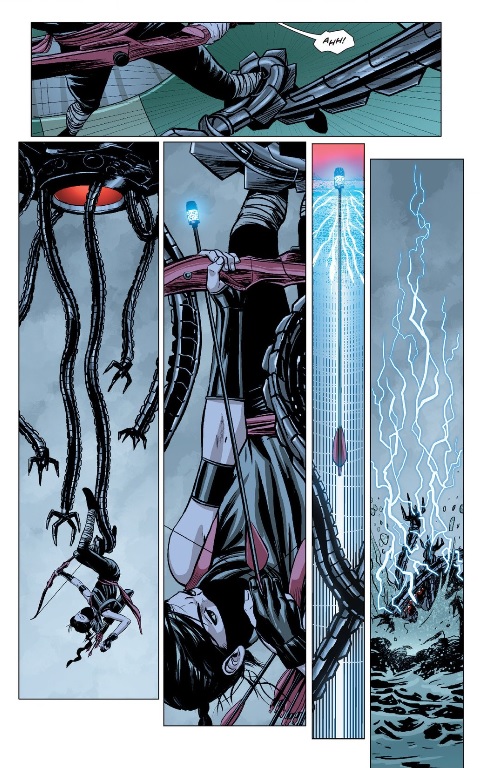
If I had my druthers, Green Arrow stories would still have a goateed aging hippie Oliver Queen; but we know that’s not going to happen anytime soon. That being said I think that Percy and Zircher have made an admirable attempt thus far – more or less ignoring the past arc that was heavily Arrow-inspired. Instead, they carry on the New 52 Green Arrow torch that Jeff Lemire and Andrea Sorrentino successfully lit 30+ issues ago. My favorite part of Green Arrow 43 is the continuing incorporation of Oliver’s half-sister Emiko. With her smartass comments, killer upbringing and large hound companion, Emiko is now going full Damian Wayne – and I approve. The sequence where Zircher draws Emi doing an upside down EMP-arrow shot was all kinds of awesome. Emiko aside, I wish that Percy would’ve given “The Nightbirds” arc a few more issues to breathe. So many things came to a head in this issue that didn’t seem to be tracking at that pace: a city under mechanical marshal law, Mr. Albino’s rebellion against Zimm for not being the racist he wanted and Zimm’s downfall itself. What made it all sting a little more was how it was wrapped up by a clichéd “I realize that I’m not alone after all” monologue from Oliver. I think that Percy has a unique take on Green Arrow that I’m looking forward to seeing more of, as long as the story takes its time – and has a Damian/Emiko team-up. Right??
Gotham Academy 9
 Spencer: It’s no wonder teenagers relate to vampires and werewolves so much. These creatures aren’t born monsters — they’re turned into monsters against their will, and for teenagers, most of whom are still waist-deep in the throes of puberty, that may be a familiar sensation. It’s certainly one Olive and Tristan, of Becky Cloonan, Brandon Fletcher, and Kark Kerschl’s Gotham Academy, are familiar with. Tristan has been literally transformed into a Man-Bat against his will, while Olive is becoming more and more haunted by the ghost of her mother (again, possibly literally) and the dark path her inherited abilities could lead her down.
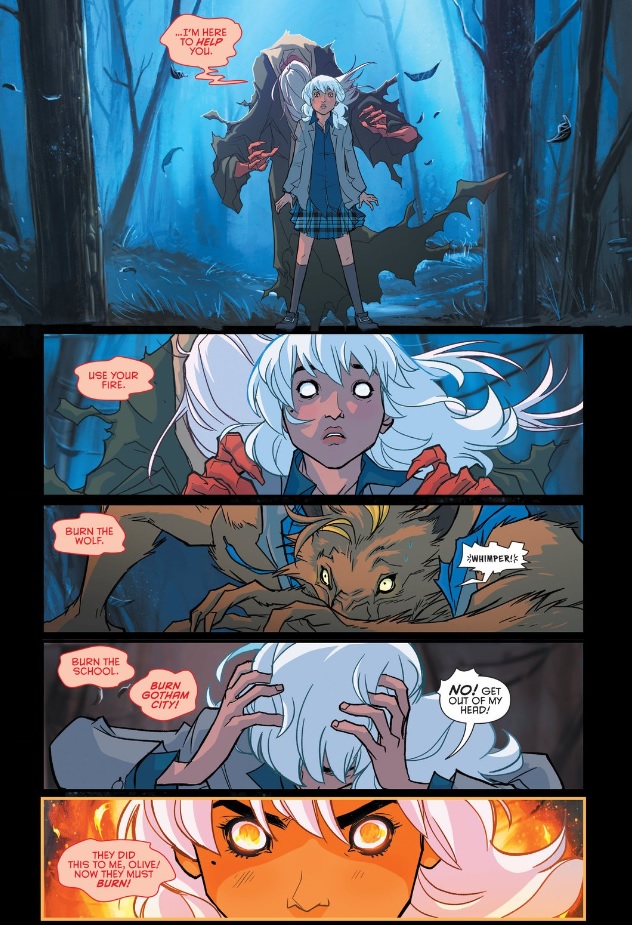
Olive’s journey here could also be an apt metaphor for mental illness, which often manifests in one’s late teens/early twenties. Either way, while Olive ensures Tristan that he’s not a monster, it’s clear she’s not so sure about herself. That’s why it’s so powerful that she and her friends get to take on monsters, such as Coach Humphries’ werewolf — not only are they literally confronting their deepest fears about themselves head-on, but they get to see that, deep down, Humphries and his ilk aren’t truly monsters, but simply hurt people like themselves. In a similar vein, Gotham Academy 9 portrays the Detective Club as an overwhelmingly positive experience for these sometimes-troubled kids, who now have a productive avenue to focus their various areas of expertise towards instead of stirring up trouble.
Hm. Despite the dangers involved, maybe Gotham Academy is an effective learning environment after all.
Batman Superman 23
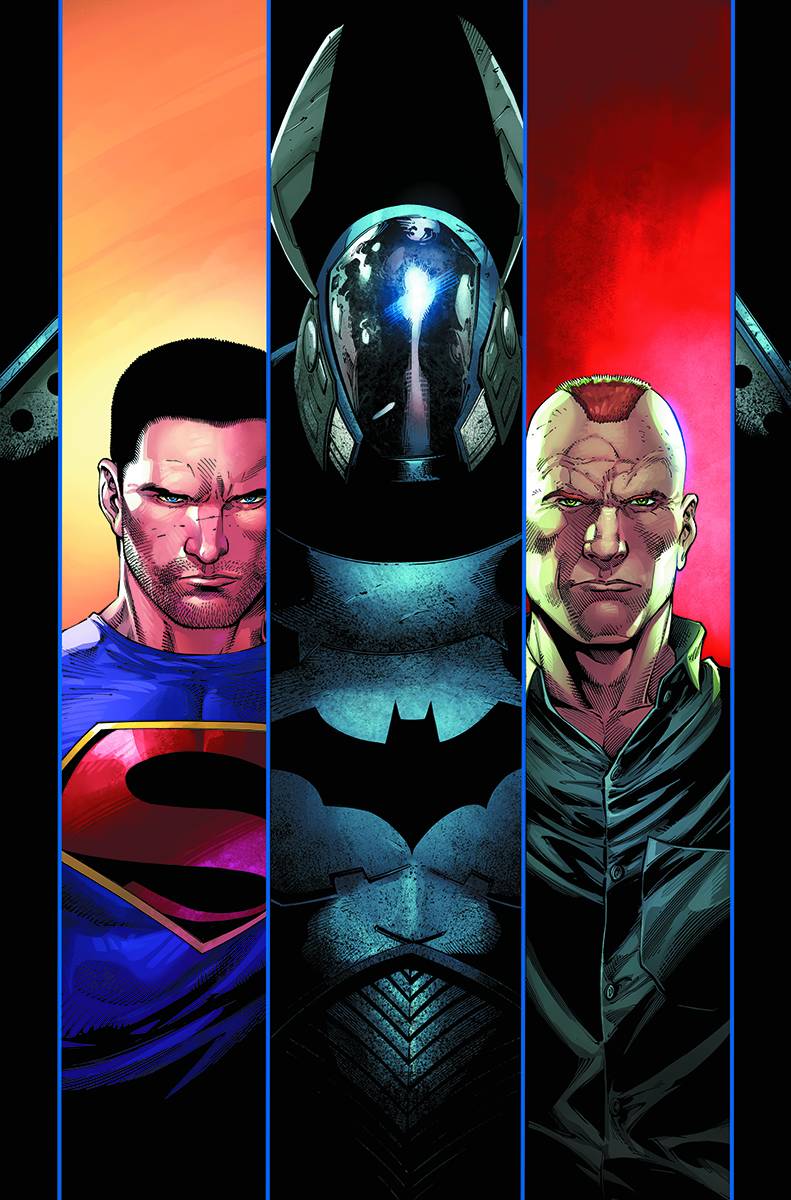 Patrick: One of the simple joys of the Batman Superman — in the abstract — is that the audience and the creators are so familiar with the characters already that the complicated relationship between the two men can take center stage. But the revised status quo of the new DC Universe flips that equation on its head: the audience has expectations about Batman and Superman’s relationship, but we no longer know who they are as individuals. Tellingly, we don’t really see Jim and Clark interact in any way in this issue – they trade phone calls at the beginning an ends of their separate adventures, but other than that, they may as well be occupying different fictions. Superman is underground, learning first-hand about the needs of the Subterraneans – including some “upperworlder” refuges from “Gotham Prison.”
(Far be it for me to nick pick this point – but what the fuck is Gotham Prison? Angie, the prisoner Superman meets, alludes to the end of Batman Eternal, and explains that she and her fellow inmates took advantage of the crumbling infrastructure and escaped to through the caves that had opened up under their prison. She’s describing Arkham here, right? She doesn’t appear to be criminally insane, but what do I know? Maybe she’s speaking metaphorically about “cracks,” and she really escaped from Blackgate. Still: the fuck is “Gotham Prison?”)
Superman spends a lot of time down there, meeting people, working to keep them warm, even taking his punishment for deserting his post. It’s sort of classic Superman – all it takes is a little bit of time and he thinks he’s one of them. Artists Ardian Syaf and Vincent Cifuentes get to show Clark going about all this mundane Subterrenean business, with Clark in his make-shift soldier disguise (which charmingly maintains his trademark red cape). Meanwhile, Jim Gordon goes on a much more grounded mission to find out who Clark Kent really is. He talks to Lois and Perry and slowly comes to the same conclusion the reader is coming to: Superman is always going to be an empathetic character, whose sense of right and wrong is dictated by fairness and trust, and not by money. Writer Greg Pak very smartly makes this whole issue about Clark, even when we’re following Jim Gordon around on the surface.
Action Comics 43
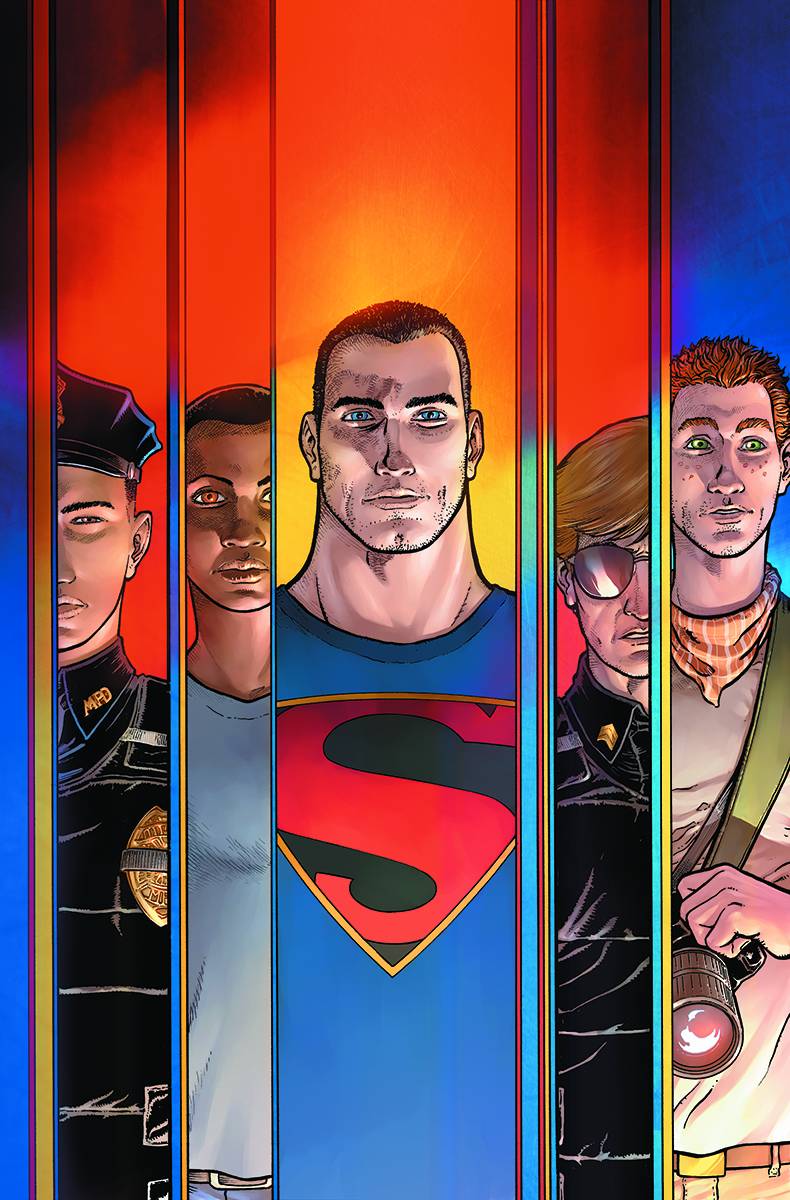 Michael: Oh shit, Superman just punched a trigger happy cop in the face! Well, he turned out to be a shadow creature…but still! Action Comics 43 is not as gripping as previous chapters that Greg Pak has given us during “Truth,” but it’s still an exciting and different spin on the big blue Boy Scout. Two pages into the issue, we and all of the characters residing in Action Comics 43 realize that Sergeant Binghamton – the cop who’s been leading the charge against Supes and his buddies – is not human. Binghamton slinks away after the battle and Superman tries his best to do damage control with his Metropolis fans and the mayor herself. By the end of the issue we discover that whatever these shadow creatures’ plan is, it goes all the way to City Hall; with the mayor among them.
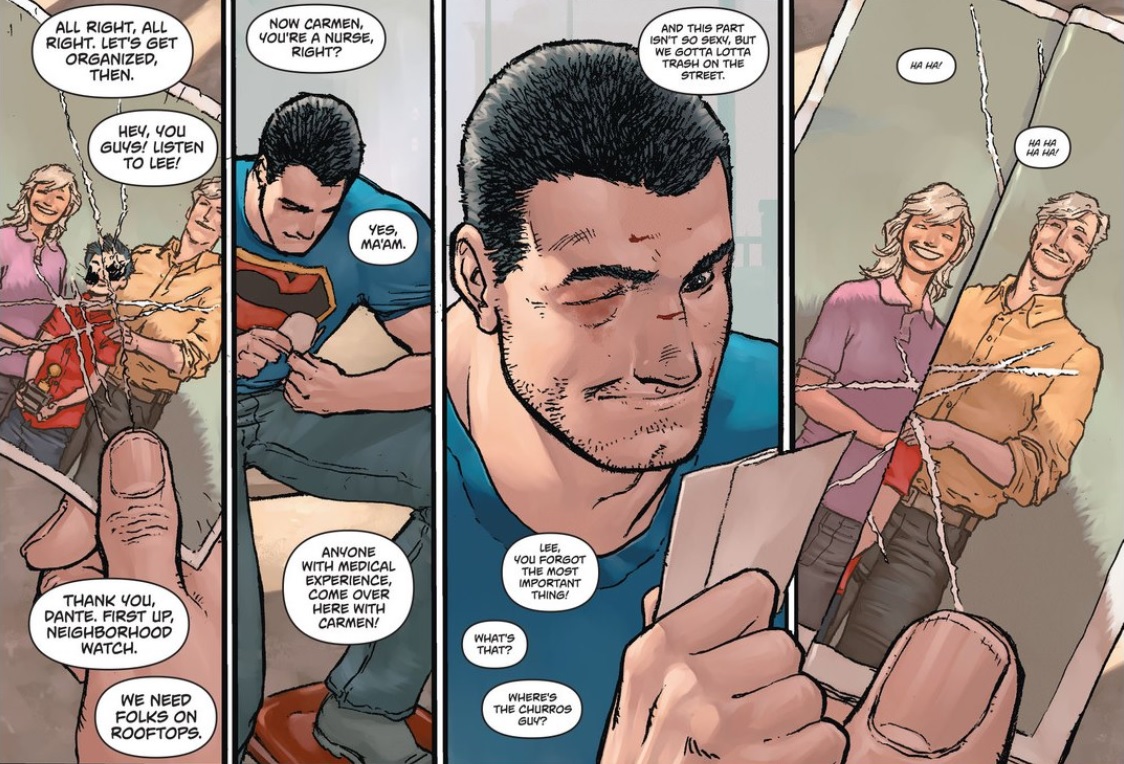
For my money, Action Comics is where it’s at for DC’s currently outed Superman. Pak once again gives Clark a missing bit of humanity; this time expressed by his rage. Internal monologue narration is commonly overused in superhero books but Pak fully utilizes it here to show us how much Clark is out of his depth here, and how that scares the shit out of him. Clark is giving into his rage – which Binghamton points out is what he wanted – causing him to be a “funny kind of luck(y).” There’s a good chance that Clark could’ve killed Binghamton, had it not been for his Shadow-ness. Here’s a little thing I chose to nitpick at: apparently when Jimmy Olsen takes pictures they automatically upload to the internet? Is that through a personal blog or from the Daily Planet? Doesn’t Jimmy have an editor he reports to? Come on! One visual I’m still trying to make sense of is the photo of young Clark with Ma and Pa Kent. Clark finds this picture defaced in his vandalized apartment. However, after he gives his rousing “you’re all Superman now” speech to his fan club he chooses to fold over himself in the photo so it’s just his parents visible. Is that gesture simply because he doesn’t want to tarnish that memory with xenophobic hate? Is Clark acknowledging that his old identity is truly gone and unsalvageable? Or is it just the perennial Superman message of self-sacrifice for the greater good?
Constantine The Hellblazer 3
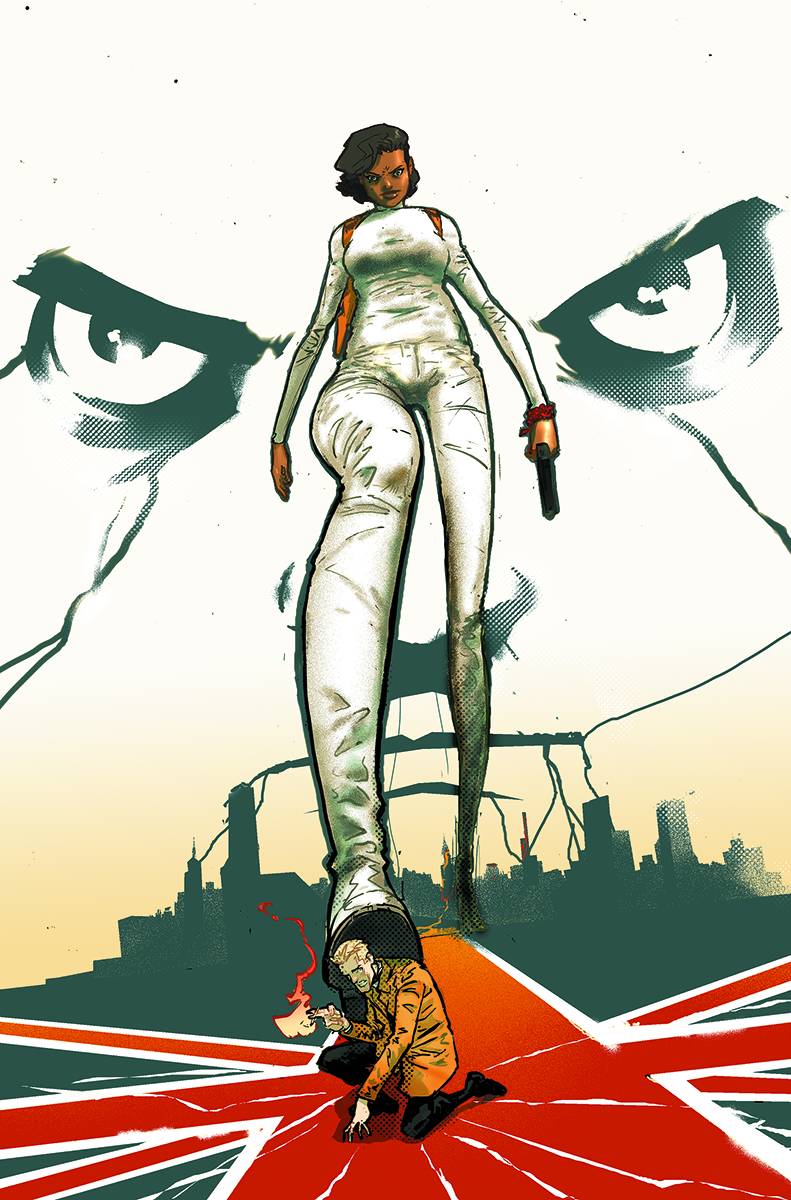 Patrick: Oh, Johnny Constantine – the life of the journeyman demon expert is bound to be lonely and isolating, but we always kind of assume that this is something John has come to terms with. For as much as his rogue-ish ways and any-way-but-by-the-book approach to magic are self-styled, John might not be as confident and self-possessed as we originally thought. Issue 3 of Constantine The Hellblazer puts John a case with a former colleague: Georgiana Snow. Compared to Georgiana, Constaintine is a total fraud – he may boast that he “used to drink with the monsters whose heads [she] wants to stick on pikes,” but the reality is that his street-smarts are embarrassingly out-paced by Georgiana’s training. Writers Ming Doyle and James Tynion IV, do a great job of making us believe that the opposite is true – not too difficult of a trick, because audiences are pre-programmed to suspect that the self-made under-dog will somehow be better at his job. But John’s got nothing. All he can do is find the perpetrator; he doesn’t even have the kind of demon properly identified until he sees him. Then John burns a ton of time talking to the Incubus, assuming that he can somehow charm his way to victory. Georgiana has no such delusions about her charms, and simply swarms the Incubus’ apartment with dudes, tackles the demon and stabs him in the neck. It’s deflating for John, but only half as deflating as the realization that the friend he wanted to reconnect with is dead.
There’s a lot of quiet little losses in here, and most of them happen between the pages. The most notable loss seems to be in unrealized potential. The art duties are split up between Ming Doyle and Vanesa Del Rey, and while the credits don’t state it explicitly, I think Doyle is handling the flashback and Del Rey is handling the present-day stuff. Doyle affects a hopeful, almost cartoony style for the flashback – almost more inline with Sophie Campbell’s work on Gem and the Holograms, imbuing those sense with even more hope, wonder and potential. By contrast, Del Rey’s grim, inky interiors appear to show us the cold light of day, and what all that potential has turned into.

These are very similar scenes – both show a demon playing guitar (err… maybe bass) and both employ those weird-looking music notes. But check out how tonally different they are. Doyle’s show is bursting with youthful energy, but Del Rey’s private performance is cold and lonely. What a perfect metaphor for Constantine’s life.
Starfire 3
 Spencer: There’s been quite a bit of exposition — both about the characters and about Earth in general — throughout the first three issues of Amanda Conner, Jimmy Palmiotti, and Emanuela Lupacchino’s Starfire. While I’ve enjoyed some of the history lessons (such as this month’s tale about Hemingway’s Cats), these moments can still come across as talky and slightly unrealistic at times. What I realized while reading Starfire 3, though, is that even the characters in this book don’t normally talk like this — this is a quality that Kori just brings out of people. People aren’t normally this patient when faced with so many questions, but Kori is so genuine, enthusiastic, and empathetic that people just can’t help but to open up to her. Kori’s good qualities help to smooth over some of her faux paus (such as mentioning how she’d like to trade skin colors with an African-American man), and it appears that the positive effect of Kori’s temperament on the people of Key West will be a prominent thread of Starfire.
Starfire’s unique perspective even serves as a nice reminder for the audience.
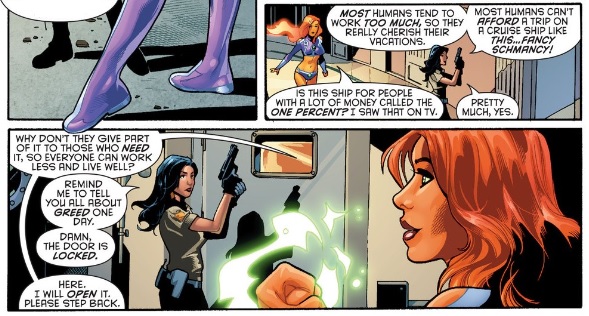
When we live every day in a corrupt world, it’s easy to forget how strangely unjust and unnatural this actually is; Kori’s confusion about our strange customs is a welcome reminder of our own faults.
At the end of Starfire 3 Kori meets Atlee, a character who once was in the same situation as Kori but has now better adjusted to life on Earth. I’m curious to see what kind of effect that perspective on the world will have on Kori (and vice versa), but I’m more curious to see if their shared positive attitudes will have any effect on the Chida Monster, the first legitimate villain Starfire’s taken on since arriving in Key West. Either way, I think it says a lot about this book’s take on the world that its first living threat isn’t a human being. Do Conner and Palmiotti just have that much faith in human nature, or they waiting to crush Kori’s faith sometime down the path? It should be interesting to find out.
The conversation doesn’t stop there, because you certainly read something that we didn’t. What do you wanna talk about from this week?
 Retcon Punch
Only comic of these I read this week was Hellblazer. I think they’re doing some really neat things with the comic. It’s not a horror comic to me – It’s a modern day tragedy. I don’t know if the chorus at the end is going to show how Constantine learned his lesson and lived to be happy or if he will end up lost and alone for eternity. I suppose as it’s comics he’ll be on the road to lost and alone for pretty much as long as someone is writing Constantine stories. I’ve found these three issues to be up there with Batman for the top two DC titles I’m reading right now.
Gripping and sad. Are the only friends he has left his ghosts, and they’re disappearing too?