

Today, Patrick, Michael and Spencer discuss Star Wars 8, and Kanan – The Last Padawan 5.

Patrick: One Star Wars series wraps up a story arc while the other kicks off a fresh one! They’re interesting points of comparison: Kanan 5, being the end of something, delivers information and catharsis, with a clean thematic unity, while Star Wars 8 more tepidly tests the waters, both in terms of theme and plot. Luckily, both issues are emotionally honest, and brimming with personality.
Star Wars 8

Michael: First off: by no means did I hate this issue – in fact I thought it was pretty entertaining. But as far as propelling the plot goes, Star Wars 8 might’ve only moved a few steps in that direction. Both Han and alleged wife Sana Solo know their whole backstory but at no point does either of them try to give/attack Leia with a clear explanation of this marriage. Granted, Sana is holding Han and Leia at gunpoint, which makes not getting his ass killed more important than Han taking an exposition-timeout. Which brings me to my next point/fear: is Sana Solo going to boil down to nothing more than a “crazy ex-girlfriend” cliché? There are so few women in the Star Wars universe, so I’d like to remain optimistic that she will be a little more complex than all that. But can you imagine? Han Solo marrying a bounty hunter? Perish the thought.

Though he’s not a farm boy anymore, Luke Skywalker is still very much the Luke of A New Hope. After he reads Obi-Wan’s journal he acts like a kid at Christmas who got a pair of socks; though I can’t blame him. Luke then has the adorable plan of sneaking into the old Jedi Temple that is surrounded by the best of the best Imperial goons. I’ll chalk up the rarity of lightsabers to the Nazi-like nature of the Empire – destroying propaganda and whatnot, but can they really be that hard to make? Stuart Immonen makes his debut on the title and I think he absolutely nailed Leia’s snarky cool.
Patrick: Immonen does a lot of really good acting in this issue. It’s probably most notable in Han and Leia, if for no other reason than we have so much film to actually compare these drawing to. But even Sana’s got personality just dripping off the page, a raised eyebrow or curled lip telling more than Jason Aaron’s copy ever could.
Which isn’t to demean Aaron’s more charming flourishes. He’s a characterization machine in this issue, giving personality to just about everyone who flits onto the page. The bartender that agrees / doesn’t agree to help Luke is some kind of streetwise, fat Darth Maul (awesome, awesome, awesome), and the alien dude that eventually absconds with Luke’s lightsaber has precious few lines of dialogue, but all signs point to this guy being Loony Tunes. F’real, in his first line, he refers to his boss (who is probably a gangster of some kind) as “big guy” and then chirps “don’t mind if I do!” when he yoink’s the saber. There’s always a danger that new Star Wars characters are going to be stuffy and boring, speaking in that dull affected English you hear in an Imperial Board Room. Aaron is even good at giving those Imperial jerks a little extra personality:

I suppose I can’t argue with the note that it seems like this series reads like it’s written for trades. Incremental plot development isn’t that big of a deal when you get to read 7 issues at a time, but with a couple weeks before our next entry in the series, Aaron is testing the audience’s patience with rolling out information at a glacial pace. It makes it doubly hard that there’s no strong thematic statement in this issue, other than the idea that everyone has secrets. Han has a secret, Kenobi has a secret, that alien who collects lightsabers has a secret, even Leia’s got a secret in the form of that teeny boot-blaster. How exactly that idea will pay off, however, is a conversation will have to reserve for a time after we read the whole arc.
Kanan – The Last Padawan 5
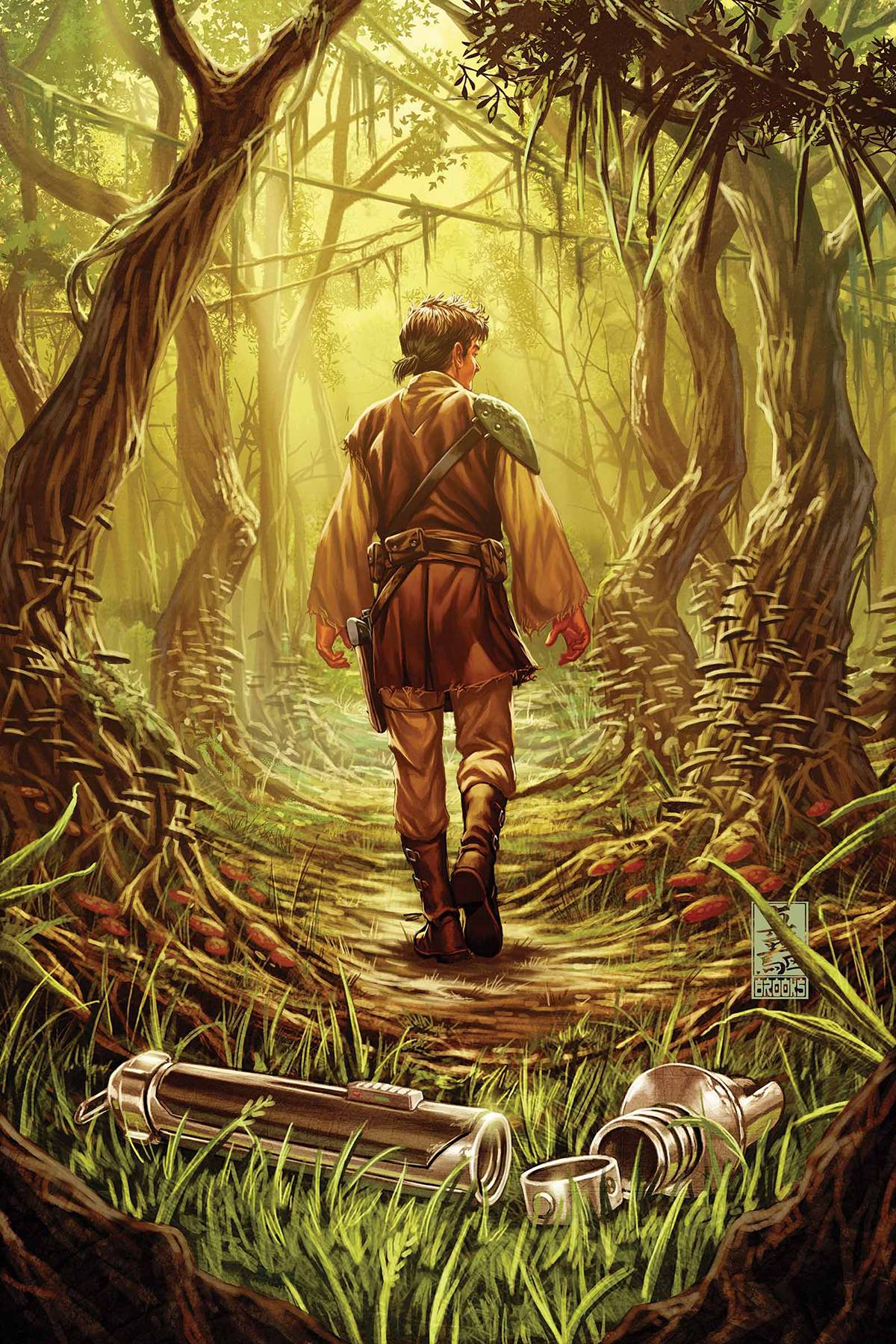 Spencer: “I was just following orders” has got to be the weakest excuse there is. It essentially implies that whoever’s giving the excuse is some sort of mindless servant, incapable of questioning their superiors or thinking of the moral ramifications of their actions. Of course, it’s easy to think of the Star Wars prequels’ Clone Troopers as mindless, robotic servants, and I think we all took that for granted when it came to their carrying out Order 66. Did any of you stop to think of why all the Clone Troopers would so readily carry out that assignment? I certainly didn’t, so I appreciate how Greg Weisman and Pepe Larraz address that question in Kanan — The Last Padawan 5. Weisman doesn’t treat Grey and Styles as interchangeable soldiers, but instead as two men with very different personalities who just so happen to share the same DNA. Styles clearly takes pleasure in murder, but Grey has a different explanation for his complicity in Order 66.

I love the implication that some form of mind control — perhaps even mind-trickery from Palpatine himself? — may have been behind the Clone Troopers’ role in Order 66, but Grey doesn’t use that as an excuse to justify his actions. Grey’s change in heart comes about because Caleb takes a second to actually talk to him like the friend he once was, and that one moment of doubt leads Grey to question the orders he previously followed mindlessly. Thought really is the enemy of organizations like the Empire, and that’s why it’s so important to always question and ask “why” instead of acting without thinking.
In contrast to Styles and (initially) Grey, Caleb’s been turning Order 66 over and over in his head and still doesn’t fully understand why the Clone Troopers turned on him and his master. He still refers to them as his “friends” even after they’ve chased him halfway across the universe trying to murder him, and it seems like Styles and Grey dying is the moment when Caleb loses the last few pieces of his old life that he actually cared about. It’s the moment where Caleb Dume dies and Kanan is truly born, and that’s achingly sad.
Patrick: Spencer, I hadn’t even considered that there was some kind of literal mind control going on, but I guess the prequels are always a bit fuzzy about Palpatine’s powers of persuasion. Is he a naturally charismatic leader or is he really skilled with multi-targeting the Jedi Mind Trick? Follow up question: which possibility feels more like magic? The former is scarier because it’s a real phenomenon that’s driven people to do just awful, awful things in the name of following orders. Star Wars generally doesn’t delve too deeply into the psychology of people effected by the titular wars, but this is a potent break from that form, making Kanan a much more historied and nuanced character than I ever would have expected. I mean, he’s a former child soldier / defector / smuggler – those are some emotionally tough slashes to live down.
And this story plays to his implied desperation so well too. When Caleb blows the airlock to totally gamble on drifting through the vacuum of space, that’s about as desperate as you can get. One of the themes of this issue — and of Caleb’s life following the execution of Order 66 — has been survival; Caleb Dume is a survivor. I’m not at all familiar with the Rebels TV series, but if this rich of a character is part of its cast, I probably need to remedy this omission quickly. Interestingly, Weisman and artist Pepe Larraz seem intent on reminding us that, no matter how solitary Caleb feels in this journey, he is never really alone. In that same jumping-out-into-space gambit, it’s only through the action, and affection, of Kasmir that Caleb survives at all. Larraz may fill most of these pages with space-dogfights, but his most potent panel leans hard on that relationship between Kasmir and Caleb.
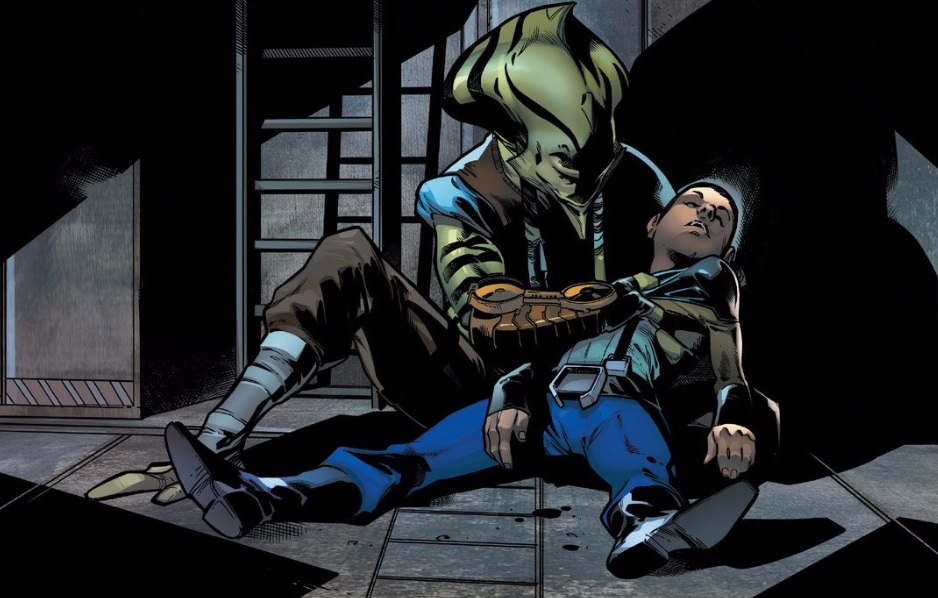
Caleb can object to being called “boy” all he wants, Kasmir (and the audience) will always have this image to remind us of how young and vulnerable he was when he lost everything.
Evidently, there were some non-Star Wars comics released this week. Check out the rest of our coverage this week!
 Retcon Punch
I always figured the StormTroopers/clones were, quite literally, made to be loyal to the Emperor and the Empire. The idea that they were programmed to be unquestionably loyal always seemed like a given perk when one purchases a laboratory-born clone army. It makes Grey’s sacrifice all the more meaningful.