
 Retcon Punch is on Summer Hours, which means we’re going to be writing fewer in-depth pieces for the month of August. But we’re addicts at this point, so we need a place for our thoughts on all those comics we can’t stop reading. Today, we’re discussing Batgirl 43, Justice League of America 3, Gotham by Midnight 8, Cyborg 2, Flash 43, and Superman 43

Batgirl 43
 Michael: Of Batgirl 43 I can say this: Babs Tarr is a skilled enough artist that she knows how to make a tiger both menacing and cartoonish. In the world of Batgirl, the concept of tigers-as-henchmen is as common as startup tech companies thriving in once-forgotten Gotham neighborhood. There’s a lot going on in Batgirl 43: tigers attack the aforementioned startup tech companies, Qadir being framed for aiding and abetting said attack, Barbara (somehow) being saddled with planning ex-roomie Alysia’s wedding and Frankie trying to further establish her identity as a member of team Batgirl.
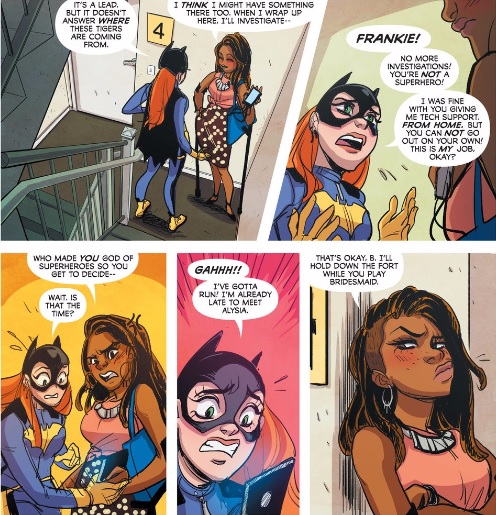
That last plot point seemed to strike me the most however. Whenever Frankie wants to go “beyond the call of duty” as far as her Oracle-ish job duties go, Babs stops her at every turn. Often times in situations like these I find myself instantly siding with the character that I picked up the book for – Batgirl. But Frankie makes a good point when she questions why Barbara gets to be the only one who sneaks off in the cover of night wearing a mask. After all, Barbara decided to become Batgirl on her own – in many origin stories against Batman’s orders. We can make the argument that many members of the Bat family have been trained to fight crime, but…so? At the end of the day, if you’re a superhero – even if you have super powers – you’re just some crazy yahoo do-gooder who allows themselves the authority to deal out justice. So even though I was a little apprehensive at the idea of Frankie – this new character – taking Babs’ cowl for a spin, I now say “why the hell not?” We’ll see if that line of thought pays off next month or not.
Justice League of America 3
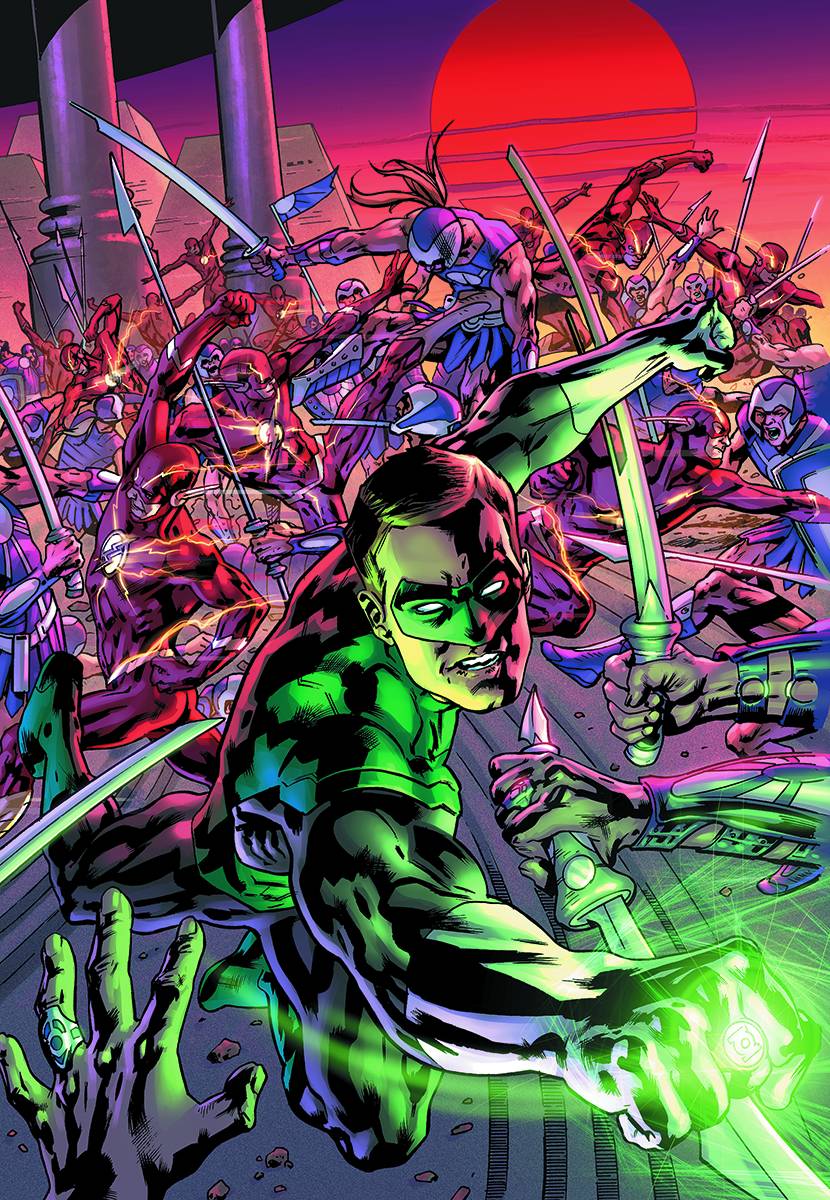 Spencer: Bryan Hitch’s art throughout Justice League of America has been fantastic, because, of course, he’s Bryan Hitch. But issue three is really the first time I’ve seen Hitch live up to the “cinematic, widescreen” hype most fans lay on him. The opening sequence — a battle between the Flash, Green Lantern, and a hoard of (at the time) unnamed warriors, stretches across six pages, and is one of the most satisfying fights I’ve seen in quite a while.
Hitch opens the book on a double-page spread of Hal and Barry that sets the scene (and the scope) of the battle in stunning detail. Hitch uses the next page to acclimatize Hal and Barry to their new surroundings, and the next to build up to Hal’s attack; both pages cleverly alternate between large, wide panels that focus on the setting and smaller close-ups that focus on Hal and Barry.

These panels also develop a kind of symmetry, keeping Hal and Barry side-by-side but swapping their position with each row. The pattern continues, building up tension, until Hal suddenly takes over both side-by-side panels; that disruption of everything Hitch’s been building is the lull before the storm. In this case, the storm is Hal’s attack.
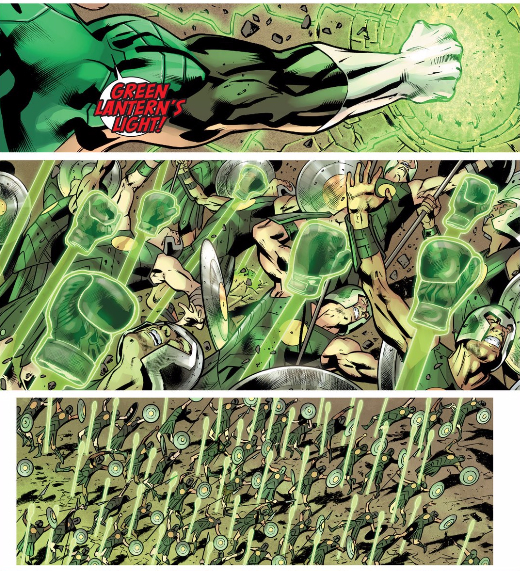
It’s rare to see a moment hyped up for this many pages that actually delivers, but this one absolutely does. That’s an attack worthy of six pages, an attack capable of transversing the massive scale Hitch has established since the issue’s beginning. I actually had to catch my breath afterwards; it’s not just the attack itself, which is incredibly cool, but the way Hitch builds up to it that makes it such an impressive visual feat.
Of course, the downside of this type of storytelling is that the story itself ends up moving at a snail’s pace. There isn’t much forward momentum this month; Hal, Barry, and Diana are moved around like chess pieces while the scenes with Rao and with Batman and Superman both mostly retread ideas we already established last month. I can see Hitch’s writing — and especially his dialogue — improving with each passing issue, but let’s be real — good or bad, we aren’t reading this title for Hitch’s writing. I’m glad to see Hitch finally giving himself room to play to his strengths and create something worthy of a spotlight title.
Gotham by Midnight 8
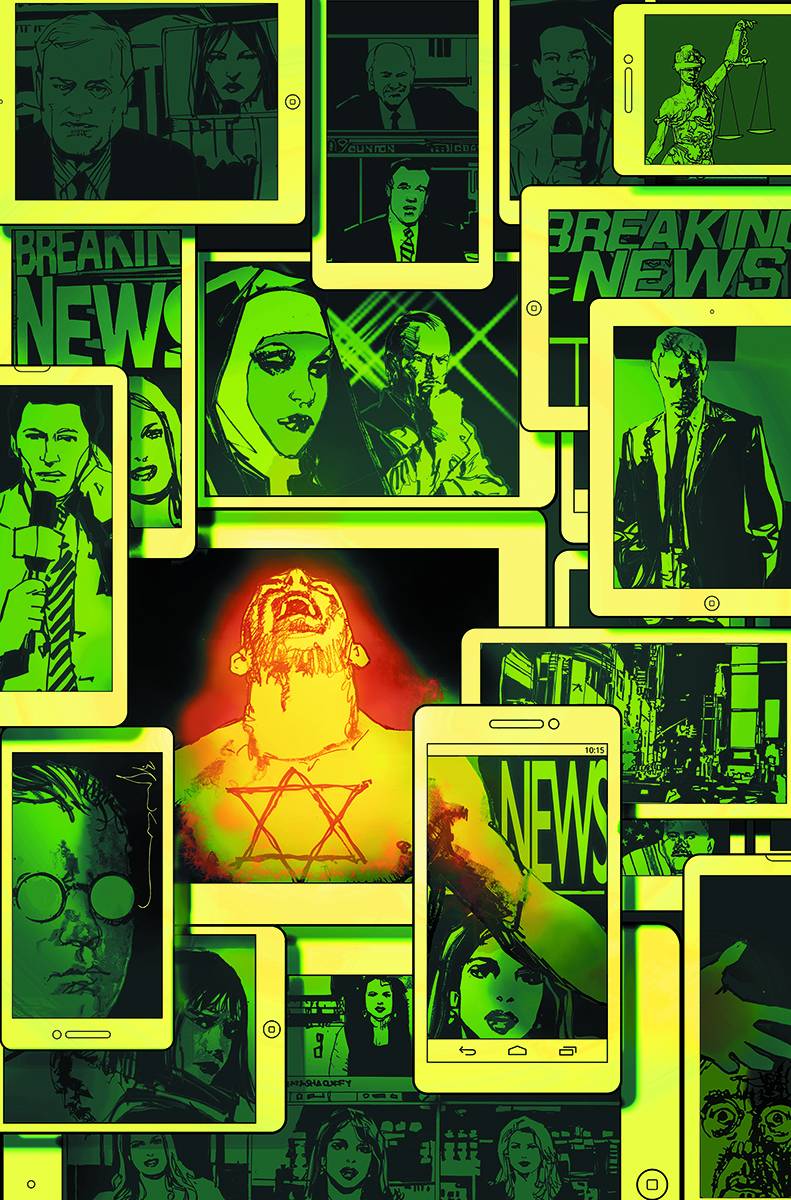 Patrick: Ray Fawkes and Juan Ferreyra’s Gotham by Midnight is so well-informed by the tropes of its two main genres, it’s surprising that the series is able to deliver fresh perspectives on either. But it does! On the supernatural-story end of the equation, this installment’s case-of-the-week is a twist on the “entertainer sells his soul for success” trope. The entertainers in question are Walker Albright and Brooke Patterson — Fox News-esque political pundits — and the cost of their fame and success is that their bullshit bickering is magnified and then literally projected out to their viewers. We get this in the form of a Times Square riot (or, whatever the Gotham equivalent of Times Square is), but the commentary about actual pundits is pretty powerful. These two TV personalities are irresponsibly encouraging and modeling uncivil behavior with no regard for their effect on the population, so long as they have the ratings. That’s a Faustian bargain with or without the supernatural underpinnings, and I love how quickly Corrigan and Tarr blow past the explanation.

Easy-peasy. The fact that they were slowly being merged into one fleshy, Lovecraftian monster is just icing and this deliciously simple cake.
Then there’s the serialized-police-drama end of this issue, which moves the Internal Affairs into high gear. I like Corrigan and Blake, and as such, I want to believe that those early reports about murdering suspects (and covering it up) are exaggerated or misunderstood or something, but it seems like I.A. is also savvy to the shady shit they’ve been doing in the name of the “Midnight Shift” – necessary or not, they have left a trail of bodies in their wake, so their probably should be some oversight here. It’s a cool storytelling trick that Fawkes pulls off here – we’re simultaneously invested in Corrigan and Co.’s supernatural crusade, but their administrative enemies are fairly sympathetic, with goals that totally make sense. I’d love if this whole thing just came down to a better understanding of what the Midnight Shift does, complete with force-wide best practices for confronting poltergeists or something equally mundane.
Cyborg 2
 Patrick: Last month, I mentioned how I felt that Vic was an inactive player in his own series. This is still largely the case in the second issue, but we’re finally starting to steer towards a scenario where he will have to take some action. Vic has discovered that he’s actually receiving warnings of an on-coming alien invasion in the form of his graphic nightmares. But that’s not the only discovery he’s making about himself – there’s also the matter of his new cybernetic abilities. I have to confess: I’m not really clear on what these new abilities actually are. Vic seems to flip out at the ability to turn his arms into guns or microphones or whatever, but that seems like pretty standard stuff for this character. He’s also discovering this stuff in the most low-stakes scenarios imaginable – the first scene is literally Vic petting his kitty on the front porch.

Writer David Walker raises the stakes on this power-testing by pitting Vic against S.T.A.R. Labs droids that Vic repurposed for just such training. While that certainly follows a straight line from a less-intense scenario to a more-intense scenario, that’s such a low ceiling. Why isn’t Vic learning about these powers while fighting bad guys? It’s be like if an X-Men comic ended with a Danger Room simulation: it’s just not exciting.
Elsewhere, Vic is totally oblivious to the “Body Shops” that are outfitting people with cybernetic implants and prosthetics in his home town of Detroit. It’s like there’s a story happening around Cyborg, but he’s just not really a part of it. Again, it looks like this stuff is all heading to an inevitable intersection, but in the meantime, I’m just not sure what we’re supposed to be latching on to. Artist Joe Prado is committed to articulating all the tiny mechanical details of Cyborg and the aliens, often to the detriment of a panel’s clarity – and if that’s why so many of the backgrounds lack detail, I’m not sure it’s a beneficial trade off.
Michael: Recently I watched Justice League: Attack of the Legion of Doom, which depicted Cyborg as a jovial, wide-eyed youngster trying to fit in on a team of adult superheroes. A 72-minute Lego movie absolutely nailed Victor Stone’s character in a way that I don’t think DC has been able to since The New 52 began. This is the second month that I’ve walked away from Cyborg thinking that this character is a grade-A asshole. Barring the curious aforementioned scene where Vic tries out his new tech, he’s pretty much a joyless son of a bitch. The dude is actively looking to pick fights with his dad – instead of testing his powers out at say, Justice League headquarters; he decides to stop by his dad’s lab to be a huge prick. Essentially Cyborg is saying “Jesus Dad chill out! I’m just fucking up your lab, IT’S NO BIG DEAL!” He then storms out in a huff accusing Silas Stone of caring more about his “toys” than his son, when Vic himself is clearly more interested in HIS toys than his dad! DC continues to use Cyborg as nothing more than a blunt object, which makes him (drum roll) a tool.
The Flash 43
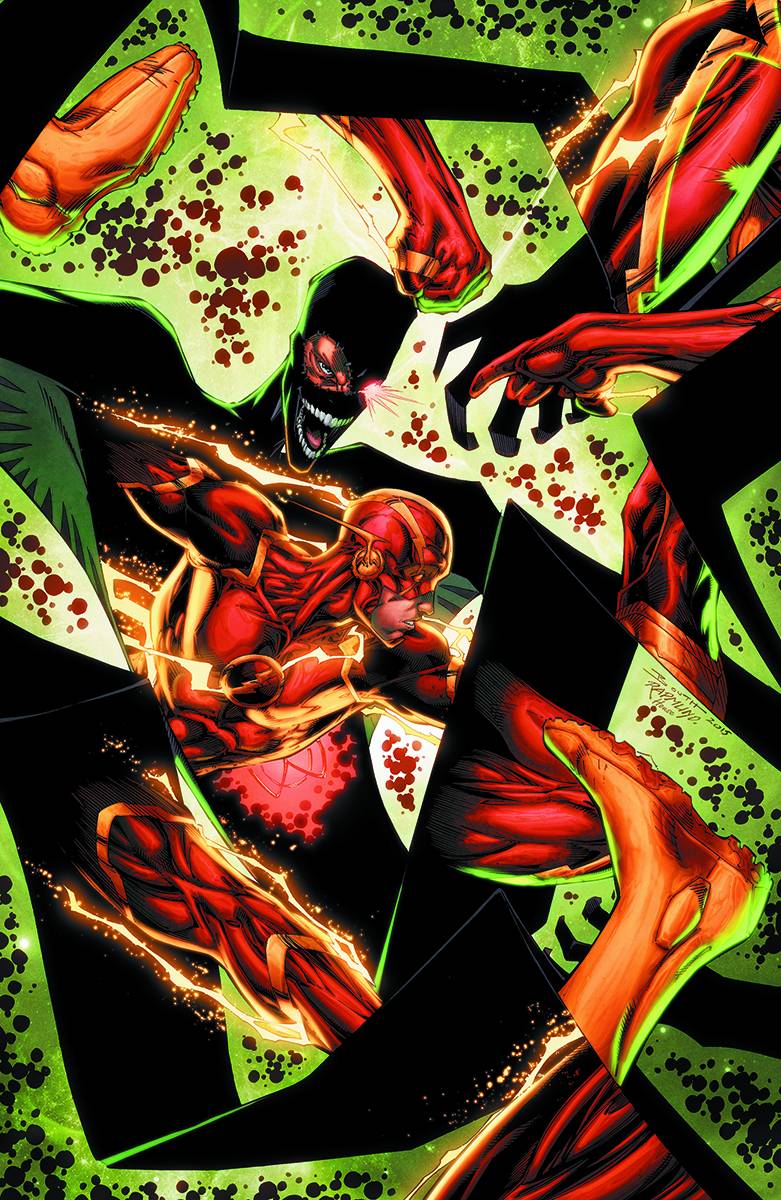 Spencer: Robert Venditti, Van Jensen, and Brett Booth’s Flash run has always featured long stories. I’ve always appreciated the forethought these guys put into their stories, and the time and space they’ve given them to play out naturally, but this kind of storytelling also has some downsides: the creative team can sometimes get so caught up in the big picture that the individual issues don’t stand on their own as a satisfying installment. Maybe I’m just impatient this week, but The Flash 43 seems especially slight.
This is an issue that spends most of its time filling the characters in on information the readers already know (in this case, Henry Allen’s true motive for the breakout), and that always makes for frustrating storytelling. Meanwhile, because Venditti and Jensen aren’t ready to reveal Zoom’s full motives yet, Henry must continue to speak about him in vague whispers and hints; there’s been no forward momentum in that area, and that’s also frustrating. Even the fact that Zoom intercepts Henry before he can be taken back to Iron Heights turns what seemed like a concluded element of the story into yet another loose end. Then there’s the Wally subplot that, at first, appears to be there to teach Barry a lesson; instead, it plays no part in Barry’s development throughout the rest of the issue. This scene is more than likely setting stuff up for Wally in the future, but in the meantime, it feels out of place in issue 43 — the storytelling mechanics at work in all these cases are sound and obvious, but they never really gel into a satisfying story. This issue is a padded middle-of-the-storyline-installment in every sense of the term, and by this point I’ve seen one too many of them from The Flash. I appreciate the creative team’s forethought, but I wish they’d start speeding their stories up a little. The Flash should never be this slow.
Superman 43
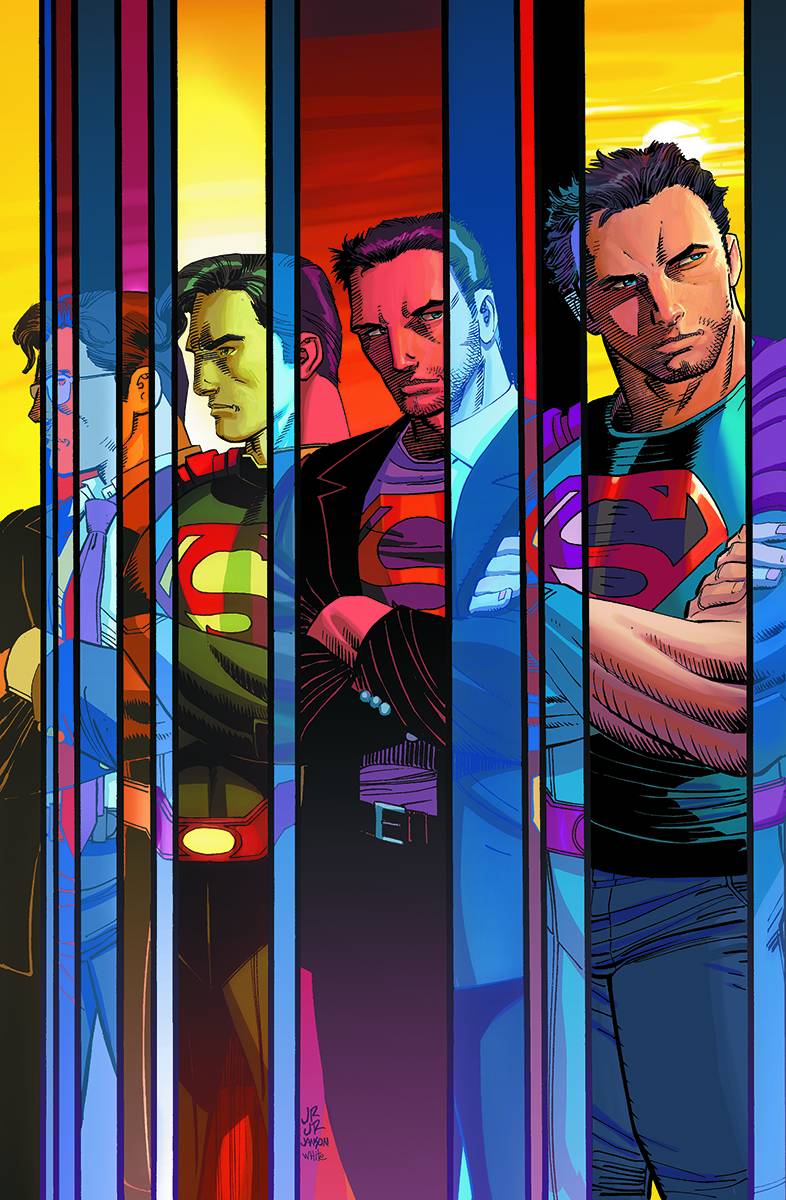 Michael: Superman 43 finally shows us the “how” and “why” of Lois Lane revealing Superman’s secret identity to the world. With the direction of Gene Luen Yang’s “Truth” thus far I’m not exactly surprised that this particular plot point wasn’t all that satisfying. In order to protect his identity, Superman is about to embark on another errand for Hordr_Root (which is still one of the dumbest villain names ever by the way.) So in a completely misguided attempt to safeguard her friend’s integrity, Lois blows the whistle on Hordr_Root and reveals Superman’s identity to the world. And guess what? Superman is pissed, because why the hell wouldn’t he be? Superman argues that she had no right to make this move without consulting him first, and I 100% agree. Gene Luen Yang has said that he has framed his approach to Superman from an immigrant’s perspective, but the way that Lois went about his public outing makes it seem more like an allegory for coming out of the closet. Secret identities and sexualities are very personal things. Imagine if a close friend outed you before you were comfortable doing so; even if they did it with “the best intentions,” it would feel like a major violation. I suppose that Yang spends a decent amount of time explaining to us that Lois makes this decision not for personal gain as a reporter, but out of compassion. He does this by referencing Superman’s torture by the U.S. government waaaaay back in Grant Morrison’s Action Comics run, then reignites those fears in Lois by showing that Hordr_Root is doing similar tortuous experiments to aliens.

One thing I will credit this book for is that John Romita Jr’s character work is finally tolerable. Though I found it highly ridiculous that Lois uttered the line “I know the guy I almost fell in love with,” I finally saw human characters from Romita instead of the stunted mannequins of a few months ago. Lastly, this book should probably be retitled Superman and His New Solar Flare Power. I mean seriously, Supes has probably used that goddamn solar flare at least once an issue since Geoff Johns introduced it. Learn some restraint, guys.
The conversation doesn’t stop there, because you certainly read something that we didn’t. What do you wanna talk about from this week?
 Retcon Punch