
Today, Spencer and Drew are discussing The Fade Out 9, originally released September 16th, 2015.
 Spencer: Those in power always prey upon those they consider “beneath” them. This is true in pretty much every aspect of life, but especially in the Hollywood depicted in Ed Brubaker and Sean Phillips’ The Fade Out. Almost every character in this title is a victim in one way or another, and issue 9 takes a special interest in the damage those with power inflict upon those less fortunate than themselves.
The clearest victims, of course, are those poor children who were raped and abused by Victory Street Pictures co-founder Al Kamp. Gil Mason’s been tailing Brodsky, and his investigations have turned up horrific, concrete proof of crimes that, to this point, had only been implied and alluded to. Brubaker and Phillips have never shied away from depicting graphic, disturbing moments, yet wisely keep any depictions of Kamp’s crimes just out of frame; these are by far the most disgusting, evil actions committed by anybody in the series, and it even lights a fire in the milquetoast Charlie Parrish (but more on that later).
I’ve been impressed by Phillips’ inking and use of shadow for the entirety of this series. It’s clearly a noir-inspired touch, but I feel like you can read it in quite a few ways. In issue 9, the shadows seem to represent guilt, shame, and horror, and they’re never more prominent than they are in the scene that reveals Kamp’s crimes.

Things can’t get much darker than discovering your boss is a pedophile, and Phillips makes that quite literal, eschewing backgrounds completely in favor of all-encompassing shadow — shadow that’s quickly enveloping Charlie as well, even as he tries to bury his own rising anger and guilt. About the only figure on this page not dripping in shadow is the monster Kamp himself, which I take as a sign that he (along with Brodsky and Thursby) feels no guilt over his actions — they cover it up to avoid the consequences, but the sheer fact that Kamp documented his crimes shows how little feeling he has for any of his victims. Kamp, like the majority of the authority figures in The Fade Out, cares only about his own gratification.
I took Brubaker’s advice and reread The Fade Out from start to finish before tackling this issue, and that little project lead me to another observation about Phillips’ use of shadow — he very, very rarely casts shadows on his female characters. At first I thought that maybe this was just an aesthetic choice, but I quickly reconsidered when I gave more thought to these women’s role in the narrative. Unlike most noir, there’s no femme fatale — Brubaker and Phillips are more interested in exploring the way Hollywood abuses and exploits its starlets than turning them into villains.
That’s likely why shadows don’t fall on these women — they’re free of guilt, victims rather than victimizers (the only exception may lie with Maya and her ex-husband, and even then, her actions are painted in a wholly sympathetic light). Dottie’s been a victim of Charlie’s obliviousness; Valeria and Maya are victims of the way Hollywood (especially Kamp and Thursby in particular) uses starlets for its own gratification and self-promotion, then throws them away when they’re no longer of use; Gil’s wife Melba is a victim of his alcoholism; even Charlie’s ex, Rebecca, has been a victim of his own alcohol and mental health issues. In fact, the only time we see a woman in shadow in this whole issue is when Charlie’s actions cause Rebecca distress.
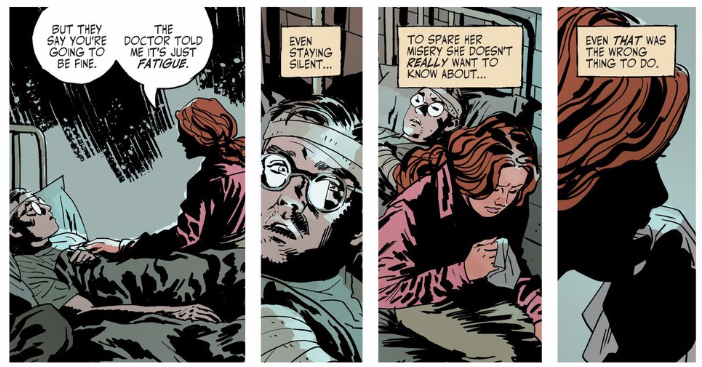
The omniscient narrator here is quick to shift the blame for Rebecca’s pain to Charlie; she’s being swallowed up by Charlie’s darkness, and that seems an apt description for the lives of most of the women in this book.
Unlike the rest of these characters, Charlie and Gil are straight white men, and thus have quite a bit of privilege, especially in the 1940s; therefore, Brubaker and Phillips paint these characters more as victims of their own failings and flaws than any external force. The first half of this issue flashes back to establish the origins of Charlie and Gil’s partnership, and especially the endless cycle of friendship, guilt, and antagonism they’re caught in. Their relationship is based as much in guilt as it is in friendship; Gil feels guilty for getting Charlie stuck at Victory and ruining his career, while Charlie feels guilty for sleeping with Gil’s wife. These two resent each other as much as they admire each other, so it’s no wonder their relationship has become so dysfunctional and symbiotic; it’s no wonder they regularly take their frustrations out on each other.
Yet, as much as these two are to blame for their issues, they’re still victims. Gil’s the victim of the bloodthirsty studio-heads who went out of their way to unfairly blacklist him, while Charlie, who’s still traumatized by the war, is the victim of all those responsible for it. Those in power don’t care if you’re a man or a woman, young or old; if you’re in their way, if they can use you, then they’ll hurt you no matter who you are.
Both these men are well aware of that, but while Gil’s been ready to fight for a while now, Charlie’s been hesitant. He’s been more worried about his own safety than anybody else’s, but even he can’t stand by and let Kamp and his cohorts get away with their crimes anymore.
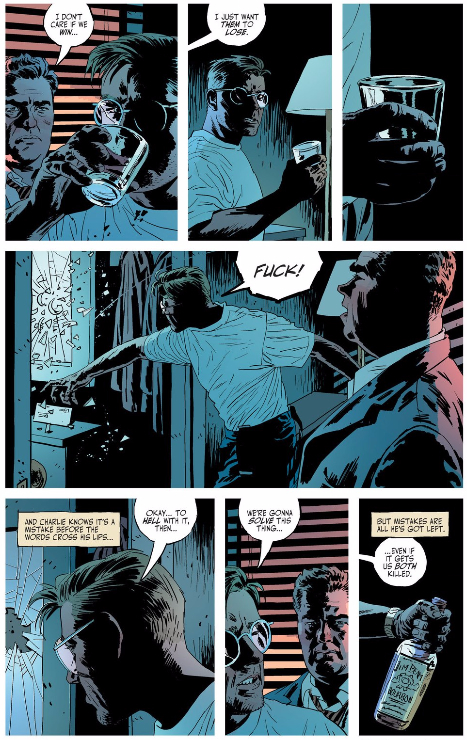
Charlie and Gil are the only people with the power to do something, to make sure more people don’t wind up just as hurt as Valeria or Maya or the Krazy Kids or even themselves. That’s what powerful men like Kamp never realize; every person they hurt is one more person with a reason to take them down, and eventually, one of them will succeed.
Or, at least, that’s the way it works in more uplifting fiction; it’s still up in the air whether Charlie and Gil can fight a Hollywood this dark and gritty, and even the narrator has doubts. Drew, do you think they stand a chance?
Drew: Not if Charlie’s awareness of how careless this is is as accurate as it’s been throughout the rest of the issue. In fact, that he recognizes it’s a mistake before he’s even done it speaks to just how reckless he’s being here. Brubaker leads us very carefully to that point, starting with a smaller transgression Charlie only regrets after the fact.

This kind of carelessness of phrasing is small potatoes compared to the rest of the issue, but it cues us in to Charlie’s regrets — and especially that he doesn’t think twice about this one until “the second the words leave his mouth.” There’s not a lot of risk here, so the analysis doesn’t come until after the deed is already done.
The next of Charlie’s regrets that Brubaker gives us is Charlie’s tryst with Melba, which Charlie begins to think better of in the middle of the act.

The stakes here are obviously much higher than the hurt feelings in Charlie’s thoughtless comment to Rebecca — and indeed, they’re ultimately higher than Charlie can really anticipate here. Spencer, you suggested that Charlie’s guilt is over sleeping with Melba, but the repercussions are actually much bigger than Gil’s broken heart. Indeed, Brubaker draws a pretty clear line that Gil’s ensuing tailspin stems from this very moment. That is, Charlie feels guilty for costing Gil his entire career. If that’s the kind of fallout Charlie can only anticipate while he’s acting, imagine how bad things will end up when he goes into them thinking they’re a bad idea.
Brubaker presents these decisions and regrets in escalating order — from low stakes to high stakes, and from regretting them after-the-fact to recognizing a bad decision before it’s made — but their chronological order tells a slightly different story. Charlie’s tryst with Melba happened before any of these other decisions, followed by his conversation with Rebecca, suggesting that he’s actually getting worse at controlling his impulses. This whole series may represent that — issue one opens with him waking from a bender that ended worse than really any of these other decisions. In that case, Charlie’s recognition of Gil’s plan as a bad one may actually represent a turning point for him, though that point may be undercut by the fact that he choses to do it, anyway. Or maybe it just emphasizes how profoundly bad of an idea it is — if even Charlie Parish, king of terrible decisions, can see this idea stinks, it must be truly terrible.
Ultimately, I don’t think we can really hope to glean this foreshadowing in any kind of predictive way, but its a testament to Brubaker’s writing that he can give us this kind of intensifying repetition without tying it to any one reading. In fact, the writing subtly emphasizes the temporality of the regret, inching each successive regret earlier on the page. Perhaps that move from reactive to proactive is the biggest takeaway from this issue. I’m still not sure it’s a good thing for Gil and Charlie, but it’s certainly exciting.
For a complete list of what we’re reading, head on over to our Pull List page. Whenever possible, buy your comics from your local mom and pop comic bookstore. If you want to rock digital copies, head on over to Comixology and download issues there. There’s no need to pirate, right?
 Retcon Punch
Good catch on Charlie feeling guilty about ruining Gil’s career (as a byproduct of sleeping with his wife) moreso than for sleeping with his wife itself, Drew. That creates a nice bit of symmetry, as both men feel guilty about ruining the other’s career.
Also, I agree with you that this probably won’t have a good outcome. My reading took more of a moral victory attitude, where Charlie should be praised for doing the only right and decent thing he could do in this situation, but in the noir world of The Fade Out, that more than likely guarantees his failure in one way or another. At the most, any victory he and Gil achieve will be a bittersweet one — even if they manage to take down Kamp and his studio, they won’t have fixed the prevailing attitudes in Hollywood that allowed Kamp to get away with everything he did in the first place. They’re never going to achieve any kind of lasting change with their methods; maybe that’s why I’m so invested in the moral victory of Charlie standing up for what’s right even if it almost certainly means his downfall.