

Today, Peter and Drew are discussing All-Star Western 1-3, originally released September 28th, October 26th, and November 23rd, 2011.
 Peter: DC took a couple of major leaps with the New 52 in terms of character development and took a few chances as well. Those chances were, of course giving several lesser used and known characters their own books; Mr. Terrific, Hawk and Dove, Static Shock, etc. All-Star Western is probably the most ambitious of these books, and I firmly believe this book is a ‘high-risk, high-reward’ book for DC.
All-Star Western is different from the other New 52 books, simply because it takes place in an entirely different time period from all of the others. All-Star Western takes place in the 1880s, in Gotham, and it lets us see into the past of the DC Universe. This is a very different time, with a significantly smaller amount of traditional superheroes in the sense of superpowers, and more so just extraordinary people.
Issue 1 starts out with an introduction to Gotham in the 1880s, as we see Jonah Hex arriving in town via train. He immediately is jumped in an alley by some hoodlums and kills them with ease. Cut to a crime scene, involving a murdered prostitute and blood writing on the wall. The current head of police, and a psychologist, Amadeus Arkham, are examining the scene and commenting on how this is not the first of these style of these murders, thus giving a very ‘Jack the Ripper’ feel to it. The killer has been penned the Butcher. Jonah shows up, and is roped into helping with the investigation, for a fee, of course, partnered with Amadeus Arkham. Using Jonah’s less than legitimate contacts, they get some leads, engage in a good old fashioned saloon fight, and leave. We then find that Jonah’s contact, another working girl, found dead, with an ominous message for Jonah to leave Gotham. Just like a good detective sequence, complete with Arkham’s play-by-play about Hex’s psyche. Arkham and Hex eventually climb their way up the information ladder, and find themselves a party, complete with the ‘whos-who’ of Gothamites. It is quickly discovered that several, if not all of the attendee’s at the party are wearing a ring, black with a skull set in it, an icon that was previously described in relationship with the Butcher. It becomes blatantly clear to Hex and Arkham that these people are all members of a secret society.
We then jump to issue 2, and it is revealed that these people are member of the Gotham coven of the Religion of Crime; a group of people who follow the Crime Bible, which Arkham discovers from his studies. This is short lived as several gunman approach Arkham Manor. Hex dispatches them with much ease, and interrogates the last one, to discover that Blackgate Isle is where they are basing themselves out of. Upon arriving at Blackgate, Hex and Arkham discover the Head of Police being tortured by the Religion of Crime. Issue 3, Hex fights off the large bruiser of the coven, and they apprehend the Butcher. The story makes the paper, and after some final words, Arkham and Hex part ways. We end with seeing Hex coming upon some other scumbags, and I can only imagine what is about to happen.
Okay, I was skeptical at first about this book. All-Star Western hasn’t been a book of it’s own in quite a long time, and the Jonah Hex book prior to the reboot wasn’t that good. But I cannot start to say enough good things about this book so far. It is a difficult task to build and cultivate a book that is not set in the current timeline. This hinders you greatly on a story stand point, because a lot of things aren’t known, and you are not allowed interaction with other mainstay characters because it’s simply isn’t possible. So it’s a very different experience even reading this book, and the team of Justin Gray, Jimmy Palmiotti and Moritat make it a real experience. First of all, this is the only good that I am reading right now that is written by more than one person. Gray and Palmiotti are doing a great job so far. But the stand out is Moritat’s art. He gives it this grainy look, with a constant sepia tone that really makes it like a movie set in the 1880s. Also, take a look at the first page.

This is a beautiful shot of the skyline of 1800s Gotham, and loves how the smokestacks make a skull cloud that hangs over the city. This really imparts onto me a feeling that, as we soon discover, there is an evil presence lording over the city, and that it makes the city itself a character and it is evil. This is not the first time that Gotham City itself is a character. Gotham is constantly taking the forefront in stories, which personify it. This is also true for Metropolis and it’s difference from Gotham; the light and the dark, the well light and poorly light. It also is reflected on the heroes that take residence there.
Hex is no exception. He is a Civil War veteran, and is tough as John Wayne’s own boots. He comes off as a great character with a charisma of sorts, and a can-do attitude. He is very much an anti-hero, akin to the likes of the Punisher. He has no apparent superpowers, and like Gotham’s later hero, Batman, is driven, and willing, despite his lack of powers. But really, this is not just a Hex book, but an Arkham book. We are introduced to the character of Amadeus Arkham, who has yet to open his infamous asylum, and, in this book he acts as a direct foil to Hex. I love how he is written in this book, and we are seeing him grow into the man that he will later become. He also serves as the narrator of the story, and I enjoy his observations and commentary on the characters around him.
With the book being set back in the past, we are also devoid of traditional supervillans. I love that Gray and Palmiotti decided to use the Religion of Crime. It shows us that there is an inherent evil in Gotham, and that it will end up lasting a long time. The Religion of Crime is relatively unknown, and it lends itself well the 1880s and the industrial revolution theme. It shows us the baser instincts of men with power, and their willingness to do anything to get more power.
All-Star Western is a fantastic book, and as we catch up, I love reading it. It is fun to see a book that is printing more than one story, with the inclusion of the El Diablo story at the back of the book. It reads like a old school comic book, like the old Action Comics or Detective Comics, telling more than one story inside the pages. This is a good homage to the older runs of All-Star and I look forward to reading more of it, and it’s inclusion in the upcoming Night of Owls.
 Drew: It’s a strange line Grey and Palmiotti walk on this title. Their treatment of Amadeus Arkham is based largely on Grant Morrison’s characterization from Arkham Assylum: A Serious House on Serious Earth. That characterization is based largely on the tone of his meticulous pseudo-Freudian journal entries; in short, Arkham is a man who thinks and writes about everything he encounters. Grey and Palmiotti nail Arkham’s voice, but it’s a voice that almost diametrically opposed to the aesthetic of a western. Jonah Hex is very much cut of the cloth of the old western heroes, the kind that never examines their own motivations, or really talk any more than they have to. What makes him cool is his tight-lipped recklessness, so pairing him with a gun-shy intellectual runs the risk of undermining exactly what’s so fun about his character.
It’s a testament to Grey and Palmiotti that the pairing doesn’t just work — it’s a rousing success. It’s a true odd-couple, but we end up getting a lot out of their teaming-up; Arkham is able to offer some genuine insight into Hex’s psyche, and Hex is able to land some hilarious deadpans at Arkham’s expense. It’s a lot of fun, and you’re right — it’s enhanced immensely by Moritat’s art and Gabriel Bautista’s colors. Check out the way the two work to convey Arkham’s realization that almost every powerful man in Gotham is wearing a skull-ring:
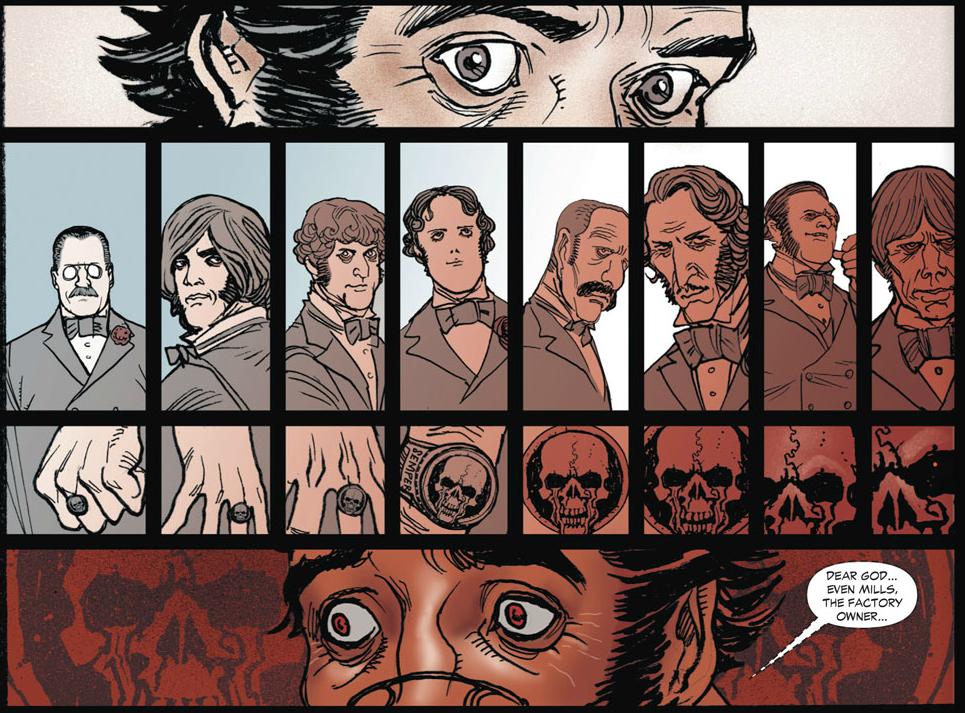
It’s a beautifully-staged sequence, and is only enhanced by the slow shift to red as Arkham realizes just how deep this case might go. Moritat deserves a lot of praise for his truly western-inspired pencil and ink work, but I’ve been particularly impressed with Bautista’s coloring on this title. He tends to keep things pretty muted, which only serves to make the occasional splashes of color all the more effective.
I may quibble with you a bit, though, on the characterization of Gotham. There’s a lot to like, here; the roots of the religion of crime in Gotham, Mayor Cobblepot, even the then recently completed New Trigate Bridge (sorry to geek out on this, but I just finished reading Batman: Gates of Gotham, and am feeling utterly immersed in 1880’s Gotham).

But I also don’t totally buy this place as Gotham. Sure, the mansions and the corruption are familiar, but the smoky saloons and the wide dirt streets lined with lantern-lit porches feel more like Tombstone than a burgeoning east-coast metropolis. At the same time, the obvious Jack the Ripper parallels make the Butcher feel more like 1880’s London than anything American. I think this kind of eclectic approach is intended to make Gotham unique, rather than making it a period clone of New York, but I don’t think it entirely works.
Something else that isn’t working for me is the phonetic representation of Hex’s accent. I recently defended the written-out cockney accent Brian Azzarello is using for the Lennox character on Wonder Woman, but for whatever reason, the written out southern accent really bugs me. It might be because I don’t exactly know what Grey and Palmiotti are going for — I keep reading it as an Alabama accent, but that obviously isn’t right. I guess it just seems a little hammy for a character that looks so much like Clint Eastwood.
There are a lot of ways this title reminds me of Eastwood’s westerns, but I suppose the biggest similarity is just the subject matter. If you like westerns (and I don’t see how you can’t if you’re into Gotham’s other tight-lipped, hyper-masculine vigilante), I can’t recommend this title highly enough. It delivers the gun-slinging, bar-brawling goods, all while fitting into the current history of Gotham being developed in Batman, Batwoman, and elsewhere. That’s no easy task, but this creative team is up to the challenge. I’m really pumped to be reading this.
 For a complete list of what we’re reading, head on over to our Pull List page. Whenever possible, buy your comics from your local mom and pop comic bookstore. If you want to rock digital copies, head on over to DC’s website and download issues there. There’s no need to pirate, right?
 Retcon Punch
Drew, I totally see where you are coming from on your input on Gotham as a character. You’re right, some of it doesn’t fit. I am hoping that this gets fleshed out a little more along the way. The wide dirt street don’t fit, and really, they don’t fit into the wide shots of the skyline that we are given. So I really don’t know why that is. But we do see an crowded alley, when Hex first gets off the train, crawling with hoodlums, which is reminiscent of Crime Alley. I would have to disagree with you on the voice thing. I do read him with a more Clint Eastwood voice as heard in The Good the Bad and the Ugly. I really got that sense at the beginning of issue 2, when he is talking to Arkham, and then through the firefight. The shot of Hex on the porch cradling the rifle is iconic. I would have to think that the root of your problems with his voice stem from how you are hearing it in your head, and not how it is written.
His ” voice” is based on the letters and language of soldiers from the civil war and a bit of street language. Much research has gone into this particular fact.
I don’t think Drew was commenting on the accuracy as much as he was partially acknowledging our conversation about a Wonder Woman character’s English accent. Reading accents just feels weird sometimes – I feel the same way when I read Dickens.
I really didn’t mean to suggest that the language you’re using is inaccurate, or even that the accent is incorrect, just that I’m not sure how to read it. There are a lot of ways to pronounce “Ah,” and I keep defaulting to the accent Tom Hanks used in Forrest Gump, which I’m sure isn’t what you’re going for. Anyway, I’m loving what you guys are doing with this title, and we’re flattered that you took the time to read and comment. Keep on doing what you’re doing — I can’t wait to pick up issue 6!
Jimmy, I really love this book. Seriously. I think that the concerns with his voice are more about how it is heard in Drew’s/my head than the actual spelling and grammar he is using. I love how this book is shaping up. I am also flattered that you took the time to read and comment here. It is incredibly cool that you put time and energy into researching in order to draft a voice unique to Jonah.