
 Today, Patrick and Drew are discussing the Flash 11, originally released July 25th, 2012.
 Patrick: Flash 11 (and 10, for that matter) is a bit of a place-setting issue. Francis Manapul and Brian Buccaletto are smart enough to fill these issues with self-contained stories, but it’s becoming increasingly clear that this series is currently in the business of establishing a new breed of Rogues. And they’re not just new to the audience, they’re new to the world of the Flash and — more distressing — new to each other. Thankfully, this is done without the slightest hint of an origin story: these bigger, better Rogues have a history together that’s half what-you-already-know-about-The-Rogues and half total mystery. And all of this villain business unfolds gracefully without ever losing sight of Barry Allen.
The issue opens on a prologue of sorts: an introduction of Heatwave into the New 52. He’s looking for a place in Keystone to lay low for a couple of days, but accidentally engulfs a seedy hotel in flames when someone pisses him off. Meanwhile, Barry tries to determine how he fits into the world now that he’s faked his own death. Step #1: relocate to Keystone City (and the dodgiest area at that). He figures the best way to fight crime is to embed himself with the criminals… also he sees a “help wanted” sign in the window of a dive bar — double-win, there. Barry goes in an adorkably* asks for, and secures a job. But this ain’t no normal dive bar, this is the dive bar – a notorious meeting place for The Rogues back in the day. Turns out, Captain Cold is hanging out there right now! Heatwave storms in and demands justice. Y’see, Heatwave blames Captain Cold for their newfangled superpowers.
Barry recognizes the potential for shit-going-down, and changes into his Flash costume. With relative ease, Flash disables the bad guys and sends them off to Iron Heights. Just as they’re about the start fighting in their jail cell, they’re visited by Glider (who also appears to have superpowers; she’s passing though the walls).
There’s also some business with Patty being chewed out by Singh and Dr. Elias appearing on a talk show to discuss the state of the city. We’ve seen this sort of thing in recent issues of The Flash: there’s a strong central story but there are little scenes catching us up on the goings-on of the peripheral characters (usually Singh). Sometimes I question the necessity of these scenes, but this issue pulled them off with enough panache that I don’t mind. In fact, Elias’ talk show appearance artfully marries Cold little rage-fit with Patty’s scolding, as they’re all watching it. Ever since the EMP/blackout, there’s been a communal feeling to the suffering of the Gem Cities. As readers, we’ve been spending most of our time with Barry, and he’s been everywhere but the Cities (Guatemala, Gorilla City, Speedforce, whatever). Now that he’s home, we’re able to feel the effects of this communal experience.
There’s a more generalized experience that everyone in this issue is dealing with: change. Barry states this explicitly at the top of the issue, “That’s the way it goes… everything changes… it’s the one constant in the universe.” That’s only part of the truth. Things change in the Gem Cities and everyone needs to respond to these changes – it’s the one things that bind them all together. Take a look at how both Barry and Heatwave start their respective stories by looking for places to hide from society. Take a look at how both Captain Cold and Barry are disappointed and frustrated by Dr. Elias’ TV appearance. They’re not so different after all. And that complicates matters.
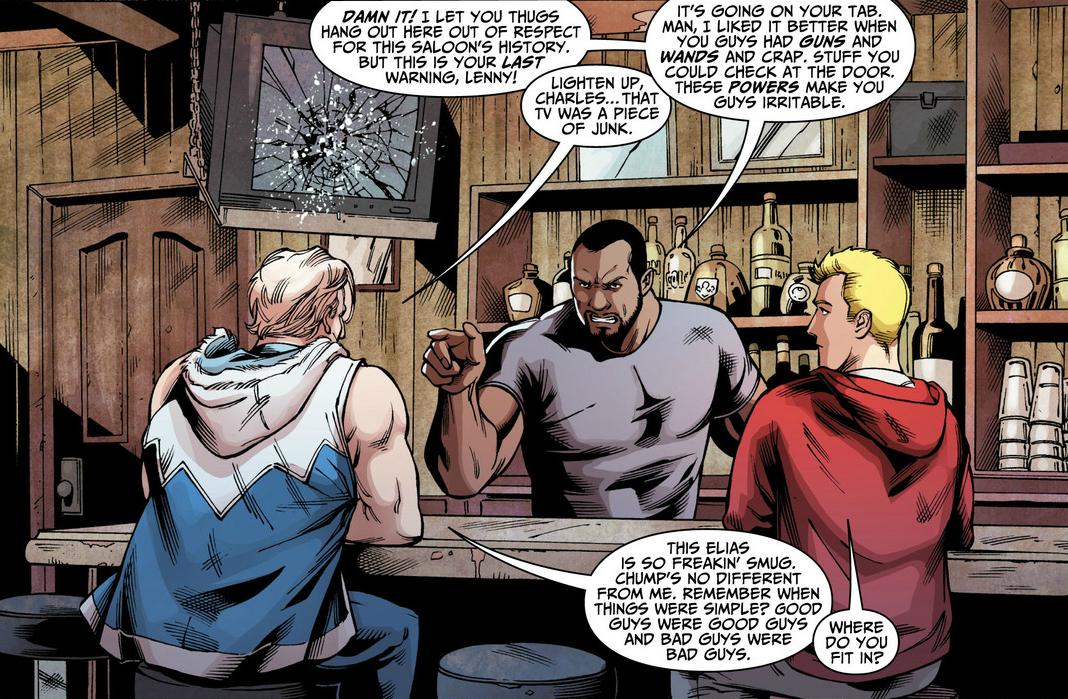
I love this. “Remember when things were simple? Good guys were good guys and bad guys were bad guys.” As we’re being so sympathetically introduced to The Rogues, this sentiment reflects the way I feel about them — they may be named as the villains in the series, but they’re just doing their super-powered best. I mean, what’s the difference between the damage Barry accidentally caused and the damage Heatwave accidentally caused?
There are a lot of little details I like in this issue. Snart’s inability to drink a cold beer because it freezes when it touches his lips is simple and heart-breaking. He can’t even escape his problems! I like Barry addressing himself as “Al the bartender” — he’s so ready to embrace this new identity. Even the fact that there is a bar that’s a KNOWN HANGOUT for supervillains is super delightful to me.
You can also tell that Manapul and Buccaletto delight in squaring Cold off against Heatwave. They know full-fucking-well how nice it looks to place these characters on opposite ends of a panel. Drop the Flash in there for good measure, and you’ve got a damn graphic action sequence on your hands.
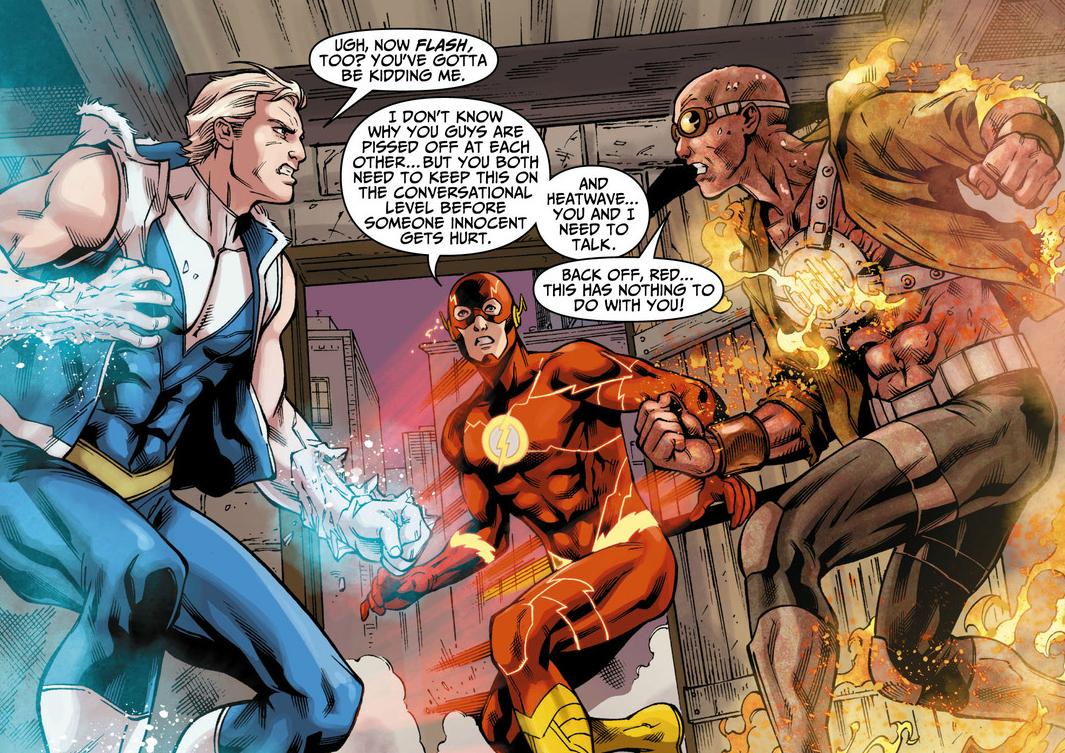
As long as this team can keep this team-building light and fun – and keep Barry in the spotlight – I’m more than happy to watch the Rogues assemble over as many issues as it’s going to take. There will come a day when they actually organize and strike against Flash, and that’s going to be awesome.
* Yeah, I didn’t like the marketing for New Girl any more than you did. BUT, the word is appropriate in this case AND New Girl ended up being a really nice show. Drew: If issue 9 was a statement of purpose for the Flash in the New 52, issues 10 and 11 have felt like a meta acknowledgment that Barry isn’t exactly sure what his purpose is anymore. Or rather, he’s found his purpose — running — but he’s not sure how to build a life around that. It’s hard for these issues not to feel like a step backwards, but Manapul and Buccellato have demonstrated time and time again that a little patience will make the payoff all the better.
What really interests me in all of this is that the Flash is still the Flash — nothing about who he is or what he does is changed — but Barry is now jobless, penniless, and without an identity. He’s afraid of hurting the people he cares about, so can only build his new life around his one constant: the Flash. He chooses his new home and his new job based on proximity to crime, placing him in danger of becoming the Flash full-time. Without people to ground him, his non-costumed identity is quickly reduced to a method of reconnaissance, sitting in a dive bar, waiting for something bad to happen. I suppose the same could be said of his Crime Lab job, too, but at least there he had friends and coworkers; some kind of a life outside of the Flash. Maybe that’s all coming, but in the meantime, our hero is in danger of losing his human connection.
To be fair, those human connections are still around, even if Barry is staying away from them. Patty is still easily upset at the mention of Barry, while Singh seems preoccupied at headlines proclaiming the Pied Piper to be back. Most intriguingly, Dr. Elias has positioned himself as the Gem Cities’ new savior, leading me to suspect a dark turn is in his future. His comments during that interview suggest that he is the answer to crime the police can’t stop — a statement he later hedges as a kind of populist message about giving the power back to the people. I don’t know exactly where he’s headed, but it sure seems like he’s destined for super villainy.
The art by Marcus To and Ray McCarthy is distinctly darker than Manapul’s, which rather suits this issue. I wasn’t thrilled with the artist switch last month — mostly because I was so loving what Manapul was doing — but the art really matches the tone here. The majority of this issue is set in a dive bar, so To’s specific sense of texture along with McCarthy’s moody shadows fit perfectly. Add to that some subdued color work from both Buccellato and Ian Herring, and this issue has a very distinct sense of place.
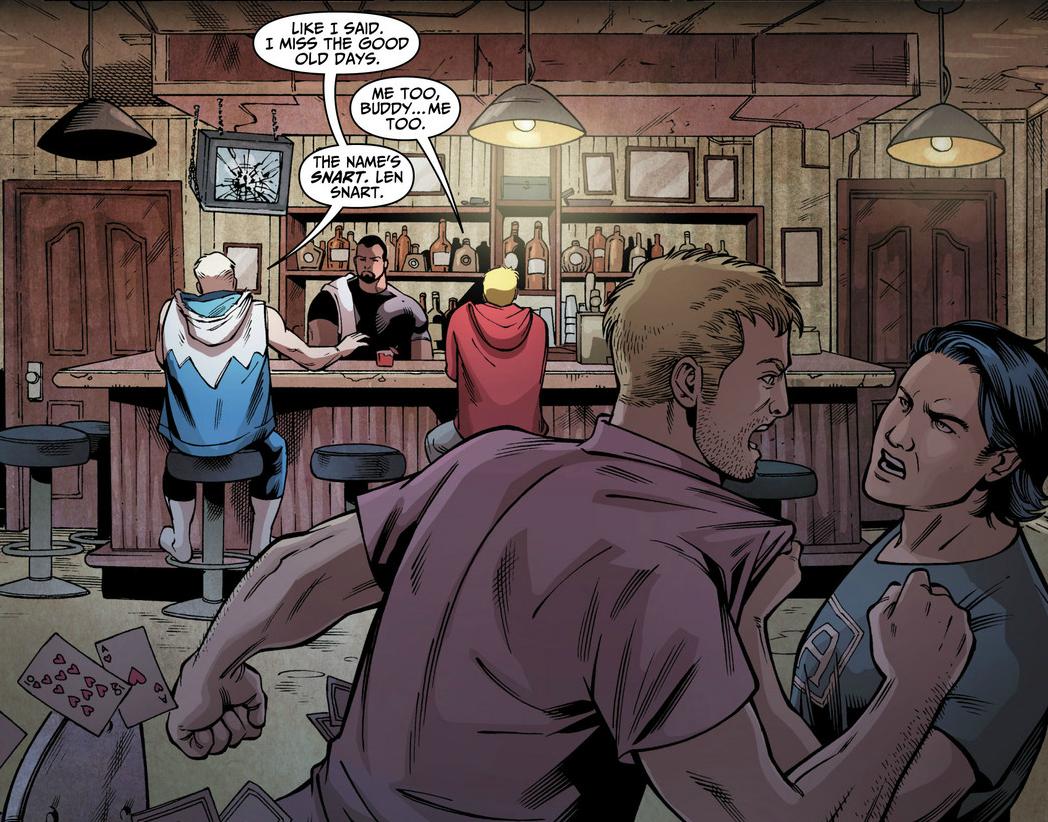
That darkness carries over to the other scenes, adding that sinister quality to Dr. Elias’ interview and enhancing the drama of Patty and Singh’s argument. The only place it doesn’t really work for me is when Barry is accessing the speed force with his mind, and that’s mostly because I’m so enamored of the way Manapul draws those sequences.
Patrick is absolutely right about the mystery here. Barry mentioned way back when we first encountered Cold that his powers were new, but it was never presented as something Manapul and Buccellato were particularly interested in exploring. Now, it appears to be a central mystery, one that is clearly a point of contention for the Rogues. The answers to that question may be doled out sparingly over the coming months, but like I said, this is a title that likes to reward our patience.
 For a complete list of what we’re reading, head on over to our Pull List page. Whenever possible, buy your comics from your local mom and pop comic bookstore. If you want to rock digital copies, head on over to DC’s website and download issues there. There’s no need to pirate, right?
 Retcon Punch
Man, these past two issues have been a case study in the dos and don’ts of exposition. Where issue 10 was happy to let massive monologues from unknown characters answer questions nobody asked, issue 11 is laying the groundwork of actually making us want the answers. Issue 10 was such an anomaly for this creative team, it almost feels like it was written by somebody else.
Also, how funny is the footnoted explanation of Crime Alley? Not only is the information totally inconsequential to the story, it’s patently obvious to anyone with deductive reasoning skills. I guess it conveys that Crime Alley is in Gotham, but all we really need to know to understand the comparison is that it’s an area of high crime, which I think is effectively broadcast by the name “Crime Alley.”
Oh man, the editor’s notes… Not only was that Crime Alley one totally unnecessary – who in their right mind would imagine anything BUT a bad neighborhood at the mention of “Crime Alley?” – but even those that pointed to previous issues were totally pointless. Like there’s the one that explains Barry’s Speedforce-assisted cognition that then also explains how this almost got him shot, only to have Barry narrate something about almost getting shot like 3 panels later. That guy needs to calm down.
I’m just trying to imagine how he thought readers would react to the phrase “Crime Alley” if they were unfamiliar with it. Is “that sounds nice” even a remote possibility? Like, it wasn’t named after former Gotham Mayor Alexander Crime. It’s either really condescending, or this guy thinks theres some need for stating the obvious. Do you suppose he hears about a city’s theater district, and as just confused as hell as to what goes on there? Wait, which state is New York City in again?
It’s exactly that perplexing. Like, why explain Crime Alley but not explain “Gotham” or “Batman?”
Peter and I were chatting yesterday about how it’s neat that there’s enough ambiguity around what the Rogues are up to. They’re assembling – but for what purpose? To fight Flash? Maybe not. It is also interesting that the only reason they’re getting together at all is because Glider is putting together a team. Each issue is like one of the pre-Avengers movies, and Lisa Snart is Nick Fury.
Yeah, it definitely seems like they’re dealing with issues completely unrelated to Flash. Like, he shows up, and they’re like, “Oh…you…” They’re clearly dealing with other shit right now.
Anyone heard about how long Marcus To is penciling this series? He’s doing a nice job, but I’ve got such a soft-spot for Manapul’s artwork that I’m starting to feel some separation anxiety. It’s like the Cliff Chiang / Tony Atkins split on Wonderwoman. Both artists look great, but there’s one I definitely prefer over the other.
Last I read Marcus To was doing a 2 issue fill in. Manapul should be back next month for issue 12, and the fat 48-page Flash Annual.
God, I think I had that information about the Annual, but had totally forgotten. 48-fresh pages from Francis Manapul is enough to make me VOMIT WITH JOY.
Plus, double helpings of the Flash!
Heatwave and the bartender make it sound like there was something that happened that internalized the Rogues powers. Also, that it is somehow Cold’s fault. I hope we find out what that event was. Maybe the reason the Rogues are no longer together?
Pingback: Speed Reading: Flash #11 Review Round-Up « Speed Force
It’s been an extremely LONG haul between Barry and I but I think for the first time since he died I might be interested in him again. This is not the fault of the writing team here since I do find their style to be quite fun but I’ve found the character of Barry to be so boring and the fact that I’m such a big Wally fan does not help matters. I was fully willing to give Barry a chance at the top spot again assuming DC was going to do SOMETHING with Wally but since he was killed unceremoniously in Flashpoint and then shelved I’ve found it very difficult to give any fucks about Barry. However, seeing him as “Al the bartender” has changed all of that and I really hope the writing team extends Barry’s journey as “Al” for a good long while.
Drew and I are both way-new to the Flash. I started picking up trades beginning with Rebirth – it was Geoff Johns that got me more seriously interested in comics in the first place. So I’ve mostly ONLY known Barry. Sure, I’d been exposed to the occasional JLA cartoon and I was able to soak some Wally West up that way, but I didn’t really have that conflict built-up in my mind.
One of the things I find refreshing about Barry is how fucking nice he is. Superheroes are so frequently huge jerk-bags – especially the main stable of Justice Leaguers. Superman’s the next closest thing to a nice guy, but his personality it so wrapped up in a black-and-white morality that he can be hard to sympathize with him. But Barry seems like he’s reacting honestly and kindly to the needs and feelings for those around him. Plus, I know so many quiet, smart, bow-tie wearing motherfuckers in the real world that Barry feels a lot like an old friend to me.
And at the risk of starting a fist fight, Wally West feels very 1990s to me. Like I can picture the pitch meeting: “He’s not your father’s Flash – this Flash has attitude and tells jokes and is fun. (Rasta-fy him by about 10%).” I’m totally willing to concede that a well-rounded, interesting character with a ton of cool history (that family…) eventually evolved from that, but his invention feels extraordinarily corporate to me.
But, change my mind – any Wally West arcs I should be read to make me fall in love with him?
It’s crazy to me that you don’t really know Wally West but I love it because this encapsulates so many nerd rage battles of which version is superior across this great land of ours! But don’t worry, there won’t be a fist fight here…probably. 😉 Unless you want to punch me for writing the longest comment ever which is understandable!
Wally West wasn’t just an invention of the 90’s. If you really want to know how I feel about him I can send you a link to something I’ve written. But basically Wally’s been around since the 60’s. He started as a sidekick and fans (throughout DECADES) got to see him grow into his mentors role. DC had and continues to have sidekicks all over the place but before Wally we never got the chance to see the sidekick truly become the main hero.
Dick Grayson got a taste of that but we all knew that Bruce would return. With Wally it was different and for twenty years he WAS the Flash. Generations of fans grew up knowing him as the Flash and for that he was an important character.
And yeah, he was younger and cooler and had a sense of humor but the only thing 90’s about him was that he started to come into his own at that time. Through Wally, we got to see the discovery of the Speed Force, something that continues to have an impact on the Flash today (among other things). Writers like Grant Morrison, Mark Waid, and Geoff Johns all left their marks on The Flash and his mythos through Wally. So anything written by them would be a pleasure to read. But since you said Johns got you more into comics I’d definitely recommend his run.
Finally, Wally West embodied the idea of legacy in the DCU. From the time of the original Crisis in the 80’s up until the New 52, DC comics was all about legacy. Barry Allen was essentially sanctified when he sacrificed himself and when Wally took over the whole idea of generational heroes really took hold in the DCU. You also had the JSA formerly of Earth 2 suddenly a part of the history of Earth 1. Solidifying the concept of generational heroes and predecessors along with Wally. The idea that the Teen Titans would eventually become the Justice League became much more real. Johns explored that in his Teen Titans story arc “Titans Tomorrow” and James Robinson explored how many of the original Teen Titans would serve as his version of the Justice League.
I started reading DC comics about 12 years ago and I’ve loved DC’s focus on legacy. The erasure of Wally and many other legacy characters (Cassie Kane, Steph Brown, Donna Troy, maybe Ted Kord) is what many people are upset about with the New 52. And I think their disappearance is symbolic of DC’s moving away from the idea of legacy. Personally, I like the new DCU less because of it but that’s just me. The bright side is that I assume I’ll get to see a new legacy created throughout the next few years and because of that I’ll keep reading.
Legacy heroes are an interesting topic. Honestly, the existence of such hero legacies kept me from investigating comics in the first place. The whole concept is enormous, and totally alienating to outsiders. Now that I’m fully submerged in the world of superhero comics, I can see the appeal.
But man, I remember reading the Blackest Night and Flash from that era and being confused as fuck about who everyone was. I mean, even the Rogues were legacy characters – that’s a lot to unpack. (Legacy Heroes and Villains could make an interesting Chat Cave one of these days…)
On the actual subject of Wally and his ninetiesness: I was merely commenting on my perception of the character, which is admittedly limited. Especially as a kid, I could shake how similar Wally and Sonic the Hedgehog were to me. SACRILIGE, I know. As with all things superhero-related, I should have simply looked deeper and found the meaty bits on my own.
I’d definitely read that Chat Cave!
I definitely understand where you are coming from. I started reading DC with the Crisis on Infinite Earths trade. I saw a billion superheroes on the cover and I just couldn’t resist. When I read the thing I was completely overwhelmed but in a good way. At the end of that story Wally West picks up the tattered remains of Barry’s old Flash costume and takes on the mantle himself. I don’t know what it was about that comic but I became hooked on DC. I was driven to learn all I could about these characters which led me to being such a huge comic fan today. I bought so many back issues and trades and made DC a pretty penny in the process!
I hope that you not knowing about the various Flashes didn’t decrease your enjoyment of Blackest Night because for me it was such a fun ride. So many characters from different eras of DC were explored (whether they were zombified or not) and it was just a great way to look back at these characters lives together. That comes entirely from me being an old reader of these characters.
I think the issue of legacy characters boils down old vs. new readers. DC and Marvel are always going after the elusive new reader but even if they do constant reboots (like DC) or simply start to ignore huge parts of their past (like Marvel) new readers will always be somewhat out of the loop or sometimes completely clueless about a character unless they decide to dig a little deeper like you said.
There are few pleasures as pure as digging deeper into any subject. Before I got into actually reading comics, I picked up Green Lantern: Rebirth on a whim. I had read some of the greatest hits of the Batman canon (Hush, Year One, DKR) and just arbitrarily decided I should give another hero a try. And while that’s as fine an entry point as you’re likely to see for GL, it was overwhelming as hell. Parallax, Kyle as Ion, Guy (as kind of a GL/Warrior hybrid), John, the motherfucking Spectre. That was enough to propel me down the rabbit hole of wikipedia and the DC wiki. And it was an awesome introduction into just how vast this universe could be – even in the very specific Lantern-centric way.
I did like Blackest Night – a lot. In the name of completionism, I bought all of it in trades. And the only part that I couldn’t really sink my teeth into was the JSA stuff – I don’t know if i was another case just too much history for me to even begin to understand it, or what.
I love hearing people’s stories about what triggered the big “holy shit, I have to read more” moment. Thanks for sharing yours!
You’re welcome! Coming from a HUGE JSA fan, I’ll say that I think their Blackest Night stuff was some of the weakest. Although, I highly recommend reading Geoff Johns run on the characters. “JSA” was originally written by David Goyer but then Johns took over shortly after. I can’t tell you how much I love this book. Not only is it entertaining as hell but it’s a pretty good DC history lesson as well!
And yeah, GL: Rebirth was a lot to take in for new readers, but the fact that it got you into DC shows that even books featuring legacy characters or just ones with a lot of baggage can capture new readers.
That’s a big part of why I love these characters. They can have so much history and baggage but still be written in a way that hooks in new audiences. It amazes me how incredibly versatile they all are.
Pingback: The Flash Annual 1 | Retcon Punch
Pingback: Weekly Round-Up: Comics Released 2/19/14 | Retcon Punch