

Today, Drew and Spencer are discussing Sherlock Holmes: Moriarty Lives 1, originally released December 11th, 2013.

“Spinoff!” Is there any word more thrilling to the human soul?
Troy McClure, “The Simpsons Spinoff Showcase”
Drew: Spinoffs are a strange beast. They’re designed to cash-in on the success of another series, giving them a fine line to walk, creatively. They can’t be the same as the parent series, or things will get stale quickly, but they also can’t be too different, or they’ll risk losing that borrowed audience. This can obviously fluctuate over time — series might drift away from their spinoff origins as they find their footing, or might rely on cameos from the parent series when things start to go south — but my experience dictates that, while a carbon copy may result in flash-in-the-pan success, changing things up dramatically is the recipe for longevity. Unfortunately, Sherlock Holmes: Moriarty Lives 1, may rely too heavily on it’s miniseries aspirations, delivering up a Holmes story minus the Holmes.
Confession: I’ve become a bit of a Holmes-phile in recent years, and while I haven’t read every Holmes story, I certainly know enough to recognize that Moriarty is an almost entirely untapped goldmine for stories. Much like in the stories, his reputation has grown over the years, but he appears in only two short stories, and is only briefly seen by narrator John Watson. Sir Arthur Conan Doyle kept him an enigma, and much of his allure lies in that mystique. Still, I was intrigued at the thought of exploring him more thoroughly, so wanted to give this series a shot.
The issue picks up directly after the events of “The Adventure of the Final Problem,” where Holmes and Moriarty seemingly both tumble to their deaths into the Reichenbach Fall. We already know that Holmes survived [SPOILER ALERT: two more Homes novels and short story collections were published after “The Adventure of the Final Problem”], but here we learn that Moriarty did, too. We follow him into a town, where he uses suspiciously Holmes-like deduction to con a man out of his clothes, and equally Holmes-like disregard for social mores to bluster his way into food and drink at a local tavern. It is there that he crosses paths with Baron Bombastus von Hohenheim, a science-powered magician determined to recover something from the tavern barmaid. Hohenheim kills the barmaid, leaving a humiliated Moriarty the unwitting guardian of her son.
It was hard for me to have much in the way of expectations going into this series — like I said, the character of Moriarty is all but undeveloped in Conan Doyle’s work — but this somehow didn’t live up to them. Sure, my favorite thing about reading any Holmes story is his uncanny ability to deduce important facts from seemingly insignificant details, but seeing Moriarty repeat the trick is an exercise in diminishing returns.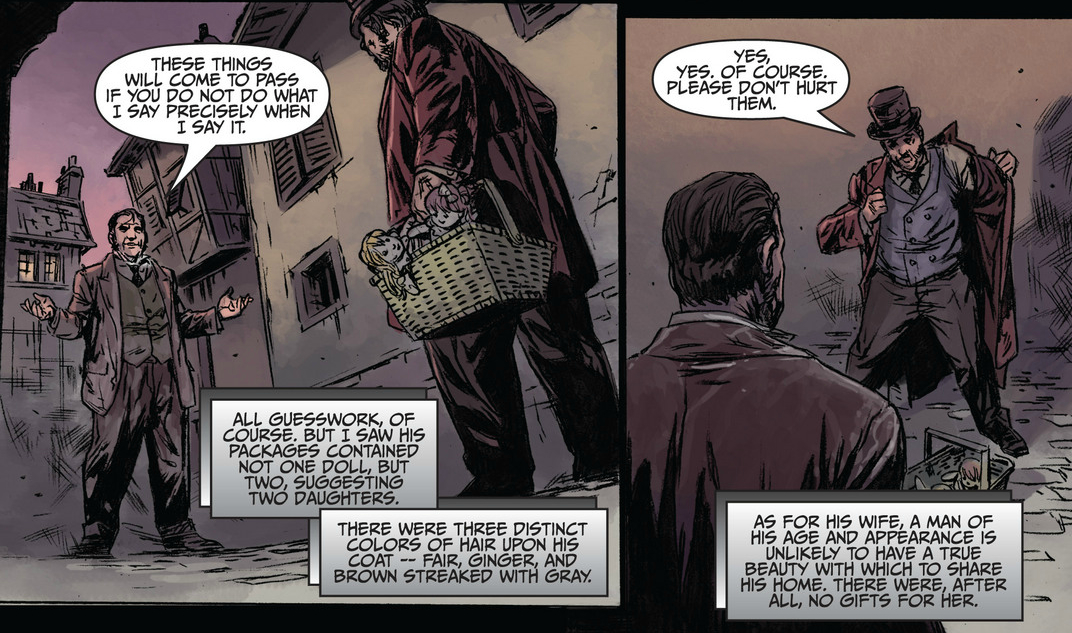
I’m largely willing to excuse the huge leaps in logic — Holmes is sometimes guilty of the same — but I have a much harder time forgiving the notion that Moriarty has the same skill-set as Holmes. I get that they’re meant to be equally matched, but giving Moriarty the same deductive skills actually makes them way less impressive. It’s also just boring and unimaginative. Writer David Liss provides a plausible criminal application for those skills, but you’d think Moriarty might have cultivated a different set of skills as a criminal mastermind.
Ultimately, I may be more bothered at the seemingly supernatural thriller Moriarty finds himself entangled in. I may not have known what to expect of his characterization, but I certainly knew not to expect an electricity wizard shooting lighting bolts with his hands. I know, I know, there’s some perfectly comic book-logic scientific explanation for his superpowers, but these sci-fi elements feel completely out-of-place in the world of Sherlock Holmes.
Ick. In spite of myself, it seems my expectations are getting in the way. I guess I just really want to see a story where a former criminal mastermind has to rebuild his empire from scratch (and, you know, not the 19th Century take on Shoot ‘Em Up). I don’t know, Spencer, is my familiarity with Holmes getting in the way? Were you able to find more to like here, or did this feel kind of generic and dull to you, too?

Spencer: No Drew, I think “generic and dull” fits this issue fairly well. Here’s a confession of my own: I’m not all that well-versed in Sherlock Holmes. This is a pretty astounding feat considering that my Dad watched Jeremy Brett’s Sherlock Holmes series constantly when I was growing up, but somehow I never latched onto it — probably because my Dad always made me play the “quiet game” when it was on so he could hear. Regardless, besides for one episode of BBC’s modern Sherlock series (it’s in my Netflix queue, I swear), my largest exposure to Holmes was owning The Great Mouse Detective on VHS as a child.
That said, I think the general idea behind Sherlock Holmes and the dread his archenemy Moriarty inspires are both pretty well-known to the public at large, and I came into this issue interested to see just what exactly all the fuss was about; true to form, while this issue as a whole is lackluster, Moriarty is probably the most interesting part.
Moriarty’s a tricky character to pin down throughout the issue; he first surfaces in a flurry of grandiose, arrogant dialogue seemingly straight out of the mouth of Otto Octavius, but effortlessly juggles various personalities depending on his needs, be it the dapper stranger in the bar or the gruesome torturer in that back alley:
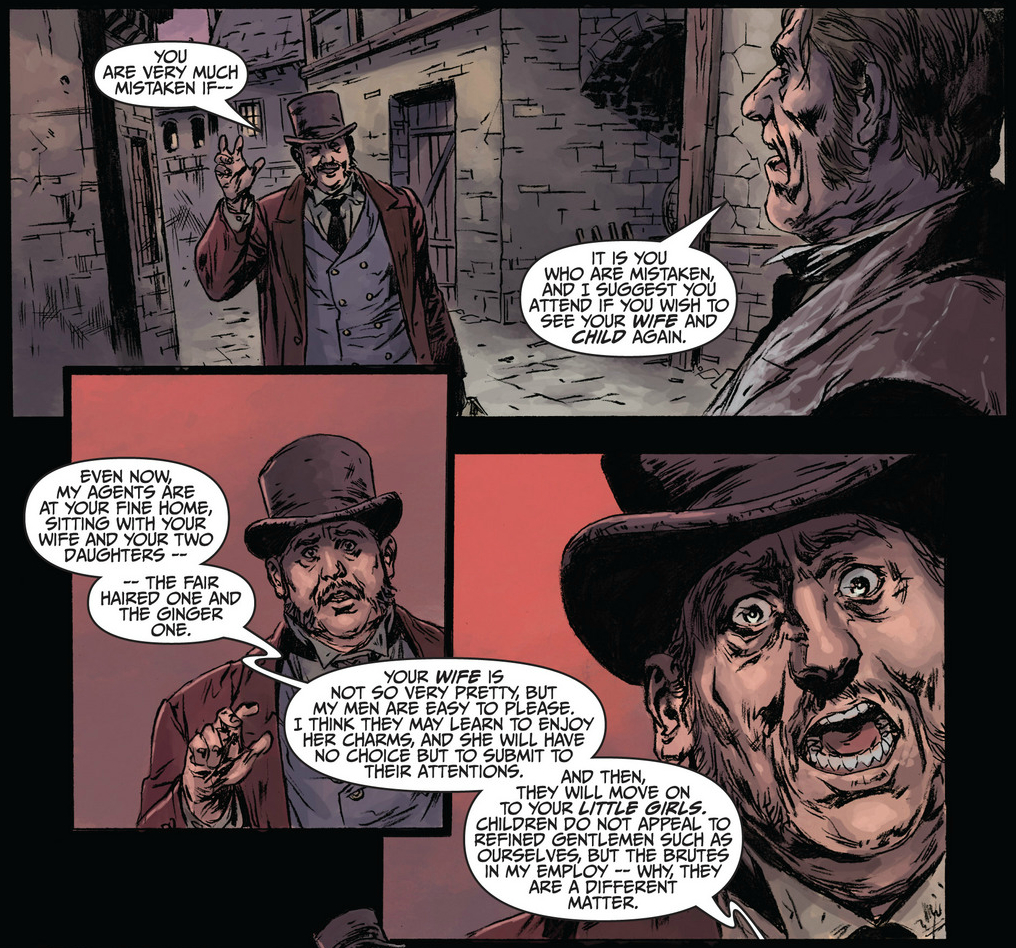
The tension in these panels is palpable, and I truly believed Moriarty was pulling that con off somehow even with it being logically impossible considering his situation and resources at the moment; if the rest of Moriarty’s writing was as on point, I’d be a happy camper, but here’s where he starts to get muddled. Moriarty’s clearly showing all the signs of being a full-on sociopath at this point, so why does he seem to care so much for Johana the barmaid? At first I just thought he was looking for sex or favors, but the concern he shows for Johana when she’s attacked and the honor he seems to take in fulfilling his promise to her both strike me as out of character for somebody as manipulative and callous as Moriarty. I just don’t buy it that he’d be so devoted to her so quickly, and I don’t believe he’d stick with her kid without getting anything in return. Moriarty’s supposed to be the Joker to Holmes’ Batman, right? Joker would’ve iced that kid in a heartbeat.
Then there’s his fighting skill. Moriarty takes down Baron Bombastus’s men (now there’s a name!) with ease, and while I guess I don’t see any reason why he couldn’t be able to, I don’t think it’s the best use of the character. I’d rather Liss stick to Moriarty’s smarts and cunning; by giving him both brains and brawn, Moriarty becomes so formidable that Liss has to resort to a man shooting electricity out of his hands to give him a challenge.
It’s just too much, and that’s my biggest gripe with Moriarty’s characterization. At first it was interesting trying to piece together all the disparate pieces of his personality — easily the most fun I had with this issue — but eventually I realized that these pieces didn’t fit together into a full, functional character, and there’s no joy in looking for an answer that doesn’t exist.
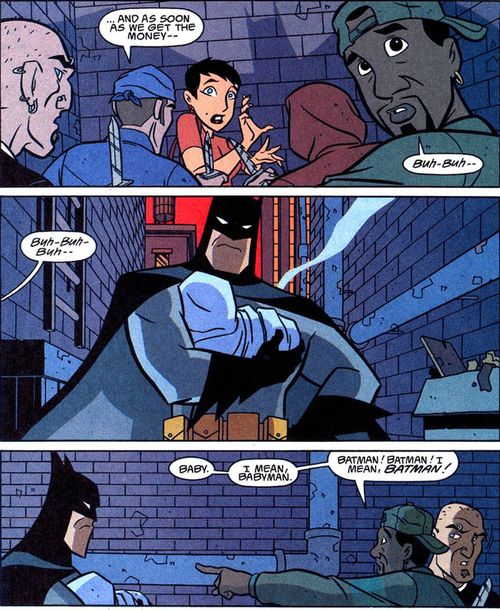
So Moriarty — the issue’s centerpiece — is kind of a mess, but how’s the rest of the story? Well, it’s more stable, but also much, much duller. I’ve seen the plot a billion times before — the unwelcoming town, the barmaid, the crimelord terrorizing the poor defenseless widow — it’s rote, and honestly, I could predict every beat pages before they came. Leaving Johana’s son in Moriarty’s care is even more cliche. Seriously, can we just retire the trope of the gruff loner/villain being forced to care for a child and growing and learning from the experience? The only time it really worked was that time Batman was forced to fight crime with a baby in his arms:
So, for all your die-hard Holmes fans out there who will continue to pick up this series no matter what, I hope you find something in here to latch onto. If any of you are on the fence about this series, though, I’m pretty sure you’d be better off looking elsewhere for your Sherlock Holmes fix; there’s, like, a gajillion different interpretations of the character out there, after all. I seem to remember The Great Mouse Detective being pretty good.

For a complete list of what we’re reading, head on over to our Pull List page. Whenever possible, buy your comics from your local mom and pop comic bookstore. If you want to rock digital copies, head on over to Comixology and download issues there. There’s no need to pirate, right?
 Retcon Punch
In researching the intro (I originally wanted to talk about the success of Frasier), I learned that Cheers actually had another spinoff: The Tortellis, which followed Carla’s ex-husband (and his second wife) to Las Vegas. It was cancelled after 13 episodes.