

Today, Drew and Spencer are discussing Ms. Marvel 1, originally released February 5th, 2014.

But what did he see in the clear stream below? His own image; no longer a dark, gray bird, ugly and disagreeable to look at, but a graceful and beautiful swan.
Hans Christian Andersen, The Ugly Duckling
Drew: We all know the story, but have you ever actually read Hans Christian Andersen’s original The Ugly Ducking? It’s beyond dark. Before he realizes he’s actually a swan, the ugly duckling has embraced suicide as his only escape from a life as an outcast. Even without that particular detail, the ending has always struck me as grim. The happy ending stems from the ugly duckling actually being classically beautiful, after all, not from any kind of acknowledgement that looks aren’t everything. This particular duckling happened to be a swan, but what of ducklings that are actually ugly? I guess those end up actually committing suicide. In spite of this straight-up “difference is awful (unless it happens to make you the same as someone else)” message, this story is treated as though it empowers different-looking children. Its contradiction is almost tragic. As I read through the letters column of Ms. Marvel 1, which praised the notion of a non-white heroine, I couldn’t help but feel that same tragic disconnect, as the heroine herself turns out to be, well, you can see for yourself after the jump.
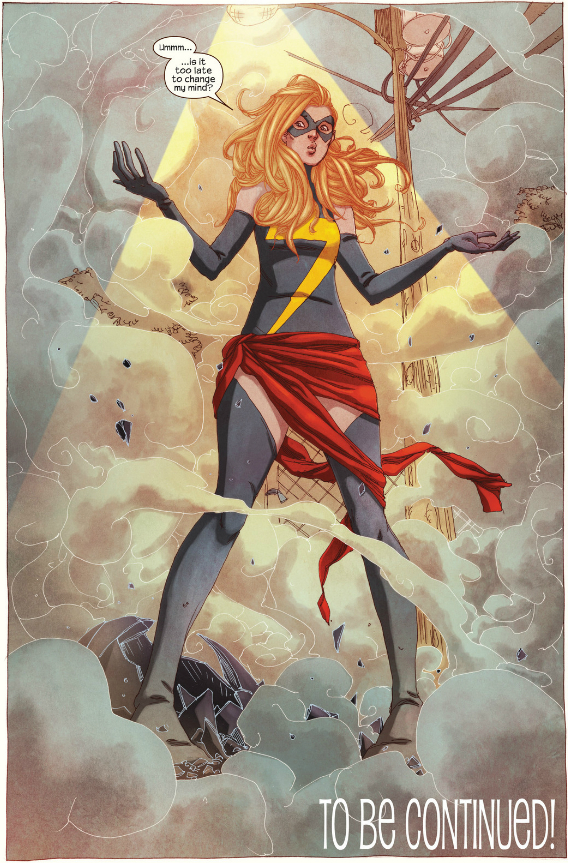
Now, I don’t want to mistake this issue’s conclusion for this series’ attitude towards beauty/difference/heroism — this is only the beginning of the story, and even here she seems to regret the wish to become Captain Marvel — but Kamala’s heroic manifestation as a white inhuman is a tad troubling. I also don’t want to mistake this appearance as permanent, as we’ve seen from All-New Marvel Now! Point One 1, Kamala looks a bit more like herself, and apparently has shape-shifting abilities. That is to say, I don’t think this series will be about a sad muslim girl who becomes a better person by becoming white, but I do think that having Kamala buy into that notion, however temporarily, lends strength to all of the detractors of this series who think heroes should be white.
Again, I appreciate that this is just the first step on a journey, and that Kamala’s story is likely going to be her learning to embrace who she is (as so many coming-of-age stories are), but it sure seemed like she was already at that point before she ended up in an inhuman cocoon.
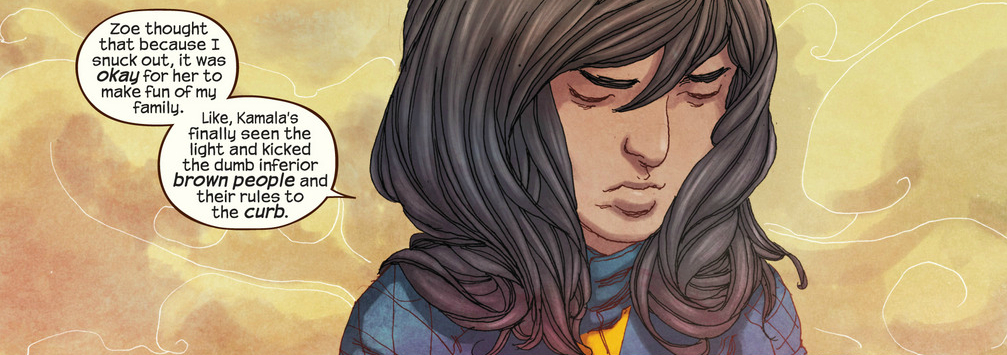
I understand that there are folks out there who believe that heroes should be tall, beautiful white people, and that some level of self-loathing might be realistic for somebody who isn’t those things, but I suppose my discomfort comes from that age-old question of how idealized we want our heroes to be. Is Superman doing the right thing more inspiring if he’s tempted to do the wrong thing first, or if he’s simply never tempted? Marvel has long been the place where heroes grow into their roles — ultimately, I think Kamala’s desire to look different is decidedly less immoral that Peter Parker’s decision to let that thief go free — which gives me confidence that this series will turn all of my concerns into assets.
That may be the most long-winded “I want to give this series room to grow before I come to any conclusions” I’ve ever written, but after coming down maybe a little too hard on the first issue of Punisher, I want to make sure I’m not rushing to judgement. That said, this issue trades in a lot of the same kinds of tropes and shorthands that frustrated me about Punisher 1. Kamala literally sneaks out of her window in order attend the jerk jock’s wild teen party, where she attempts to befriend the alpha bitch. It reads more like a remix of TV Tropes’ “Teenage Tropes” page than anything original, albeit with barbs about headscarves and halal meats in place of digs about trapper-keepers and whatever else kids insult each other about these days.
The rest of the story — Kamala is transformed by the Terrigen mist — is classic superhero origin, with the twist that Kamala herself is an Avengers obsessive. To me, that detail is actually more important than her religion or heritage — when she finally has her hallucinatory moment of clarity, it is not God or Muhammed that she sees, but a few of her favorite superheroes. She’s a fan first, which has the potential to make her more relatable to other fans, muslim or not. Unfortunately, I feel like that fanishness gets looked over in favor of looking at her ethnicity. Let me put it this way: there might be reasons a comic book fanfic writer might not be invited to a high school party that have nothing to do with their race or religion. Exploring those reasons might cut across the demographics of comic fandom, and might ring a bit more true. As it is, ethnicity is emphasized as the only reason Kamal can’t relate to the popular crowd, making me wonder exactly how many white fangirls Zoe Zimmer is friends with.
Wow. I guess my relationship to this issue is more complicated than I realized. I’m not entirely sure what I want out of it, but I’m also not entirely sure what it wants out of me. I think I have to stick around through the end of this first arc to really know how I feel, but if nothing else, this issue has made me think about a lot of subjects that don’t come up very often in the world of comics. That’s certainly something.

Spencer: True enough, Drew. Writer G. Willow Wilson is trying to do a lot of new and different things with Ms. Marvel, and I think that leaves a lot of room for us to be lenient with some of the more standard trappings of the issue. Yeah, Kamala sneaking out of the house and going to that party borrows liberally from just about every teenage-focused story out there, and yeah, Zoe and her meathead brigade are rather cliché archetypes, but the details surrounding these tropes are so out-of-the-ordinary that I’m not even bothered by them.
Specifically, Wilson’s handling of religion was the first aspect of this issue that impressed me. This story doesn’t read like a pamphlet on being Muslim, but at the same time, Kamala’s being Muslim isn’t some tiny aspect that’s largely brushed over; being Muslim is an important part of Kamala’s life, but it’s far from her only defining element. More importantly, the other Muslim characters don’t all necessarily share Kamala’s viewpoint towards their religion.
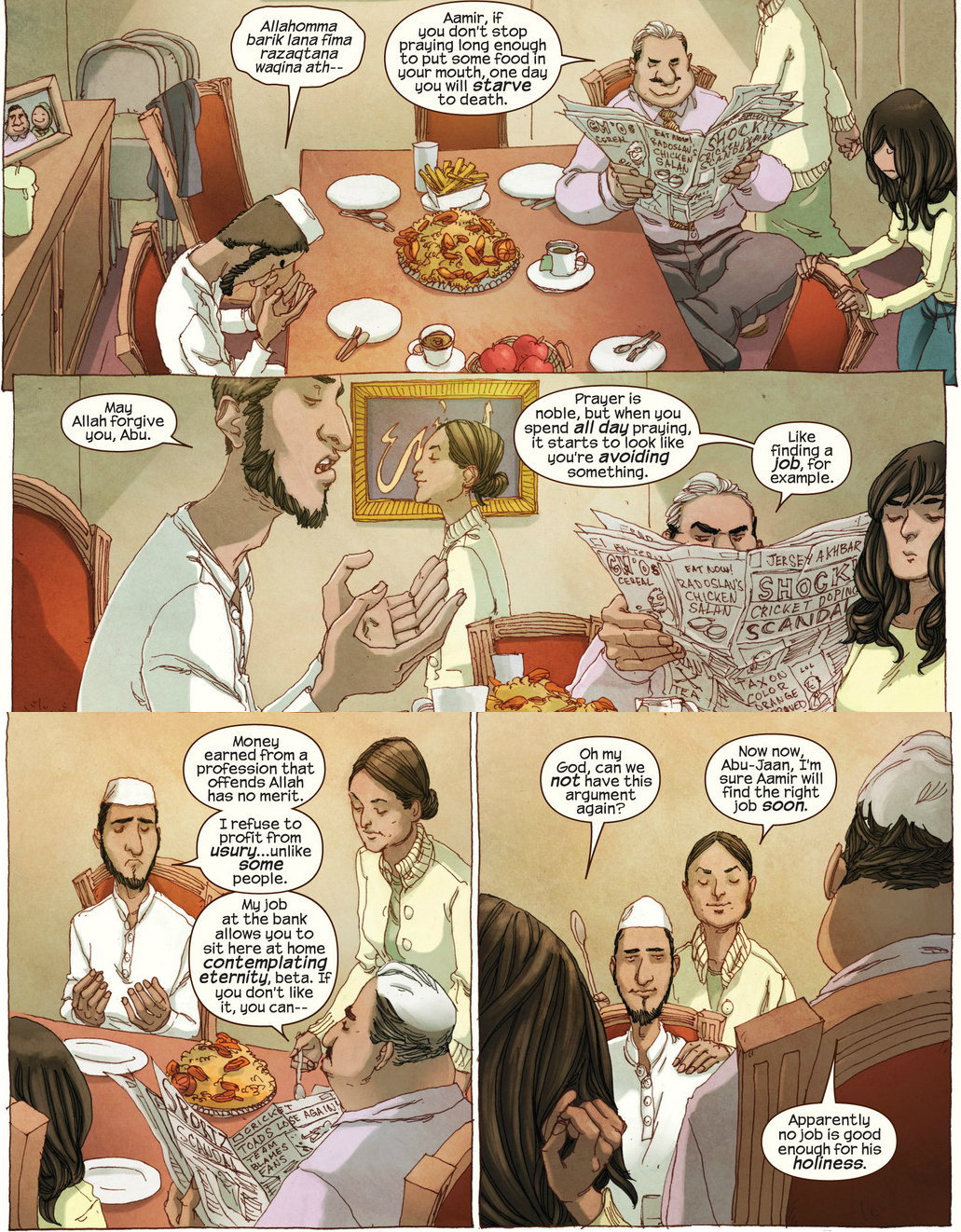
In fact, every Muslim character we see seems to practice their religion in a slightly different way, and that rings quite true to life; just because two people share the same religion doesn’t mean they’re going to feel exactly the same about it—even within the same family—and I’m sure that sort of divide and conflict over religion is something many of us can relate to.
I think that relatability is Ms. Marvel’s—and Kamala’s—greatest strength. After all, Kamala is also a superhero fangirl of the highest magnitude, and, let’s be honest, who among us can’t relate to a hero-worshipping, fan-fic writing, superhero-emblem wearing main character?
(Drew, you argued that Kamala’s religion seemed to overshadow her fannish tendencies when it came to her interactions with the popular crowd at school, but I can totally understand that. Being a geek isn’t as big of a sin as it used to be, while being Muslim is like wearing a giant target on your chest. Beyond that, while Kamala certainly isn’t trying to hide her love of superheroes, it still seems like a more personal detail about her, the kind of thing that just her best friend pokes fun of. If anything, Zoe’s crew doesn’t even seem to know Kamala well enough to know it’s something they could even make fun of her about, which is, in its own way, a telling detail.)
Still, what I admire the most about Wilson’s decision to make Kamala a superhero fan is, again, the specificity of it. In any sort of media targeted towards young adults there’s a tendency to avoid specificity so as to make a character or concept as generally relatable as possible; just look at Bella Swan, the bland protagonist of the unfortunately popular Twilight saga, who is clearly meant to be nothing more than an audience surrogate, or even look at a band like Linkin Park, whose lyrics are just vague enough and filled with just enough general “you’s” so as to make them applicable to literally any teenager’s angst. As much as I dislike this practice as an adult I’ve got to admit there’s certainly a place for it, but I feel like Kamala as a character gains a lot more strength from the specifics of her situation. Wilson has given us a full-fledged person instead of an archetype, but more importantly, she’s proven that she gets why we’re superhero fans instead of just assuming that having the hero be a superhero fan would be enough to hook us.
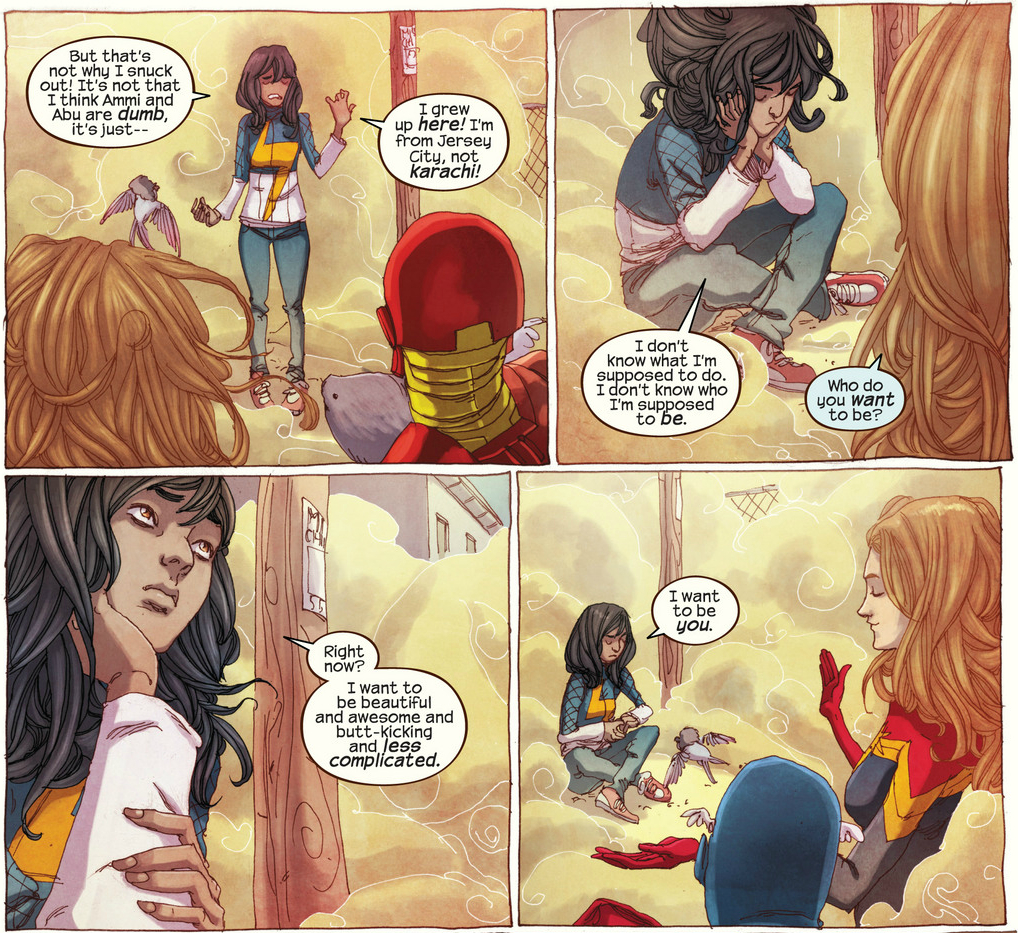
Like many young people, Kamala latches onto superheroes because they’re role models, they’re who she wants to be instead of who she’s stuck being, and man, do I sure relate to that. Honestly, what struck me most while reading this book is how much it felt like reading a story about myself. Yeah, sure, I was never a young Muslim girl, but I was a bullied kid from a strict religious family who found escape through the stories of these fantastic heroes who seemed like they were everything I wanted to be, everything I thought I could never be, so in that sense, yeah, I am Kamala, and I imagine many of the people reading this book are too, in one way or another.
Drew and I have both rambled on for a while now without mentioning the art, and that’s criminal. Adrian Alphona—assisted ably by Ian Herring on colors—fits the tone of this book perfectly with his cartoony, sketchy work. I’m not necessarily a fan of every decision he makes—for example, of how some of the character’s faces become crude when drawn from a distance—but Alphona’s handling of facial expression more than makes up for it, and I especially love how he’s not afraid to exaggerate a situation to play up the emotion behind it, such as the confrontation between Kamala and her father or even Kamala’s pitch-perfect indignant “marching off in a huff” routine.
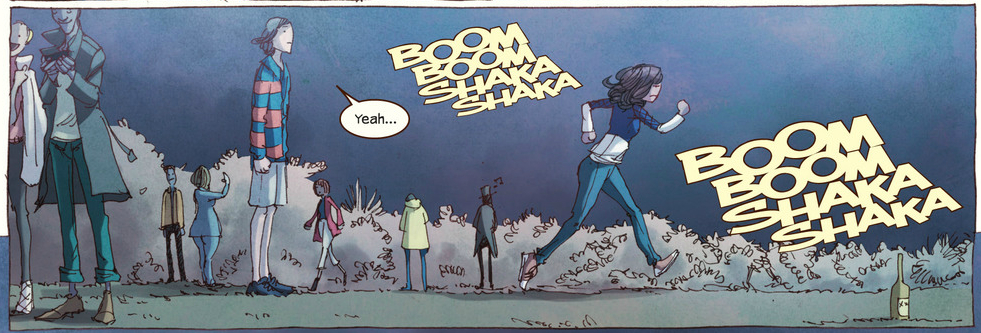
I find it interesting that Alphona’s work doesn’t really change in either of the two fantasy segments of this issue (Kamala’s fan fiction and her Terrigen-fueled hallucination). To me, that says that there’s an element of fantasy to all of Kamala’s story, not in the sense that what we’re reading isn’t real, but in the sense that Kamala’s transformation into Ms. Marvel is very much a wish fulfillment. Obviously Kamala is already facing a little “be careful what you wish for” kind of backlash, but from what I’ve seen in this first issue so far, I know the book will find a way to elevate Kamala’s development beyond that simple, tired concept.
Regardless, I’m beyond excited about the future of this book, and I am honestly just so grateful that it exists. Ms. Marvel is obviously an invaluable step in the right direction when it comes to giving both young girls and Muslim readers representation, but it’s also something that I feel almost any reader of comics should be able to find themselves in. When I first put this issue down I was grinning ear-to-ear, and I can already feel it starting to fill up the giant, gaping open wound that the cancellation of Young Avengers left in my heart.
For a complete list of what we’re reading, head on over to our Pull List page. Whenever possible, buy your comics from your local mom and pop comic bookstore. If you want to rock digital copies, head on over to Comixology and download issues there. There’s no need to pirate, right?
 Retcon Punch
Thinking over the way Kamala’s religion is brought up, my problem may less be with the scope of this series, and more with the fact that teenagers tend to have pretty low-stakes problems. She can’t eat bacon, can’t drink, and can’t attend parties put on by highschool assholes. Those are genuine issues for a teenager, but prompt an emphatic “get over it” from me. Am I just too old and bitter to get teenage characters?
Grrr… not every book has to be about saving the planet. The fact that stakes are so high in so many books is part of what has been ruining a lot of good story telling in comics.
I am very invested in the low stakes of this series because I like Kamala a lot and want to see her happy. So large or small her problems matter to me because she matters to me. It is the same reason I am so into Daredevil even though he is not saving the planet from destruction. His saving Foggie’s trust in him is epic enough for me.
This book did a great job bringing in a new character, it did everything right. I get a sense of her goals, her fears, the obstacles in her life, the things she draws strength from and what her world is like. That is a perfect first issue in terms of what it needs to bring to the table for me. I want more of the world because I care about the folks in it (personally I like the corner store worker a lot seems like a sweet guy.)
Rant time: Now I understand that this might be my personal view of narrative but I don’t understand how folks (looking at you Drew 😛 though there are many these days) who can enjoy the start of series by writers like Hickman who are all posturing and stakes with little else… no character understanding little real sense of the setting, no real insight into the fears or hopes of any of the people. East of West and Pretty Deadly being perfect examples of this. Books based on nothing but a promise of what might be good just don’t do it for me. It is like watching a magician fumble for time while trying to find the deck of cards for a trick they promise is very cool. End of rant
Yah I really liked this book, granted I am a sucker for young team or young hero books since they tend to have more humor, heart, and character growth. I thought the art was a perfect fit for the tone of the story and I really hope they can keep these two paired up for a good long time since both are doing some very good story telling.
Also there is an adorable stuffed sloth in this book. WIN!!!!!!
When I complain about “low stakes,” I don’t mean that I need her to face problems that mean something in the universe, just that I need her to face problems that mean something in life. Maybe I’m out of touch, but I think someone not fitting in at high school is pedestrian to the point of being universal. Nobody fits in in high school. What’s next, a story where the main character struggles with the fact that they need to breathe air?
Seriously, my problem isn’t that she isn’t punching out Thanos, it’s that there isn’t enough specific here to make me more interested in her story than any of the kids on Glee (or whatever teen show people watch these days). I maybe need to admit that I tend to hate dramatizing the lives of teenagers because it feeds in to the notion that the stupid stuff they make big deals about are worth making big deals about. As someone who spends so much time around teens, I really wish there was a teen role-model who was explicitly above petty dramas. As an adult, I can’t bring myself to care if so-and-so gets to go the the big party or whatever.
You understand that Teenagers have no frame of reference. You and more so me and more so my parents have years of being able to weigh experience against situations as well as the ability to see that what we feel/are going through now is not the only state that will ever be in. We know and understand that things shall pass and new good and bad will fill our future.
Teens not so much. You are right that no one really fits in and most kids will get picked on for something usually what ever is the easiest to point out. For you Drew I am sure the kids picked on you for having a beard in grade school.
This story works just fine for me but I love spidy who had the same issues to over come.
Oh, I totally understand, but I can’t really sustain my empathy for a problem that I think is totally petty. Just because the character cares about it doesn’t mean I can. Like, I would have even less patience for a story about a four-year-old who’s upset that she’s not getting the cookie that she wanted. I appreciate that it would be a big deal to her, but that doesn’t make it a big deal to me.
I’m right with you. I’ve de-Hickmanned my pull list and I’m only getting Manhattan Projects by him these days. This is for the exact reason you’ve mentioned; HUGE events, characters be damned. I read Avengers for 25 issues and I still didn’t really know anything about most of them. Manhattan Projects is huge, but is all about these fictional recreations of real people.
This felt like school to me. Not my school (I’m too old to remember any of that stuff, thank god), but the school I teach at. I feel Drew’s “Get over it!” attitude, but you can’t change what matters to 15 year old kids. The need for acceptance, the desire to be the cool kid, the desire to at least be looked at by the cool kid when not hanging upside down from a locker, getting to go to a party you’re not supposed to. . . That’s actually what matters. That’s what makes being a teen in America so great and such a fucking waste at the same time.
I liked Kamala. I liked the convenience store kid. I liked that she wanted to be like a super hero and that all she knew was big and blonde and wearing skimpy clothes and IMMEDIATELY knew something was wrong.
I thought this was way up there as far as first books go. Were there cliches? Oh, yeah, all over the place. But high school is full of them. It’s full of people who don’t know how to be people yet and are strongly influenced by tv and each other. I know, I just got done teaching the star of the basketball team, 2 cheerleaders, a band nerd, a fat honors kid, 2 comic nerds (just loaned one of them Planet Hulk, the other Secret Wars), a girl on the dance team who is trying not to be associated with them, about 180 slackers, and a kid who just got dumped by his girlfriend and turned his calculus homework into a giant demon face.
You might be, Drew? I wouldn’t hold it against you, but just from reading these threads I can see that you understand why teenagers react a certain way, you just can’t buy into it as an adult anymore, which is perfectly acceptable.
Thing is, I REALLY hope readers who are actually close to Kamala in age are picking up and reading this book. Maybe they won’t get that “above it all” role-model you’re searching for, Drew, but I’m sure they’ll all get somebody they can relate to in one way or another. Comics used to be a childrens’ medium in the first place, and while I’m grateful for the maturation of the genre, there just aren’t enough book for younger readers anymore, and this could fill that niche perfectly.
I still think there’s plenty for adults to enjoy in this book as well (as both my reaction and some of the comments can testify to), but it may be worthwhile to keep in mind that we aren’t necessarily the book’s target audience.
And Drew, you and me always get thrown together on these teen books specifically to see sparks fly, don’t we? We’re about as far apart on the spectrum as possible relating to our enjoyment of and reactions to teenage heroes haha.
Apparently, the nexus of teen books and first issues is a sure bet for me to be unhappy. Your reaction (and that of the commentariat) to both this issue and Punisher 1 makes me think that my assessment of first issues may be a little out-of-whack. Here’s hoping She Hulk 1 agrees more with me today!
I’m cautiously optimistic. Drew, I definitely understand where you’re coming from with your Ugly Duckling comparison; as a kid, my favorite Disney movie was The Little Mermaid, but even as a child I never liked that Ariel had to change herself to be with her prince. Of course, then it was because I couldn’t imagine why you would not want to be a mermaid. I’m hopeful, though, that after her stint as the classic Ms. Marvel (which she very specifically requested to be), she’ll realize she should just be a superpowered version of herself. I was never a Muslim teen, but I was definitely a teen girl, and it takes a very long time to become comfortable with who and what you are. As in, I have only really figured it out in the last few years, and I’ve been a grown-ass adult for quite some time.
My hopes are that this series is about exactly that: Kamala coming to accept who she is. It won’t be particularly ground-breaking (and may still suffer from that Ugly Duckling-itis in suggesting that a Muslim girl would need superpowers in order to accept who she is), but it could be a charming take on an old story.