
 Look, there are a lot of comics out there. Too many. We can never hope to have in-depth conversations about all of them. But, we sure can round up some of the more noteworthy titles we didn’t get around to from the week. Today, Drew and Patrick discuss Manhattan Projects 18, Deadpool 24, Batman/Superman 8, Tomb Raider 1, Fantastic Four 1, All-Star Western 28, Daredevil: Road Warrior Infinite Comic 1, and Guardians of the Galaxy 12.
 Drew: I love tvtropes.org. Its snarky tone is a great salve when you’re identifying lazy stereotypes or tired scenarios in whatever you’re reading (which I’ve been doing a bit recently), but I also respect it as a catalogue for those tropes. Without that site, I would have never put a name to The Worf Effect (when a villain is proven a physical threat by making short work of a known physical threat), which means I wouldn’t have been able to so specifically identify what is going on in Manhattan Projects 18. Feynman and Einsteins alien Frankenstein might not exactly fit the definition of a “known” threat, but by the end of the first page, there’s no real doubt what he might be capable of. That Westmooreland then takes him down (adding the creature’s ear to his necklace) cements the general as perhaps the biggest threat the Projects have faced. That Groves then forms a partnership with Westmoreland feels a bit like a deal with the devil, but is quickly trumped by Einstein’s partnership with Oppenheimer.
The action is as effervescently gory as ever, as Nick Pitarra predictably delights in the violent battle between Westmoreland and the monster (which runs through just about every fight scene cliche you can think of). Those scenes are leavened further by the surfer affect Jonathan Hickman gives the creature. The truly insane ideas only kick back in at the end, which leaves us on a “Who shot JR”-level cliffhanger.
Would that I could transition this Alien-inspired issue to Deadpool 24, but alas, it seems Brian Posehn and Gerry Duggan used up all of their Alien jokes in issue 23. Instead, they move the action into the metaphysical realm, as Wade finally sits down to unload Agent Preston’s brain to her new LMD body. Something predictably goes awry, forcing Wade and Preston (and Dr. Strange, Michael, and Ghost-Ben Franklin) deeper into Wade’s subconscious, examining exactly how uncomfortable he is with the idea of being alone. It’s a tricky balancing act keeping that premise from becoming too on-the-nose, but Posehn and Duggan are more than up to the task, giving Wade a heroic moment of sacrifice that feels totally earned. It’s a fantastic return to form for this series.
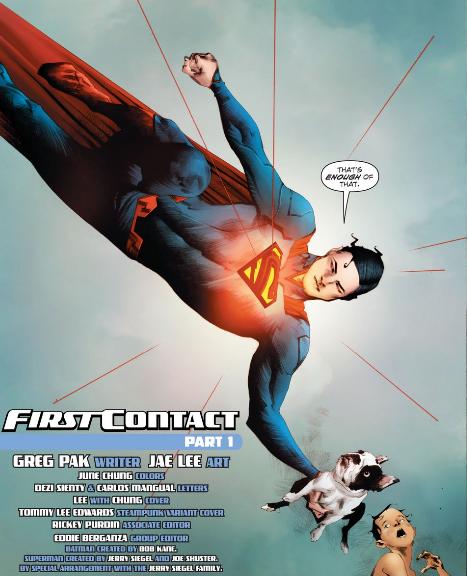
In another return to form, Jae Lee returns with Batman/Sumerman 8, bringing with him the heart and scope that made the first arc so memorable. Clark and Bruce have traded in their Earth-2 counterparts for their Earth-2 sidekicks, but that still leaves plenty of room to examine how these characters can (or even should) interact. Any reservations I had about even acknowledging the existence of Worlds’ Finest are silenced by Greg Pak’s deft handle on each character’s voice. I seem to have a rather extreme love/hate relationship with this series, but this issue swings me rather firmly back to love. Patrick, am I just setting myself up to get burned again? Is it just that I can’t say no to some pretty art?
Patrick: It’s definitely not just the art, but, man oh man, does it feel good to have Jae Lee on this title again. It’s strange, the issue largely amounts to yet another trope, that of the heroes fighting for manufactured reasons. The thing is, it totally works, partially because Pak has such a keen grasp on what makes Batman and Superman so different from each other. I love seeing them both engage in the kind of heroics they’re traditionally associated with while their Earth-2 sidekicks tag along. For Bruce, that means going undercover as his non-alter-ego to uncover some information, and for Clark, that means punching in space. IN SPPPPAAAACCCEEE! Also helping things is that Jae Lee seems to have developed a sense of humor, so his most impressive pages don’t have to be pigeonholed as ornate meditations on despair. I mean, look at Supes saving this ugly dog!
I picked up the first issue of Gail Simone and Nicolas Daniel Selma’s Tomb Raider series, largely out of loyalty to Simone, but also because I’m tangentially interested in the on-going adventures of the video game icon. I literally downloaded the new Tomb Raider game this evening (free on PSN+ right now, if you’ve got it), so I feel woefully under-equipped to evaluate the state of Lara Croft as presented in this issue. There’s a good amount of PTSD and survivor’s guilt explored in issue 1, which puts Simone in a pretty comfortable place — that’s basically Batgirl’s bread and butter right there. Without knowing exactly what Lara goes through during the events of the game, and therefore without knowing what trauma she’s responding to, some of the action comes off as mopey and heavy handed. There is a fantastic dream sequence at the beginning that finds Lara confronted by the animated corpses of the friends she lost on the island, and I was actually kind of disappointed when she woke up and went about having new adventures. Simone’s at her strongest addressing these psychological issues head on, but I can’t fault her for wanting to inject some WTF action into the proceedings as well. Tell you what: I’ll play the game between now and the time issue 2 comes out, and we’ll re-evaluate the whole endeavor then.
Dude, does it seem weird that the new Fantastic Four series would start with a story arc called “The Fall of The Fantastic Four?” James Robinson and Leonard Kirk take the issue to reintroduce readers to the “normal” of the First Family of the Marvel Universe. That means they’re fighting Fin Fang Foom, looking after the Future Foundation, and generally picking up their surreal lives where they left off before they disappeared from the space-time continuum. Any of the levity inherent in that is undercut by Sue Storm’s journal entry, which bookends the piece and bemoans the non-specific downfall of the Fantastic Four. It makes for something of a tonally inconsistent ride. In fact, tonal inconsistency is the most consistent thing in the issue — example: I can never tell how seriously I’m supposed to take a conversation about Fin Fang Foom’s molecular biology. Like… is he a ridiculous man-dragon or a sci-fi concept we need to take seriously? Drew, how’d the tone of this one sit with you?
Drew: You’re right about the tonal whiplash — this issue is bookended with sorrow and tragedy, but the meat of it is madcap fun — but I actually liked that fun enough to excuse whatever shortcomings the issue might have. Having never read a Fantastic Four comic before Marvel Now, I’ve actually never had the pleasure of seeing the Fantastic Four in their element, defending New York with a mix of science, force-fields, fire, and punching. James Robinson has a firm handle on that brand of action, which only makes me lament that this issue effectively ends with everything changing forever. Robinson also demonstrates a firm handle on the characters, so my interest here may weather the storm, but it seems almost cruel to tease us with throwback fun only to immediately take it away.
Over in All-Star Western 28, Jonah is making a slow recovery from his motorcycle accident last month. Of course, that extra time is mostly elided to explain away how he was able to fully recover from reconstructive plastic surgery, but it also affords us time to focus on Gina a bit. Unfortunately, there’s not much there, and even Gina’s moment of strength when confronted by her father is undercut by its own genericness. And then undercut once more when she later opts to never see her father (or anyone else she cares about) ever again. Oh right: Booster appears out of nowhere to send Hex back, and Gina volunteers to go with him. Booster is a bit incredulous at the thought of sending someone back to the 1880s on a whim, which is mostly borne out by Gina’s utter uselessness when they arrive. It’s more a place-setting issue than anything, more notable for being the first issue of this series to feature no art from Moritat than for anything that happens here.
Hey, speaking of art, Daredevil: Road Warrior 1 may very well be the first infinite comic I’ve read that has made me appreciate the medium’s unique capacity to change little details within an image. I usually see that effect used to show somebody shaking their head or moving an arm, but it always required the rest of the image to stand artificially still, and robbed the action of the gutter — the single-most important syntactical element of comics. Here, Peter Krause finds innovative ways to show how Matt experiences the world, either by building a scene from the radar sense visualization, or having heartbeats pop in as they become important, creating effects that simply aren’t possible on the page. Mark Waid has always been interested in conveying Matt’s enhanced senses, which makes the breaking of new ground here extra impressive. The quality of this issue is as high as the rest of Waid’s run, which makes these infinites downright irresistible to me. Were you as charmed by this as I was, Patrick?
Patrick: Oh, absolutely. Waid has been so good about making his Daredevil about Matt’s perspective in a very literal way, so it’s refreshing to see him and Krause figuring out how to use this whole new set of tools to express that. I know you and I have talked about the experiential nature of infinite comics before, and I shouldn’t be surprised that we’re both able to enjoy the experiment when it has so many of our favorite elements from one of our favorite comic series built right into it.
But I’m also digging just how unpredictable the story is. Kristin mentions at one point that she knows Matt wanted this to be a road trip, but that’s impractical. She’s talking to readers there. “Road Warrior” obviously summons the image of Daredevil stomping around the country, fighting whatever crime they encounter, but the set-up here allows for a more focused story. A mystery, specifically: what the deal with this super strong dude with no heart? Rather than being four issues of infinite filler, it looks like we’ve got a full-fledged arc to sink our teeth into. Plus, what can I say, I like seeing Milwaukee’s Mitchell International airport on the page (they fly to Canada, that counts as “International”).
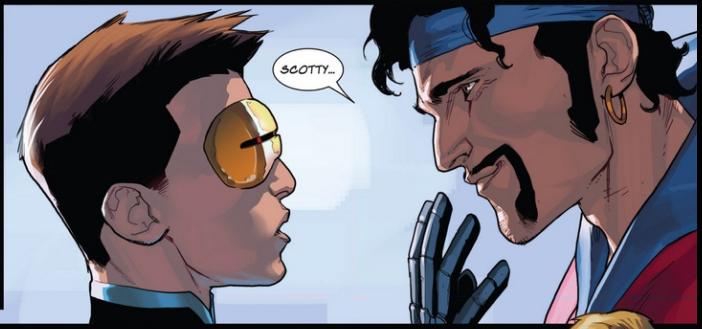
Oh, and speaking of things being a little bit different than I expected, Guardians of the Galaxy 12 ends up feeling more like an issue of All-New X-Men than anything else. Sure, we bounce around the Galaxy and get the perspectives of J’son and some action on the Shi’ar homeworld, but the emotional center of this issue is still the time-displaced Jean Grey and Scott Summers. Stuart Immonen draws all the X-Men stuff and his patience and commitment to character work pays off tremendously when depicting the reunion of Cyclops with his father. There are double hurdles here: the first being that no one really has this experience to draw from (time travel + outer space reunion = ????) and the second being that damn visor covering Scott’s eyes. But Immonen still finds a way to make the moment feel at once special and awkward, so we’re right with Scott when it triggers a fresh existential crisis.
The conversation doesn’t stop there, because you certainly read something that we didn’t. What do you wanna talk about from this week?
 Retcon Punch
I liked Fantastic Four #1. Your assessment was very similar to mine – how serious is this? Fin Fang Foom is SO ridiculous on the surface, but apparently this is the type of comic where EVERYTHING CHANGES. Very Dan Slott like. I’ll pick up the next one.
Side note: As a Marvel comic reader, I feel like I *should* read Fantastic Four. I don’t have a great reason for it, but it feels like the type of thing I should be conversant in. I’m currently not aware of much with them, so maybe this will be interesting. I didn’t like Fractions run on it at all, and FF got a little too cutesy for me at the end, so I’ve got some high hopes here.
All Star Western was a bit cliched, but I really, really enjoyed the Hex in modern times story line. It’s made me appreciate Western and other style comics a bit more and I’m a bit of a Hex fan these days. That’s new for me. I’ll stick with this one as long as they keep coming up with stories that are entertaining, and they hit the right note for me over 80% of the time.
Other modern stuff hasn’t caught my eye a ton lately. I actually just finished collecting the Web of Spider-Man series (1-129.1) and am reading that, Spectacular Spider-Man (starting at 100) and Amazing Spider-Man (starting at about 260) concurrently, recreating the experience of reading these as they came out back in the ’80s. I have most of Spectacular and a good chunk of Amazing (what I don’t have I have on a compilation disc), so this will be a fun experience. I’ll pick up storylines that interest me as I read but I’m enjoying it quite a bit. Comics were definitely different then and I’m amazed at some of the goofiness in the Spider-Man titles. (Spider-Man, Toad, Frog-Man, and Spider-Kid team up in the last ASM I read. Completely nuts.)
I totally know what you mean about Fantastic Four — I feel like I’m obliged to like them, even though I’ve never read an issue that I loved. Maybe I just need to dig into the classic Lee/Kirby stuff? I get the sense that the action in this issue was pure throwback, but it totally worked for me. For me, this is one of the big bummers of the drive for everything needing to be paradigm shiftingly-new (which I’m generally a fan of) — I’ll never get to read just a straight-ahead issue of Fantastic Four as it’s published.