
 Today, Shelby and Spencer are discussing Black Widow 4, originally released March 12th, 2014.
 Shelby: I have a friend who’s having a frustrating time at work. Her department and position is currently transitioning to something different, so until everything is finalized she’s working two different positions. I can see how, from a management perspective, that would be the perceived best way to transition someone into a new job. For her, though, it just means she’s two jobs to do instead of one, and instead of focusing on one or the other she has to half-ass both. I think one of the toughest things about managing a company is avoiding situations like my friend’s. You have to be able to manage your people in such a way that they are able to do their tasks to the best of their abilities. It’s important to diversify and grow the skills of your employees, but not at the cost of prohibiting them from doing their actual job, especially if that job is being one of the world’s greatest spies.
This series has so far been a lot of, “When Natasha Romanoff isn’t an Avenger…” stories, but in this issue she is. On a routine (read: boring) mission for S.H.I.E.L.D., she tries to plant bugs to spy on an embassy when BOOM.
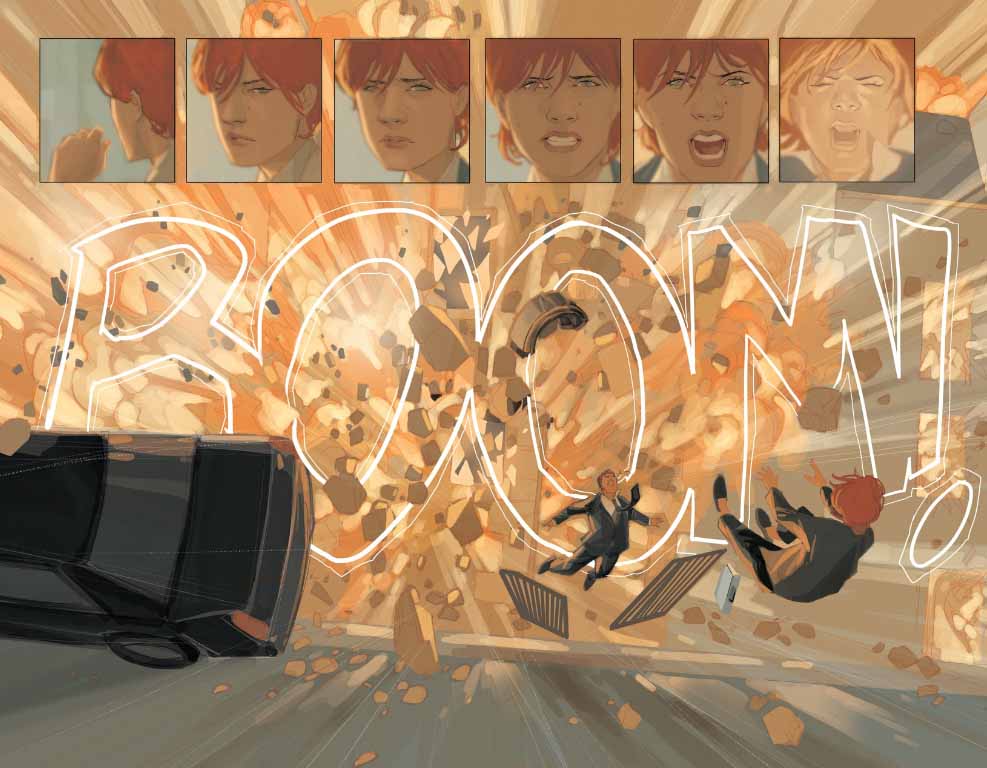
Natasha chases the perp across the rooftops, but he punches a hole in a roof, causing her to fall through and lose him. She does some spy stuff and learns that, rather than a terrorist act, the explosion was a heavy-handed hit on one man, and there will be another in Cape Town, South Africa. There, she gets into a fire fight with Molot Borga, the Hammer of God, who wields a machine gun and not one, but TWO grenade launchers. She can’t compete against that kind of firepower, and Molot kills his target and escapes. Natasha switches into full on spy mode to track this guy down.
I think Nathan Edmondson was really smart with the structure of this title so far. The first three issues of Black Widow were little one-off adventures to give us a feel for who this woman is and how she operates. We know she works for S.H.I.E.L.D., we know she does “humanitarian” spy/assassination work on the side, and we know she is an incredibly solitary individual. With that character baseline firmly established, Edmondson starts us on an arc to explore Natasha’s role with the Avengers. He’s delving into what exactly it is that makes her necessary for the team as a non-super-powered hero, which I think is fascinating. The problem with team books, I’ve always found, is explaining the presence of the token “regular people.” Batman doesn’t have any powers, and yet he stands equally with Wonder Woman and Superman, two of the most powerful beings on Earth; how do you make sense of that? Likewise, as Natasha faces Molot on the streets of Cape Town, she points out that this is not her purview because she is not the super-powered action star. She is a spy; she sneaks around and finds out what she needs to take people out quietly in the background before anyone even knows they’re gone. Molot Borga is not a man to go down quietly, however.
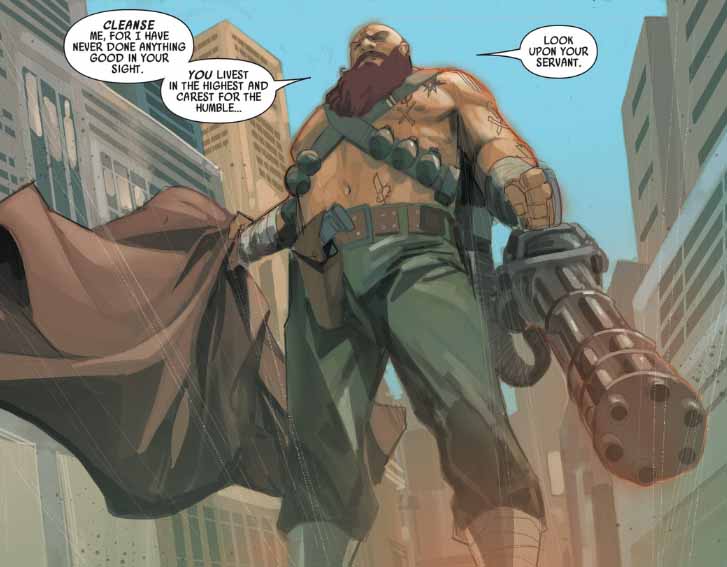
I am super intrigued by this guy already. He believes he is doing the work of God, a belief stoked by the mysterious figure who sends him on his hits. I love that, in theory, he SHOULD operate like Natasha; he’s a hitman, he should be sneaking through the shadows killing people and disappearing without a trace. But he lives up to his name as the Hammer of God; there’s nothing subtle about a sledgehammer, it’s not exactly a precision instrument.
As usual, Phil Noto delivers beautiful work in this book. The character design of Molot is fantastic; he’s a mountain of a man, covered in what I assume are Russian prison tattoos, including an Orthodox Cross tattoo’d on his forehead. There’s also a lot of superb acting in this issue. Look back at that first splash I posted with the embassy explosion. We see the exact moment Natasha figures out what’s going on while at the same time her face is illuminated by the explosion as it happens. It’s such a neat depiction of time; the whole spread takes place in the time it takes her to turn her head, but he breaks it down so we can feel the milliseconds of that moment. My absolute favorite panel, though, is near the end of the book as Natasha tells Maria Hill she needs to go into full-on spy mode.
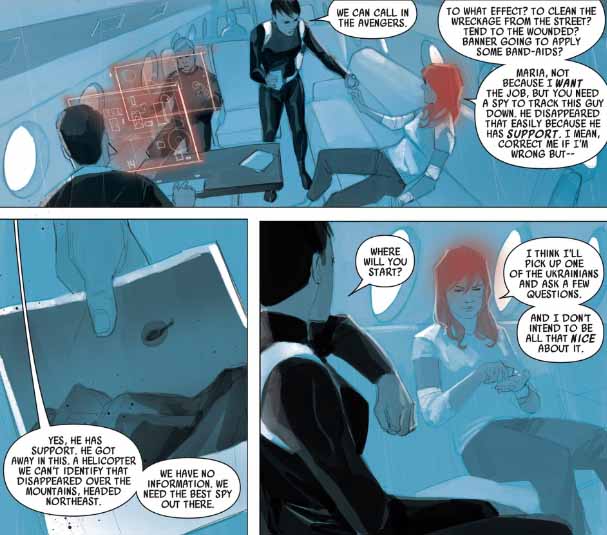 The blue wash of the plane’s interior would be enough to make this a beautiful image, but that’s not enough for Noto. No no, he’s got to make Natasha’s hair glow in the dim light, giving her a soft halo. It’s gorgeous, and it calls back to the cover of the book, which features Natasha with an actual halo (or possibly target) around her head, while Molot gives a blessing in the background. I’m glad Edmondson took the time he did to establish Natasha and her world, and now I can’t wait to dive into it. Spencer, what did you think of this issue? Do you have any idea who Molot’s mysterious boss is? It seemed like maybe we were supposed to recognize him…
 Spencer: Maybe we were supposed to recognize him (or her!), but I didn’t, although I’ll be the first to admit that I don’t quite have an encyclopedic knowledge of Marvel comics the way I do DC. I am quite intrigued by this mysterious figure, though. Most mysterious figures are purposely left as ciphers with nondescript dialogue, but this one is already showing some actual personality.
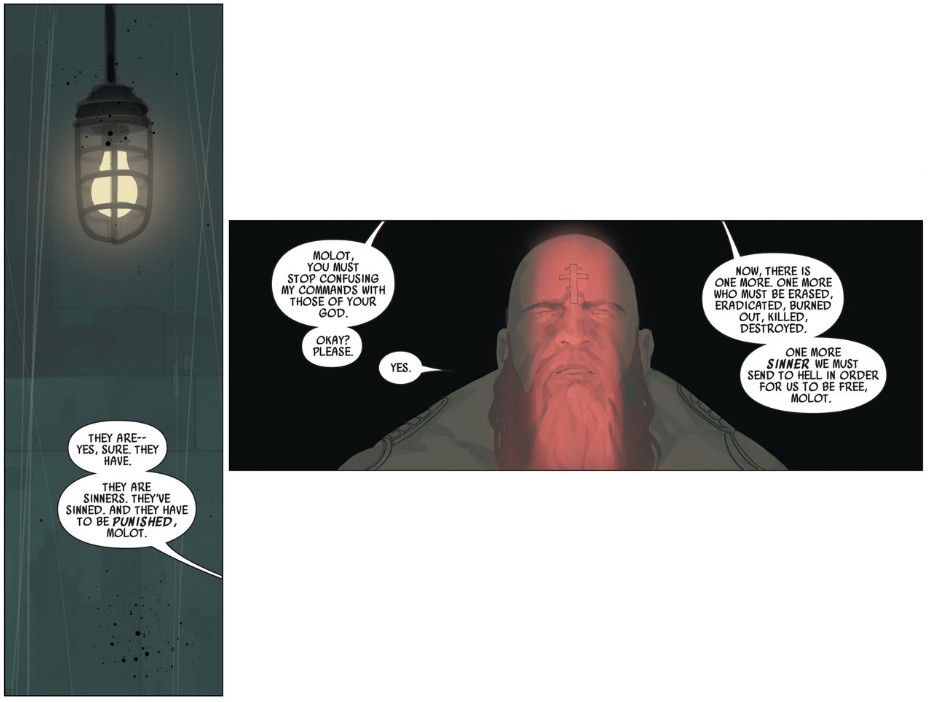 I love how visibly frustrated he gets over Molot’s religious convictions/delusions, yet this mysterious figure doesn’t hesitate to use them to play Molot like a fiddle. There’s a lot of personality in his voice, from the way he trips over his words when he gets frustrated at Molot to the vicious, repetitious wording he uses when speaking of his enemies. Just from a few lines of dialogue we can already tell that this character is cunning and ruthless, but not without his quirks. I don’t have any inkling who this actually is hiding in the shadows, but I can’t wait to find out.
Anyway Shelby, I’m pretty happy with this issue as well. I admit that it threw me a bit at first; as you mentioned, it completely upends the formula established by the first three issues. That’s not necessarily a bad thing, but it is a little strange that there’s no signs of Widow’s assistant or the cat or even of the theme of loneliness that were all so prominent in those issues. Fortunately, Natasha is a dynamic enough character that she’s still interesting and recognizable even when viewed from this entirely different angle.
There’s a lot we can learn about Natasha by comparing and contrasting how she handles this S.H.I.E.L.D. mission to how she handles a personal one, actually. In those first three issues we saw Natasha take on missions that went perfectly according to plan, that went horribly wrong, and that were much more morally complicated than she expected, but despite it all, Natasha always seemed engaged and focused. In this issue, though, at first she’s complaining of boredom and the low pay and about how complicated S.H.I.E.L.D.’s red tape can be, and then after Molot shows up she complains about how her skills are being misused. There’s a dissatisfaction coming across in her narration that’s unusual for the character, and it makes me wonder why Natasha works for S.H.I.E.L.D. at all.
Perhaps the answer lies in Widow’s statement that “they’re better than the other direct-action, covert-intel bureaucracies.” I suppose this could just mean that S.H.I.E.L.D. is the easiest paycheck, but I’d prefer to think that it means that S.H.I.E.L.D.’s goals and morality align with Natasha’s, and that she’ll put up with the tedium and crummy pay if it means getting to do some good in the world.
Still, I think what interests me most about getting to see Natasha take on a S.H.I.E.L.D. mission is the opportunity to see more of her spy skills in action. Sure we’ve seen Black Widow use plenty of subterfuge so far in this book, but it’s been a little light on actual intelligence gathering. I’ll admit it can be a challenge to make this entertaining to read, but it can certainly be done; one of my favorite Black Widow moments of all time comes from the Avengers movie, where she manages to interrogate Loki without him even realizing it. Edmondson is off to a good start with Widow’s fancy fly-camera (the dissolution of which Noto lovingly renders in all its disgusting glory), but I’m pretty excited about the possibility of seeing more mind games from Natasha. Show us what she’s capable of, Edmondson!
As always, Phil Noto proves himself to be a real life superhero with his artwork on this book. Shelby’s already pointed out how perfect his acting and color work is, but I was most impressed by the action. The scene where Natasha chases Molot is exhilarating; I could feel every painful action she took, and including some of the more tedious parts of the chase, such as Natasha pulling herself up windowsills and over ledges, helps to make the chase feel more real, more physical. The scene later on where Widow and Molot finally face off is just as exciting; the shootout is well staged, and some of the panels show off a wonderfully cinematic flare.
 That low angle with the spent cartridges falling towards the camera is one of the most interesting panels I’ve seen in a while — it’s like something out of a Western! — and the close-up of her reloading is a perfect way to say without words that Natasha means business, which makes it all the more jarring when Molot then takes her shots without flinching and sends her flying.
As much as I love the art, I’m equally impressed by the sound effects (I’m assuming they’re done by the letterer, who is credited as VC’s Clayton Cowles, but please correct me if I’m wrong). Sound effects are something I tend to glaze over at their best and that actively take me out of the story at their worst, but there’s something special about the effects this issue.
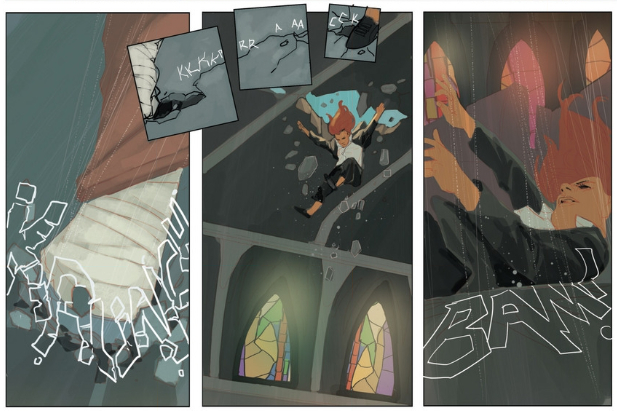 Instead of using effects that look like clip-art or something out of Batman 66, Cowles incorporates them into the action. Molot’s punch actually shatters the effect in that first panel, and in the third Natasha flattens the words beneath her as she hits the ground. The thin font of the effects matches with the muzzle-flash of gunfire, helping them feel organic to the ongoing action. There was obviously a lot of thought put into these effects — as there seems to be with every facet of this book — and I appreciate that.
This issue may be a change of pace from what came before, but it’s just as exciting and gorgeous as ever. Natasha may be bored, but I’m sure not.
For a complete list of what we’re reading, head on over to our Pull List page. Whenever possible, buy your comics from your local mom and pop comic bookstore. If you want to rock digital copies, head on over to Comixology and download issues there. There’s no need to pirate, right?
 Retcon Punch
The sound effects are marvelously handled in this issue, Spencer, you’re right. I never know who to attribute those to either. When I see it in Mateus Santoluoco’s work, I think that’s him drawing the SFX right in the panel. But, you know, when they look bad I assume it’s some “effects” person (or a letterer), but that’s a weird assumption to make. Who do we talk to about this?
I just tagged Cowles and Noto in a tweet asking about this…hopefully one will respond.
God the internet is cool.