
 Today, Drew and Taylor are discussing All-New Captain America 1, originally released November 12th, 2014.
 Drew: Am I the only one who sees Captain America as an unlikely legacy hero? I understand that the precedent was set back when Bucky first took up the mantle, but Captain America has always struck me as a character more defined by his personality than his power-set. I think that tends to be true of Marvel’s heroes in general — Iron Man is less the adventures of a guy with a metal suit, and more the adventures of Tony Stark, for example — which makes the thought of separating the hero from the alter-ego seem almost impossible. If you take Steve Rogers out of the equation, what is Captain America other than a good fighter with a patriotic outfit? That question seems to be at the center of Rick Remender and Stuart Immonen’s All-New Captain America, and while the first issue only addresses it glancingly, it’s clear they have a compelling answer.
The issue mostly focuses on one of Sam Wilson’s first missions as the titular All-New Captain America, a boilerplate extraction of some Hydra doomsday device, but it opens with a meditation on Sam’s childhood. It’s a device that will be familiar to readers of Remender’s previous volume, focusing on the innate American-ness of the hero’s story, with Sam’s Harlem standing in for Steve’s Brooklyn.
 It’s to Remender’s credit that he plays to the similarities of their experiences, leaving us to draw our own conclusions about the difference of their race. There’s no doubt that Steve’s pre-war first-generation Irish-American experience is a world different from Sam’s post-war African-American experience, but Remender is able to take advantage all of the focus Sam’s race has gotten in anticipation of this new series by leaving it as subtext. It may be the thing everyone seems to talk about, but Remender smartly leaves that issue for another time.
Indeed, the choice of Batroc the Leaper — a proud Frenchman — as the issue’s villain emphasizes Sam’s American-ness over everything else. Aside from a line about “the real Captain America”, all of Batroc’s barbs are generic American stereotypes — obesity, warmongering, and illiteracy. Importantly, they’re no truer of Sam than they are of Steve, putting them in exactly the same place in their opposition to Batroc’s pretension.
Not that Remender ignores all of the controversy surrounding Sam’s rechristening. Nomad wonders aloud why he wasn’t picked to succeed his adoptive father, but doesn’t go so far as to suggest internet’s common cry of affirmative action. Ultimately, it’s a non-issue — both Sam and Nomad have more important things to worry about — but I think it’s smart of Remender to acknowledge some discomfort with the appointment, even if it is to simply take the wind out of it. Sam has exactly as much right to the title as Bucky did, or as much as Dick Grayson did to become Batman. Though the acknowledgement brings me back to a variation on that question I asked earlier: what does Sam gain from becoming Captain America?
Sam spends a surprising amount of the issue talking up the shield, but I’m most struck by how much this feels like the title of the series could just as easily be called Falcon. His outfit has changed a bit, and he’s now got Steve buzzing in his ear, but he’s not a different character — heck, he doesn’t even have a different power-set, he just happens to be carrying around a shield on his back. No, I think the big thing Sam Wilson gets out of this arrangement is notoriety. He’s been a Captain America sidekick, Avenger, and Defender for decades, but he’s never anchored a solo series before. Maybe people would have bought a Falcon series, but there’s no doubt they’ll buy Captain America. I realize that’s a little cynical, and doesn’t exactly explain the benefits to Sam in-narrative, but it certainly allows Marvel to capitalize on the popularity of this character from Captain America: The Winter Soldier, potentially permanently elevating him to first-tier hero status.
Point is, I’m excited for this series. Aside from his supporting role in Avengers and Captain America: The Winter Soldier, I am almost totally unfamiliar with this character. Remender hasn’t had a ton of time to establish Sam’s personality, but we’ve already gotten glimpses of his mischievousness and morality, which I’m hoping continues to paint a slightly different portrait of Captain America as a symbol of America as a whole.
Taylor, what did you think of this issue? I realize I was so enamored of the idea of it that I failed to address much of the actual events. Or the stellar art team. Or that last page reveal of a whole horde of Hydra goons Sam now has to fight. Did any of those thing strike you?
 Taylor: The art in this issue struck me as quite revealing, this after I first happened to not notice the subtle skill at work here. I guess the reason for this oversight is that on first reading I wasn’t struck by anything super new or different in the character design or set layouts. However, the beauty of Immonen’s art in this issue comes from the things you don’t notice at first glance. What makes this discovery rewarding is that what Immonen does in this issue is weird but also wonderful.
Since I’m focusing on details, it seems fair that I should pay respect to the detail Immonen gives all of his work in this issue. From the belts that the Hydra henchmen wear to the waves of underground lava, everything is given a delightful amount of care. This attention to all things tiny is best exemplified when we see the reflection of Sam battling a henchmen in the eye of his falcon.
 It takes a little bit of eye strain, but when you peer closer, you see that’s the shape of the speeder the henchmen in this scene is riding. As pictured here, this panel is magnified a little bit. I can only imagine what it would look like in print. Would someone even notice it? How does someone even draw that small? It’s an incredible little trick that Immonen plays here and it’s hard to say if he does it more for the benefit of the reader or himself. Still, this attention to detail is truly stunning and indicative of the level of detail present throughout this issue.
Aside from the detail, what I truly enjoyed about the art in this issue is all of the distinctive positioning Immonen does with his characters. When I say this, I don’t mean he’s having Sam twist and put his legs over his head. Rather, I’m referring to the way he places his characters on the page. Take a look at this shot of Batroc:
 He’s striking a pretty dramatic kick-butt pose here. Immonen draws our attention to this fact by subtly splaying the Frenchman over every panel on this page. It might strike some as garish, but I love how it brings so much attention to the lethality of what could easily be a silly character. It makes him seem like a legitimate threat instead of simply a gimmicky with witty punchlines.
If that pose doesn’t strike you as a little unique, then take a look at this page.
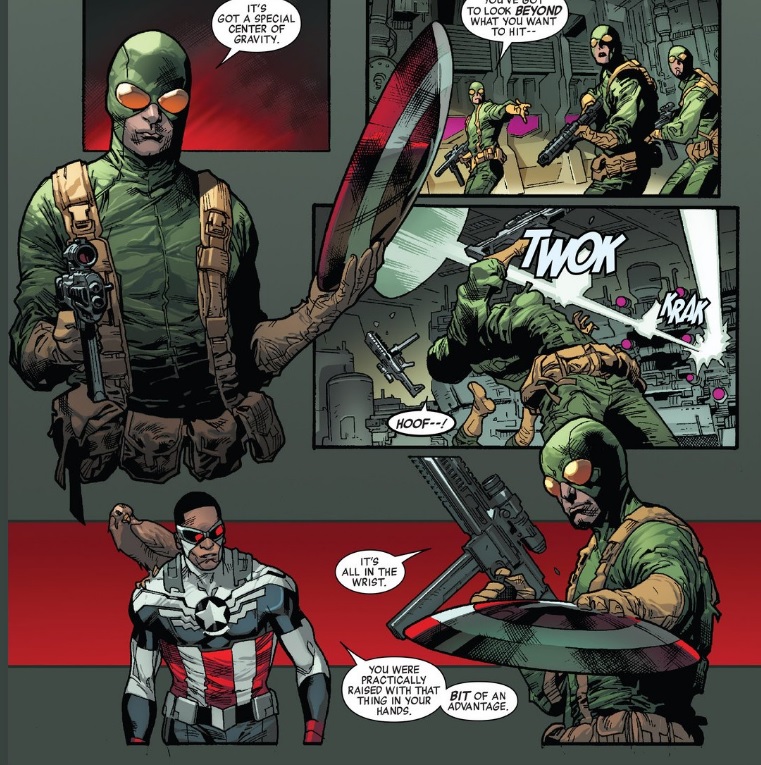 If you look at the depiction of Nomad in the top left corner, you’ll notice that he doesn’t have legs. While the idea of a torso shot isn’t all that stunning, it is neat how Immonen keeps Nomad’s belt perfectly intact. That article of clothing acts as the perfect cutoff point for this portrait. It makes Nomad pop out from the page. Pair this with the odd red bar running along the bottom of the page and this is a very unique page layout. It’s just so much fun seeing an artist toy with his medium in such a quiet, yet meaningful, way.
The story, to this point is pretty standard stuff but I’m sure that will come around in time. All first issues have the burden of grabbing the reader’s attention somehow and I’m happy to see that obligation fall to the art team as opposed to the writer. So while Captain America might be missing Captain America, I think it’s safe to say his shield and story are still in good hands.

For a complete list of what we’re reading, head on over to our Pull List page. Whenever possible, buy your comics from your local mom and pop comic bookstore. If you want to rock digital copies, head on over to Comixology and download issues there. There’s no need to pirate, right?
 Retcon Punch
I’m one of those guys who really fell in love with Falcon during “Captain America 2: The Winter Soldier”, so I was pretty psyched for this, but I wound up feeling a little deflated. This issue isn’t bad, but it’s a little standard, and I still don’t feel like I know comics-Sam all that well. The action and Sam’s interaction with his bird and Nomad was fun, but Batroc just annoyed me. I’m going to give it to the end of the arc to see if anything reaches out and grabs me. As it is, it’s not a bad comic at all, but it’s also not a great one.
(It’s kind of sad that out of the relaunches of Marvel’s Big 3, only Thor has really struck me as a great book)
I have high hopes for this series. I didn’t love Remender’s previous volume of Captain America, but I think he’s a talented writer, and I suspect that a big part of why I wasn’t enjoying it was the small cast. This series seems to have solved a lot of those problems, and features Stuart Immonen — one of my favorite artists at Marvel — so I think it could be great.
That said: yeah, Thor had an easier time winning me over — it’s very much a continuation of the previous volume, which I really loved. I think this series will be good, but it’s going to take some time to really prove it.
Yup, I’ll also jump on and say that Immonen alone might be enough to make me buy in to this series. I thought that both this and Thor both had really nice art (I mean: duh, Dauterman), but was definitely disappointed with Cinar’s art in Iron Man.
Hey, so I know we always wring our hands when we end up focusing on gender in female-led books, but race hasn’t come up nearly as often. My focus on it here may be more a response to the climate this issue was released in than anything within the issue itself, but even that is kind of messy. Like, could this book be post-racial? Should it? Would it be more inspiring to see Sam treated equally, or to see him overcome more obstacles. I realize I’m veering into prescription here, but it’s such a complex issue (and one this creative team may not be fully prepared to address), I’m curious what other folks think.
I understand the argument otherwise, but I’ve always preferred the Roddenberry approach of entertainment which depicts a society worth aspiring to rather than one that reflects our more disappointing realities. You can call it the ostrich approach if you’d like, and that’s probably true. However, I feel like the discussion of how to fix the world’s myriad problems are best tackled elsewhere. When I read a comic book I’d mostly like my brain’s pleasure center to be firing on all cylinders. It can be very impactful to dedicate an issue to a very important issue, though, and I appreciate that from time to time. I’m sure this is a very selfish, escapist view of sequential art, but when it comes to superhero comics then I prefer them to be a safe place for escapist retreat wherein the real world rarely comes knocking harshly.
…says the guy who prefers (and was recently arguing in favor of) the grimmer house stye of DC.
Oh I don’t think DC has any socio-political intent by depicting Captain Cold killing Johnny Quick with his freeze ray/stomp combo; To me that’s still escapism. It wouldn’t be unlike depicting a Star Trek episode in which the Klingons battled the Borg. I just like my villains extra fucked up and my heroes extra dedicated to goodness. I’m a fan of extremes. My qualm is in introducing rape, racism, or anything that particularly hits close to home. That’s what’s not escapist. And no matter what people like to say about comics being art, to me superhero genre comics at the big two should be giving me entertainment above all.
That style of cutting off figures using elements of their outfit, and generally the floating figures in general is pretty much a Travis Charest thing. Look back at his old Wildcats issues and you’ll see where Immonen got a lot of this from. Immonen is no question a spectacular artist, but I don’t feel he’s necessarily got a voice of his own – he’s almost like a Bowie. He does amazing things, by taking the best that he sees around him.