
 Today, Taylor and Patrick are discussing Zero 12, originally released November 19th, 2014.

Taylor: As a comic, Zero has bucked many of the conventions that have come to define our understanding of a comic book series. Whereas most comics enjoy a prolonged run of writer and artist, Zero has one writer with a rotating cast of artists each issue. Instead of following a straightforward plot progression, Zero tells its story with no truly describable pattern, instead exploring mood and ideas before plot. The hero, usually given the most amount of ink in words and artwork, here shares his pages with other characters in an act that shifts the focus of the story away from him and onto the world he calls home. All that being said, it’s easy to see why Zero might be overlooked by some. But for those seeking a unique reading experience, there’s nothing quite like it.
Zero is back with the Agency. His first assignment is to go and investigate (and possibly kill?) a former member of the Agency, Chaz. Chaz, for reasons left unclear, has the ability to control fungi or something close to it. With this ability he’s made his parents “immortal” by turning them into the equivalent of talking mushrooms. After his mission, Zero return to the Agency and Sara Cooke informs him that the recruitment and indoctrination of children is going to be ended, with the help of Zero of course. Cooke also gives Zero his file, which among other things details his ties to Roman Zizek and his deceased mother.
While I’ve become used to being thrown into the deep-end at the beginning of each Zero issue, this particular installment threw me into the ocean. While there have always been elements of science fiction present in Zero (teleportation, future setting), the series has never contained anything like Chaz. He’s a failed project of the Agency – an escaped agent who seemingly can’t be killed do to his unique abilities. The fact that these abilities manifest themself as a disgusting, fungi like entity makes this entry point into the issue quite bizarre.
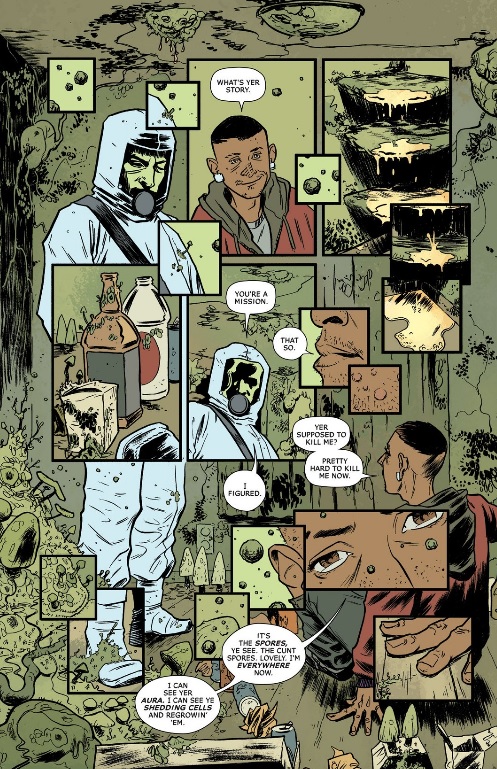 Basically, Chaz is all of that green stuff pictured above, aside from his human form. We’re never told exactly what his abilities are or what the Agency planned to use them for, but it does set a disquieting mood for the entirety of the issue. While writer Ales Kot certainly gets a hat tip for this, it’s amazing how artist Adam Gorham renders Chaz’s ability on the page above. Each panel emphasizes the unsettling power of Chaz, who can feel everything his fungi spores come into contact with. From the goo on Zero’s shoes to urine dripping down the wall, Chaz is aware of it all. In fact, he IS it all. Gorham’s paneling shows us this disturbing revelation with perfect balance to Kot’s writing.
The scene of Chaz’s home is contrasted sharply with the place where he came to be. While Chaz lives in a home that is practically a living extension of his body, the Agency office is more sterile than an operating room.
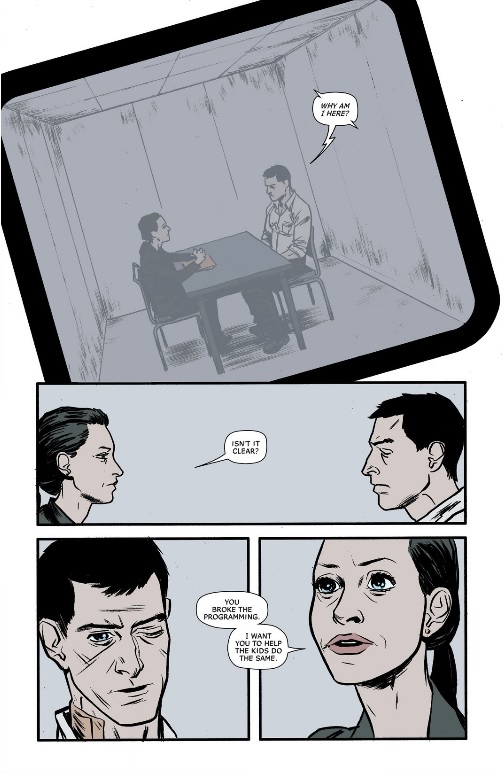 The contrast between the two settings is staggering. Chaz’s house is overgrown while the Agency hardly has anything in it. Credit is due to Jordie Bellaire who colored these scenes in such dramatic and contrasting colors — green and white. This change in colors serves to further pronounce the different between Chaz and and his roots. The color change has a cinematic feel to it and when the transition happens you almost reflexively squint your eyes in the new-found florescent light of the debriefing room.
Of course the debriefing that happens in this room is no normal event. Here, Cooke informs Zero that he has been called back to the agency because he was the first agent to “break the program” so to speak. As such, he’s highlighted the dangers of training super agents and as such he’s also uniquely qualified to help end the program once and for all. Cooke continues with her cope de grace by leaving Zero with his file. This climatic moment is beautiful and disturbing — calling cards of this title.

The three differently colored panels for three different scenes, all of which are connected — the page is stunning. Kot’s script, Gorham’s line work, and Bellaire’s color come together for about as perfect of a comic book page as you are likely to find in recent memory. This page is basically the synthesis of three artists working in perfect harmony.
I know that’s all hyperbolic, but I have no regrets. This title is daring and constantly challenges my perception of what a comic book can be in so many ways. Patrick, do you feel the same way? What do you think ended up happening to Chaz? Can Cooke be trusted? Also, what else stands out to you about this series or this issue in particular?
 Patrick: Taylor, you know full well that I feel that this series is capable of challenging perceptions about what is and is not possible in this medium. I’d even go so far as to argue that Zero dismantles serialized storytelling all together, stubbornly committing to something closer to a character study than a narrative. This is actually one of those issues that cashes in on the series extensive mythology — we’ve seen that weaponized fungus stuff a couple times before, but never with this much context.
Context — that may actually be the key word to this issue. Kot is characteristically patient in spooling out the story. Take the opening scene at Chaz’ house, for example: Edward is in that environment, witnessing the horrors the fungus-man hath wrought for five pages before it becomes clear what’s going on and why Edward is there in the first place. It’s all very evocative imagery of moldy people fused to walls, but it’s up to the audience to make the connection to the giant waves of spores we’ve seen in flashforwards in other issues. To read this series is to participate in the narrative, meaning that no one else is going to provide context for us, but Kot and Gorham do place some subtle hints that we should make that effort. The most explicit, and my favorite, comes early in the issue — a pair of images contrasting what the fungus-house looks like from the outside of that containment tent, and just under the tent:  The second panel is a trick — a magical perspective you couldn’t actually capture — and it’s otherworldliness is emphasized with that blacked-out background. Other than this one panel, Gorham uses a pretty traditional camera, presenting characters head-on or in profile, in familiarly cinematic styles. But just this once, he lets us peek beneath the skin and see what’s going on inside. It’s an effective invitation to explore. And much of what we have to explore, to really dig in to, is simply the past of this series. This issue doesn’t offer up much information about what’s in Zero’s file — the only thing we really see is a photograph of Zizek with Zero’s mother. That’s a devastating revelation for the character, but it’s not at all new information for faithful readers. By this point in the issue, we’ve been primed by all these smaller examples of having to access our memories to make sense of what’s going on. In just the previous scene, Cooke refers us back to the events of issue 11. That’s an awful lot of gazing into the past but it’s all necessary to make that moment wherein Zero loses his composure and breaks down weeping really count. That’s a fascinating page too, by the way. It’s set up in much the same way that the houses in the previous image I posted. On the top of the page, Zero wracked with the revelation that his Zizek is his father and that he is literally a bastard child of war, but the second panel shows (or at least begins to suggest) the much more unusual thing that’s really going on here.
  Frankly, I don’t even know what to make of the external threat the Agency faces from these dudes out in the woods. For all the other crazy stuff at play in this issue — the subterfuge, the sentient fungus, the mysterious past revealed — they are the only thing the audience isn’t prepared for. No amount of past-issue detective work was going to prepare us for them. I like to see these guys as a promise that we should be digging into future issues with the same discerning eye. For a complete list of what we’re reading, head on over to our Pull List page. Whenever possible, buy your comics from your local mom and pop comic bookstore. If you want to rock digital copies, head on over to Comixology and download issues there. There’s no need to pirate, right?
 Retcon Punch
So, the fungus — does it ORIGINATE from Chaz, and Agency scientists eventually study him and learn how to weaponize it, or is Chaz simply a stepping stone in the process of experimenting with the fungus and learning how to master it?
Either way, we’re one step closer to that future of Zero sitting on that cliff overlooking those giant alien ships
There’s one panel of Chaz’s ear that shows it surrounded by fungus, which made me think his body had also been consumed, and that this was some kind of new, fungal body that his consciousness had been transferred to. Maybe I’m reading too much Swamp Thing…