

Today, Drew and Taylor are discussing Zero 16, originally released May 6th, 2015.

“You” believed this was “your voice” and “you” were a story “you” were telling to a boy who was “your son” but “who” was telling the story of “you” telling the story to “your son?”
Ales Kot, Zero 16
Drew: In our discussion of Zero 14, I noted that, while the framing device of Zero telling his story to the boy about to shoot him gave us a narrator for our story proper, I had to wonder who was “telling” the story of that framing device. Of course, that was just before writer Ales Kot pulled the camera back even further to reveal another framing device in issue 15. That issue explained that the “higher narrator” is actually William S. Burroughs, introduced as a character in the comic, but still left open the question of who was presenting us with that framing device. That kind of nested reality could go on forever, but this issue actually finds Kot doing something much more clever — dissolving the borders between these framing devices. It’s a fascinating trick that brings us closer to the fiction that is Zero…or is it that it brings Zero closer to reality?
The issue itself occupies a phantasmagorical space between Burroughs and Zero, whose realities become so permeable that it is often difficult to tell where one ends and the other begins. Kot (via Burroughs) expounded upon this idea at length last month, but it’s up to artist Stathis Tsemberlidis to make sense out of two worlds flowing together. He comes up with some surprisingly effective solutions.
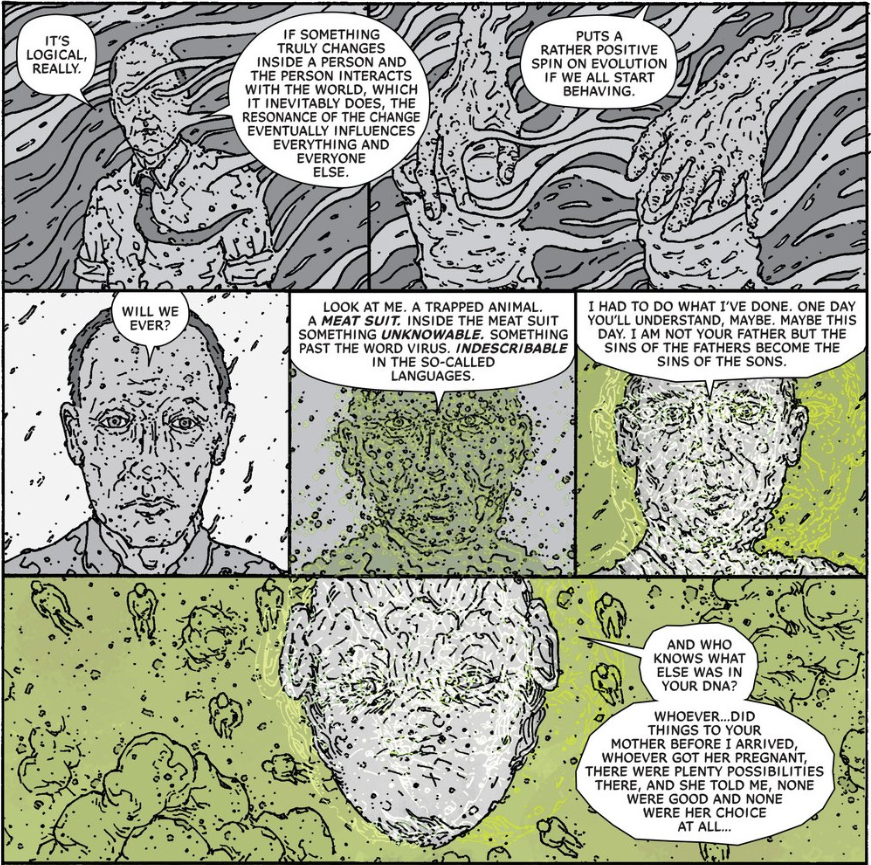
This sequence begins with Burroughs, who has just taken psilocybin mushrooms with Allen Ginsberg, and ends with the fungally-resurrected Zizek speaking directly to Zero. That the transition happens in the middle of a page and not at a page turn is itself remarkable, but Tsemberlidis blurs the lines much further, giving us a transition panel between these characters that is somehow both of them.
The effectiveness of that transition is aided by both letterer Clayton Cowles and colorist Jordie Bellaire. Note how Cowles differentiates Zizek’s dialogue by giving him polygonal speech balloons. This would seemingly suggest that the middle panel is Burroughs, but Bellaire’s choice to color that figure alone as green differentiates him both Burroughs and Zizek (though green is a key color in both scenes). Bellaire’s choices throughout the issue are idiosyncratic — I’ve never seen a drug trip rendered in grayscale before — but work to collapse these stories into one universe (even as colors cue us into different periods, emotions, and subjectivities).
Not to be outdone by his collaborators, Tsemberlidis accentuates his own style to unify these threads. I’m most struck by the squiggles and dots he adds to give texture to surfaces. It’s a common technique for modern purveyors of the ligne claire style, but Tsemberlidis turns it up to 11 here, giving the very air itself (perhaps even the “lens” through which we’re viewing all of this action) a unique texture. We can almost feel, smell, and taste the mushroom spores hanging in the air, whether its Tangiers in 1961, Bosnia in 1992, or Dover in 2038. The effect is certainly unsettling, but is also surprisingly effective, as when those dots and lines resolve into tears on Zero’s cheeks.
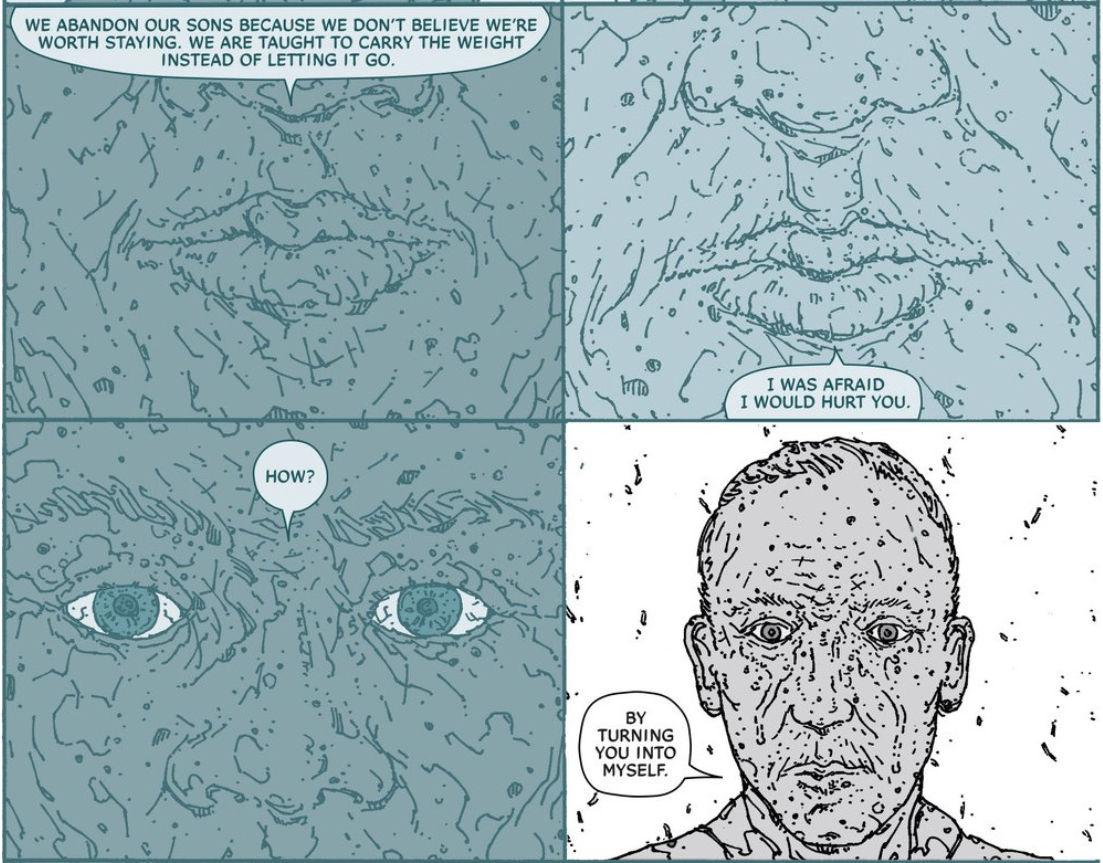
But again, a lot of that expressivity is obscured in service of making these characters indistinguishable. That sequence in particular pairs shots of Zero and the boy, often giving them identical (or mirror image) compositions. The layout (with the boy on the left and Zero on the right) and the coloring (Bellaire gives the boy just a bit more value) are all that differentiate these characters visually. This carries us to another transition, where Tsemberlidis uses the same composition to carry us through Zero’s subjectivity between two different scenes.
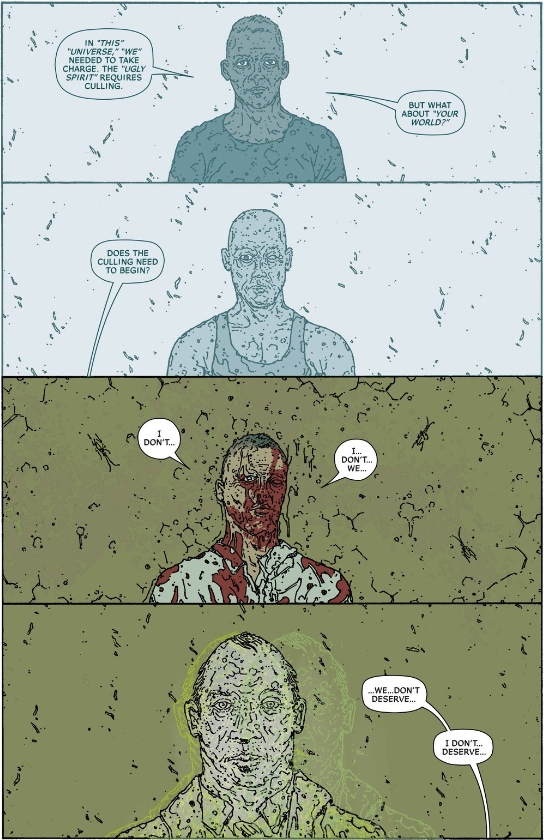
It’s a simple shot-reverse shot structure, but the two consecutive shots of Zero take us from 2038 back to the present. Once again, this transition happens in the middle of the page, which suggests that this isn’t really a transition. Even Zero’s reaction in the third panel suggests that he’s answering the question posed in the second, even though the first scene doesn’t occur until decades after the second. Unlike the first transition, which blurs the lines between realities, this one blurs the lines between time and space. It’s important to note, however, that both put the narrator in the story they’re telling, showing both Zero and Burroughs being transported to that bunker.
The ultimate effect of all of this blurring forces us to confront the relationship this story has to our own reality. If Burroughs, the in-narrative writer of the story can dissolve into his own story, perhaps Kot, the extra-narrative writer of that story does, too. I suppose that’s true no matter how metaphysical we believe it to be — stories are necessarily made of their tellers — but the multiverse discussion in the previous issue asserts that there’s no distinction between these “levels” of narrative, that our world might be no more real than the stories presented here.
This series continues to veer into territory that I don’t feel fully qualified to speak to. I’m working up to a theory on all of these, but for now, I’m okay with the fact that I haven’t left enough space to draw any grand conclusions. Taylor, I don’t want to force you into “grand conclusion” territory, either, so feel free to ignore any or all of what I’ve written here. Maybe you can dig into the “ugly spirit”/”black thing” that lives inside Zero. Or not. There’s a lot to talk about here!

Taylor: It is interesting to consider the idea that our stories, that is the stories of our actual, real lives, are no more real than those which we read on the page. An argument can be made both ways depending on your viewpoint. On the one hand, the characters in stories don’t lead real lives; they have no volition outside of what the author tells (or rather forces) them to do. However, these same characters are actually going to be a tangible part of the universe long after we’ve died and everyone has forgotten us. Few will probably read the story of Taylor or Drew in 100 years, but chances are more will be reading the story of Zero. And in some sad way, doesn’t that make the story of his life a bit more real than our own, at least for the would-be readers of the future?
The reality of our and Zero’s universe aside, it is at least clear that the two are influencing each other in ways I would have barely imagined even two or three issues ago. Confronted with the narrator of Burroughs who is given life by Kot, we are left to wonder just what the relationship between, us, Kot, Burroughs, and Zero really is.
At the center of it, both literally and figuratively lies the “ugly spirit” you speak of Drew. Throughout issue 16, reference is made to the “black thing” that lives inside of all men. Whether “men” is used to talk about all mankind or simply males in general, I’m not sure, but it is clear that it is something which men have grappling with seemingly for all time. It lives in war atrocities dating throughout the 20th century and it lives in any of us who have committed a horrible act.
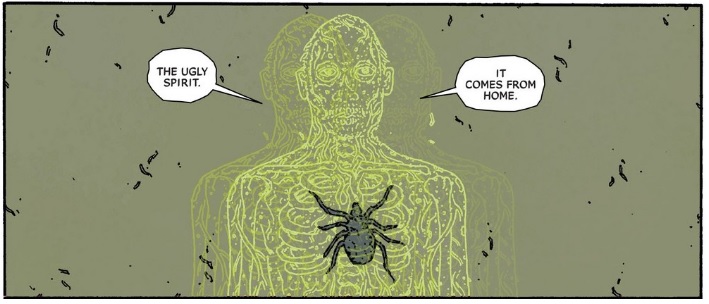
When I first read about this evilness that is grappled onto the hearts of men, I thought it but a commentary on the generally despicable things many humans do and have done throughout history. However, when Burroughs brings up the act of shooting his wife in the introduction to his book Queer, he describes it as “the invader, the Ugly Spirit, [which] maneuvered me into a lifelong struggle, in which I had no choice except to write my way out.”
With this information, everything changes. Instead of the ugly spirit being just a metaphor for evil deeds, in fact becomes both a literary reference and a proper noun. If Burroughs could only escape the guilt of his personal ugly spirit by writing, it seems to me that Kot is writing for a similar reason. Now, I don’t know enough about Kot’s life to guess what guilt or evil deed he may be trying to escape by writing, or if perhaps he is writing to escape the evilness of the world for us all, but it seems clear that this “black thing” of which he is trying to escape stems from some sort of guilt.
Of course, what makes this conceit interesting is that we have the multiverse to contend with. By writing about Zero, Burroughs is exorcising his inner demons — that much is clear. However, Zero also has his demons which he must excise as well.

Zero may have destroyed the organization which spawned his ugly spirit, but it still lives within him. Could it be that the telling of his story, as we saw in flashforwards, be his own way of writing his way out of guilt? And if we have the character in a story writing to expunge his guilt, whose own creation creates a story to expunge his particular guilt, doesn’t it stand to reason our writer, Kot, is writing for the same reason?
One could go into what exactly the multiverse’s role on Kot is, but I’m with Drew in thinking I don’t know enough right now to adequately discuss it. Still, what we have in Zero 16 seems to be a commentary on the creative process and questions just why we bother to create anything at all. Is it that we need conflict, a black thing, to create a story? Classic storytelling lessons say yes, and perhaps the fictional story of Zero is saying exactly the same thing.
For a complete list of what we’re reading, head on over to our Pull List page. Whenever possible, buy your comics from your local mom and pop comic bookstore. If you want to rock digital copies, head on over to Comixology and download issues there. There’s no need to pirate, right?
 Retcon Punch
Another interesting sequence is the one where Allen/Nova Ginsberg interacts with an older Burroughs. William says what he has just written isn’t his style but it will be found in the “psychosphere,” for Ales Kot or Zero to find perhaps? Ginsberg also mentions “Billy,” seemingly a reference to Burroughs’ son William Jr, and his last book. My presumption is the book in question would be “Cursed From Birth,” which title fits in perfect with ideas of inherent guilt and masculinity through violence. The references to “all men” is also a reference to the contemporary movement in self applied change in all men.
I know the feeling when you say “This series continues to veer into territory that I don’t feel fully qualified to speak to,” but its certainly exciting and rewarding to try to dig through all the layers. This whole review/discussion doesn’t even mention the fascinating cross title concepts Kot is doing with references to The Surface’s holograms and mental projection through out the last couple issues of Zero, let alone the references to Burroughs and Change that pop up in The Surface. So much cross pollination of sorts, perfect for this concept of Multiverses and story telling.
We dug into that a bit in issue 15. The Surface 1 actually forced me to go back and read Change, which Kot name-checks in the interview portions of that issue. In that case, he’s writing as “Doublehead,” a character in Changes, who quotes Burroughs and loves the notion of “psychomagic,” and may or may not be “writing” the story of The Surface and/or a character within the narrative of that story. We tend to focus on individual issues in our discussions, but that’s just another way where this series forces us outside of our comfort zone. Ultimately, there’s way more going on here than we could ever hope to cover in a 1500 word discussion, but that’s why we have comments sections! I’m excited that you’ve found us, and am definitely enjoying your perspective on this series.
Dont worry i definitely wasn’t knocking your style/critique. There’s so much to cover and talk about with this book, and I already feel my Burroughs background is lacking, so I’m already streching. I’m having trouble myself trying to express thoughts coherently while blasting these points out while at work too. Lots to be excited about when it comes to Zero and Kot, especially if you consider the dozen plus fantastic artists he’s worked with on this book alone. Keep the good work coming, I have a feeling I’ll be around if you’ll have me. Thanks for the feed back.
Even more impressive is the ability of this issue to work. The whole staff weaves ideas of masculine oppression, father son dynamics, political commentary, anti war ideas, meta fiction fantasies, parallel universes/stories, creation, inspiration, and more, set to the backdrop of multi dimensional mushroom trip.
It’s a shockingly coherent issue, isn’t it? I think Drew does a good job of highlighting how the entire creative team rallies together to both unify and distinguish times, realities and ideas, but I don’t think it can be overstated how engaging of a psychotropic, multiversal trip this issue is. I tend to need a fixed point in reality to really enjoy a narrative (I had a tough time with the final issue of Multiversity), but the ideas are so clearly presented here, even if we have to trace them through time and reality to follow them.
I was really into how little copy Kot uses in this issue. Minimal dialogue is a total Kot move (and even more specifically, a Zero move), but this was an issue so much denser with conceits than most other issues of this series. The one moment with a large block of text is repeated – once coming out of 2038 Zero’s mouth and again printed on Burrough’s typewriter. Kots specifically tying texts together, and it’s interesting to consider how comics are more than simply that text.
Actually, teasing that out a little further, that final page that Taylor posted shows a kind of cross-section of comic panels, stacked up in 3D space, our perspective on it somehow outside and beside it. I’m not that close to putting my finger on the significance of it, but that’s not simply a statement about stories (that is, “stories” generically) all being part of the same reality, but a statement about comics.
I love that thought and I’m going to chew on it for a while. My interpretation was the page was supposed to mirror the Agency’s physical space, the building itself, with each layer representing a different character in time. The pink frame on the bottom represents Zero’s father, the grey a fetus version of Zero with his already inherited “black thing,” the green one representing “the present” (if there is such a thing) where he’ll remove it, and the top one the ever dominate “black thing” that’s there always, with or without the Agency, that’s present in all men.