
Retcon Punch is on Summer Hours, which means we’re going to be writing fewer in-depth pieces for the month of August. But we’re addicts at this point, so we need a place for our thoughts on all those comics we can’t stop reading. Some comics fall neatly in the the categories “DC” or “Secret Wars” — these comics don’t! Today, we’re discussing Godzilla in Hell 2, Lando 3, Drive 1, Teenage Mutant Ninja Turtles: Casey & April 3 and East of West 20.

Godzilla in Hell 2
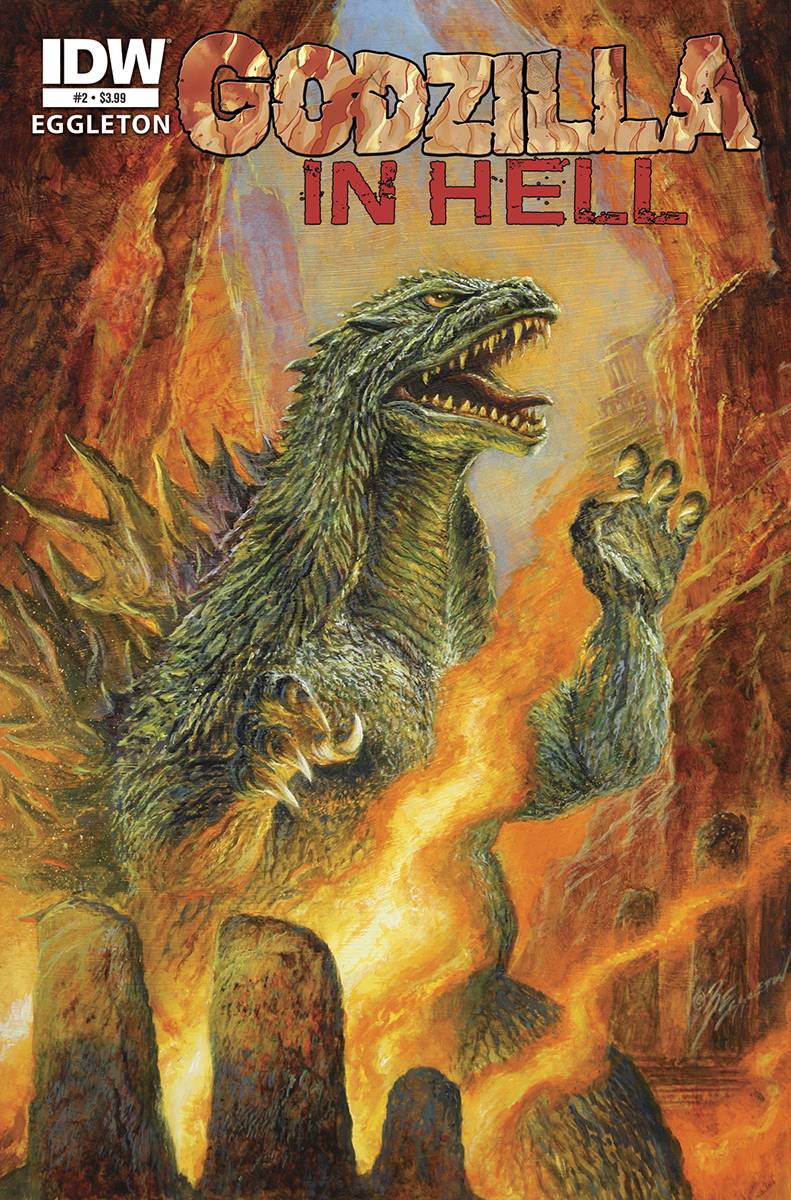 Patrick: I love this series, partially because there’s so little story to discuss, so it frees me up to just talk about art. I know I write about comic books literally every day, but the medium’s reliance on narrative frequently forces the analysis toward character psychology or plotting or literary symbolism. Or whatever. Godzilla In Hell is proving to be a series solely about showing, with very little attention paid to the story. I mean, really: who gives a shit why Godzilla is in Hell? The series’ premise is so damned appealing that any explanation runs the risk of diminishing its raw appeal. Writer and artist Bob Eggleton totally gets this, and while he’s not quite as adventurous as Jim Stokoe, and does include a handful of narrative pieces along with his action, those captions could just as easily be skipped. In fact, Eggleton’s narration mostly reiterates the reader’s questions rather than attempting to answer them. When Rodan, the first of Godzilla’s opponents, attacks him, the narration asks “what is this demon besieging him for?” Rather than explore that question, the action just rolls on to the next series of blows traded.
Eggleton lists influences for this specific piece at the end of the issue, so I won’t rehash any of that here. While he does a great job of channeling those ancient masters, I’m almost more impressed by his ability to employ some very smart and subtle storytelling techniques along the way. Godzilla’s icy fight with Anguirus, for example, hinges on the eventual shattering of the ice, and Eggleton foreshadows this shattering twice in their five page battle. First, he cracks the first page of the fight: for the first time using panel dividers that aren’t are 90 degree angles to each other, upsetting the neatly rectangular rhythm established everywhere else in the issue.
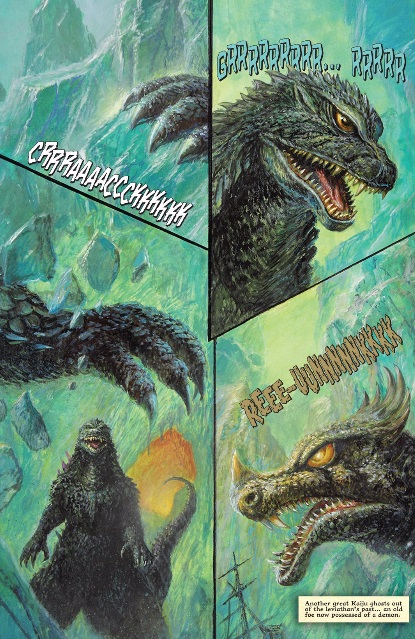
There’s also a quick close-up on Godzilla’s foot on the ice; it’s paired with a close-up of Godzilla’s eye, so maybe Eggleton is hoping we don’t consciously register that the shattering of the ice is being telegraphed so early on.
Lando 3
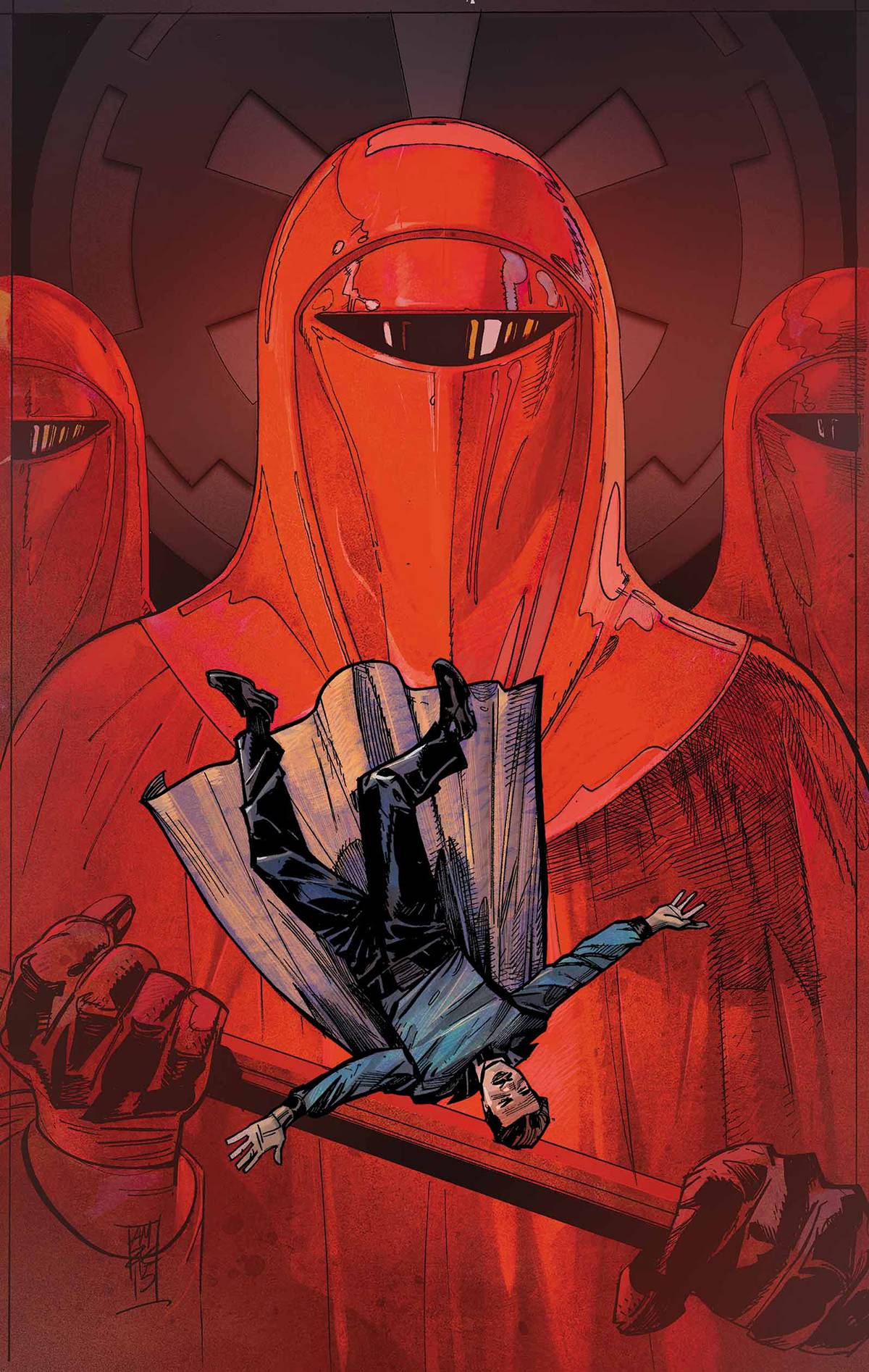 Michael: Similar to last week’s Star Wars 8, Lando 3 has me asking a question that can be particularly dangerous when it comes to Star Wars: “I wonder what happened before this?” That question gave us the prequels. That question gave us midichlorians. That question gave us what felt like a broken promise; a betrayal of a trusted friend. Still I can’t help but ask that question: how? Why? In my Star Wars 8 round-up I commented on how lightsabers were being presented as something that was very hard to come by. Lando 3 has me asking how much the citizens of The Galactic Empire know about their ruler Emperor Palpatine. If you haven’t been following Charles Soule and Alex Maleev’s Lando, then the leap from Lando Calrissian to Palpatine might seem like a couple degrees of separation too many. On the other hand, we chosen Lando readers know that Lando and his crew: Lobot, Sava Korin and incestual cat-people warriors “The Twins” have inadvertently stolen one of Palpatine’s prized vessels. There were a handful of reasons that led me to ask the curious question I posited before: 1) that Palpatine’s ship had a room that was protected by his Royal Guard 2) that this particular Royal Guard was made up of undead/”corrupted” humanoids and 3) that Lando had no goddamn clue what the word “Sith” meant. This might seem unrelated to the ongoing story but I am curious/impressed as to how Palpatine has pulled the wool over an entire galaxy’s eyes. For example: Korin knows that they are in deep shit when he realizes that they’ve stolen one of The Emperor’s prized vessels, but he doesn’t seem to have any indication that ‘ol Palps himself is a Sith to be feared for lightning bolt-related reasons. Ok until next month, here endeth the Palpatine speculation.
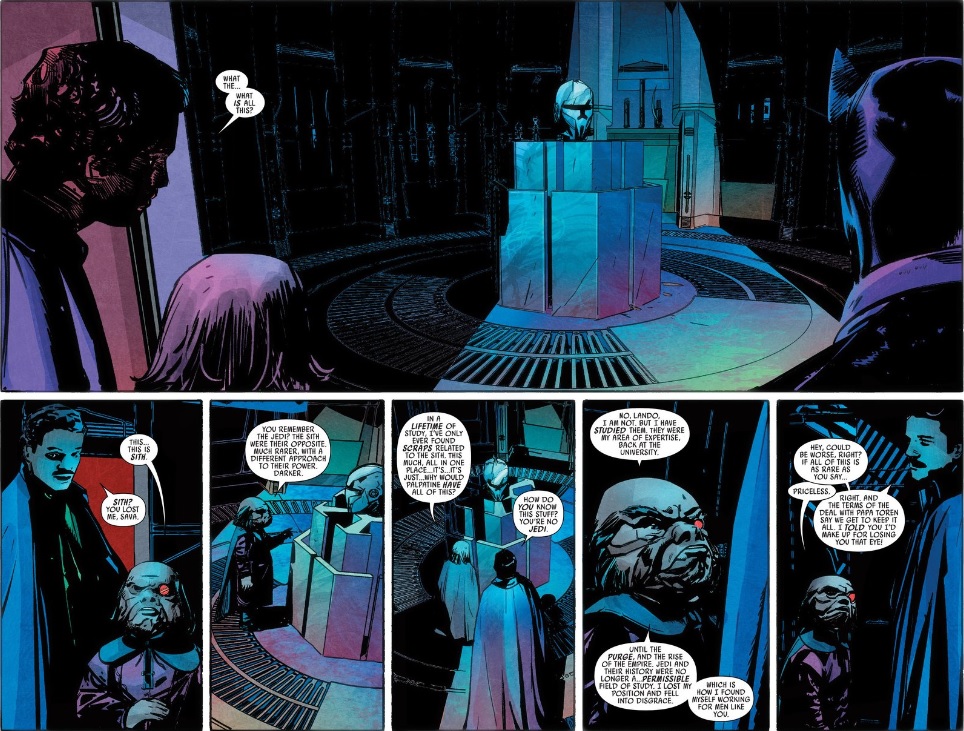
Another reason that Lando is the book we didn’t know we wanted is that it gives us some much-needed Lobot stories. Let’s just pause for a minute and once again say that The Empire Strikes Back is a hell of a movie. I think that like Boba Fett, many of us Star Wars fans were curious as to what the deal was with that bald dude Lobot – a guy we only knew as a Lando’s silent #2 who may or may not be a robot. Similar to my dangerous, prequel-ish question earlier I wonder why/how Lobot is the way he is. Instead of arduously dedicating an entire issue to flesh out Lobot’s backstory, Soule gives us the info we need to know and moves on; prequel problems averted. The Lando series is a surprise for me in many ways, including how much I needed Alex Maleev in my life again. Maleev’s somber style and subdued color palette definitely doesn’t provide the aesthetic that I anticipated for a book following a character who is for all intents and purposes an extension of Han Solo. Soule and Maleev show us that even if you are the lighthearted type who relies on charm and abhors violence, you still have to live in a galaxy that has been formed on such terrible violence and atrocities.
Drive 1
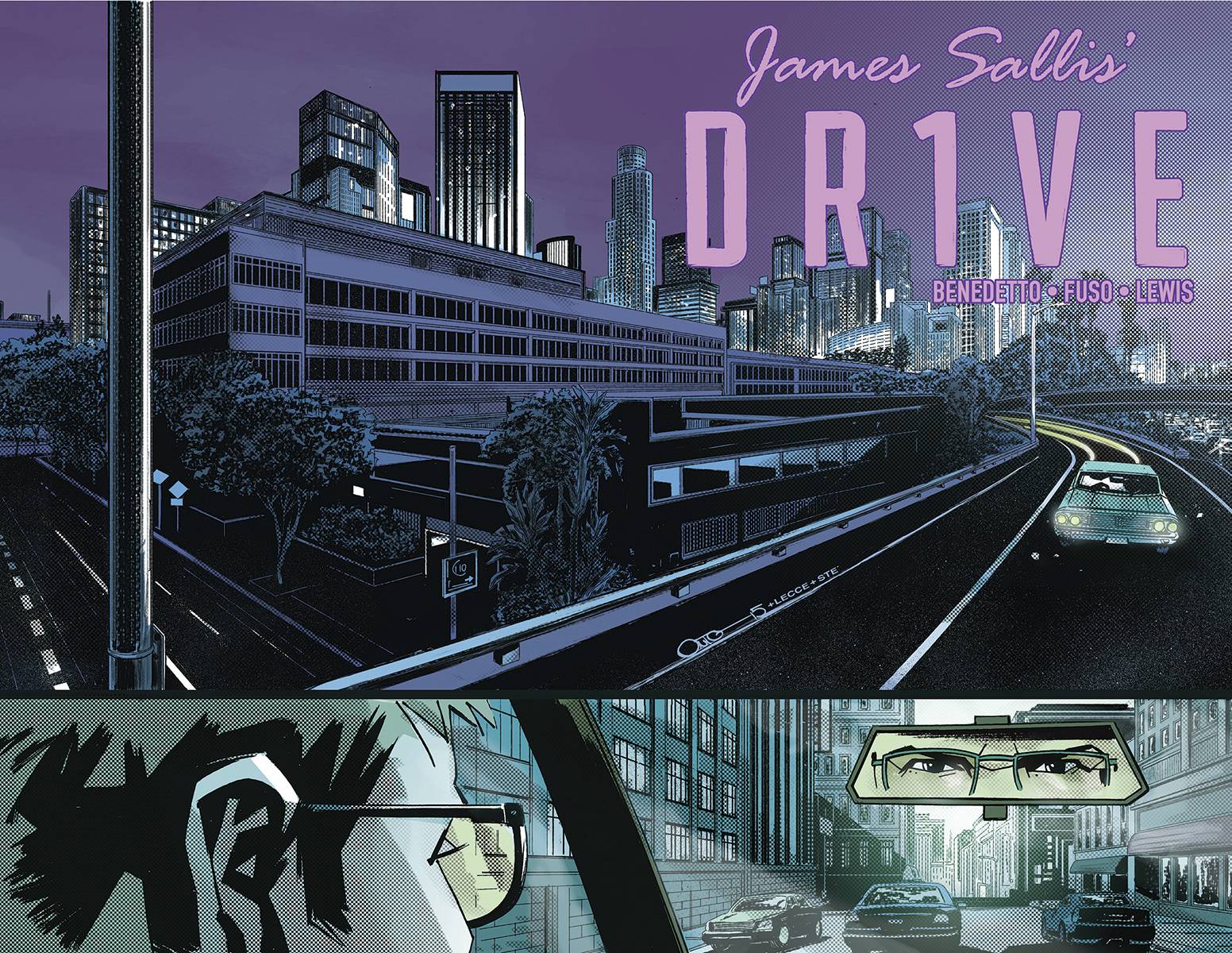 Ryan: Drive 1 suffers from being an adaptation of the 2011 film, which captured the essence of ‘cool’ through mood, compelling performances and a killer soundtrack. Translating these elements to a four-issue comic is a challenge that Drive side-steps by abandoning the neo-noir vibe for a straight ahead crime story. Even taking this issue on its own, it doesn’t fare well.
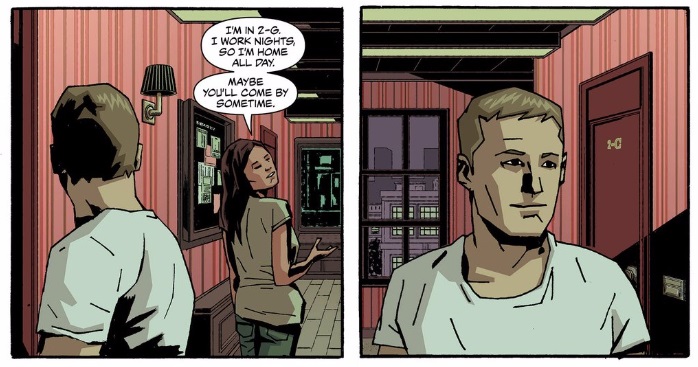
Drive centers on a stunt car driver who moonlights as a getaway man. He is the best in both his day and his night professions. When the issue opens, a job has gone wrong and Driver is alone among several dead bodies in a hotel room. Michael Benedetto’s use of an in medias res opening and heavy-handed voice over creates a plodding rhythm to the story that doesn’t allow for authentic tension or surprise. Driver as a character is self-aware without irony. He tells us who he is and then we see him act that way. Rather than add a sense of complexity or depth to his character, the running monologue makes him somewhat boring. Even Irina, the sole human connection he allows himself in the film, is introduced in a perfunctory hallway neighbor introduction, albeit Driver almost has a facial expression if you stare really hard at the last panel.
Antonio Fuso’s art also fails to create the kind of tension that could push the story forward. The climactic car chase, which otherwise could be the centerpiece of the issue, is inert. While large sound effects assure the reader that Driver is making big and flashy moves, the art is difficult to follow. Without knowing what Driver is doing, I missed out on the tension and release of the sequence.
Perhaps the voice over is a smokescreen and we will discover that Driver’s view of himself is as much an illusion as his movies. Or, maybe, the pace of the first issue is establishing a banality that will dissipate once things go pear-shaped. I’ll need some kind of surprise from Benedetto and Fuso to view this series as more than an obtuse retread of an enjoyable film.
Teenage Mutant Ninja Turtles: Casey & April 3
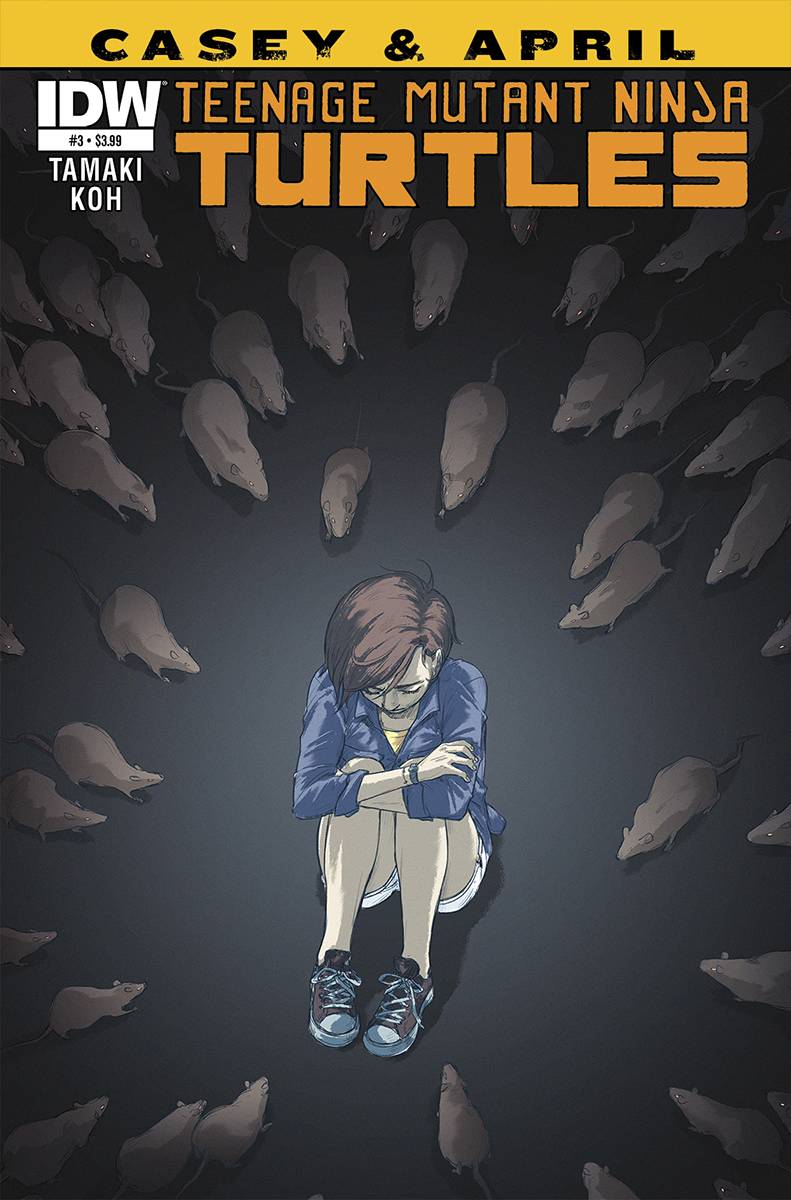 Spencer: Reading Mariko Tamaki and Irene Koh’s Teenage Mutant Ninja Turtles: Casey & April 3 is a bit like reading somebody’s dream. Items appear and disappear at random and the landscape around Casey and April shifts on a whim — it can be hard to follow at times, but that’s the point. We aren’t trying to track our heroes’ every move; we’re following them down the rabbit hole and deep into their subconsciouses. The dreamlike nature of Rat King’s maze allows Tamaki and Koh to bring this couple’s problems to life in the most literal of fashions — most notable is the distance that’s grown between Casey and April being illustrated as an actual massive chasm stretching out between them.
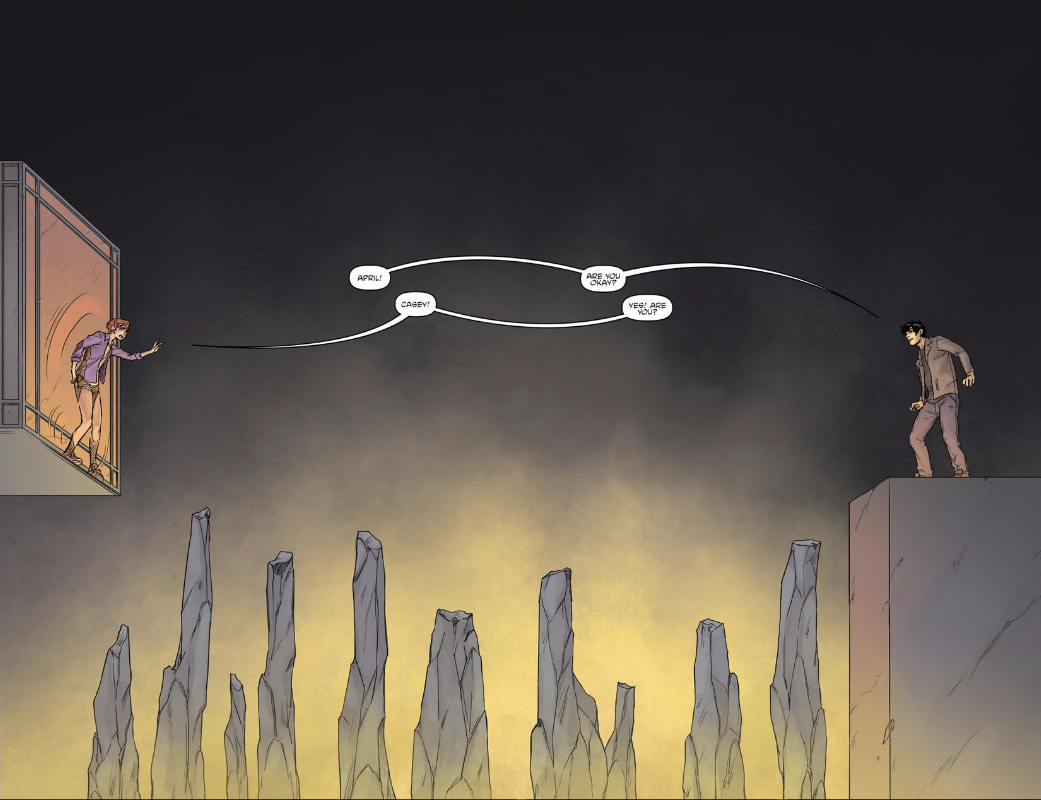
So in order to mend their relationship, of course, Casey and April must literally bridge the gap and come together. This is smart storytelling, allowing Casey and April to talk through their issues while still keeping things visually interesting, and using the visuals to emphasize the issue’s theme to boot. The other visions/flashbacks — both to significant, yet drastically different moments with their fathers — are interesting peeks at defining moments for both characters, but don’t really seem to further this theme of reconciliation — unless they mean that Casey and April must accept their own weaknesses before they can accept each others?
I suppose there’s a lot still open to interpretation here, so it’s a bit of a relief that Rat King and his associate may finally have some answers for us, but I hope any explanations don’t shift the focus too far from Casey and April; there’s still plenty of ground to cover with them as well. This issue gave them an excellent start at working through their differences, but it still finds them coming together because of battle/supernatural stuff, which has never been their issue; their relationship weakens when things slow down. No matter how Tamaki and Koh choose to keep exploring Casey and April’s relationship, though, if it’s half as clever as their work this month, I’m know it’ll be worth checking out.
East of West 20
 Patrick: Second chances are not a luxury afforded to most characters in East of West. It’s hard, cruel world that drags the end of the world out over lifetimes of pain, suffering and disappointment. Which is why Doma’s story in issue 20 is so interesting.
Against the backdrop of an uneasily forged alliance between the PRA and The Endless Nation, Doma is sent as the latest diplomat from The White Tower. All previous diplomats have been sent home in boxes (and in characteristically gruesome condition) so the expectation is that The Endless will make an example of Doma too. Writer Jonathan Hickman is a master plot-smith, and the turn of events that leads to Doma being spared is a classic example of how he can carefully — and believably — leverage the culture and values of his characters to make enormous choices. In this case, the Maoist Widowmaker extends the same re-purposing mercy to Doma that was once extended to him, upsetting The Endless’ cycle of diplomat murder. That’s huge personally for Doma, but it could also represent a huge shift in power within the PRA / Endless alliance.
But politics aside, I like the idea that this story — which could have gone so much worse for the endearing Doma — is made all the more palettable because of its multiculturalism. One of the unarticulated problems with this new world is that the various kingdoms are all culturally homogeneous – there is essentially only one perspective in each government. That leaves very little room for ideological grey areas: you’re either with us or against us. But the combination of the PRA tradition of sparing and recruiting these “Widowmakers” and the Endless Nation’s quenchless bloodlust produces a culture with decidedly richer and more complex values.
The conversation doesn’t stop there, because you certainly read something that we didn’t. What do you wanna talk about from this week?
 Retcon Punch
I think it’s okay for people to know that Palatine is a weird evil dude that’s into spooky shit, but not know that he’s a Sith. I mean, it’s not even really like “Sith” is a term that civvies were throwing around during the Clone Wars, right? There were like 5,000 Jedi, but only, what three Sith around during that time? It’s weird that the Jedis weren’t better at fighting such a small force…