Archie 6

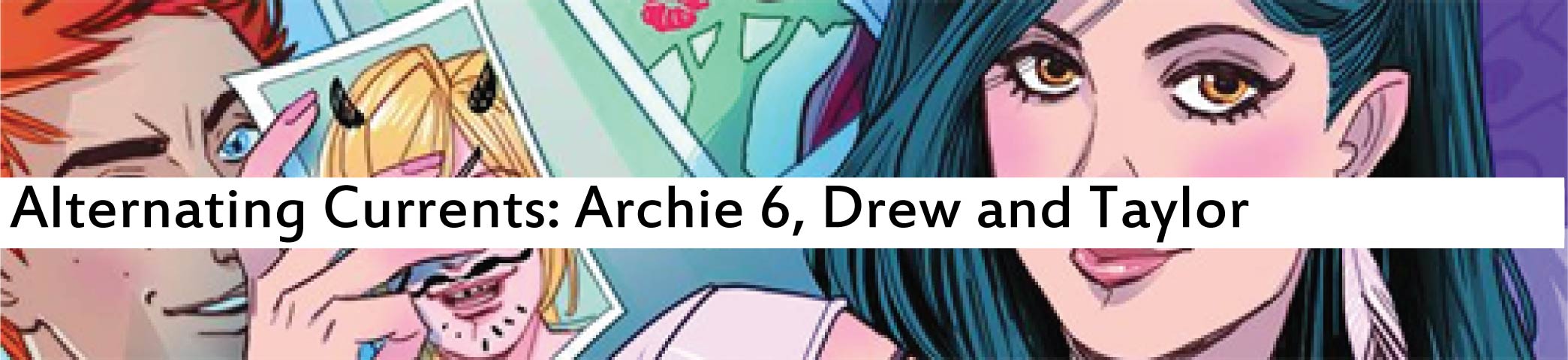
Alternating Currents: Archie 6, Drew and Taylor

Today, Drew and Taylor are discussing Archie 6, originally released February 17th, 2016.

Drew: My biggest frustration in dealing with teens is their lack of perspective. That’s probably my biggest frustration in dealing with adults, too, but teens are notorious for blowing things out of proportion. That tendency is exactly what makes teen dramas so volatile — everything is high-stakes for teens — but it’s easy for that volatility to alienate adult readers who know this could all be resolved if any of the characters just sat down to talk with one another. It’s important, then, to occasionally re-ground the stakes in a teen drama, giving readers of any age a relatable touchstone in between the more elaborate flights of fancy. That’s exactly what we get in Archie 6, as a miniature health emergency reminds everyone of what’s really important. Continue reading

Jughead 3

Today, Ryan and Spencer are discussing Jughead 3, originally released December 30th, 2015.

Ryan M.: My name lends itself to nicknames. Since both my first and last names are easily shorted and morphed, I’ve never had the sort of nickname that doesn’t sound like my name. In middle school, I tried to get people to call me “R Money” but as we all know, you can’t give yourself a nickname. Jughead Jones does not go by a derivative of his birth name, so when the first page of Chip Zdarsky and Erica Henderson’s Jughead 3 ends with someone calling him Forsythe, you can tell things are not right in Riverdale. Continue reading

Jughead 2

Today, the Ryans are discussing Jughead 2, originally released November 18th, 2015.

Ryan M.: Nobody likes a smart ass. Of all the things adults said when I was a kid, this may be the most full of shit. Everybody like a smart ass. They are funny! They say what they want without worrying about decorum and, in doing so, disrupt the mundane. The truth is, what “nobody likes” is being disrespected. And to tell a sass-filled kid that they have the power to undermine you is to further offer them power. In Jughead 2, the new regime at Riverdale High is struggling to regain the upper-hand over King of the Smart Asses, Jughead Jones.

Continue reading

Jughead 1

jughead 1

Today, Ryan and Taylor are discussing Jughead 1, originally released October 7th, 2015.

Ryan: Every character has a worldview. Conflicting worldviews can be enough to fuel an entire story. Sometimes, they allow for characters to be dismissed or reduced. Jughead Jones is Archie’s food-loving, girl-indifferent, and lazy best friend. Jughead #1 digs deeper into his way of seeing the world, retroactively justifying and deepening decades worth of burger and nap jokes.

Continue reading

Archie 3

archie 3

Today, Patrick and Ryan M. are discussing Archie 3, originally released September 30th, 2015.

Patrick: David Fincher’s adaptation of Fight Club surpasses the original Chuck Palahniuk novel in a lot of ways — chief among them is Fincher’s stylish filmmaking. Fincher is so cool behind the camera, and the gulf between the drudgery of the narrator’s everyday existence and the idyllic (if chaotic) world that Tyler Durden offers is wide enough to made Durden’s obviously bad ideas sound like great ones. That’s a tool that Palahniuk didn’t really have at his disposal — Tyler’s ideas seem much more ridiculous on the page without that veneer of cool to legitimize them. My favorite way that Fincher improves on Palahniuk’s story is in the meeting between the narrator and Tyler — up until this point, the audience is inundated with Edward Norton’s voice over, and an almost oppressive score from the Chemical Brothers. The film is also largely an extended montage until we meet Tyler, and the pacing of the scenes quicken right up to the point that they wind up next to each other on a plane. But the action, the narration, and the score all come to a screeching halt the second Tyler opens his mouth. He represents freedom from all the neurosis the narrator has been filling our head with since the moment the movie started. Tyler — both in the life of the narrator and in the film — is the ultimate disruptor. Archie 3 pulls a very similar trick, but who has the force of personality to be Archie’s Tyler Durden? Why, Veronica Lodge, of course. Continue reading

Archie 2

archie 2

Today, Spencer and (Guest Writer) Ryan Mogge are discussing Archie 2, originally released August 19th, 2015.

Spencer: First issues are meant to sell a title to new readers. The creative team is putting their finest foot forward, introducing their characters, world, and the conflicts and themes they wish to explore, but the one thing first issues aren’t great at is showing how the creative team is going to tell their story from month to month. It often takes a few issues for readers to start to get a handle on a series’ format, and that’s very much the case with Archie. Mark Waid and Fiona Staples’ first issue wow-ed readers with its gorgeous, modern reinterpretation of Riverdale, but it’s issue 2 that gives us a clearer picture of just what kind of stories we can expect each month. Continue reading

Afterlife with Archie 7

Alternating Currents: Afterlife with Archie 7, Drew and PatrickToday, Drew and Patrick are discussing Afterlife with Archie 7, originally released December 10th, 2014.

The critic encounters standard elements of comics work — word balloons, square panels, standard layouts — and immediately interprets them as meaningful to the content of the work. This is another example of the critic’s own ignorance coming out to play. Imagine if a critic wrote (of a prose novel) that “the straightness of the lines of text reflect the narrator’s matter-of-fact perception of the world, and the ordering of the letters from left-to-right functions as a subtle reference to his growing political conservatism as he comes of age over the course of the novel.”

Dylan Meconis, “How Not to Write Comics Criticism

The medium is the message.

Michael McLuhan, Understanding Media: The Extensions of Man

Drew: These two statements might seem contradictory, but I firmly believe both of them. All elements of any work of art are meaningful, but not all are uniquely meaningful. Meconis makes this distinction later in his essay, acknowledging that even the elements we tend to take for granted can be full of meaning, but I tend to agree that they aren’t always worth noting in a discussion with a limited word count. The problem, of course, is in distinguishing which elements are uniquely meaningful to the work at hand, and which can be understood as “standard elements” — an easy task when you’re familiar with the medium (or genre) in question, but becomes a bit more treacherous when you aren’t. In those cases, we have to weigh the value of those fresh eyes (which might be more valuable for a discussion aimed at people equally unfamiliar) vs. doing more research (which will be better for an audience already well-versed in the medium/genre). I’ve opted for the former in this discussion of Afterlife with Archie 7, so my apologies to anyone who is no longer as excited about the novelty of Archie! With! Zombies! Continue reading