
 Today, Greg and guest writer Shane are discussing Superman: Lois Lane 1, originally released February 26th, 2014.
 Greg: When I was a little kid, I dealt with some pretty heavy duty separation anxiety. Going to first grade was a nightmarish ordeal on a daily level. I would do and try anything to get out of it — faked stomach aches, insistence on a high temperature, temper tantrums like nothing else. And if my parents did manage to get me to school, I was still a wreck — crying over nothing, lashing out at teachers and latchkey supervisors, generally weirding out my classmates. Eventually an attempt at a solution was posed: go to school, but bring a photograph of my family at home that I could look at whenever I wanted. I only had to try this once to know immediately that the pain this caused wasn’t worth it. Rather than soothe my anxieties, it stoked their fires. Looking at this photo and knowing I couldn’t be there evoked a cutting sense of nostalgia, the meaning of which comes from, as Lois Lane reminds us, the clash between the desire to return home and the pain of knowing you can’t. Superman: Lois Lane deals with these evocative themes like separation, reunion, melancholy, yearning, and family with aplomb, showcasing mature and heartwarming storytelling even amidst plot-busy coverups and set pieces.
Lois and Lucy Lane had a special sisterly bond, one that loosened, but never disappeared as they grew older and watched their mother tragically succumb to illness. Now, as Lucy breaks into Lois’ home distraught and hysterical, telling the story of her drug-addled roommate (and girlfriend?) Amanda transforming and being kidnapped by a cartel, Lois knows she needs to take care of her again. Lois gets her private detective on, and figures out what might be going on. Borrowing a camera from Jimmy Olsen, and posing as a junkie, she gets in cahoots with a demonic looking dealer, only to be ambushed and kidnapped by the cartel Lucy referred to — a cartel with greater power and more nefarious plans than Lois imagined. Lois realizes this is a group that kidnaps normal humans who have mutated thanks to the drug, and vows to set everyone free. As she learns that Lucy is one of the victims, she finds Amanda in a cage, and they make their violent escape on a grotesque yet friendly creature. Lois can’t set everyone free, however, and this regret is compounded by learning that Lucy was, in fact, the monster they escaped on. As anger and pain spikes through Lois, she comes to the understanding that no matter what, she will always be her sister, and she will make sure she never falls alone.
Theorists and critics often love to talk about auteur theory — the idea that that the one person’s creative voice who shapes and defines a piece of work produced mechanically by many people should be viewed as the author (in films, this is the director; in TV, the showrunner, etc.). Conversely, I was pleasantly surprised to see the sheer number of people credited for their visual work in bringing this issue to life. Emanuela Lupacchino, Meghan Hetrick, Ig Guara, and Diogenes Nevens are all credited for pencils; Guillermo Ortego, Hetrick, Ruy Jose, and Marc Deering are credited for inks; and Hi-Fi, a collective, is credited for colors. Happily, all of these artists work together tremendously, bringing stunning clarity to writer Marguerite Bennett’s vision, and presenting aesthetics that feel classically familiar, yet uniquely timeless.
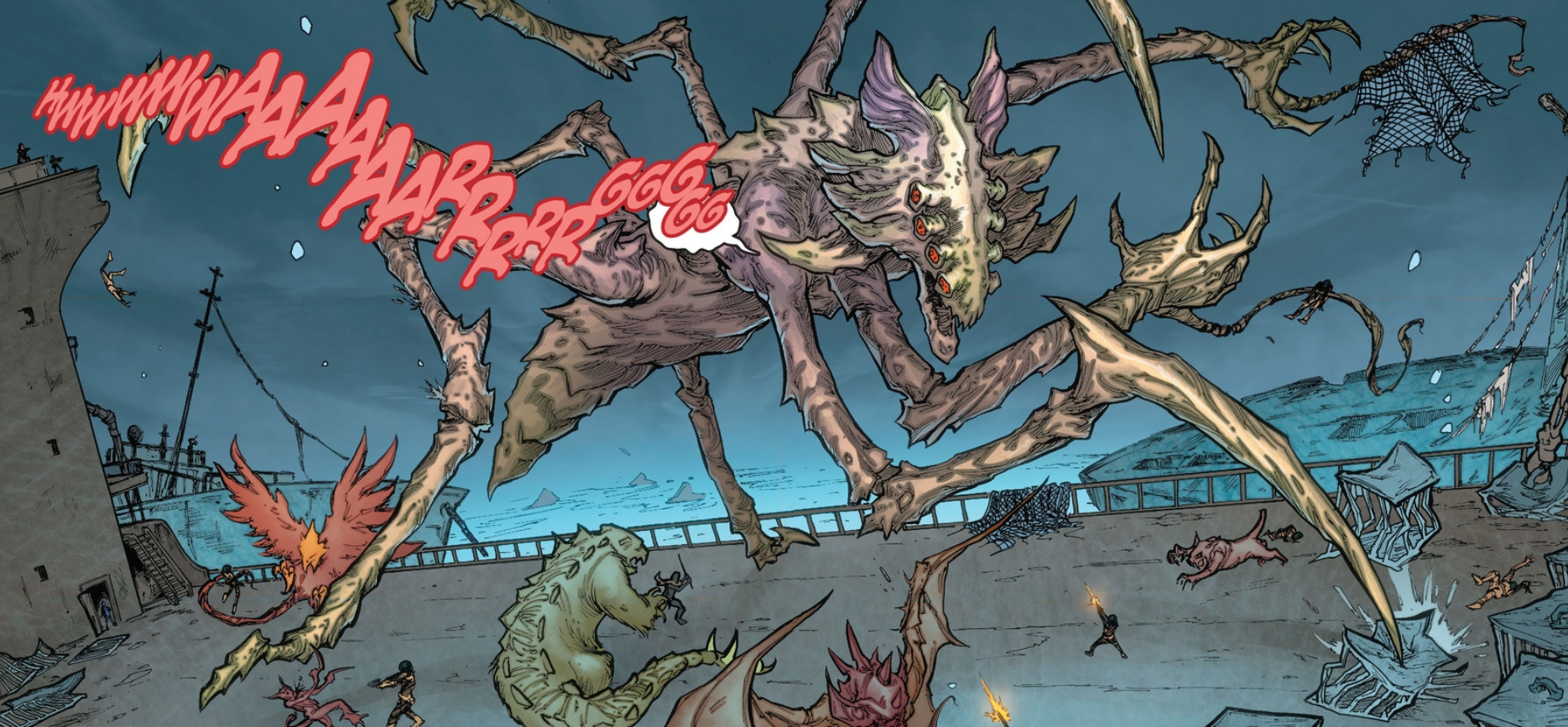
Take this spread of a possessed creature attacking. Taken on its own merits, this result of art by committee is immensely satisfying, visceral, and badass. But it also provides a sneaky examination into the issue’s themes of separation, particularly when looking at the inkwork. These humans have, thanks to this horrible yet beautiful drug, separated from their physical selves into monstrous entities, and thanks to the thick outlines surrounding each subject, their separation is made crystal clear. Simply put, they don’t exist in our world, and the inkwork draws our attention to that fact. Sublimely subtle and clever work.
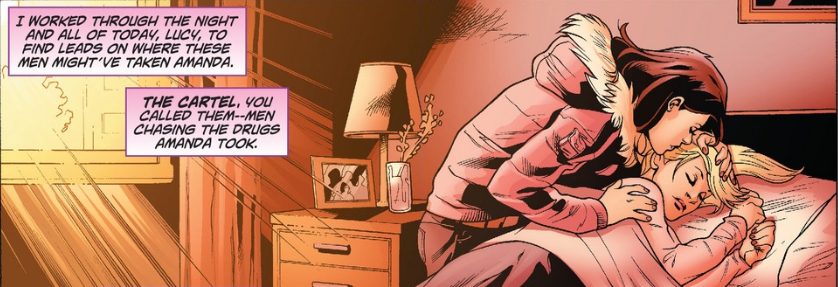
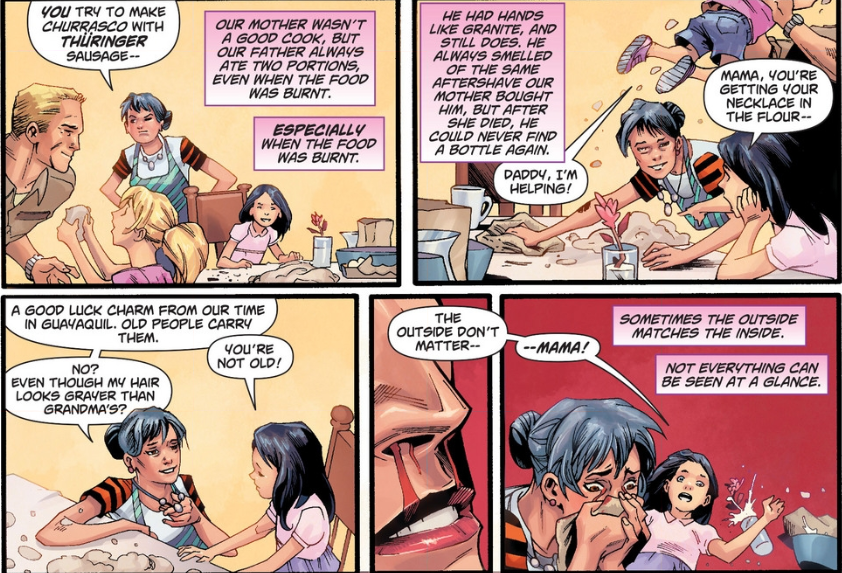
 Also, while Bennett contrasts between the two relationship timelines of the Lane sisters, the art crew provides a brilliant contrast in art styles delineating between the past — bright, warm, peppy colors filtered through a nostalgic haze — and present — dark, cool, aggressive colors rendered shadowy yet sharply. This visual representation of the past corresponds poignantly to Lois’ examination of the melancholic etymology of “nostalgia,” and her regret that she no longer possesses a “complete portrait” of her mother’s face. Of course, then, it makes sense that her memories would feel hazy. And then, when Lucy re-enters her life and Lois must take care of her again, the art follows suit.
 Shane, as you can tell, this issue really worked for me, bringing up stuff I haven’t thought about in years (Comics Therapy, patent pending). Were you as impressed as I? I love Lois describing the problems of being a mother figure to Lucy, noting that “trying to pass for something else comes with its own troubles.” Do you think there’s any resonance to this statement beyond this issue — perhaps the relationship between Clark Kent and Superman?
 Shane: I think that the notion that being someone other than yourself is exceptionally interesting in Lois’s case–not simply due to how it may parallel Superman’s struggles, but in the context of who her character has been in the past, versus who she is now. Lois Lane has presented herself as an arbiter of truth, one of the greatest journalists in the world, constantly uncovering and presenting secrets seemingly without a care. Even at one point, she was transformed into a literal Goddess of Integrity — and yet, she hid from the world one of the DC Universe’s greatest secrets: the identity of her husband, Superman. Setting aside how understandable and valid her reasons may be, one could argue a certain level of hypocrisy in her actions, doing her part to maintain an elaborate ruse while accepting worldwide accolades for her work at uncovering deep-seated secrets. At first glance, Lois Lane’s character in the New 52 hasn’t had such a character nuance — in one complicated storyline, she learns Superman’s identity and swears to him that she’ll reveal his secret to the world. And yet, in this issue, Lois offers to withhold an incredible story — a covered-up drug trade with horrific, gene-altering side effects — to protect her sister. Because beyond all else, Lois Lane protects those she loves.
And that’s why I was so pleased to see this issue open with, and maintain, such a focus on Lois Lane’s family. Sam and Lucy Lane have been such important characters to Lois’s development as a character, and outside of small roles (few of which had significance to Lois and her relationships with those characters), we haven’t seen much of the Lane family in this new continuity. The struggles that Lois went through from an early age: protecting her sister, her father’s desire for a son, and, in this continuity, the early death of her mother, built Lois into one of the strongest-willed characters in comics, and it’s about time DC showed that side of her in the New 52.
In fact, I really admired how quickly Marguerite Bennett cut to the iconic heart of who Lois Lane is, immediately setting aside her complicated New 52 history (a non-Clark Kent paramour? An executive media position? Coma? Telepathic abilities?) and launched into one of the most fascinating solo Lois stories in years. One of the one-shot’s greatest strengths comes from how Lois is so firmly entrenched in Superman’s world: Bennett explores the depths and complications of Metropolis and offers fantastic, science-fiction based threats… while still minimizing the role of Superman in the story. Lois is no supporting character, here. She’s firmly the star. The comic may officially be called “Superman: Lois Lane,” but Superman appears in a grand total of one panel. It’s to DC’s credit that they didn’t insist on putting Superman in the cover art: even in the logo, which begins with his name, challenges his importance, with Lois Lane’s name greatly eclipsing his in size and prominence.
The interior art continued to show why Lois is such an incredible character, presenting her confidence and care in such a way that freed the words to further other aspects of the story. I was initially disappointed to see not one, but four pencillers on the issue — you’d think a one-shot, removed from immediate continuity, could afford the time needed for a single artist to finish the story, and I was very excited at solicitation to see Emanuela Lupacchino, one of my favorite new artists, tackle an oversized Lois Lane story — but as you said, Greg, the collaboration of artists worked. Each of them offered a different presentation of Lois, with their strengths leading to an even more nuanced visual, while simultaneously flowing from page to page so as not to shock the reader out of the story. I also want to take a moment to discuss another note on the art, and what it may imply: I don’t know whose idea it was, but with how Eleanor Lane, Lois’s mother, is presented in the story (a very different look than she had previously), can Lois Lane now be considered bi-racial? If so, that’s something of a significant change to the character, and one I applaud.
 It’s a shame, really, that in the New 52, Lois has been used less as a character and instead as a plot device, because this one-shot demonstrates how incredible DC’s first female character can really be. Not a damsel in distress, nor merely a romantic interest, she is capable of carrying a story on her own. I sincerely hope that sales demonstrate this fact, because with a creative change coming for the flagship Superman title and the renewed interest in his film franchise, this is a prime time for DC to embrace Lois Lane as not just a member of Superman’s supporting cast, but as a leading lady. And with any luck, after this issue, we can have Marguerite Bennett and Emanuela Lupacchino along for that ride.
At any given moment, Shane is probably spending money that he doesn’t have. When not driving himself towards poverty, Shane spends his time writing and working in the food industry of New York City. You can bear witness to his escapades through his Twitter handle @shanevolpone.
For a complete list of what we’re reading, head on over to our Pull List page. Whenever possible, buy your comics from your local mom and pop comic bookstore. If you want to rock digital copies, head on over to DC’s website and download issues there. There’s no need to pirate, right?
 Retcon Punch
My girlfriend was trying to get my attention as I was reading the last couple pages of this issue, and it was one of those moments where I couldn’t acknowledge her because I was experiencing FEELINGS and just needed to sit in them for a little bit. I’m a sucker for siblings helping each other out, and the recurring idea of catching each other was just too sweet for me to read with a dry eye.
I actually found the ending really confusing. Like, Lois knows the guys are looking for her sister. She knows her sister is in her apartment with her cat. She is then told (or assumes?) the monster thing is the cat, and never bothers to freak the fuck out about what must have happened to her sister. Like, taking the cat, but leaving Lucy makes exactly zero sense, so doesn’t she need to find her sister before leaving the scene? Also, is her sister just stuck as a monster now? Wouldn’t it be better to have stayed with the guys who can cure her? I get that it was kind of an analogy for homosexuality, but like seriously, wouldn’t you opt to not turn into a giant bug monster if you could help it?
She’s definitely told to call the monster “Sam” — and I guess she’s got no reason to believe that Amanda would be lying to her. And she didn’t know that Lucy was there, last she saw her, she was hiding out at Lois’ apartment.
Also, I was just talking about the last like 2 pages – you know: sisters hugging and shit.
Right, but Sam was with Lucy at the apartment, right? Like, the cartel had for sure been to Lois’ apartment, and they were for sure looking for Lucy. Even if everyone thought the bug thing was Sam, they should have assumed Lucy was somewhere on that boat.
Greg, thanks for sharing that story. I didn’t have a hard time as a little kid, but I do remember my first day of college being infinitely more terrifying that I expected it was going to be. I used to talk such a good game about leaving my sleepy little Wisconsin and town not seeing my family for months at a time, but when it came down to it, I was so upset I almost threw up (… a couple times…). Luckily, I met my now-good-friend Siri (voice of our cram sessions) a few hours later and that feeling of home started to creep back in. Scary couple of hours though.
Thank you for sharing that in return! Makes me feel less self-conscious. If there’s one thing we learned from this comic, it’s that people are not and should not be alone, yeah?
Yeah Greg, I had almost the exact same issue in elementary school, even down to having to bring a picture of my parents to school with me. That actually helped me a lot, but it got me made fun of a lot by my classmates, so I dont know if the trade-off was worth it