
 Look, there are a lot of comics out there. Too many. We can never hope to have in-depth conversations about all of them. But, we sure can round up some of the more noteworthy titles we didn’t get around to from the week. Today, Spencer, Patrick, Drew and Shelby discuss Harley Quinn Invades Comic-Con International San Diego 1, Batman Eternal 15, Robin Rises: Omega 1, Teenage Mutant Ninja Turtles 36, Original Sin: Hulk vs. Iron Man 2, Elektra 4, Original Sin 6, Uncanny X-Men 23, Ms. Marvel 6, Nova 19, Silver Surfer 4, She-Hulk 6, Rat Queens 7 and The Wicked + The Divine 2.
 Spencer: As many of you probably know (due to my extremely in–depth coverage), I recently attended my first Comic-Con. With that experience still fresh in mind, I have to say that Harley Quinn Invades Comic-Con International San Diego 1 feels like an uncannily accurate representation of the Comic-Con experience. I mean, sure, Wizard World is nowhere near as large as SDCC, and I am nowhere near as manic as Harley Quinn (I hope), but I can still relate to Harley’s various quests to meet creators, as well as to the suffocating crowds (which probably necessitated the eight different artists who contributed to this thing).
This book takes place in some strange universe where the DC characters are somehow real (like Harley and Batman), but so are DC Comics themselves, leading to some confusion (at one point Harley finds a room full of Joker cosplayers; are they dressing up as Joker-the-fictional-villain, or Joker-the-infamous-mass-murderer?). If you can look past that, though, then there’s a lot of laughs to be found, both in the many background Easter Eggs and references to DC creators (and a cheap shot or two at Marvel) as well as in Harley’s actions. Just as in Conner and Palmiotti’s Harley Quinn ongoing, much of the humor can be hit-or-miss or callously sociopathic, but the best gags deal, not with Harley’s penchant for destruction, but with her more sympathetic side. For example, the issue ends with Harley meeting her actual creators (Bruce Timm and Paul Dini) and stealing a copy of her first comic-book appearance; it’s remarkably meta, but also quite sweet, and an excellent example of the kind of magic that can happen only at Comic-Con.
Batman Eternal 15 deals with more literal magic as Batwing and Jim Corrigan descend into the hellish bowels of Arkham Asylum. There are some elements of this issue that feel off, such as Batman and Jason Bard’s sudden partnership — it almost feels like this issue takes place before the previous — but the focus of this issue isn’t the story, but the atmosphere, and that makes the art team of Dustin Nguyen, Derek Fridolfs, and John Kalisz the MVPs this week.
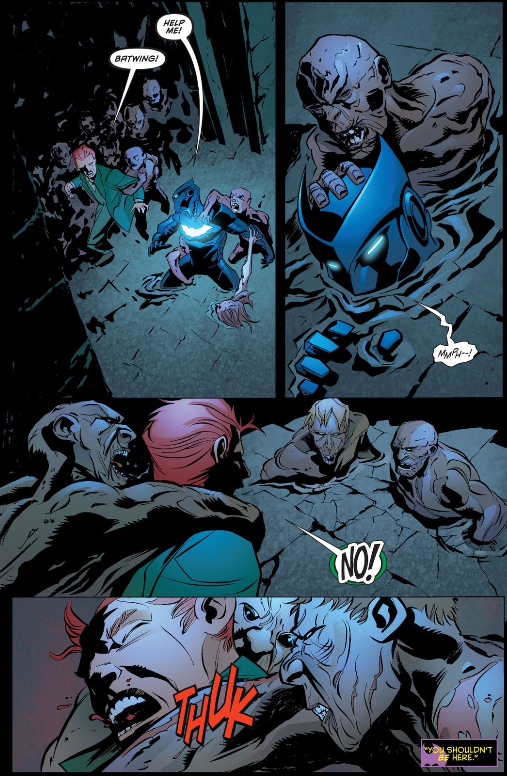 The work of these three brings to life the oppressive, murky realm of the new Arkham Asylum, giving it a feeling of hostility and doom the the writing could never do alone, but they also show an entirely different set of skills in the scenes involving Red Robin and Harper or Red Hood, Batgirl and Batwoman; each character is expressive and lively but also look their age, a feat many artists can’t pull off.
Peter Tomasi likewise continues to pull off feats many writers can’t, tying Robin Rises: Omega 1 into Morrison’s Batman epic, his own run on Batman and Robin, the first arc of Batman/Superman, and current changes in Justice League in a way that makes the DC Universe feel like a cohesive whole but that also makes this one-shot feel like both the epic beginning of a new chapter and yet also the culmination of years and years of Batman stories all at the same time. The plot itself is a little slight (this is very much a just a prelude), but if Tomasi and artist Andy Kubert were trying to pump the readers up for what’s to come, then they certainly succeeded — even if the promise of more Damian was all I really needed to check this story out.
Patrick: It’s insane how engaging those first couple pages are, especially as it’s just recap of all those stories Spencer mentioned. Andy Kubert’s got such a great eye for which iconic images to use to support Tomasi’s narration, so rather than feeling like a flat retread, the opening is kind of a celebration of everything that lead Batman to this point. Kubert also plays a little bit loser with the realism in the opening pages, reinforcing the idea that we’re not just recapping, but re-presenting in an artistic way. I mean, check it out — the saddest panel in the whole issue has a residual blue guiding line left running through it.
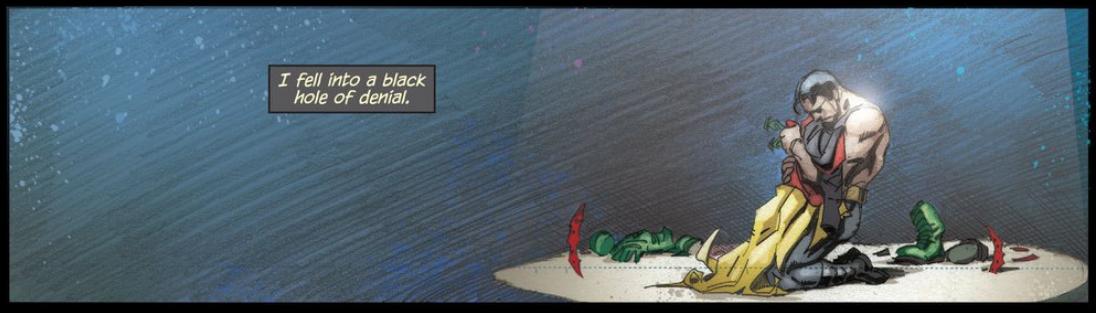 I’m a little less excited by the prospect of more Damian. Tomasi’s spent over a year exploring the idea of Bruce without Damian, and there’s been a lot of sincere growth there. Look, I like seeing Batman slap Shazam around as much as the next guy, but it’s unnerving to see Bruce swearing up and down that he’s going to bring back Damian alive. Didn’t we just get over that?
Teenage Mutant Ninja Turtles 36 continues to flesh out the as-of-yet unexplored corners of the TMNT mythos while providing a little insight into why that narrative exploration is significant. Leo and Splinter continue their on-going argument about priorities while exploring the sewers connected to their new(ish) home. Suddenly, they’re set upon by The Rat King, in a form much different than I’m used to. Instead of the bulky, sewer-dwelling weirdo from the cartoons, he’s revealed to be Kitsune’s brother, the Pied Piper of myth, and something of an overworldly sorcerer. After meeting Metal Head and Nobody in the previous issue, I was starting to feel a little fatigued by this piling on of character-reinventions, but writing team of Eastman, Waltz and Curnow justify the whole thing by explaining that all the new weird shit happening in the universe signaled the Rat King’s coming. Instead of being a bunch of fan service, the appearance of all these franchise favorites signals what Rat King refers to as “a world once more ready for the extraordinary… as in the days of Noe.” I have Noe Idea what that means (and I shan’t apologize for the pun!) but it all sounds very purposeful and cool.
Spencer was telling me that all the printed copies of Original Sin: Hulk vs. Iron Man 2 were somehow washed out and unreadable, but let me tell you: the 1s and 0s don’t wash out at all, and the digital version of the comic is solid. It’s weird how obvious it is that Waid and Gillen are trading off dialogue-writing duties between issues, as this issue contains quite a few Gillen-y turns of phrase. I don’t always love his results — Tony blaming his inability to remember the Original Sin in question on his alcoholism, but using the copy “for reasons” reeks of too clever — but there quite a few moments where Gillen hits on some genuinely hilarious character moments. I love the moment Bruce Banner rhetorically asks who the leading expert of Hulk physiology is. I’m not sure that we learned much more about how or why Tony fucked his science bro over all those years ago, but it is super cool to see Banner level up his Extremis to fight Iron Man in the present. I’m eager to see where this is all going.
I think I’ve written about all the previous issue of Elektra, and in every single one, we’ve made some mention of the fact that Elektra and Bloody Lips as different sides of the same murderous coin. Issue 4 makes that comparison even more explicit as they’re simulanteously visited by the ghosts of their loved ones. Or… sorta… there’s something fishy at play here, but Elektra and the Match Maker assume Bloody Lips is behind it. (I guess they weren’t privy to his hallucinations like we were.) Hayden Blackman does a great job of distinguishing the two killers by suggesting that Elektra could have had other lives, but circumstances forced her to become to the warrior/ninja/assassin we know today. By contrast, BL was always going to be a monster. It’s a cool distinction to make, and articulates that difference much more clearly than I ever had.
Spencer: When Patrick says that this issue makes the comparisons between Elektra and Bloody Lips explicit, he wasn’t exaggerating:
 Their two hallucinations literally split the page, creating parallel experiences designed to show how similar these two are even as the writing begins to demonstrate the differences. It’s interesting, then, that after this page this device ends, with Blackman and Del Mundo devoting the entirety of the next two pages to Elektra justifying her lifestyle. I think we’re supposed to agree with Elektra — I believe that most of her victims probably deserved it — and her ruminations about how horrible death is later on in the issue (she’s died before, so she knows all about it) show that she understands the ramifications of what she’s doing. Bloody Lips, though, throws out a line about eating his wife again like it’s nothing. Blackman and Del Mundo know that Elektra is no saint and want to make sure we realize that too, but at the same time, presenting Bloody Lips as a dark mirror of who Elektra could be ensures that we’re still on their protagonist’s side. If I have to side with the self-aware murderer who preys on the wicked or the selfish murderer who only kills to appease his own animalistic desires, I’d go with the former any time.
Original Sin 6 finally gets to some revelations, but they’re not quite the ones we were promised on the cover; turns out Nick Fury wants one of the motley crew he assembled to take over his “secret job” once he dies. The idea is intriguing, but I can’t help but agree with Black Panther, who keeps trying to interrupt Fury’s pitch to ask who actually killed the Watcher; I respect the story going in another direction, but I’m still feeling a little impatient. There’s some clever character stuff in here, especially in regards to who Fury considers worthy to replace him, but there’s also some off-notes, such as Dr. Strange being so morally outraged by Fury’s actions when he’s done much worse to protect the Earth over in New Avengers (in a way, Panther and Strange already have Fury’s job as a part of the Illuminati). Mike Deodato, though, has really outdone himself — his layouts are still fascinating and his work still remarkably detailed, but he also tosses in some fun background gags (such as Rocket blowing the head off a downed LMD) that finally help the art fit the more outrageous tone of the title instead of just acting as the straight-man.
Drew: Agreed. Nothing is quite as funny as the panels where you can only make out Rocket’s head at the bottom. Aaron makes that sense that Rocket is out of place explicit, having Nick suggest that his presence at this showdown was unexpected — perhaps a bit of meta-commentary regarding Marvel’s marketing push for the Guardians? I like to think so, but this issue is goofy enough just taken at face value. I mean, what could be better than old Nick Fury suiting up for a fight, flashy Cable eye and all?
Uncanny X-Men 23 is an Original Sin tie-in in spirit, even if there’s no mention of the Watcher. Instead, the sin in question is somehow related to the recently discovered last will and testament of Charles Xavier. Jennifer Walters is tasked as the executor of the will, which means she must assemble all of Xavier’s beneficiaries — including Scott Summers. This issue sets up quite a few threads, but all are thematically tied into characters reconciling with their own histories, whether it’s killing their mentor, recovering from identity theft, or mourning a spouse lost in the Skrull invasion. How these will all fit together isn’t clear, but if nothing else, we can all get behind the sparks that are sure to fly as Scott must return once again to the Jean Grey School.
Hey, speaking of schools and absent mentors, Ms. Marvel 6 finds Kamala putting a fine point on her own lack of a guiding figure. That is, until Wolverine (everyone’s favorite schoolmarm) shows up, apparently to investigate the same villain Kamala is tracking down. Turns out, it’s a clone of Thomas Edison (with a little cockatiel mixed in), who has been attacking Kamala with robots and cyborg crocodiles to test her mettle (or something). I’ll admit, after such a personal origin story, it’s a bit of a bummer to get such a willfully random villain. Helping out a bitchy frenemy or rescuing a friend’s troubled brother tied in beautifully to the teen experience in a way that giant reptiles simply can’t. It’s still goofy fun, but it’s of such a different species that it’s hard not to be a bit disoriented by the change. Did that distract you, too Spencer?
Spencer: Maybe a little, eensy weensy bit. The Inventor has always been a strange choice of villain for Kamala as, thus far, he doesn’t seem to represent any aspect of her coming-of-age, but Kamala’s actual superheroic activities have always been a bit removed from her character arc anyway. If that’s what you’re looking for in Ms. Marvel, then I recommend paying closer attention to Kamala’s conversation with Sheikh Abdullah.
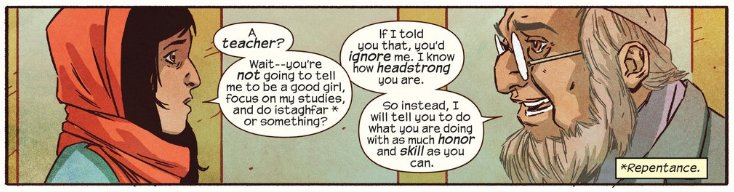
Much of Kamala’s story so far has been focused on her becoming comfortable in her own skin, but I think this issue hits on another important milestone; realizing that adults are not the bad guys. Wolverine’s an easy sell, but Kamala was dreading talking to Abdullah; turns out, though, that he had just the advice she needed to hear. I think there comes a certain point in everyone’s life where they realize that not all figures of authority are out to get them (I’m sure I’ll reach that point any day now), and even if Kamala isn’t in a position to tell any of her secrets to her family or even just feel 100% comfortable with them yet, she’s now made significant progress that goal.
Unlike Kamala, Sam Alexander finds his idols letting him down in Nova 19. The Watcher’s death has revealed some unsavory secrets about Sam’s father, and his quest for answers finds him teaming up with Rocket Racoon but ends with him at the mercy of Adomox, who blackmails Sam and Rocket into getting him a black Nova helmet. Unfortunately, this development seems to be repeating some beats from previous issues, but the rest of the book fares much better; the early pages with Sam and his family emphasize how good of a kid he is and his much he cares about his family, showing why his father’s crimes are so gut-wrenching. The rest of the book is elevated by the inspired interplay between Sam and Rocket, who are quite the odd couple and whose casual, inventive take-downs of goons liven up the exposition. It’s not a perfect issue, but it’s a lot of fun.
So hey, I’ve already written about two issues in this Round-Up that were stolen by Rocket Raccoon; The Guardians of the Galaxy are all over the place this week! They also show up in Silver Surfer 4, but here they’re more of an afterthought; this book is all about Norrin and Dawn. It’s a sweet look into both the alien and human sides of Norrin, and it shows why Dawn is such a good influence on the Surfer, how she helps him slow down and appreciate new elements of a planet he already thought he knew literally everything about. This book continues to be an absolute pleasure under Dan Slott’s pen, and artist and colorist Michael and Laura Allred are indispensable to creating this Norman Rockwell-esque tone, yet they can also pull of creepy and surreal with equal aplomb:
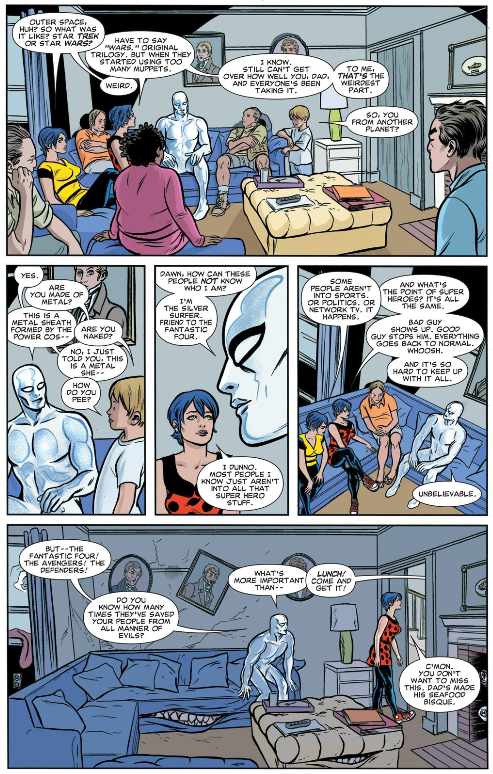 I don’t think there’s anything else on my pull even close to striking the same tone as Silver Surfer. This issue makes both outer space and the planet Earth look awe-inspiring, and that’s how I feel whenever I finish an issue: in awe.
Drew: I’m definitely with you, but I think the thing that’s truly impressive about this series is the way it balances awe with “aww”. I mean, come on, Norrin and Dawn already have a Wizard of Oz-quoting inside joke? Adorable. Four issues in, and it’s already crystal clear what these characters can teach each other — Dawn has an appreciation for the familiar, the routine, while Norrin values the infinite possibilities afforded by the power cosmic. Slott finds the perfect ways to highlight this — Norrin brags about feeling every blade of grass, but is unfamiliar with the smaller pleasures of life, like seafood bisque and a nice nap. Basically, Norrin is Doc Hollywood, and an extended stay at a Cape Cod B&B might be just what he needs to really appreciate life.
Meanwhile, it looks like Jennifer is about to get much busier in the pages of She-Hulk 6, as word of mouth finally seems to start getting the word out about her practice. Of course, that’s not until after she’s decided to give up the ghost on the Blue File, determining that the investigation isn’t worth the risk. If that feels oddly out-of-character, I think that’s the point — Jenn’s behavior is about as illogical as anyone else’s when they are triggered by the mention of this case, it just happens to be much less violent. It’s clear that we’re not done with this case, but writer Charles Soule cleverly throws up some interference to extend the life of this runner.
The real star of this issue, though, is Ron Wimberly’s art, which once again uses an array of unusual perspective choices to emphasize the drama of each panel. I personally loved that affect last month, and was thrilled to see him return here. I couldn’t help but be distracted at the way Wimberly changed Jenn’s skin color with every new scene. Was it to emphasize those scene changes? To give us some insight into her mood? I’m curious if you can see any logic behind that particular choice, Shelby.
Shelby: I actually didn’t even notice; I just assumed it was Wimberly’s style combined with lighting changes in the scene and the way light affects someone with green skin. You’re right to call attention to his art, however; I adored the big fight scene in Jen’s office building.

He split the page up into panels using the floor as the gutter line, all so he could show that guy who can go through surfaces in both; it’s clever, and so visually engaging.
The three books we’ve got left here are really all dealing with women trying to do the right thing in the unlikely circumstances they’ve found themselves in. Here, Jen’s decision to call off the investigation into the blue file just might be the right one; it’s very dangerous, after all, and people are getting hurt. Plus this is going to raise the hell out of her rent. But is it the right thing when she’s not making this choice wholly on her own? If someone is willing to mess with reality to keep her from exposing this (whatever it is), isn’t that all the more reason for her to bring it to light? We’ll have to wait and see.
In Rat Queens 7 what’s right is all based on context. Hannah helps Old Lady Bernadette to the relative safety of Rat Queens HQ, despite the fact that her betrayal brought about an orc attack and nearly got Violet killed. I’m glad Kurtis Wiebe decided to have Hannah be the one to bring Bernadette in, and defend her from an equally betrayed adventurer who wanted revenge; it shows that while Hannah is definitely a bitter, jaded asshole on the outside, she’s a good person at her core. I mean, this woman is the reason Hannah’s teammate had a spear through her neck; in this WoW-esque world, shoving her off a cliff would not be an unusual way to deal. But Hannah has an idea of the suffering Bernadette has gone through, and knows that no one deserves to have their eyes replaced by Sarlacc pits, so she takes care of this poor woman.
Wiebe also further explores Dee’s relationship with her religion in a wonderfully realistic way. A crisis of faith is a tricky and troubling experience; Dee has to balance the right thing as she was raised her whole life to believe with the right thing for her right now. What’s especially interesting to me is that there’s isn’t a lot of faith as we know it involved here. There’s no need to believe in something unseen and unknown; Dee’s god is currently extending its tentacles from the sky. Dee’s crisis is more about being able to find her own answers instead of being forced to accept the answers she’s given.
Laura is also not ready to accept the answers she’s given in The Wicked + The Divine 2 as she investigates what really happened in that courtroom last issue. Interestingly enough, Gillen and artist Jamie McKelvie have given us a world where the right thing to do is enter the service of Lucifer to prove her innocence. There exists an entity who is worse than the Devil, and I think we’ve met him: meet Baphomet.

Quick mytholoy lesson: Baphomet is a pagan idol rumored to have been worshipped by everyone from The Knights Templar to Aleister Crowley. You know that image associated with Devil-worshippers of the goat-headed creature with the pentagram on its forehead? That’s Baphomet, and he appears to have just killed the Morrigan. It seems pretty obvious that he’s the one responsible for the death of the judge; the real question here is why. Why would an entity so closely tied to Lucifer they are assumed to be one in the same (I certainly thought so, anyway) frame her for murder? A mere two issues in, and Gillen and McKelvie have already created a world and mythos so complete that I feel as entranced as a kid at an Amaratsu concert. I gasped out loud at the above panel because I was so shocked the Morrigan was dead, and this panel is our first time meeting her. That’s how complete this world already feels.
Dealing with gods as people gives Gillen a huge sandbox in which he can play around with different moralities. So far, Luci has appeared more mischievous than evil; Baphomet is clearly supposed to be the baddie at this point. At one point Laura is defending Luci to Cassandra (the investigative journalist) who points out that she could be lying, that “Satan does that.” Laura is quick to reply, “People do that,” for which Cassandra has no retort. If we took a more strict, Christian look at this, we could argue that people only lie while under Satan’s influence, but I don’t think that’s the point Gillen is trying to make here. I think he’s asserting that power is what you make of it, that these kids are granted godhood, but that they’re still people to choose how to use that power. I feel just as confident, though, in the fact that I could be completely off-base in my assumptions, and probably in a way I never contemplated. That’s what this book has become to me already: an exercise in subverting my expectations in the most delightful way possible.
The conversation doesn’t stop there, because you certainly read something that we didn’t. What do you wanna talk about from this week?
 Retcon Punch
Yeah, my working theory is that Batman Eternal 14 and 15 should be read in reverse order. Not only would it be weird for Batman to shake Bard’s hand after the final scene of 14, but the Spectre mentions that Batman is busy with the gang war. Is there still a gang war with both Falcone and Penguin behind bars?
Yeah, I was thinking of that tweet you made about this point when writing my part of the Round-Up. This is cheating a bit, but #16 honestly just has me more confused on this point than ever. The Bard plot isn’t making a lot of sense, unless Batman and Vicki Vale are somehow working together to take down Bard or something (But I’m jumping way ahead of myself here)
I love that line from Silver Surfer “Most people I know just aren’t into that superhero stuff.” Marvel seems to like to play their heroes as celebrities, and it’s just cool to see that inverted here.
I think they’re celebrities in a very New York-centric way. Like real estate moguls or even Yankees players. Why would someone from Cape Cod pay attention to that stuff?
Now THIS is a weekly round up. Holy cow.
Batman Eternal 15: One thing I’ve liked about Batman Eternal (and I haven’t liked everything) is that if one week doesn’t fit your tastes, don’t give up. The next week or two weeks later could be ENTIRELY different. I liked the pseudo-resolution last week and I liked the mysticism this week. I still think it is frequently colored way too dark and as a Bat-Novice I’m still confused at times about who people exactly are, but I’m looking forward to going back and rereading some of this because I think this is starting to look pretty magnificent in scope.
Robin Rises: I did not like this at all. I thought the combat scenes were a jumbled mess, while Shazam seemed like a dick, and for me, a guy who stopped reading Justice League about 8 issues in because all they did was fight each other, it was mildly disturbing if predictable the Justice League shows up and starts punching each other. I liked the New 52 Batman and Robin quite a bit until Robin died. My comic guy even laughed at me that when I was debating going down to one bat-title, I was going to keep B&R instead of Snyder’s Batman. This just didn’t do it for me. The only part I liked was the 7 page intro, which told me stuff I already knew.
Ms. Marvel #6: I can definitely say that there was not a greater tone change in comics that I read last week than when in the span of three pages, Ms. Marvel goes from sweet teen dealing with being a teenager with superpowers to Ms. Marvel vs. Cyber-alligators and a Thomas Edison/Cockatiel clone. I tried finding clues that THIS would happen. Nope. And I didn’t need Wolverine here – is he going to make the rounds in every comic to give him one last appearance as no-healing-factor-Wolverine before he “dies” in a couple of months?
I still think Silver Surfer is unreadable. I like everyone associated with it, but I can’t read it. I hate the story, I hate the art, I hate the colors. I don’t have an opinion on the letters.
She-Hulk #6 – I’m not as enamored with the art here as you are, either. I’ve liked the story so far and I like what the artist does. I like the weird angles and the weird perspectives. I just feel like She-Hulk burst into Dr. Katz’ office, turned it into a law office, and set up shop. I’m not a fan of the lines is the best way I can put this. It may just take getting used to – it looks like NOTHING else I read, and not how I pictured She’Hulk in all the times I’ve read her.
Rat Queens is surprisingly rich in character underneath its dick jokes. And dicks. I have many more naked man parts in my comics than naked woman parts. I have no particular objection to it other than it’s a bit weird to read a comic on the bus and have someone look over my shoulder and see a dick. But who reads Rat Queens on the bus? I guess we had gratuitous boob last issue. I’m a little sad that my prudish American upbringing is weirded out by comic book dicks and boobs, but I really don’t know if I think that the comic is better for showing them. Speaking of showing, the art is consistently fantastic in this thing. The Betty eating the cookie-woman and the page turn however reminded me of an old Snoopy comic from somewhere.
I like Keiron Gillon, but The Wicked and the Divine #2 bored the living crap out of me. It seemed like posers I didn’t care about doing boring and stupid things in the most poserish manner possible. I liked the first issue and HATED with all caps this one. It looked fine, but I couldn’t stop saying, “SHUT UP,” to the comic (in my head) every single page. This one grated on me non-stop. Really unlikable and irritating characters.
Good times! A metric crap-ton of comics last week. I haven’t put any away for about 3 weeks, so my pile is confusing as to what I actually bought. Was Manifest Destiny this week? I liked that. I still love the art. It turns out my best friend in town (a history teacher) is a HUGE Meriwether Lewis fan. He’s not a comic reader but really liked the first trade of this.
Yeah, I’m not a huge fan of Wimberly’s art either. There’s some cool points to it — I love the angles he chooses, even if I thought they worked better last month with the Tigra fight, and the panel Shelby posted is super cool — but I honestly just had a terrible time following it this time around. I don’t think I got as much out of the issue as I should’ve and I hope the regular artist is back next month, although I’m glad Drew and Shelby got so much out of it.
Holy shit, I forgot the only comic that made the news.
Life With Archie #36 – Archie DIES. My other comic guy (Bob, he just re-opened his fantastic store after 10 years away and gives me 20% off new issues) was huge on this book. It was an interesting read. It was definitely a nostalgia trip as far as style goes. Reading the back story to this issue was insane. Life With Archie was a giant What If? book, dealing with two separate story lines about who Archie married – Betty or Veronica. This issue brings it all together and actually never shows who he chose (although it seems Reggie got whoever he didn’t marry. I’m not going to go into how creepy that is), but in the end, Archie dies saving his friend. This won’t end Archie, it merely ends Life With Archie and Archie as a 40 year old that is married with kids. But it was a pretty good story and issue 37 came out this week called “One year later” and then the series ends.
Note: This website talks a lot about the role of women in comics. It’s something I’ve noticed and paid attention to, but am never comfortable completely discussing because it leads to fights and it’s at times hard to say,…. I’m not even going to try to get into it here. However – Only when I was writing about this here did I realize how little agency Betty and Veronica seem to have. I don’t know how to justify this with words or even explain my feelings on it, but here, right now (this is very stream of consciousness), how does one support a comic where the two female leads are merely options for the lead male to choose from. Whichever one he doesn’t choose goes to his best friend. Now, I’m not an Archie scholar. I’ve got some Archie comics in my old comic pile and I know the basics of the story. I’ve been keeping up with Afterlife With Archie (and I can’t decide if I’m going to keep buying it or go to trades), but I don’t know if there are any deep nuances to Betty or Veronica. But it seems really damn creepy here.
(I am getting better at this – I have talked with guys about the Teen Titans cover and the terrible depiction of Wonder Woman in Superman/WW #10 at the comic store. I try to be a civilized 21st century dude. But I don’t even NOTICE so much of the time.)
I’ve been trying to understand Archie lately (their app gives you access to a surprising number of free comics, making the exploration a little easier), and for as much as Archie modernizes itself every year (the kids all have cell phones and tweet and shit), it has some really awful baggage regarding Betty and Veronica. But I also know that female fans of the Archie universe are really into both of those characters, despite the fact that they are weird friend/rival/sex-trophies-for-Archie. I think the relationship between the girls is compelling, but the central reason they both exist is totally anachronistic, but no one’s done a good job of modernizing this love triangle. Maybe that’s because “Betty and Veronica both want to date Archie” is like the “Thomas and Martha gunned down in front of their son” of the Archie mythology – the series loses its identity if it’s changed.
Ultimately, the adventures of Archie and his Riverdale High friends probably just isn’t for me. It’s bothersome that those kinds of ideas would continue to be sold to kids, but on the flipside, I don’t think they sell particularly well. The Black Circle announcement coming out of Archie Comics (on the heels of the success of The Fox and After Life) indicates that they are in need of some pretty drastic changes over there.
I do think that there’s a place for Archie — I love what the do with Harper (wheelchair) and Kevin (gay) — but it needs an overhaul of some of its core elements.