

Today, Drew and Michael are discussing Batman 43, originally released August 12th, 2015.

It seems like so many of these interpretations [of Batman] are somebody’s favorite. And the truth be told is that they all feel like it’s the same character. Regardless of how different they might be or how separate they might feel, they all feel like they’re Batman. They all feel true to the core conceit of what that character is.
Dan DiDio
Drew: As diverse as Batman stories can be, they’ve always shared some core tenants of who the character is and what he stands for. Or, maybe we need to be more specific — there have been a few different Batmen over the years, with some variation in guiding principles (and origin stories), but Bruce Wayne has always stood for the same things. Scott Snyder and Greg Capullo’s run on this series has been a slow indictment of each of those guiding principles, from Batman’s relationship to Gotham to exactly where he falls on the “superstitious and cowardly” spectrum, but this issue takes away something even more central to Bruce than all of these things combined: his drive as a detective. Indeed, that seems to be the linchpin that makes Bruce Batman — without it, he’s almost unrecognizable.
I appreciate that “drive as a detective” is a little broad, but Snyder cleverly parses it into two distinct parts: the desire to stop crime and the desire to learn the truth. It’s arguable that Bruce was only ever interested in learning the truth in order to stop crime (as can basically everything else Bruce has ever done with his life), but Snyder pays special attention to that point, explaining why Bruce would insist on being left unawares of the details of even his own life.

Bruce goes on to explain that this information doesn’t apply to him because he doesn’t remember that night in the alley. That particular memory may actually be the master switch, but this situation presents a catch-22: he’ll never gain that desire to know without the memory of that trauma, and he’ll never relive that trauma without the desire to know.
The exact origin of that detective drive is intriguing, but the effect is the same: without the explicit desire to hunt down criminals, we can’t recognize this man as Bruce Wayne. Alfred can, which is why he defends Bruce’s choice to live out the life he might have led if it weren’t for that fateful night, but his motives are totally alien to us. They’re so unlike the Bruce we know, in fact, that Superman feels the need to reveal all (again, in the name of truth). Alfred is eventually able to disabuse him of this notion, suggesting that this is Bruce’s peaceful afterlife, a reward for years of service that can’t be recreated with all of those memories lost.
This is where this issue gets into some murky moral territory. Bruce is obviously much happier now than he ever was as Batman, but Zero Year revealed that giving up happiness was a conscious choice he had made in order to be Batman. Alfred believes he’s making this choice in Bruce’s best interest, but is it Alfred’s decision to make? Bruce was willing to sacrifice his own happiness in the wake of a tragedy, but can anyone ask him to make such a sacrifice? Even if we can agree that Alfred is making the right choice for Bruce, how do we weigh that against the needs of Gotham? Gordon even turns to Bruce for help in this issue — Gotham and Batman need Bruce in order to survive.
When you get down to it, I suppose the question is: if you had the power to make someone a superhero, would you do it? They would help others, for sure, but they would also suffer immensely. It’s only a question we can ask in hindsight — Bruce himself would never hesitate to protect a family walking through crime alley — but it forces us to weight the needs of the many against the needs of one (and reconcile our own fondness for the character with that equation).
It’s no coincidence, then, that the villain of this arc is all about giving people superpowers (and allowing them to suffer) in the name of some master plan. There’s really no arguing that he’s a moral actor in this issue, which adds to the case that we couldn’t force Bruce to be Batman, or even conspire to put him in a situation that would make him Batman. It’s not totally clear if this is a criticism aimed at the writers, editors, and readers of comics who are forever putting their heroes in peril for the sake of a good story, but it certainly makes you think twice about what it means to “like” Batman. Two (fictional) people had to be murdered to make him exist — is that worth our entertainment?
Michael: Based on what he has said in countless interviews about his Batman run, I believe that Scott Snyder is a student of the Grant Morrison school of Batman (much like myself.) Snyder is certainly leaps and bounds more grounded that Morrison in his Bat-work, but they both love to revisit the idea that Batman is the alpha male mortal. Snyder believes in the importance of what Drew labeled as the “core tenants” of who Batman is as a character. Snyder recognizes the symbolic significance of certain moments in Bruce Wayne’s life and how vital they were to the creation of Batman. Being super skeptical to bearded Bruce’s return so soon I found myself delighted with Snyder’s explanation of how he was back and why he was not in the cowl. As evidenced by the Dan DiDio quote, there are many different versions of Bruce Wayne/Batman. As opposed to a film like The Dark Knight Rises, Snyder subscribes to the idea that Bruce Wayne could never willingly choose to stop being Batman. Instead, Snyder uses previous mythologies that he himself put in place (IE: the dionesium-splanation) to relieve Bruce of that choice to hang up the cowl. It seems that so much of Snyder’s Batman run fits into this mold: either Snyder is more of a long-term planner than he lets on or he has an incredible hindsight to realize that he has set himself up for future stories. I’m perfectly fine with either option.

All of this talk about Bat-sacrifice brings out the Catholic schooling in me, putting Batman in the Christ role once again. Another essential tenant of Batman for me is his self-sacrifice; something that Snyder has been playing up a lot in this “Superheavy” arc. Gordon decided to put on the cowl and be the sacrificial (bat) lamb so a younger cop and his family would be spared. Similarly, Alfred wants someone else to take on the burden of being Batman instead of Bruce. I do think that Alfred is being a little selfish by not laying on the full truth for Bruce; but it’s a kind of selfless selfishness. Alfred has always been Bruce’s father for all accounts and purposes, so as a parent he is trying to spare his child the painful truth and allow Bruce to be happy. To Drew’s point, Bruce did make the conscious decision to not be happy with Julie Madison back at the end of Zero Year. But here that choice of self-sacrifice is taken away from Bruce by a higher power – so I’d argue that Alfred can’t truly be held accountable for allowing this new Bruce the chance to flourish. Along with the whole “sacrificial lamb/bat” theory, Snyder also presents us with the unique possibility of Batman becoming his own father. Just like Christians believe that Jesus would be equal man and God, so too would every subsequent Bruce clone see Bruce as his father. It’s a twisted and unnatural plot that is delivered to us so heartbreakingly by Alfred. With his gut-wrenching monologues and stage delivery, I’d argue that Alfred is the MVP of this issue.
Greg Capullo continues to kill it in the art department. I admire the drastically different physicality that he gives Jim Gordon in his Batsuit. While Gordon has certainly been doing his sit-ups, you can see how Capullo illustrates that this is not our typical young and buff Batman. Capullo gives Gordon a wry smile that you wouldn’t see on Bruce’s face under the cowl; or Dick Grayson’s for that matter. Especially with that heavy-handed line of dialogue about “great stickiness” Snyder and Capullo are conditioning us to equate Gordon’s wise-cracking with Spider-Man’s. Ever since Zero Year the Batman team has tried to employ more outlandish and stark colors. FCO Plascencia once again brings back those bombastic purples and greens to the panel; especially in sequences that lead to big action surprises. The first thing I noticed when I opened this issue was the grid layout introduction. This is a technique that I’m pretty sure Capullo has used elsewhere in the series run but most definitely in the “Death of the Family” finale. In Batman 17, Capullo has Joker’s “bat skeleton puppet” appear from the darkness; Batman 43 has a similar introduction with Mr. Bloom’s flower. While I don’t think that this equates Mr. Bloom to The Joker, it could be representative of both criminals being entirely unpredictable.
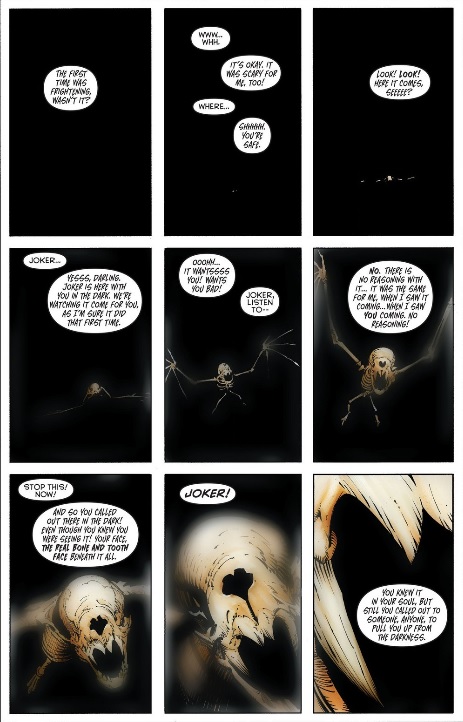

As far as Mr. Bloom goes, I still don’t know what to think. Both he and Penguin (R.I.P.?) refer to him as a weed. If Bloom is a kind of mirror for Batman, is that an indication that Bruce’s memories lie dormant somewhere? We all know that Bruce will return to the cowl someday, but right now that is just as unpredictable as the weedly nature of Mr. Bloom.

For a complete list of what we’re reading, head on over to our Pull List page. Whenever possible, buy your comics from your local mom and pop comic bookstore. If you want to rock digital copies, head on over to Comixology and download issues there. There’s no need to pirate, right?
 Retcon Punch
The thing with Alfred’s choice not to tell Bruce that he’s Batman is that he WAS going to tell him. Alfred only stopped because Bruce asked him not to and left before Alfred could tell him any more. We could argue whether this addled version of Bruce has the ability to consent to that, but it would certainly feel a bit weird for Alfred to defy his wishes — and how could he, other than shouting over Bruce with a bullhorn or dragging him down to the Batcave using force?
This is where I once again get aggravated at Snyder’s decision to no longer use Damian, though, cause while I’m fine with Bruce deciding to (and Alfred agreeing to) not learn about his past in the case of being Batman, there’s nothing okay about not telling Bruce he has a son. And Damian will/would more than likely spill the beans about Batman in a heartbeat — how could he not?
(The decision not to tell Bruce also leaves Grayson in the lurch, but Alfred isn’t aware of his situation, so can’t be blamed).
When it comes to Bruce’s memories, I think they’ll either come back due to an ally just needing him too badly to not tell him, or Bruce will witness a crime so horrific that his desire for justice will resurface on its own, bringing his memories with it. But jury’s out on how long that will take.
I really enjoy reading these discussions of comic issues, even if I did not read specific the comic itself, is a good way to chill out after a day working. Keep on with the good work!
I really enjoy reading these discussions of comic issues, even if I did not read specific the comic itself, is a good way to chill out after a day working. Keep on with the good work!
New slogan? “Ret-Con Punch: We read the comics so you don’t have to!”