Wolf 1

wolf 1

Today, Ryan and Drew are discussing Wolf 1, originally released July 22nd, 2015.

Ryan: Stop me if you have read this comic before: a dark, supernatural noir following a seemingly immortal protagonist and featuring Lovecraftian — oh, yes, that’s Ed Brubaker’s Fatale. Or this one, then: a hard-nosed paranormal detective named Wolf tries to right wrongs in a major American city populated by folkloric — yup, you got it, that is Fables. The first issue of Wolf strides over well-trodden territory — really, we have seen this all before. So why, then, does it work so well? Better yet, what is it that Ales Kot is doing better than everyone else? Continue reading

Zero 18

Alternating Currents: Zero 18, Drew and Patrick

Today, Drew and Patrick are discussing Zero 18, originally released July 1st, 2015.

Drew: I don’t love fetishizing endings. I resent the idea that the final moments of a work of art are somehow more important than all of the other moments that came before. I do, however, appreciate that it’s not until the end of a work that we can properly understand what it is. It’s not that the last piece of the narrative puzzle is necessarily more important than the rest, it just happens to be the last one added, which makes it the one that completes the image. True to that analogy, most endings are increasingly predictable as they approach — by that late in a narrative, we have a sense of likely conclusions. But then there are those narratives that aren’t so easily tied down. Zero started as a relatively straightforward spy series, but became increasingly postmodern, turning itself into a pointed commentary on the artificial division between “life” and “art.” Even with that trajectory in mind, issue 18 offers a conclusion of such bizarre beauty that nobody could have ever predicted. Continue reading

Material 2

material 2

Today, Ryan and Michael are discussing Material 2, originally released June 24th, 2015.

Ryan: Have you ever sat down and read the entirety of James Joyce’s notoriously difficult Ulysses? As a pretentious, young undergraduate studying English, I snickered into my coffee when a friend asked me whether I would attempt to tackle the classically obtuse text with a reader’s companion or not. Having recently curbstomped arm-loads of 18th Century British Lit. and avant-garde contemporary poetry, I thought, “How hard could it be? It’s only words. Making them make sense is what I do.” Ulysses quickly humbled me with the wall of metaphors, symbols, ambiguities, and overtones which allow it to remain one of the most critically-scrutinized novels of all time. While nowhere near the same “run away from the book right now” level as the aforementioned modernist masterpiece, Ales Kot and Will Tempest’s Material 2 struck me in a similar way – one which a comic book has never inspired in me. With the feeling that everything I read seemed fresh, dense, and that I barely scratched the surface on the first go-through, I recommended the two issues of the series thus far to a friend whose opinion I trust greatly, who simply thought that Material “had its head up its own ass.” So, which one of us is right? Continue reading

Zero 17

zero 17

Today, Patrick and Taylor are discussing Zero 17, originally released June 3rd, 2015.

Make art, not war.

Traditional

Patrick: Perhaps it’s because the above statement is so simple that tracking down a specific origin proves so difficult. A little bit of on-line research will keep pointing back to street artist Shepard Fairey — who did design the now-iconic image that often accompanies the phrase. Even if we assume Fairey’s authority, the artist’s populist message and street-art aesthetic makes it hard to credit him with any particular concept or turn of phrase. “Make art, not war” is also clearly a reference to the anti-Vietnam War slogan “make love, not war,” which itself has an origin that is up for debate. Be it art or be it love, there is a persistent need for something that man can consider the opposite of war, so it’s fitting that these slogans should resist a single point of origin. Like the fungus in Zero, they come from everywhere — in all times and all realities — to mitigate the suffering caused by war. Continue reading

Material 1

material 1

Today, Drew and Patrick are discussing Material 1, originally released May 27th, 2015.

It was the best of times, it was the worst of times, it was the age of wisdom, it was the age of foolishness, it was the epoch of belief, it was the epoch of incredulity, it was the season of Light, it was the season of Darkness, it was the spring of hope, it was the winter of despair, we had everything before us, we had nothing before us, we were all going direct to Heaven, we were all going direct the other way – in short, the period was so far like the present period, that some of its noisiest authorities insisted on its being received, for good or for evil, in the superlative degree of comparison only.

Charles Dickens, A Tale of Two Cities

Drew: Like most Americans, I first read A Tale of Two Cities in high school, and like most Americans, that experience utterly ruined the book for me. My 9th grade teacher proudly trotted out all sorts of historical information about the French Revolution, making it all the more difficult to keep in mind that its themes of privilege and oppression are, unfortunately, timeless. Indeed, I’d long seen the famous opening paragraph’s use of past tense as an affirmation of that historical distance, but only because I’d forgotten the less-quotable final clause that reminds us that this is mostly remarkable for being “so far like the present period.” It’s that same “present period” that is reflected in Ales Kot and Will Tempest’s Material 1, which offers a tale of many cities that is just as timeless as Dickens’, but also decidedly more of-the-moment. Continue reading

Zero 16

Alternating Currents: Zero 16, Drew and Taylor

Today, Drew and Taylor are discussing Zero 16, originally released May 6th, 2015.

“You” believed this was “your voice” and “you” were a story “you” were telling to a boy who was “your son” but “who” was telling the story of “you” telling the story to “your son?”

Ales Kot, Zero 16

Drew: In our discussion of Zero 14, I noted that, while the framing device of Zero telling his story to the boy about to shoot him gave us a narrator for our story proper, I had to wonder who was “telling” the story of that framing device. Of course, that was just before writer Ales Kot pulled the camera back even further to reveal another framing device in issue 15. That issue explained that the “higher narrator” is actually William S. Burroughs, introduced as a character in the comic, but still left open the question of who was presenting us with that framing device. That kind of nested reality could go on forever, but this issue actually finds Kot doing something much more clever — dissolving the borders between these framing devices. It’s a fascinating trick that brings us closer to the fiction that is Zero…or is it that it brings Zero closer to reality? Continue reading

Zero 15

zero 15

Today, Patrick and Drew are discussing Zero 15, originally released January 28th, 2015.

Patrick: Last time we talked about Zero, Drew was interested in the discrete loops of experience necessarily unshared by the artist and the audience. This came on the heels of two issues which seemed to actively push the audience away — largely wordless volumes soaked cover-to-cover in intense, non-romantic violence with cryptic references to half-remembered song lyrics — so it was easy, almost necessary, to rely solely on the reader’s perspective of the events in question. With issue 15, Ales Kot and artist Ian Bertram re-introduce the concept of the meta-narrative first explored in issue 10, and along with it, a fictionalized version of Williams S. Burroughs, as the author of this story. The move simultaneously buys into the culture of exploring authorial intention and discounting it all together, as the experiences, reality, dreams and non-reality of creator and creation merge, both on the page and off. Continue reading

The Surface 1

Alternating Currents: The Surface 1, Drew and Spencer

Today, Drew and Spencer are discussing The Surface 1, originally released March 11th, 2015.

Writing becomes not easier, but more difficult for me. Every word is like an unnecessary stain on silence and nothingness.

Samuel Beckett

Drew: It’s not often that we scrutinize whether a work of art “justifies its own existence.” Indeed, it’s a focus we tend to reserve for sequels, re-masterings, new editions, or other works that might be accused of returning to a specific well, but it’s curious that we’re not equally dubious of ALL art. I suspect it’s because we don’t actually care. Why a work of art exists may be an easy target when we dislike it, but ultimately, the only thing that matters is how it exists. There may be creator-side issues that explain why the nuts and bolts of a work of art are the way we are, but on the audience side, we can really only evaluate whether or not those nuts and bolts work. As a guiding principle, that philosophy has kept me happy, allowing me to both separate art from the artists that make it and remain blissfully ignorant of whatever business considerations might go on behind the scenes. But with that happiness came a kind of complacency, forgetting that there might be works of art that might actually be about their own existence. The Surface 1 is one such work, focusing so self-consciously on its own existence that I can’t help but feel a little insecure about justifying a written discussion of it — not because it’s bad, but because that self-consciousness is kind of infectious. Continue reading

Zero 14

zero 14 Today, Drew and Taylor are discussing Zero 14, originally released January 28th, 2015. Art and Social Function

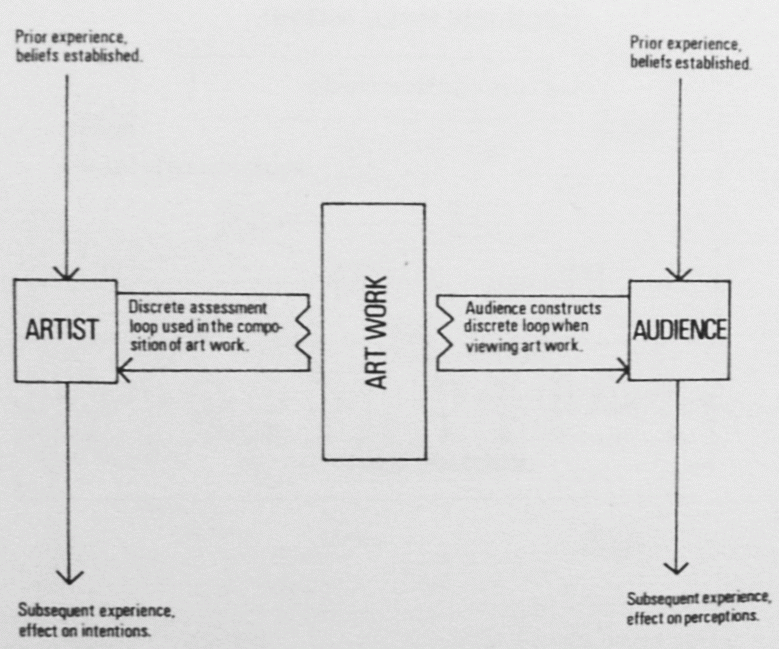
Two fundamental discrete cognate loops are shown, which are isolated from each other by the artwork. There is no form of interaction between the two which could generate mutual understanding as would be the case in a successful conversation. In the absence of such a procedure both the audience and the artists become locked in their own perceptual biases.

Stephen Willats, Art and Social Function

Drew: Where does meaning happen? I was brought up on the postmodern ideals outlined in the epigraph, but it seems that a great deal of modern society still clings to romantic notions of artistic intention. We celebrate and scorn artists based on their intentions, forgetting that the value of their art may not have anything to do with the artist. Indeed, we’re so obsessed with intention that we conflate it with meaning, minimizing the audience’s role — a role I might argue is the whole point of art in the first place. It’s because of this climate that I enjoy art that obscures its artist’s intentions. It’s easy to assume the moral is the “point” of one of Aesop’s fables, but it’s decidedly harder to draw such a clean line in something like Zero 14, where ambiguity and sheer density of ideas makes any meaning we can parse decidedly our own. Continue reading

Best of 2014: Best Series Part 2

Best of 2014: Best TitleWe all love a good one-off or anthology, but it’s the thrill of a series that keeps us coming back to our comic shop week-in, week-out. Whether it’s a decades-spanning ongoing or a short-run miniseries, serialized storytelling allows for bigger casts, bigger worlds, and bigger adventures. Indeed, we’re so enamored of serialization that we decided to split our favorite series list into two installments. Here’s part 2 our top 14 series of 2014 (click here for part 1).
Continue reading