Batman 1

batman 1

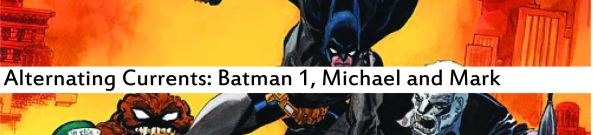
Today, Michael and Mark are discussing Batman 1, originally released June 15, 2016.

Michael: I keep saying this lately, but there is something so powerfully elemental about Batman. Not all Batman stories are exactly the same, but there is a certain amount of thematic carryover from one story to the other. I remember that, at the start of The New 52, I noticed a lot of similarities between Scott Snyder’s Batman and Grant Morrison’s that preceded it. Now I find myself doing the same thing with Tom King’s Batman and the Scott Snyder run that preceded it. Judging by the name of King’s first arc (“I am Gotham”) and the heroes Gotham and Gotham Girl, King is going to explore Gotham City as a character; a hallmark of Snyder’s run. Continue reading
Future Quest 1

future quest 1

Today, Patrick and Spencer are discussing Future Quest 1, originally released May 17th, 2016.

Patrick: If you’re going to see Yngwie Malmsteen perform, you want to see a man just shred the ever-loving fuck out of the guitar. If he played a bunch of layered, subtle ballads with no ripping guitar solos, you’d be pretty disappointed. On the flip side, if you went to an Enya concert and she did a rollicking, virtuosic 13 minute guitar solo over the of “Only Time,” you’d be disappointed. I mean, you’ve have a story to tell, for sure, but “must have killer solo” isn’t one of your criteria for enjoying an Enya performance. We have different metrics for success depending on the art, is the point I’m driving at here. Yngwie’s got the fastest fingers in the world, Enya’s got evocative soundscapes, and Future Quest has a nostalgia-tickling cast. Continue reading

Moon Knight 1

moon knight 1

Today, Michael and Drew are discussing Moon Knight 1, originally released April 13th, 2016.

Michael: Superheroes do so love wallowing in self-doubt and self-reflection. Along with trading blows with supervillains and helping the helpless, self-reflection is one of the great pastimes of the American superhero. “Am I strong enough?” “Am I supposed to be this?” “Can I overcome this?” and so on, and so on. In Moon Knight 1 our hero is questioning himself (or selves) on a completely different level. The main question our hero asks is “Have I ever actually been Moon Knight? Or did I make that up?” Continue reading

The Vision 5

vision 5

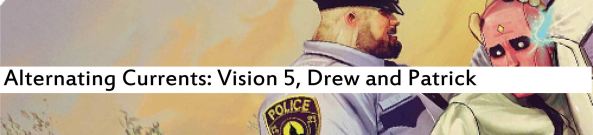
Today, Drew and Patrick are discussing The Vision 5, originally released March 9th, 2016.

Drew: I’m always baffled that the notion of privilege — that the majority class might benefit from their majority status in ways they aren’t aware of — is met with such resistance. But, I suppose that’s another symptom of privilege: blindly assuming you’re in the right, evidence to the contrary be damned. That’s the spirit that made Imperialism such a cultural force in the 19th and 20th centuries, as Western Europeans and (later) Americans replaced indigenous cultures with their own, believing whole-heartedly that it was the moral thing to do. Of course, whatever high ground a colonist might presume their medical technology or christian theology gives them, there’s no denying that imperialism brings all of the evils of the western world, as well, from literal plagues to damaging social and economic practices. The Vision 5 opens with the most memorable line from Shakespeare’s Merchant of Venice — Shylock’s pledge to embrace the evils of the majority class — suggesting that the Visions might be better off not being human, after all. Continue reading

Injection 7

Alternating Currents: Injection 7, Ryan and Drew

Today, Ryan D. and Drew are discussing Injection 7, originally released February 10th, 2016.

Ryan D: The iconic novel Moby-Dick is peculiar in two specific ways. Firstly, for such an important example of turn-of-the-century literature which spawned many films based off of it and sits as a part of our literary lexicon, a surprising amount of people have not read it, which I attribute to its length (927 pages in the first edition, 635 in the US release) and the abundance of dry non-narrative chapters dedicated to things like an exhaustive cataloging of ships. Secondly, and more relevant to this review, is the idea that though the presence of the eponymous white whale is felt constantly, it does not actually appear until the last three chapters. I would hazard that the influence of this affects much of our modern media, happily adopted by horror films, especially; we never get a full view of the shark in Jaws until the climax, and the same can be said about the organism from Alien. This same feeling of looming danger and presence pervades Injection 7, and this feeling of tension makes this arc wonderful to read. Continue reading

The Vision 4

vision 4

Today, Drew and Spencer are discussing The Vision 4, originally released February 3rd, 2016.

Drew: I recently watched a video titled “Why Donald Trump is a Gift to Democracy,” which effectively argues that the correlation between Trump’s disproportionate coverage and high poll numbers reveals the problems in how a profit-driven news media can be hijacked by anyone desperate for attention. I’m not as optimistic as the video seems to be about our collective will to change this phenomenon, but the more I think about it, the more absurd a profit-driven news agency is — if good reporting and the bottom line don’t match up, a publicly traded company really only has a duty to the latter. It’s ultimately not in service of the public it reports to, but the shareholders. This may seem like an odd introduction to a discussion of a comic about a robot-family’s struggles at fitting in in suburbia, but a profit-driven news media is actually the closest thing I can think of to an artificial intelligence that would harm humans in order to sustain itself. Only, you know, I have a lot more sympathy for the family of robots. Continue reading

Injection 5

Alternating Currents: Injection 5, Ryan and Drew

Today, Ryan D. and Drew are discussing Injection 5, originally released September 9th, 2015.

Ryan: Who is the main character in this comic? At first glance, I fancied Maria Kilbride to be our lead. Her character arc seems to be one of the most vivid; every issues’ flashback scenes show her as the bright-eyed genius responsible for tying together the Cultural Cross-Contamination Unit, full of piss and vision. Seeing how cheerful she was in this issue when Brigid suggested they all get matching tattoos stands in stark contrast to the gaunt, hollowed lone-wolf who tackles a Cornish spriggan infestation head-on. Though her foe here be mystical, Kilbride is haunted more closely by the Injection, which finally reveals itself plainly. The fingerprints of the Injection are stamped on every curious happenstance which has taken place over the past five issues, making a compelling case to call this creation the main character. Its character journey has taken place predominately off-page, with the bulk of its exposition in the dialogue of its “parents”, the remnants of the CCCU. It now rears its invisible head to Maria, and in doing so shows that it is responsible for the previously anonymous, seemingly omnipotent yellow narrative text littering each issue. Continue reading

Zero 18

Alternating Currents: Zero 18, Drew and Patrick

Today, Drew and Patrick are discussing Zero 18, originally released July 1st, 2015.

Drew: I don’t love fetishizing endings. I resent the idea that the final moments of a work of art are somehow more important than all of the other moments that came before. I do, however, appreciate that it’s not until the end of a work that we can properly understand what it is. It’s not that the last piece of the narrative puzzle is necessarily more important than the rest, it just happens to be the last one added, which makes it the one that completes the image. True to that analogy, most endings are increasingly predictable as they approach — by that late in a narrative, we have a sense of likely conclusions. But then there are those narratives that aren’t so easily tied down. Zero started as a relatively straightforward spy series, but became increasingly postmodern, turning itself into a pointed commentary on the artificial division between “life” and “art.” Even with that trajectory in mind, issue 18 offers a conclusion of such bizarre beauty that nobody could have ever predicted. Continue reading

Injection 2

Alternating Currents: Injection 2, Ryan and Drew

Today, Ryan and Drew are discussing Injection 2, originally released June 10th, 2015.

Ryan: The sophomore issue of proves the series of Injection to be one of shifts and contrasts. Before, we saw sweeping establishing panoramas, and now we see tight, personal framing. The locales change from an everyman’s pub to austere Manhattan penthouse and a Parisian embassy. Mysticism drenched number one; technology informs number two. The focus shifts from character and settings to a burst of intense action. This action shows that there is a surprising amount of moving parts to follow. Luckily for us, Warren Ellis and Declan Shavley imbue each of these wheels within wheels with interesting distinctiveness, and make all of these choices very intentionally. Continue reading

Zero 17

zero 17

Today, Patrick and Taylor are discussing Zero 17, originally released June 3rd, 2015.

Make art, not war.

Traditional

Patrick: Perhaps it’s because the above statement is so simple that tracking down a specific origin proves so difficult. A little bit of on-line research will keep pointing back to street artist Shepard Fairey — who did design the now-iconic image that often accompanies the phrase. Even if we assume Fairey’s authority, the artist’s populist message and street-art aesthetic makes it hard to credit him with any particular concept or turn of phrase. “Make art, not war” is also clearly a reference to the anti-Vietnam War slogan “make love, not war,” which itself has an origin that is up for debate. Be it art or be it love, there is a persistent need for something that man can consider the opposite of war, so it’s fitting that these slogans should resist a single point of origin. Like the fungus in Zero, they come from everywhere — in all times and all realities — to mitigate the suffering caused by war. Continue reading